


I’ve been thinking about how modern life has turned us into psychological giants—at least in our own minds. We’re told to curate our personal brands, optimize our happiness, and treat our mental health as a solo project.
But here’s the paradox: the more we focus on ourselves, the worse we feel. Harvard’s data on young adults is staggering—58% lack meaning, 51% are crushed by achievement pressure, and loneliness is at epidemic levels. What if the solution isn’t more self-focus, but less?
The ancient Stoics had a term for this: the “view from above.” It’s the practice of zooming out—whether through time, space, or cosmic perspective—to see your problems as they truly are: small, temporary, and part of something much larger. Modern psychology calls this the “small self” phenomenon, and the research is clear: when we feel awe, when we recognize our place in the grand scheme, our stress shrinks. We become more generous, more connected, and—ironically—more at peace.
But here’s the catch: we’ve built a culture that resists this. Therapy often treats mental health as a purely internal affair, ignoring the fact that humans are social creatures wired for connection. Religions, for all their flaws, understood this—they ritualized awe, framed imperfection as universal, and located perfection elsewhere. Today, we’re left chasing a happiness that always seems just out of reach because we’ve forgotten how to feel small in the right way.
So what if the antidote to modern misery isn’t more self-help, but more perspective? What if the key to mental resilience isn’t digging deeper into ourselves, but looking up—at the stars, at history, at each other? The data suggests it’s worth a try.
The Modern Mental Health Crisis and the Pursuit of Happiness
The Mental Health Crisis Among Young Adults: Loneliness, Pressure, and Purposelessness
The numbers don’t lie—young adults are struggling. A recent Harvard report paints a stark picture: 34% feel lonely, 51% say achievement pressure is crushing their mental health, and 58% report a lack of meaning or purpose in their lives. These aren’t just abstract statistics; they reflect a generational crisis. What’s striking is how this aligns with broader research on psychological distance and perspective.
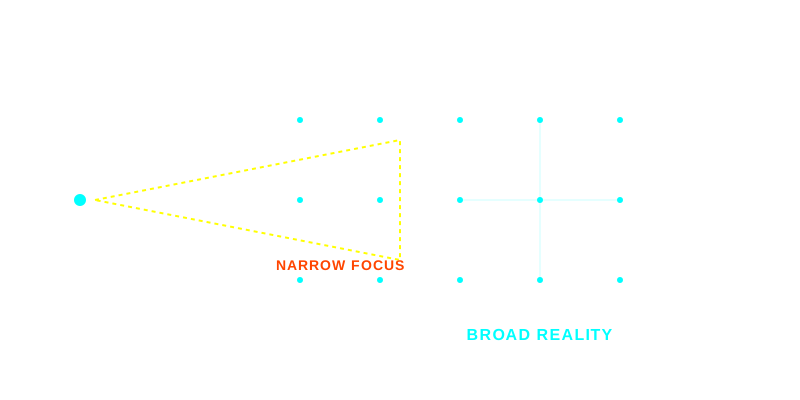
When we’re stuck in the present—hyper-focused on immediate pressures, social validation, or the next milestone—our mental bandwidth narrows. Stress tunnels our vision, making it harder to see beyond the next deadline or social comparison. But studies on temporal and spatial distancing suggest that zooming out—whether through time (reflecting on history or the future) or space (considering the vastness of the cosmos)—can shift us toward more abstract, goal-oriented thinking. It’s not just about escaping the present; it’s about recalibrating our focus to reduce the weight of right now.
Yet, the therapeutic world often reinforces the very problem it aims to solve. By treating mental health as purely subjective—something we carry around in our heads like a personal identity—it risks isolating us further. The idea that “I am whoever I say I am” might sound empowering, but it ignores a fundamental truth: our well-being is deeply tied to how we fit into larger social and cosmic narratives.
When young adults are told their mental health hinges solely on their internal state, it’s no wonder they feel untethered. The solution isn’t more self-focus; it’s the opposite. Expanding our perspective—whether through awe, community, or a sense of historical continuity—can dissolve the suffocating pressure of the present moment. 1 2
Why Pursuing Constant Happiness Leads to Misery
The modern obsession with personal happiness is a trap. Alain de Botton nails it: the idea that we’re meant to be happy—right now, all the time—is a recipe for misery. Our ancestors didn’t fixate on self-actualization; they focused on survival, reproduction, and community. Today, we’ve swapped those collective goals for an individualistic pursuit that’s as elusive as it is exhausting.
The Harvard data underscores this: 50% of young adults say their mental health suffers because they don’t know what to do with their lives. That’s not a failure of ambition; it’s a failure of narrative. Without a larger framework—whether religious, philosophical, or communal—we’re left chasing a happiness that always seems just out of reach. Religion, for all its flaws, offered something modern secularism struggles to replace: a sense of scale.
When you believe the present moment is a speck in a millennia-long story, your personal struggles shrink in significance. As de Botton puts it, “the graceful acceptance of your minuscule position in the cosmos is the gateway to calm.” But today, we’re encouraged to be “big people”—to make a big impression, to curate a perfect life. That pressure is unsustainable.
The alternative? Embracing imperfection. Religions historically acknowledged human flaws, framing them as part of a larger, imperfect world.
Modern therapy, by contrast, often pathologizes discomfort, turning normal struggles into crises of identity. The result? A generation that feels both overwhelmed and untethered. 3
Why Therapy’s Focus on Inner States Falls Short
Therapy, as it’s often practiced today, has a blind spot: it treats mental health as a purely internal affair. But humans aren’t self-contained units. We’re social creatures, wired for connection and meaning. When therapists frame well-being as something you “carry around in your head,” they ignore the fact that our minds are shaped by external relationships, responsibilities, and hierarchies.
The Harvard data reveals the cost: young adults feel lonely, directionless, and crushed by achievement pressure because they’re told their happiness depends solely on their own perceptions. The antidote isn’t more introspection; it’s commitment. As one researcher notes, “voluntarily adopting levels of hierarchical responsibility—family, community, society—gives you an identity, a purpose, and protection from anxiety.” This isn’t about self-sacrifice; it’s about recognizing that meaning emerges from connection, not isolation.
Awe, for instance, dissolves the “small self” by reminding us of something larger. Whether it’s staring at the stars or losing yourself in a collective experience, these moments recalibrate our sense of scale.
The therapeutic world would do well to remember: healing isn’t just about fixing what’s inside. It’s about reconnecting to what’s outside. 1
The Ancient Wisdom of Impermanence: ‘And This Too Shall Pass‘
“And This Too Shall Pass”: A Universal Truth
There’s a story—attributed to Buddha, though its origins are likely older—that captures the essence of perspective. A wise philosopher was tasked with finding a phrase that remains true in every situation, across all time. The answer? “And this too shall pass.”
It’s a deceptively simple truth, one that applies equally to grief, triumph, despair, and joy. The Stoics echoed this sentiment, reminding us that suffering, no matter how intense, will end—either through recovery or death. This isn’t nihilism; it’s a psychological tool for resilience. What’s fascinating is how this aligns with modern research on awe and the “small self.”
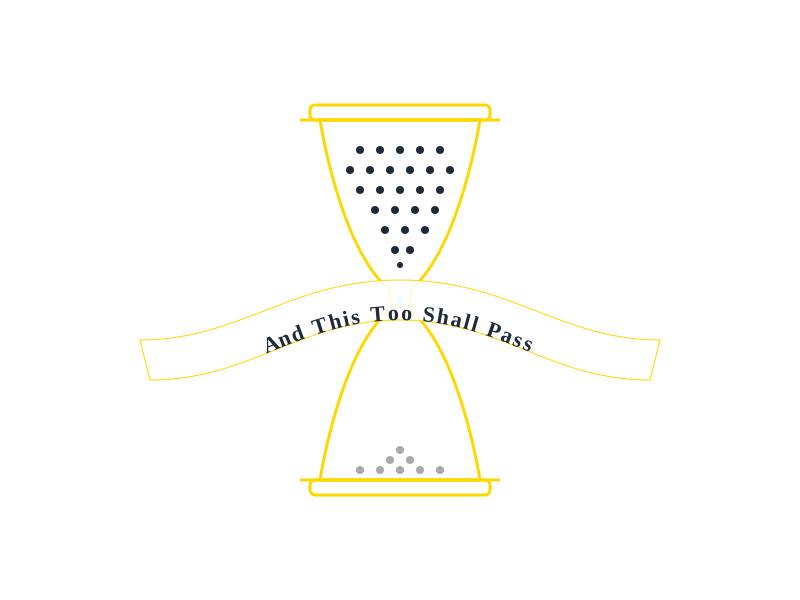
When we zoom out—whether by contemplating the cosmos, history, or our own fleeting existence—our problems shrink. Psychological distance, as studied in construal level theory, shifts our focus from immediate stressors to broader meanings. The result?
Less self-absorption, more prosocial behavior, and a greater sense of connection. The Buddha’s phrase isn’t just spiritual wisdom; it’s a cognitive reframe backed by science 4.
”This Too Shall Pass”: A Universal Truth
The beauty of “this too shall pass” is its universality. It doesn’t discriminate between emotions or experiences. Grief feels unbearable until it doesn’t. Triumph fades.
Even joy, as fleeting as it is, reminds us that nothing is permanent. This isn’t a call to detachment but an invitation to embrace impermanence. Religions and philosophies have long understood this—Catholicism’s notion of original sin, for instance, frames human imperfection as a shared condition, not a personal failing. It’s a relief, really.
If we’re all flawed, then vulnerability becomes a bridge, not a barrier. Research on awe and time perspective reinforces this. When we’re stuck in the present, stressors loom large. But when we adopt a longer view—whether through nature, history, or philosophy—our struggles lose their grip.
The “small self” emerges, and with it, a sense of calm. It’s not about minimizing pain but recognizing its transient nature.
The Stoics had it right: suffering ends, one way or another. And in that recognition, there’s freedom.
Stoicism: Putting Suffering into Perspective
Stoicism isn’t just ancient philosophy; it’s a practical toolkit for modern life. When Ryan Holiday talks about “zooming out,” he’s channeling this tradition. The Stoics didn’t deny suffering—they contextualized it. Pain is temporary.
Failure is a lesson. Even death, the ultimate endpoint, is a reminder of life’s brevity. This isn’t morbid; it’s liberating. If everything passes, then nothing is as urgent or overwhelming as it seems.
The practice of zooming out—whether through meditation, nature, or historical reflection—counteracts our brain’s tendency to tunnel vision under stress. Studies show that awe-inducing experiences (like gazing at towering trees) increase prosocial behavior and reduce psychological entitlement. Why? Because when we feel small, we remember we’re part of something larger.
The Stoics knew this. Modern psychology confirms it. The next time you’re drowning in a problem, ask yourself: *Will this matter in a year?
A decade? A century?* The answer is usually no 4.
Why Zooming Out Helps You Find Peace
Zooming out isn’t just about personal perspective—it’s about historical humility. There have been approximately 8000 to 9500 human generations since anatomically modern humans emerged about 200,000 to 257,000 years ago. Every generation thinks their struggles are unique. But history tells us otherwise.
Wars, plagues, economic collapses—humanity has endured them all. Each crisis has reshaped societies, yet life has always found a way to continue, adapt, and rebuild.
Recognizing this doesn’t trivializes suffering; it normalizes it. You’re not alone in your pain. You’re part of a long lineage of people who’ve felt the same. This is why awe works.
Whether it’s standing under a starry sky or reading a 3,000-year-old text, these experiences remind us of our smallness in the best way. They dissolve the illusion of control, the myth of permanence. And in that dissolution, there’s peace.
The Buddha’s phrase, the Stoics’ wisdom, and modern psychology all point to the same truth: perspective is the antidote to despair. So zoom out.
Breathe. And remember—this too shall pass.
The Science of Feeling Small: Awe, the Small Self, and Prosocial Behavior
What Is the True Meaning of Awe?
Awe isn’t just admiration—it’s a visceral reaction to something so vast it shatters your current frame of reference. Think of standing at the edge of the Grand Canyon or staring up at a sky full of stars. These moments force you to confront something larger than yourself, something that demands new mental schemata to process. Research shows awe arises from stimuli that are immense in size, scope, or complexity—whether it’s a towering mountain, a breathtaking symphony, or even a profound idea.
What’s fascinating is how this experience reshapes the self. When people feel awe, they’re less likely to define themselves in individuated terms like “special” or “unique.” Instead, they emphasize their connection to larger entities—humanity, nature, the cosmos. This shift isn’t just poetic; it’s psychological.
Awe expands our perspective, making personal concerns feel trivial in the grand scheme. It’s not about feeling insignificant in a demeaning way—it’s about recognizing you’re part of something far bigger.
And that realization? It’s the first step toward prosocial behavior.

How Awe Shifts Your Focus From Self to Others
The “small self(/blog/finding-direction#how-to-find-your-purpose-through-small-experiments)” isn’t about self-loathing—it’s about recalibration. When awe makes you feel small, it’s not a put-down; it’s a perspective shift. Studies show that people who experience awe report feeling like their day-to-day concerns are trivial in the grand scheme. They’re more likely to agree with statements like, “In the grand scheme of things, my own issues don’t matter as much.”
This diminishment of the self isn’t a loss—it’s a liberation. When you’re not hyper-focused on your own problems, you’re free to notice others. Research confirms this: people primed with awe are more generous in economic games, more ethical in decision-making, and more willing to help strangers.
The mechanism is clear: awe reduces psychological entitlement and increases the valuation of collective well-being. It’s not about erasing the self—it’s about putting it in proper proportion.
Awe’s Impact: 5 Studies on Generosity and Ethics
The evidence is overwhelming. In one study, participants who watched awe-inducing nature videos were significantly more generous in a resource-sharing task than those who watched amusing videos. Another study found that awe—but not pride—increased ethical decision-making. Even negative awe (like witnessing a volcanic eruption) boosted prosocial tendencies, despite eliciting fear.
The effects aren’t limited to nature: awe induced by music or architecture produced the same results. Across five studies, the pattern holds: awe makes people more generous, more ethical, and more helpful. Importantly, these effects are specific to awe—they don’t appear with other positive emotions like joy or contentment.
The takeaway? Awe isn’t just a fleeting emotion. It’s a psychological tool that reshapes behavior, making us better to each other. 3
How Awe Inspires Kindness and Cooperation
This isn’t just academic curiosity—it’s a blueprint for a better society. Awe’s effects are consistent across diverse populations and measurement approaches. Whether it’s sharing resources, making ethical choices, or helping strangers, awe reliably increases prosocial behavior. And it does so by addressing a core psychological challenge: excessive self-focus.
In a world where individualism often trumps collective well-being, awe offers a corrective. It reminds us that we’re not the center of the universe—and that’s a good thing. The implications are vast.
If we can design environments, experiences, and even urban spaces that induce awe, we might just create a more cooperative, compassionate world. The science is clear: feeling small makes us better people.
What Religious Frameworks Understood About Human Psychology
Why Feeling Small Through Awe Makes Us Mentally Stronger
Religions have long understood something modern psychology is only now quantifying: the therapeutic power of feeling small. Temples, cathedrals, and mosques aren’t just architectural marvels—they’re awe-engineering machines. Their towering ceilings, intricate designs, and sheer scale are deliberately crafted to make worshippers feel insignificant in the best way. This isn’t about humiliation; it’s about recalibration.
When you’re dwarfed by something vast—whether it’s a Gothic cathedral or the night sky—your personal problems shrink in proportion. Research confirms this: awe reduces self-importance while increasing generosity and ethical behavior. But here’s the kicker—religions didn’t just induce awe; they ritualized it, turning fleeting moments of smallness into sustained psychological benefits. The loss of these frameworks leaves a void.
Modern secularism often replaces awe with self-focus, trading cosmic perspective for personal branding. But the data shows that when people feel part of something larger—whether it’s nature, humanity, or the divine—they’re less likely to define themselves in individuated terms like “special” or “unique.” Instead, they emphasize collective identity: “a person,” “an inhabitant of the Earth.”
This shift isn’t just semantic; it’s psychological. Awe doesn’t erase the self—it puts it in proper proportion. And in that proportion, we find calm.
Why Embracing Our Flaws Brings Us Closer Together
Catholicism’s notion of original sin gets a bad rap—and rightfully so, given its historical baggage. But let’s flip it: what if the idea that “everybody’s broken” is actually liberating? Alain de Botton nails it: if we’re all flawed, vulnerability becomes a bridge, not a barrier. Imagine two people on a date.
One claims perfection; the other admits, “I’m kind of flawed but managing.” Who’s more approachable? The latter, of course. Perfection is isolating.
Imperfection is humanizing. This isn’t just theological—it’s psychological. When we accept universal brokenness, we lower the stakes of our own failures. The pressure to be “big” dissipates.
Success no longer requires invulnerability. Friendship becomes possible because we’re all, as de Botton puts it, “helpless children some of the time.” Religions, for all their flaws, offered this gift: the permission to be imperfect.
Modern therapy often pathologizes discomfort, but Catholicism (and other traditions) framed it as part of the human condition. That’s not nihilism—it’s realism. And realism, it turns out, is the foundation of connection. 2
How Religion’s Big Picture Thinking Promotes Inner Calm
Religions excel at temporal zooming. They frame the present as a blip in a millennia-long story. This isn’t just spiritual—it’s psychological. When you believe your struggles are temporary (because, well, everything is), they lose their grip.
The Stoics called this the “view from above.” Christianity calls it eternal perspective. The effect is the same: calm. Research on awe and time perspective reinforces this.

When we’re stuck in the present, stressors loom large. But when we adopt a longer view—whether through nature, history, or philosophy—our problems shrink. The “small self” emerges, and with it, a sense of peace. It’s not about minimizing pain but recognizing its transient nature.
Religions ritualized this. Modern life often forgets it.
The result? A generation drowning in the present, desperate for perspective.
Why Perfection Doesn’t Have to Be Found on Earth
Here’s the genius of religious frameworks: they locate perfection elsewhere. Heaven, Nirvana, the Eternal—these aren’t just afterlife concepts; they’re psychological pressure valves. If perfection exists beyond this world, then earthly existence isn’t a high-stakes performance. You’re not failing; you’re human.
This isn’t escapism; it’s realism. The data shows that awe reduces entitlement and increases ethical behavior. Why? Because when you’re not the center of the universe, you’re free to be kind.
Religions understood this. Modern secularism often doesn’t. The result?
A culture of exhaustion, where every moment feels like a test. The antidote?
Remember: perfection isn’t here. And that’s okay.
The Psychological Power of Cosmic Perspective
Pale Blue Dot: Finding Perspective in the Cosmos
There’s something humbling about seeing Earth as a speck in the cosmos. Andrew J. Brown’s analysis of the “Pale Blue Dot” image—where our planet is a barely visible pixel in the vastness of space—challenges our illusions of centrality.
This isn’t just astronomy; it’s psychology. When we confront the sheer scale of the universe, our personal dramas shrink.
The Harvard data shows young adults drowning in achievement pressure and loneliness, but cosmic perspective offers a lifeline. It’s not about feeling insignificant in a demeaning way—it’s about recalibration. The “small self” emerges, and with it, a sense of calm.
Research confirms this: awe reduces self-importance while increasing generosity and ethical behavior. The Pale Blue Dot isn’t just a photo; it’s a cognitive tool for resilience.
Cosmic Insignificance: Finding Meaning in the Universe
Here’s the paradox: feeling small can make us bigger. Philosophers and psychologists argue that cosmic insignificance doesn’t lead to nihilism—it deepens meaning. When we recognize our tiny place in the universe, we’re freed from the pressure of self-importance. This isn’t about erasing the self; it’s about putting it in proportion.
Studies show that awe—whether from nature, art, or ancient texts—expands our self-definitions to include larger categories like “humanity” or “inhabitant of the Earth.” The result? Less self-absorption, more prosocial behavior.
The Pale Blue Dot reminds us: we’re not the center of the universe, and that’s a good thing. It’s not about minimizing our existence but recognizing its transient, interconnected nature.
Cultivating Humility: Nature, Animals, and Wisdom
How do we cultivate this humility? Ancient texts, desert landscapes, and even time with animals can do the trick. Reading words written 3,000 years ago makes you feel small in the best way. Standing in a desert, surrounded by rocks inscribed with time, puts you in your place.
And animals? They don’t care about your narrative of success or failure. These experiences dissolve the illusion of control, the myth of permanence.
Research shows that awe—whether from nature or ancient wisdom—reduces self-focus and increases prosocial behavior. It’s not about self-sacrifice; it’s about recognizing that meaning emerges from connection, not isolation. The Pale Blue Dot isn’t just a photo; it’s a reminder of our place in the cosmos. 2
How Awe Boosts Generosity and Connection
When we zoom out, something remarkable happens: we become more prosocial. Studies show that awe reduces self-focus and increases generosity, ethical behavior, and connectedness. It’s not about erasing the self—it’s about putting it in proper proportion. The Pale Blue Dot reminds us that we’re part of something larger.
This shift isn’t just poetic; it’s psychological. Awe doesn’t erase the self—it puts it in proper proportion. And in that proportion, we find calm.
The result? Less self-absorption, more prosocial behavior, and a greater sense of connection. The Pale Blue Dot isn’t just a photo; it’s a cognitive tool for resilience.
The Missing Piece: Social Validation and Integration
Mental Health Requires Social Connection, Not Just Self-Awareness
The modern obsession with mental health as a purely internal affair is misguided. We’ve been sold the idea that well-being is something we carry around in our heads—like a personal identity we can define at will. But the data tells a different story. Young adults aren’t just lonely or anxious because of their internal narratives; they’re struggling because they lack meaningful social integration.
The Harvard report highlights that 51% feel crushed by achievement pressure, and 58% lack purpose. These aren’t individual failures—they’re symptoms of a culture that treats mental health as a solo project. The truth is, mental health isn’t just about how you see yourself; it’s about how you’re embedded in a social hierarchy. Voluntarily adopting levels of responsibility—whether to a partner, family, or community—gives you an identity, a purpose, and protection from anxiety.
It’s not about self-sacrifice; it’s about recognizing that meaning emerges from connection, not isolation. The research is clear: self-consciousness and negative emotion are statistically linked. The more you fixate on your internal state, the worse you feel.

The antidote? Commitment to something larger than yourself.
Why Self-Defined Identity Fails Without Shared Social Frameworks
The idea that “I am whoever I say I am” is a fantasy. Identity isn’t self-defined; it’s socially negotiated. If you try to force others to play your game—whether through coercion or sheer will—they’ll either resist or comply out of pity, neither of which leads to genuine connection. Even a four-year-old knows you can’t always pick the game and still have friends to play with.
The modern obsession with personal happiness as the ultimate goal is equally flawed. It’s a recipe for misery because it ignores the fact that human flourishing depends on shared frameworks. Religions and philosophies have long understood this.
They provide narratives that situate individuals within larger stories, reducing the pressure to be perfect or self-sufficient. The alternative—endless self-focus—leads to aimlessness and anxiety. The solution isn’t more introspection; it’s integration into meaningful social structures.
How Stable Relationships and Responsibility Build Resilience
Long-term commitments—like marriage or community involvement—aren’t just social expectations; they’re psychological anchors. They provide stability, purpose, and a buffer against anxiety. When you’re part of something larger, your problems shrink in proportion. This isn’t about losing yourself; it’s about finding yourself in relation to others.
The data shows that people who are embedded in stable social hierarchies experience less self-consciousness and more positive emotion. The key is voluntary adoption of responsibility.
It’s not about forcing yourself into roles but choosing to commit to something beyond your immediate desires. This shift—from “what do I want right now?” to “what do I owe to others? “—is the foundation of mental resilience.
Why Social Connection Drives Personal Success
The analogy of the four-year-old needing playmates is apt. No one succeeds in isolation. Even personal goals—like running a podcast—depend on social cooperation. The satisfaction comes not from self-focus but from the relationship you establish with others.
Good goals aren’t about you; they’re about how you fit into a larger system. This isn’t just philosophy; it’s psychology. Research shows that prosocial behavior and long-term well-being are linked to social integration, not individual achievement.
The modern mental health crisis isn’t just about loneliness; it’s about the erosion of shared frameworks. The solution isn’t more self-help; it’s more connection.
Practical Applications: How to Harness Perspective for Better Mental Health
How to Shift from Short-Term Stress to Long-Term Perspective
The modern mental health crisis thrives on short-term thinking. When we’re stuck in the present—hyper-focused on immediate stressors, social validation, or the next milestone—our mental bandwidth narrows. Stress tunnels our vision, making it harder to see beyond the next deadline or social comparison. But studies on temporal distancing suggest that zooming out—whether through time (reflecting on history or the future) or space (considering the vastness of the cosmos)—can shift us toward more abstract, goal-oriented thinking.
This isn’t just about escaping the present; it’s about recalibrating our focus to reduce the weight of right now. The Harvard data shows young adults drowning in achievement pressure and loneliness, but temporal perspective offers a lifeline. It’s not about minimizing pain but recognizing its transient nature. The Stoics called this the “view from above.”
Christianity calls it eternal perspective. The effect is the same: calm. Research on awe and time perspective reinforces this.
When we’re stuck in the present, stressors loom large. But when we adopt a longer view—whether through nature, history, or philosophy—our problems shrink. The “small self” emerges, and with it, a sense of peace.
The Psychology of Awe: How Profound Experiences Foster Connection and Selflessness
Awe isn’t just admiration—it’s a visceral reaction to something so vast it shatters your current frame of reference. Think of standing at the edge of the Grand Canyon or staring up at a sky full of stars. These moments force you to confront something larger than yourself, something that demands new mental schemata to process. Research shows awe arises from stimuli that are immense in size, scope, or complexity—whether it’s a towering mountain, a breathtaking symphony, or even a profound idea.
What’s fascinating is how this experience reshapes the self. When people feel awe, they’re less likely to define themselves in individuated terms like “special” or “unique.” Instead, they emphasize their connection to larger entities—humanity, nature, the cosmos. This shift isn’t just poetic; it’s psychological.
Awe expands our perspective, making personal concerns feel trivial in the grand scheme. It’s not about feeling insignificant in a demeaning way—it’s about recognizing you’re part of something far bigger.
And that realization? It’s the first step toward prosocial behavior.
How Psychological Distance Builds Mental Resilience
Psychological distance isn’t just a theoretical concept—it’s a practical tool for mental resilience. When we’re stuck in the present, stressors loom large. But when we adopt a longer view—whether through nature, history, or philosophy—our problems shrink. The “small self” emerges, and with it, a sense of calm.
This isn’t about minimizing pain but recognizing its transient nature. Research on awe and time perspective reinforces this. When we’re stuck in the present, stressors loom large. But when we adopt a longer view—whether through nature, history, or philosophy—our problems shrink.
The “small self” emerges, and with it, a sense of peace. It’s not about minimizing pain but recognizing its transient nature.
The Stoics had it right: suffering ends, one way or another. And in that recognition, there’s freedom.
Prosocial Goals: The Key to Long-Term Well-Being and Mental Resilience
Good goals aren’t about you—they’re about how you fit into a larger system. This isn’t just philosophy; it’s psychology. Research shows that prosocial behavior and long-term well-being are linked to social integration, not individual achievement. The modern mental health crisis isn’t just about loneliness; it’s about the erosion of shared frameworks.
The solution isn’t more self-help; it’s more connection. When you’re part of something larger, your problems shrink in proportion. This isn’t about losing yourself; it’s about finding yourself in relation to others.
The data shows that people who are embedded in stable social hierarchies experience less self-consciousness and more positive emotion. The key is voluntary adoption of responsibility.
It’s not about forcing yourself into roles but choosing to commit to something beyond your immediate desires. This shift—from “what do I want right now?” to “what do I owe to others? “—is the foundation of mental resilience.
Conclusion
So here we are, standing at the edge of a paradox: the more we try to be big—curating perfect lives, chasing constant happiness, treating our minds as solo projects—the smaller and more isolated we feel. The Harvard data doesn’t lie: young adults are drowning in pressure, loneliness, and a gnawing sense that something’s missing. And yet, the solution isn’t to double down on self-focus. It’s to do the opposite.
The Stoics, the psychologists, even the architects of grand cathedrals, all understood something we’ve forgotten: the right kind of smallness is liberating. When we stand under a sky full of stars or lose ourselves in a piece of music that’s outlasted centuries, we’re not shrinking—we’re recalibrating. Our problems don’t disappear, but they stop feeling like the entire universe. (And let’s be honest, most of them aren’t.)
Awe doesn’t erase the self; it puts it in its proper place, like a single instrument in a symphony. It reminds us that our individual concerns, while real, are part of something infinitely larger—something that has been unfolding long before we arrived and will continue long after we’re gone.
But here’s the catch: we’ve built a world that resists this. Therapy often treats the mind like a hermetically sealed container, as if meaning can be manufactured in isolation. Social media turns every life into a performance, as if we’re all the main characters in a story no one else is reading.
And yet, the research is clear: the more we zoom out—whether through time, space, or connection—the more resilient we become. The “small self” isn’t a flaw; it’s a feature. It’s the part of us that remembers we’re not just individuals, but nodes in a vast, messy, beautiful network.
So what now? Maybe it starts with small acts of perspective. Looking up at the night sky instead of down at a screen. Reading something written by someone who’s been dead for 2,000 years.
Letting yourself be dwarfed by a mountain, a cathedral, or even the sheer absurdity of existence. (Seriously, we’re all just tiny mammals on a rock hurtling through space. How is that not hilarious?)
And maybe—just maybe—it means admitting that we’re not meant to carry the weight of meaning alone. That’s what communities are for. That’s what awe is for. That’s what it means to be human.
The Buddha’s phrase echoes here: “And this too shall pass.” Not as a dismissal of pain, but as a reminder that nothing—good or bad—is permanent. The Stoics would nod in agreement. The psychologists would point to the data.
And the rest of us? We might just breathe a little easier.
Footnotes
-
How to Break Out of Old Psychological Patterns - Jordan Peterson ↩ ↩2
-
The Love Expert: The REAL Reason We’re Lonely, Loveless, Depressed - Alain De Botton, School Of Life ↩ ↩2 ↩3
-
Piff, Paul K., et al. “Awe, the small self, and prosocial behavior.” Journal of personality and social psychology 108.6 (2015): 883. ↩ ↩2


