


Stop for a second and consider the shoes on your feet. Are they simply tools for walking, or are they badges of allegiance to an tribe you desperately need to join?
Brands aren’t mere logos; they are fully formed “meaning systems” we use to build our identities, signaling exactly who we are—or who we wish we were—to the world. This is the brilliant, insidious foundation of modern capitalism.
But this psychological contract has a terrifying political corollary. As Professor Jiang Xueqin harshly analyzes, we’ve undergone a seismic shift since the 1980s, moving from being citizens with rights to isolated buyers with endless desires.
When you fuse your self-worth with what you purchase, you willingly volunteer for the chains of the market. The resulting dynamic, where we endlessly compete for social validation via acquisition, is what Xueqin chillingly terms the “perfection of slavery.” To understand the price of that perfectly tailored identity, we must unpack how we lost our political consciousness.
The Foundation: Why We Buy More Than Just a Product
Brands Sell Identity, Not Just Products
The truth is, most of what we purchase isn’t driven by necessity; it’s driven by narrative. Americus Reed correctly points out that a brand transcends a simple tagline or corporate logo; it is a full-fledged meaning system 1. When we buy an expensive outdoor jacket, we aren’t just purchasing insulation against the cold; we are buying into the values of rugged individualism, environmental stewardship, or adventurous ambition that the brand meticulously crafted.
This relationship acts as a psychological contract. The brand promises to deliver on those curated values, and by adopting the product, the consumer signals their internal synchronicity with that promised identity. Products become cultural artifacts—tools for self-expression, telegraphing to the outside world the kind of person you are, or perhaps more critically, the kind of person you desperately want to become. Your choice of apparel, the colors you wear, the very shoes on your feet—these are flags signaling allegiance.
Shoes as Tribal Badges: Nikes vs. Chuck Taylors
To understand the insidious power of this identity-consumption fusion, look no further than high school cliques. These highly stratified social ecosystems perfectly illustrate how products function as tribal badges. Reed recognized that blending into different groups (jocks, nerds, musicians) required speaking the proper social language and adopting the requisite visual armor. For the athletes, this meant Nikes, a brand inherently linked to stories of “success or a story about overcoming the odds,” often leveraging the legacy of figures like Michael Jordan.
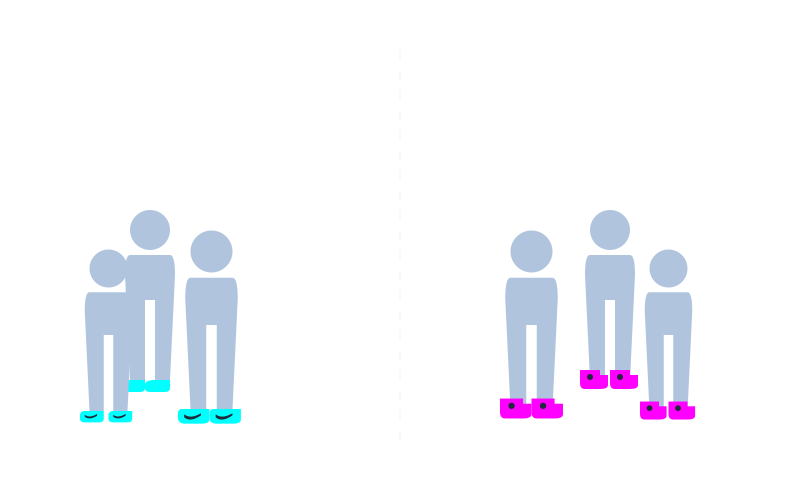
But for the musicians or hip-hop kids, the uniform shifted to Chuck Taylors or laceless Adidas. These are not merely functional items; they are costumes that carry deep social weight. They grant membership, affirm standing, and immediately communicate belonging without a single word needing to be exchanged. This demonstrates how consumerism organizes us into competing, meaning-driven tribes, each marked by their corporate insignia.
Identity Lock-In: Creating Brand Evangelists
This fusion of product and self-concept is the corporate dream, creating an enormous economic entity often called customer lifetime value. The moment a consumer believes a brand is an integral part of who they fundamentally are, the connection becomes impervious. Why? Because asking that person to switch products is tantamount to asking them to change their identity, which triggers a powerful psychological gravitational pull that is nearly impossible to overcome.
This deeply rooted identity argument insulates the brand from competitive attacks regarding mere features or price. Instead of comparing specs, the consumer is defending their very selfhood. This psychological investment generates fiercely loyal brand evangelists who eagerly promote the product for free, becoming unpaid marketers and advocates. They are so wrapped up in the corporate narrative that they willingly participate in the system because they believe it provides the meaning they lack, reinforcing the cycle Jiang Xueqin warns us about.
The Grand Deception: The Deliberate Shift from Citizen to Consumer
The 1980s: Elites Revolt Against Equality
The psychological hijacking of identity, as detailed by Reed, did not happen in a vacuum; it was the necessary cultural lubricant for a massive economic and political overhaul initiated by what Professor Jiang Xueqin starkly calls the “Revolt of the Elite.” Starting in the 1980s, the ruling class realized that a society centered on the organized worker—the model that thrived post-WWII—was simply too egalitarian, threatening their concentration of power and wealth. They did not want equality; they wanted divergence.
The antidote was the seismic shift toward neoliberalism, championed in the US by the Reagan revolution and in Britain by Thatcherism. This was an ideological war aimed at dismantling the political power of the middle and working classes by replacing the powerful figure of the organized worker with the isolated, competitive figure. This transition required a new organizing principle—a framework that allowed the elite to perpetually amass power.
Job Security Traded for Low Prices
The fundamental social contract was quietly—and radically—rewritten. For decades following World War II, the implicit promise governments made to their citizens was straightforward: if you worked hard, you were guaranteed a good, stable job. The worker, rooted in production and collective rights, naturally had political consciousness; they organized, unified, and pushed for meaningful political reforms. But when the consumer became the primary organizing unit, that foundational promise evaporated.
Suddenly, the government’s guarantee was no longer a secure future, but merely a promise of “low prices and a wide selection of goods.” This shift may sound subtle, almost innocuous, but it represents a profound political and social revolution. The consumer seeks instant, individual satisfaction through acquisition, while the worker sought collective security and meaning through contribution. By prioritizing cheapness and choice over stability and sovereignty, the state successfully redirected the citizen’s focus from political engagement to retail therapy.
CEO Pay Skyrockets: The Cost of Consumerism

The true, horrifying cost of this new “low prices and wide selection” compact is paid in the rapid, grotesque dismantling of economic equality. If you want indisputable, tangible proof that the Revolt of the Elite achieved its aims, you need only look at the cold, hard numbers on executive compensation. In the 1970s, before this ideological transition took root, the average CEO was making approximately 20 times the salary of the average worker—a ratio that, while unequal, at least maintained a semblance of social cohesion.
Today? That figure has ballooned astronomically to somewhere between 200 and 300 times more than the worker’s average pay. Inequality didn’t just grow; it exploded, facilitated by the consumer’s preoccupation with the meaning systems sold by brands. The individual was disempowered, forced to define their worth not by their labor, but by the debt-fueled, meaning-laden products they could acquire, which is precisely the architecture required for the “perfection of slavery” that Xueqin warns us about.
The Psychological Engine: Prestige, Status, and Social Media
Social Media: The Engine of Consumer Prestige
The consumerist architecture built by the “Revolt of the Elite” required an engine to run it, and that engine is prestige signaling, turbo-charged by social media. Consumerism doesn’t just encourage buying; it actively creates a constant, draining competition for status. This competition compels us to buy things not for their utility, but so we can post the nicest social media pictures.
As Professor Reed established, brands are identity flags that communicate who you are or who you aspire to be—the rich kid, the smart kid, the athlete. Social media weaponized this desire for validation, transforming products from physical objects into proofs of concept. We are essentially engaging in a continuous, globalized version of the high school cafeteria—constantly measuring our self-worth against the visual badges others display. This pressure acts as a powerful brainwashing mechanism, relentlessly fueling the desire for the next meaning system that promises temporary social uplift.
The $1 Million Experiment: Debt and Isolation
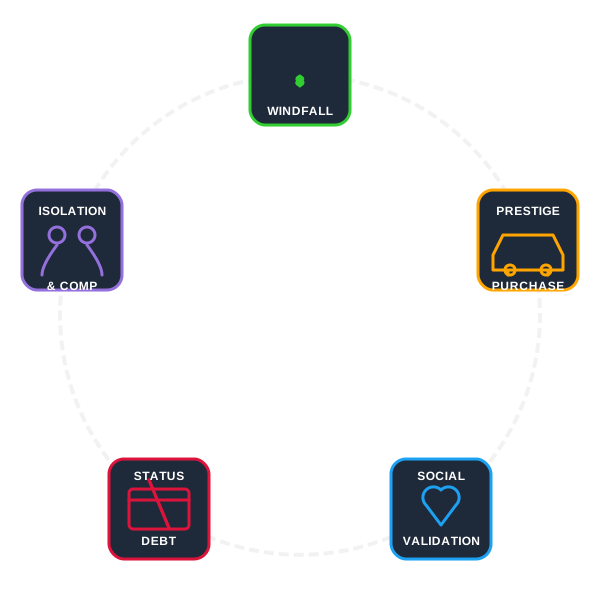
Jiang Xueqin illustrates the destructive velocity of this prestige economy with a provocative thought experiment: imagine giving everyone in a room $1 million. What’s the first thing people do? They buy something—perhaps a house or furniture. But the crucial, immediate next step is taking pictures and posting them on social media.
This is where the cycle accelerates: the purchase instantly becomes a unit of public validation. Once everyone has that initial million-dollar item, the baseline shifts. To maintain status, you must upgrade, taking on debt to buy something better, something more aspirational, than your neighbor. The inevitable outcome, Xueqin argues, is that everyone goes into debt and, critically, they “all hate each other.” Consumerism replaces solidarity with fierce, isolating competition for prestige, destroying the very social fabric that once empowered the worker.
Insecurity’s Price: Who Falls for the Trap?
This manufactured competition thrives on insecurity. When identity is fused with consumption, those who are already grappling with lower self-esteem or a profound need for social validation become the most vulnerable consumers—the perfect targets for brand evangelism. They seek to fill an internal void with external validation, attempting to achieve a sense of “greatness” or belonging that they believe is only available through the purchase of a specific set of badges.
The irony is cruel: the constant drive to acquire the next status symbol only deepens the debt and the isolation, fostering what Xueqin calls “economic logic,” where the world is seen “only through the lens of capital.” You stop evaluating others based on character or shared humanity and start evaluating them based on their material portfolio. This optimization of the individual, devoid of solidarity or collective purpose, is the quiet, perfect victory of the elite: a society of isolated, indebted consumers.
Identity Fusion: When a Brand Becomes ‘Part of Me’
When Brands Become Tribes: Apple and Eagles Fandom
If the shift to consumerism provided the economic structure, identity fusion provides the spiritual conviction. The attachment consumers form with certain brands often defies rational economic logic, morphing into something akin to religious faith or fierce tribal loyalty. Take Apple, for instance. Consumers are so “bought in” that they willingly engage in absurd behaviors, like standing outside in the cold for hours to get a slightly updated device, or even accepting the necessity of buying proprietary, expensive new chargers.
They don’t have to do this; they want to. This isn’t about features; it’s about belonging. Similarly, Americus Reed described hardcore Philadelphia Eagles fans whose entire identity is “completely fused” with the team, exemplified by individuals who travel incessantly and create elaborate spectacles. For the brand, this is the ultimate goal: creating advocates so fiercely committed that they become a walking billboard. The brand is now a community, and membership requires absolute, non-rational devotion.
The Pain of Betrayal: When Brands Poison Identity
The true measure of this identity fusion is the pain of betrayal. When a deeply connected brand or figure is exposed as fraudulent, the consumer doesn’t just lose respect for a company; they experience a profound sense of personal loss. Reed described this perfectly when reflecting on the Lance Armstrong doping scandal.
For many, Armstrong’s brand represented values like diligence, overcoming obstacles, and belief in oneself. When the doping was exposed, it wasn’t just a revelation of unethical behavior; the inspirational energy that consumers drew upon felt poisoned, resulting in a deep sense of self-loss. This fusion means that an attack on the brand is an attack on the self. The sense of loss is so acute because the individual has outsourced a part of their meaning system—their hope, their narrative, their aspirational self—to a corporate entity.

Collectibles as Status: Shoes as Useless Legacy
When identity is paramount, function becomes secondary, or even irrelevant. This phenomenon perfectly explains the value of “collector’s items” that have no practical use. In the Kim’s Convenience example, a character, Kimchee, is shown obsessing over a pair of basketball shoes that “don’t play basketball” 1.
He calls them his “legacy,” valuing the story and the scarcity over the object’s original utility. This is the peak of consumerism: buying objects explicitly designed to not be used, precisely because their value resides entirely in their signaling capacity. They are totems of prestige, and their pristine condition is the visible proof of the owner’s status. They encapsulate a story—a narrative of success, overcoming odds, or achieving greatness—that the consumer buys into and uses to define themselves, solidifying this fusion of personal identity with corporate-manufactured meaning.
The Ultimate Price: Consumerism as the ‘Perfection of Slavery’
Consumerism: Slavery You Willingly Choose
We have traced the path from the psychological fusion of identity with meaning systems to the deliberate economic restructuring by the elite. Now we must confront the conclusion: Professor Jiang Xueqin’s terrifying thesis that consumerism is, in fact, “the perfection of slavery” 2. Why is it perfect? Because traditional slavery breeds rebellion; the enslaved know they are oppressed, and they fight back.
This modern iteration is flawlessly self-sustaining because the masses are not merely compliant—they are enthusiastic participants. We volunteer for the chains. We choose to define our worth by the very debt and competition that benefits the elite, confusing material acquisition with genuine liberation.
If you don’t know you’re a slave, and you actively like the illusion of choice offered by your corporate masters, you will never, ever rebel. The system has successfully outsourced its ideological enforcement to our own deep-seated insecurity and our craving for status.
Economic Logic Replaces Critical Thought
The most corrosive aspect of this perfected slavery is its triumph over critical thought, replacing it entirely with “economic logic.” This is the worldview where every decision, relationship, and pursuit is filtered exclusively “through the lens of capital.” I see this constantly: when evaluating a potential romantic partner, do you instinctively ask if they are kind, or how much money they have? We have been brainwashed into believing that the latter is the only practical, logical measure of a person’s value.
The purpose of education has similarly been hollowed out. Where the dominant worldview of the worker was that school existed to open the mind, foster imagination, and encourage critical thinking, the consumer’s logic is simpler: I am in school to get a good job, to make money, so I can buy things. When the pursuit of wealth replaces the pursuit of wisdom, the ability to question the system that created the wealth disparity vanishes.
Competition Kills Solidarity: Isolating the Consumer
The genius of consumerism, and the reason it is the elite’s “perfect system,” lies in its capacity to ensure we remain isolated and incapable of unified action. By locking us into a frantic, individualized race for prestige and material possessions, the consumer mindset destroys the social consciousness that defined the worker. We are too busy competing to take the time to organize, too focused on posting the next aspirational photo to recognize the collective chains binding us all.
This fragmentation is lethal to political dissent. When citizens are reduced to isolated consumers—defending their personal portfolio of meaning systems and constantly comparing their debt load—they become “unwilling and unable to protest and rebel.” The fusion of our identity with corporate meaning systems is the ultimate tranquilizer, ensuring the stability of a system designed to perpetually enrich a powerful few. We are, effectively, paying for the privilege of our own subjugation.
Conclusion
We’ve journeyed through how brands offer us meaning systems, transforming them into extensions of our very identities. From tribal affiliations symbolized by shoes to the fervent devotion of brand evangelists, the line between self and product has blurred into non-existence. This profound fusion, meticulously crafted and amplified by social media’s relentless pursuit of prestige, has skillfully reshaped our society.
Professor Jiang Xueqin’s critique offers a stark lens: this system, built on manufactured desires and the “Revolt of the Elite,” has systematically shifted us from citizens to consumers. The promise of a secure job was replaced by the allure of low prices and endless choice, a Faustian bargain that widened the gap between the powerful and the populace. This relentless cycle of acquisition, fueled by insecurity and the desire for validation, ultimately traps us in an “economic logic” that stifles critical thought and fosters isolation.
Ultimately, the “perfection of slavery” isn’t about overt oppression; it’s about internalized consent. When our deepest sense of self is tied to the brands we consume, and our social interactions are dictated by the accumulation of capital, we become unwitting participants in our own subjugation. The brands we wear and the status they confer are not liberation; they are merely the gilded bars. Self-imposed prison is the result.
The question then becomes: How do we begin to reclaim our identities from the marketplace? How do we rediscover value beyond the price tag and solidarity beyond the shopping cart? How do we begin?
We must first recognize that the identities we have purchased are, in reality, instruments of our political disarmament. For in the end, true freedom is not found in what we own, but in what we can collectively imagine and build beyond the allure of the next purchase.


