


We are biologically wired to be terrible archivists of our own happiness. The moment passes, the rush fades, and we instantly snap back to baseline, wondering where all the good went.
I used to think joy was like finding a ten-dollar bill on the sidewalk—a pleasant, accidental trigger. You wait for it, or you miss it entirely.
But the reality, as psychologist Fred Bryant argues, is that waiting for external luck is a recipe for emotional mediocrity. True, sustainable happiness requires us to stop being passive recipients and start being active architects. It demands strategy.
This piece is about moving beyond mere reaction. We are going to explore the deliberate mental exercises—some surprisingly dark—required to engineer joy, extend pleasure, and ensure that the best moments of your life aren’t just gone with the wind, but actively built into your psychological scaffolding.
Why Joy Slips Away: Moving from Passive Triggers to Active Strategies
Triggers vs. Strategies: Controlling Your Joy
The crucial conceptual hinge in Dr. Bryant’s work is the stark difference between happiness that happens to you and happiness that you actively create. We often mistake a ‘trigger’ for true savoring. A trigger, like receiving a random compliment or spotting a majestic bald eagle, is a fortuitous event that evokes pleasure; it’s passive and relies purely on chance 1. These moments are wonderful, of course, but they are also fleeting and beyond our control.
If we only wait for such accidental gifts, our emotional life remains subject to the capricious whims of fate. Strategies, on the other hand, are proactive—they are voluntarily planned, engineered opportunities for joy. This requires effort, a conscious movement toward setting the stage and mentally “setting aside worries and cares,” as Dr. Bryant describes it.
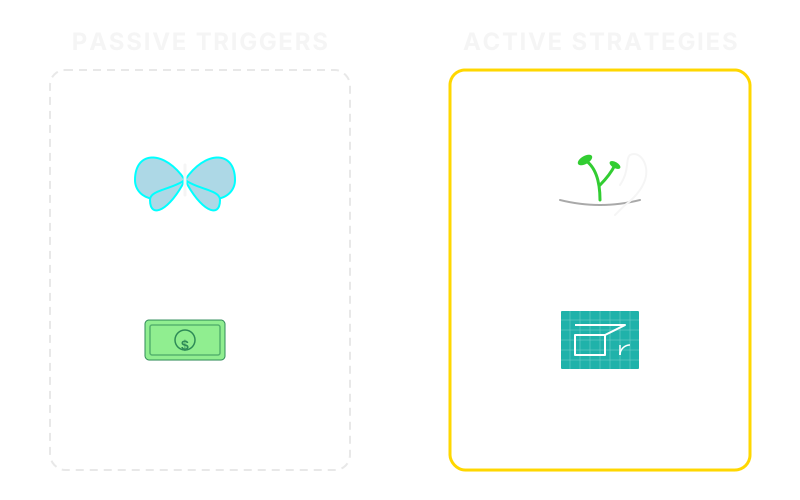
Strategy is the deliberate choice to go to a beautiful place with the intention of noticing things, ensuring that you will find pleasure regardless of whether a magnificent bird decides to make an appearance. Studies confirm that this daily, active cultivation of positive emotions can powerfully increase happiness over time.
When Anxiety Ruins the Celebration
If savoring were merely about planning a good time, we’d all be masters of joy. But the internal landscape remains precariously hostile, capable of undoing even the most meticulously arranged celebration. Consider Dr. Bryant’s story of his post-surgery mountain climb: the moment was planned, the achievement immense, yet the joy evaporated into thin air the moment anxiety took hold. He felt a twinge in his back and convinced himself his injury was serious, turning a celebratory drive into a terrifying meditation on pain.
The climax of the strategy—a celebratory dinner—was completely undermined. He ended up isolated, lying on ice, “beside myself and terrified,” unable to be part of the group that wanted to toast his success. His physical discomfort was minimal—a simple strain, as the doctor later confirmed—but his fear was catastrophic.
This is the ultimate lesson: Savoring isn’t just external planning; it’s the internal management of intrusive thoughts and the anxiety that begs us to prioritize perceived danger over actual, present pleasure. It proves that the most formidable opponent to joy is often our own ruminative mind.
Stop Waiting: Savoring as Active Choice
The cultural myth of happiness is perfectly encapsulated in the famous, if slightly weary, quote attributed to Nathaniel Hawthorne: “Happiness is a butterfly, which when pursued, is always beyond your grasp, but which, if you will sit down quietly, may alight upon you.” It’s a beautifully melancholic sentiment, suggesting that joy is a gift best received passively—a belief Dr. Bryant rightly dismisses. Frankly, I agree: this passive expectation is an insufficient life philosophy. We cannot afford to simply sit still and wait for the “butterfly” of contentment to alight on our shoulder.
Savoring is the definitive antidote to this Hawthorneian passivity. It is the acknowledgement that we possess the agency to cultivate happiness, not just wait for it to drift by. We are not simply reactive beings; we are architects of our own experience.
By embracing savoring strategies, we move beyond the ephemeral luck of triggers and make the proactive choice to set the stage, set aside our worries, and genuinely inhabit the good moments we build for ourselves. This is the pivot from merely surviving to actively flourishing.
The Savoring Toolkit: Three Core Techniques to Enhance Joy
Technique 1: Build Rich Memories Actively

If we agree that savoring is a strategy, then we need a toolkit, and the first tool is perhaps the most profound: active memory building. This technique transforms a temporary high into a lasting psychological resource. Dr. Bryant detailed this process following his triumphant climb of Snowmass Mountain, recognizing that to truly retain the moment, he needed to deliberately construct its memory.
It’s not enough to simply be there; you must become a cinematographer, directing your senses. As he journaled, Dr. Bryant described turning slowly, noticing how the overwhelming expanse broke down into discrete, beautiful elements: the “wrinkled quilt of emerald and olive,” the river as a “thin silver ribbon,” and the lakes as “a handful of silver coins.” This meticulous, sensory cataloging ensures that the memory is rich, detailed, and robust against the erosion of time.
I see this as the antidote to the mindlessness of our daily lives; you are consciously hunting for the essence of the moment, building a “mental movie” that you can replay later for an emotional boost. The quality of your memory dictates the quality of your sustained joy.
Technique 2: Emphasize the Moment’s Fleeting Nature
The second critical strategy is cultivating what Dr. Bryant terms “heightened temporal awareness.” This means deliberately reminding yourself that the current good moment is, by its very nature, transient and fleeting. It sounds counterintuitive—why focus on the ending while enjoying the experience?—but it works precisely because it heightens the preciousness of the present.
Awareness of time binding us, the fact that a moment is “here and gone,” makes it “all the more beautiful and special like a flower in the desert,” which blooms only briefly after a rainfall. This strategy provides momentum; it’s the motivation to seize the moment, realizing that “no moment comes twice.”
We tend to undervalue things we assume will always be available, but recognizing the ephemerality of a beautiful sunset, a perfect conversation, or even a simple walk forces us to truly lean into the experience. The research on anticipation and uncertainty supports this idea: when we recognize a positive experience may not be permanent or perfectly certain, it enhances our appreciation of it.
Technique 3: Use Downward Comparison
Finally, there is downward comparison, a powerful technique for appreciating the ordinary blessings of life. This strategy utilizes “counterfactual thinking”—imagining how a situation could have unfolded less favorably. While we often think of happiness as intense highs, it’s the frequency of positive emotions that truly matters for well-being. Downward comparison makes the mundane feel spectacular.
Dr. Bryant uses this technique when confronting the slight discomfort of exercising on a hot day. Instead of skipping the run, he forces himself to recall the period when his back injury made running impossible, when he “would have given a fortune” just to be able to move freely.
This retrospective “hedonic contrast” instantly reframes the current effort as a profound gift. It shifts the focus from the momentary inconvenience to the profound privilege of physical capability, ensuring that we never let present blessings become victims of hedonic adaptation.
The Morbid Technique: How Imagining Future Loss Creates Present Joy
Future Loss Amplifies Present Joy
We’ve established that savoring requires contrast, but Dr. Bryant takes this idea into surprisingly dark territory—a technique I find compellingly morbid. While our previous strategy, downward comparison, relies on looking backward at past hardships (like an old injury), this advanced trick forces us to look forward to an inevitable future state of loss. The goal is to create a fierce, immediate sense of gratitude by anticipating the absence of our current blessings. It’s a psychological time-travel hack designed to shock us out of complacency.
Why does it work? Because the mind, faced with the hypothetical terminality of a joy—say, the ability to run freely—treats the present enjoyment as a finite resource, demanding immediate appreciation.
It’s this self-induced dread, this conscious acknowledgment of fragility, that makes the present moment feel so incredibly vivid. By allowing ourselves a moment to grieve a future loss, we trade that potential sorrow for a present, amplified joy, ensuring we don’t take the “here and now” for granted.
Bryant’s Trick: The Wheelchair Visualization
To illustrate this powerful “morbid trick,” Dr. Bryant employs a vivid visualization focused specifically on his physical capabilities. When he struggles with the motivation to exercise, he doesn’t just recall his past back injury; he projects himself decades into the future: “I’m in a nursing home perhaps. I’m in a wheelchair.” He forces himself to feel the desperate, impossible longing to return to this very moment—the exact moment where he can choose to put on his shoes and run.
The technique requires him to perform the mental equivalent of a time-travel narrative: he closes his eyes, imagining that he has been granted a one-time opportunity to return to his current age and capability. When he opens his eyes, he instantly realizes, “I’m here. This is incredible.”
That sense of overwhelming shock and relief—the feeling of being granted a miracle—transforms the simple, hot-day run into an exhilarating privilege. It is a profound demonstration of how perspective, not circumstance, dictates our level of satisfaction.
Upward Comparison vs. Gratitude
The sheer potency of this downward comparison—whether retrospective (past injury) or prospective (future loss)—comes into sharp relief when contrasted with its nemesis: upward comparison. We are culturally programmed to use upward comparison, looking at people who are wealthier, more successful, or ostensibly happier than we are, with the goal of fueling ambition and achievement. The problem, however, is that this automatic scripting often leaves us feeling “impoverished or unhappy” in the present, always chasing the next rung of the ladder 1.
Savoring, by contrast, teaches us to manipulate our perspective consciously. While upward comparison serves the ego and the drive for improvement, downward comparison serves the soul, grounding us firmly in the reality that what we possess right now is valuable and uniquely precious. We always have the choice: use comparison to undermine the present, or use it to amplify gratitude.
Savoring as a Social Habit: The Opposite of Complaining
Social Savoring Multiplies Joy
We’ve established that savoring is an individual, internal skill, but its most potent form is undeniably social. It’s why the clichéd image of a solitary climber watching a magnificent sunset often feels incomplete; even at the peak of achievement, the thought creeps in: “This would really be beautiful if there was someone here to share it with”. When we share joy, we don’t just divide it; we multiply it. In expressing our savoring to others, we magnify the feeling through mutual validation. Moreover, sharing forces us to be more observant, as friends often act as extra sets of eyes and ears.
Dr. Bryant noted how his climbing partners would point out things he missed—like a specific boulder on the summit that was visible from their distant base camp—adding layers of meaning to the landscape. This collective noticing ensures that the memory built (Technique 1) is richer, more detailed, and far more robust against the forgetfulness that accompanies time.
Savoring: The Opposite of Complaining
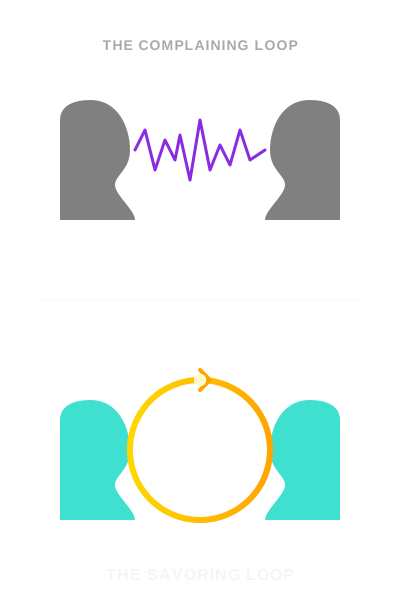
Socializing is intrinsically tied to affective states, and we must realize that our daily interactions often default to negativity. We live in a culture where complaining is an accepted social currency; people often feel they have “free rein” to vent and amplify their grievances, creating a habitual loop of shared dissatisfaction. Savoring is the direct opposite of this pervasive complaining. It is the conscious decision to invert that default negativity into an open, appreciative articulation of the good.
It forces us to hunt for things worth praising rather than problems worth criticizing. This conscious choice to share positivity, rather than negativity, is a strategy that compounds happiness, much like how complaining compounds misery.
The goal is to make savoring a habit, a form of positive social scripting that reinforces well-being, not only for ourselves but for everyone in our orbit. Research consistently shows that actively savoring life acts as a powerful moderator, boosting life satisfaction and positive affect, especially as we age.
The Mount Whitney Star: Social Savoring Bonds
The transformative power of shared savoring is perfectly captured in Dr. Bryant’s story from Mount Whitney. Lying under the ageless, star-strewn sky with his friends, facing the descent the next morning, they made a strategic decision. Despite their exhaustion, one friend proposed they wait for “just one more shooting star”—a final, collective savoring moment before the trip ended. This single, conscious act of shared anticipation was immediately rewarded.
They witnessed “the most vivid, powerful shooting star” Dr. Bryant had ever seen, streaking across the sky like a celestial paintbrush. The power of the moment elicited shared, uncontrollable laughter, forging a memory that was not just intensely positive but emotionally communal. The moment was perfect because it wasn’t just seen but shared. It was a demonstration that while strategies can prepare the mind for joy, the human connection validates and amplifies that joy until it becomes an indelible part of our shared narrative, cementing bonds far stronger than any individual experience ever could.
The Price of Admission: Finding Joy in Bittersweet Moments
Embracing Bittersweet Moments
The final, perhaps most advanced, discipline of savoring lies not in optimizing pure, unadulterated joy, but in embracing the bittersweet—those complex, exquisite moments where profound happiness is irrevocably linked to deep, underlying sorrow. We tend to operate as if life’s emotional landscape should be neatly separated into opposing camps, but true meaning often resides in experiences that defy this separation. Bittersweet moments are those personal mountain peaks achieved while standing in a valley of despair, where the current joy is intensified precisely because of the adversity or loss looming nearby.
This duality demands profound emotional courage. True savoring requires us to be present not just for the ‘sweet’ part, but also for the ‘bitter,’ which acts as the ultimate psychological amplifier.
Refusing to acknowledge the context of difficulty or approaching loss is fundamentally refusing the full measure of the moment’s beauty. If the previous techniques taught us to manufacture contrast to create joy, this stage teaches us to accept contrast when it is unavoidable.
The Final Drive: Savoring with His Mother
Dr. Bryant shared an incredibly moving, personal illustration of this bittersweet savoring toward the end of his mother’s life. Diagnosed with ovarian cancer and weakened by chemotherapy, she had lost some functioning and memory but deeply missed time in nature, having always been an outdoor person. On a whim—a “wild hair,” as he describes it—he decided to make a plan. He was going to drive her to a cherished state forest, declaring her “queen for the day,” insisting she simply sit back and receive the experience.
The subsequent drive was a deliberate strategy of savoring carved out of a dark period. The weather was glorious, the trees “verdant,” the landscape “so fertile and beautiful.” In a remote area, he stopped the car, turned off the engine, and they simply sat, drinking in the silence with the windows down.
It was, in his words, a “mountaintop moment in a valley.” Sitting there, holding her hand, noticing a single cloud in the immense blue sky, they created a sensory, shared reality that was fiercely fought for against the painful reality of her terminal illness.
The Price of Admission: Joy Requires Sadness
This final drive, a perfect act of shared presence, became Dr. Bryant’s most dear and precious memory. It was rendered so indelible because it was permeated by the knowledge that it might well be their last time together. He crystallized the key psychological lesson: those things, “those tears and the pain,” were simply “the price of the joy of that moment”.
He would have paid that price a hundred times over. The “price of admission” is the crucial realization that profound joy often requires us to fully accept our vulnerability and the impermanence of the things we cherish.
By consciously closing our eyes and letting that inescapable sadness flow in, we dignify the moment and immortalize its sweetness. Savoring, in its highest form, is the courage to deeply experience life as it is—messy, beautiful, fleeting—so that nothing, not even impending loss, can diminish the preciousness of the present.
Conclusion
In essence, we’ve explored how savoring isn’t merely about experiencing fleeting moments of joy, but about actively cultivating a richer, more resilient emotional life. It’s about shifting from a passive observer of happiness to its intentional architect.
As Dr. Fred Bryant’s work illustrates, this means distinguishing between the happy accidents of ‘triggers’ and the reliable power of ‘strategies’ we can employ. It involves:
- building vivid memories,
- appreciating the transient nature of good times, and
- even using contrast—sometimes with a touch of “morbid” foresight—to deepen our gratitude for the present.
And, as we’ve seen, sharing these experiences with others doesn’t dilute them; it magnifies them, forging stronger bonds and richer recollections.
Ultimately, savoring teaches us that joy isn’t something that happens to us; it’s something we do. It’s the conscious choice to not just witness life, but to truly inhabit it, in all its beautiful, fleeting, and sometimes bittersweet complexity.
So, the next time you find yourself in a good moment, remember: don’t just let it pass you by. Actively build it, cherish it, share it, and let it become a lasting part of your life’s rich tapestry. After all, happiness isn’t a butterfly you chase; it’s a garden you tend.


