


I think that the ends do justify the means. I know that sounds provocative, perhaps even monstrous, especially when we carry around ingrained, sentimental rules about never telling a lie or never taking an innocent life. But what happens when clinging to those rules allows a catastrophe to unfold?
Peter Singer, the philosopher at the heart of this debate, forces us to strip away intuition and rely purely on calculation: maximizing happiness and minimizing suffering. It is arithmetic applied to ethics, and it demands that we confront dilemmas where the morally “right” action feels inherently wrong.
If a sheriff can save six innocent lives by falsely condemning one, the math is brutal but clear. Are we truly better people if we stand aside, preserving our own moral cleanliness, while allowing five more people to die? This is where Utilitarianism stops being a comfortable academic theory and starts demanding real, difficult sacrifice.
What Is Utilitarianism? The Core Principle of the Greater Good
The Cold Calculus: Maximizing Happiness Over Sentiment
The central, terrifying brilliance of Utilitarianism is its radical simplicity: morality is arithmetic. The highest ethical goal is to increase the total amount of happiness and decrease suffering to the greatest extent possible 1. It transforms the moral quandary into a ledger, forcing us to ask profoundly uncomfortable questions about utility, particularly when lives are on the line. I find that this focus on maximizing the”net surplus” strips away the sentimentality that often clouds genuine ethical decision-making.
The famous sheriff dilemma illustrates this perfectly: if an angry, armed mob is about to lynch six innocent men, and the only way to stop them is to frame and sacrifice one other innocent person, the utilitarian must execute the innocent one to save five. This is the cold calculus.
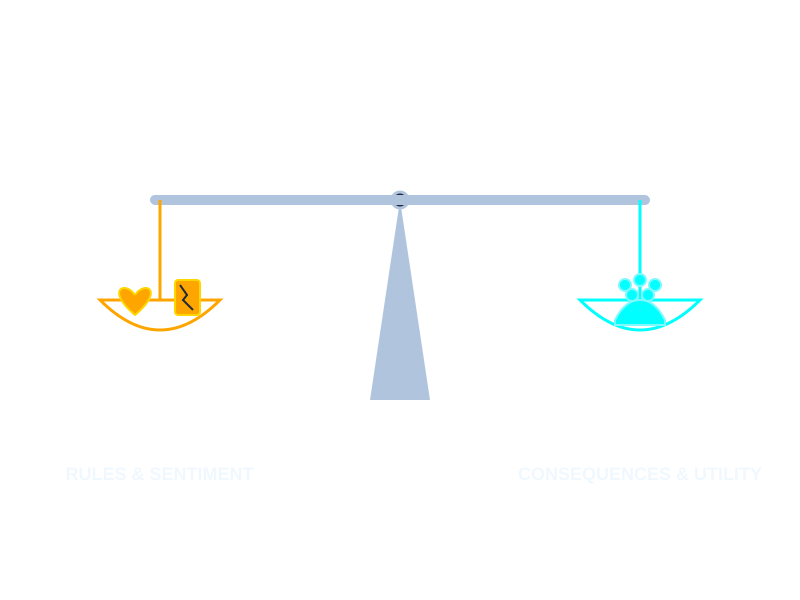
It prioritizes the maximum welfare gain over the individual sanctity of life, even going so far as to suggest that in a triage situation—like allocating ventilators during a pandemic—one should calculate which individual’s continued life imposes the smallest societal cost by factoring in underlying health issues or life expectancy. This commitment to the aggregate good is what makes the theory so potent, and simultaneously, so deeply disturbing to deontologists.
Consequences Over Rules: Why Ends Justify the Means
The reason Utilitarianism demands such stark sacrifice is because it is a pure form of consequentialism. Consequences, and only consequences, determine what is right or wrong. For a consequentialist like Peter Singer, the famous admonition that “the ends do not justify the means” is, quite frankly, nonsensical; he argues explicitly that the end does justify the means.
If the means involve temporary harm, but the end results in a vastly greater reduction of suffering, then the action is, by definition, morally correct. This framework rejects the idea of moral absolutes—the notion that there is some deed which is always wrong, regardless of the eventual outcome.
This radical stance forces us to abandon the intuitive moral rules we cherish, demanding that we justify every action not by its inherent goodness, but by its observable results in the world. It requires a permanent, ruthless commitment to effective altruism over comfortable compliance.
Founding Thinkers: Bentham and Mill’s Legacy
Singer’s deep dive into utilitarian ethics, solidified during his studies at Oxford, is a modern extension of a philosophical movement codified two centuries earlier. The fundamental framework of calculating pain and pleasure was originally established by English philosophers Jeremy Bentham and John Stuart Mill. Bentham, often considered the founder, focused on the quantitative measure of pleasure and pain, seeking a measurable metric for policy and ethical action.
Later, Mill refined the theory, introducing the idea of qualitative differences in happiness—arguing that intellectual pleasure might be inherently “higher” than mere physical gratification. Both agreed, however, that the moral action is the one that achieves the “net surplus of happiness over misery,” setting the historical stage for contemporary thinkers like Singer to apply this demanding, logical framework to global dilemmas, from animal rights to effective giving.
The Utilitarian Calculus: Why Logic Must Override Emotion
Why Singer Rejects Emotion as a Moral Guide
If the core of Utilitarianism is the hard math of morality, then the operational challenge is eliminating the messy human variables—namely, our feelings. Peter Singer is famously skeptical of emotion as a moral guide, suggesting that the intuitions which produce our moral judgments are often unreliable, biased relics of our evolutionary past. Many people recoil from this, instinctively clinging to the notion that moral judgment should be emotional, but Singer demands we override that gut feeling with cold, objective logic.
Our ancestors evolved in small, face-to-face societies where every victim was an identified victim. Consequently, our emotional programming is calibrated for immediate, tangible moral problems.
Today, however, we live in a world of billions of anonymous sufferers, and our old emotional toolkit is catastrophically inadequate. I believe Singer is arguing that we must replace the instinctual emotional response with calculated, rational analysis because only logic can properly account for these billions of unidentified lives and ensure the maximal reduction of suffering globally.
The Identified Victim Effect: Intuition’s Biased Blind Spot

The critical flaw in relying on intuition is brilliantly exposed by the phenomenon known as the Identified Victim Effect. This bias demonstrates that we are far more motivated to help—or are much more reluctant to harm—a person who is specifically identified than a statistical or anonymous stranger 1. Our emotional systems are triggered by specificity; a photograph moves us to tears, while raw data leaves us dry-eyed. This bias isn’t limited to victims, either.
There is an analogous phenomenon when dealing with causation, which Singer terms the’Identified Cause Effect.’ During the pandemic, for instance, we could easily count the deaths attributable to the identifiable cause (the virus) and felt enormous outrage toward it.
Yet, the collateral damage from the societal lockdown—a statistical cause, where the victims were not identified in advance—often felt less urgent, even if the net suffering was comparable or worse. Utilitarianism forces us to look past the identifiable immediate cause or victim and calculate the total suffering generated by all options.
Pond Child vs. Global Poverty: Visible vs. Statistical Victims
The famous thought experiment—the child drowning in the ornamental pond—is the perfect vehicle for this contrast. If you saw a small child drowning and no one else was around, you would, of course, rush to save them, even if it ruined your expensive shoes. The emotional pull to save that specific, identified child in your immediate sight is overwhelming, and everyone agrees it would be morally reprehensible to walk away.
Singer’s rhetorical trap, however, is that saving an anonymous child’s life elsewhere—say, by donating the cost of those expensive shoes to the Against Malaria Foundation—achieves the same moral outcome, often with greater statistical certainty of saving a life. The lack of an identified victim means we feel no strong emotional pull, yet the logical duty, under the utilitarian framework, remains absolute. Morality, in this view, is not about the pleasant feeling of saving a child in front of you; it is about the cold reality of maximizing the number of lives saved, whether they are known to you or are merely statistical probabilities on a distant continent.
No Sacred Rules: When the Ends Justify the Means
Sheriff vs. Mob: When Rules Lead to More Death
The infamous “Sheriff and the Mob” scenario is a perfect, brutal instrument for prying apart our cherished moral absolutes. Imagine a sheriff powerless to stop a mob from lynching six innocent men unless he falsely frames and sacrifices one of them. For many people, particularly those subscribing to deontological ethics, the sheriff must refuse to lie or unjustly condemn a person, regardless of the consequences. They argue that as an officer of the law, he has an absolute moral duty to uphold justice and truth.
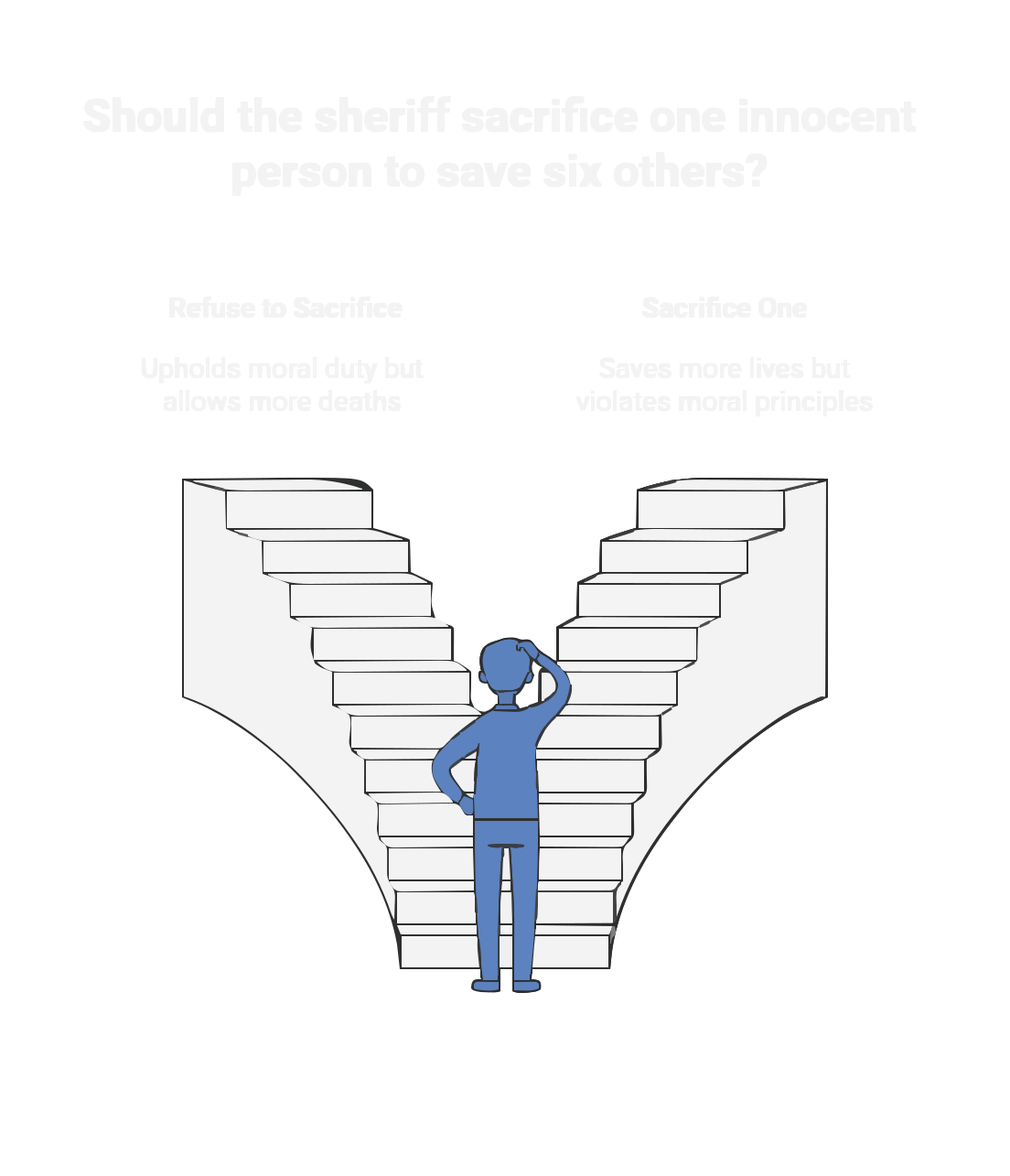
But to a utilitarian, this refusal is morally bankrupt. By adhering to the abstract moral rule (“never lie,” “never kill an innocent”), the sheriff actively allows five additional innocent people to die. Singer argues that if you can prevent six deaths by choosing one death, that is unequivocally the correct action.
The fact that the one person is innocent is tragic, but it is morally irrelevant, since all six slated for lynching are also innocent. The calculation is about lives saved versus lives lost, not about the professional sanctity of the sheriff’s oath 1.
The Lesser Evil: Obligation to Commit the Bad Means
This is where the true demand of utilitarianism emerges: the justification of the lesser evil. The fundamental principle is that if the only available path to prevent a catastrophe requires an action that is itself morally’bad,’ but significantly less bad than the catastrophe you are preventing, then you are morally obligated to choose the lesser evil. I find it crucial that Singer admits he, too, feels the profound emotional repugnance of such a choice.
It’s an objectively terrible thing to point a finger at an innocent man, but the emotional distress we feel is just noise compared to the moral imperative of minimizing death. The cold, rationalist stance dictates that we must, under these extreme circumstances, commit a specific harm (the means) only because it secures the greater good (the end). To fail to do so is to prioritize one’s own clean hands over the welfare of the collective.
Dostoevsky’s Test: Sacrificing One for Eternal Utopia
The idea that the means must be assessed purely based on the ends is pushed to its absolute breaking point by a scenario popularized by Dostoevsky in The Brothers Karamazov. Singer, referencing this, asks: suppose you could secure peace on Earth forever—a permanent global utopia—but to achieve it, you must first torture a single, small child to death. This hypothetical is meant to be morally horrendous; the visceral horror of torturing a child is almost an absolute stopper for our conscience.
Yet, if that single, horrific act genuinely prevents thousands of years of subsequent wars, famines, and suffering that would otherwise plague billions of people, the utilitarian logic inexorably suggests that torturing the child would be the right thing to do. It’s a transaction I hope no one ever has to face, but it showcases the radical depth of the utilitarian commitment: if the numbers demand it, even repugnance must be suppressed.
The Moral Weight of Inaction: Why Omissions Are Culpable
Omission is Commission: The Moral Weight of Inaction
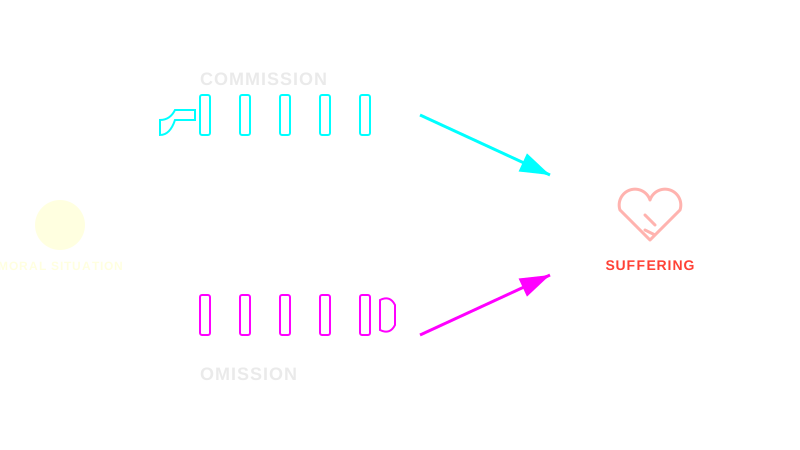
One of Utilitarianism’s most devastating challenges to conventional morality is the assertion that acts of omission are morally equivalent to acts of commission. Most of us are comfortable believing we are good if we simply “don’t hurt people.” Peter Singer calls nonsense on this passive morality. He insists that if you have the power to prevent suffering but choose not to, you are culpable; you have blood on your hands.
Consider the sheriff dilemma again. If the sheriff refuses to lie, thereby allowing five people to be lynched, his inaction is not a neutral moral choice.
The utilitarian sees his omission—his failure to save the five—as just as morally significant as the commission of killing the one. This responsibility for omissions struck Singer early in his career, particularly regarding life-and-death decisions in healthcare, where simply allowing a life to end became an active choice demanding moral justification.
Lorber’s Dilemma: Slow Death vs. Quick Relief
The medical context provides a stark, real-world example of the moral weight of omission. As a graduate student, Singer encountered the work of Dr. John Lorber, who treated severely disabled infants with spina bifida. Lorber, recognizing that some of these children were being “saved for lives that were miserable,” decided sometimes to stop treating them. However, Lorber and other doctors refused to take active steps to end the infants’ lives—a fatal failure of nerve, in Singer’s view.
Lorber would simply withhold treatment for infections or not provide food, allowing the infants to die slow, lingering, and painful deaths. Singer observed the devastating strain this put on the babies, their families, and the nursing staff.
If the doctor had already made the decision that death was better than survival for the baby, why choose the path that inflicted maximum, unnecessary suffering? Utilitarianism demands that if the outcome is death, the least painful means is the only moral option, making a slow, passive death morally worse than an active, swift one.
Affluence and Omission: Your Duty to the Global Poor
This concept of culpable omission forms the intellectual spine of Effective Altruism. Singer uses the analogy of the drowning child to pivot straight to global poverty: if it is morally awful not to save the child right in front of you, is it not also awful to do nothing to save children far away, whose lives you know you can save cheaply?.
When refugees from East Pakistan were suffering, Singer and his wife realized they, though not wealthy, had more than they needed, enabling a planned summer holiday. That money, they recognized, could save lives.
If we spend money on non-essential luxuries when that money could buy highly effective interventions, like bed nets from the Against Malaria Foundation—which are statistically certain to save anonymous children’s lives—we are committing an ongoing, inexcusable moral omission. This is the hard conclusion: affluence brings an obligation to commit substantial resources to alleviate suffering, and failing to do so is a moral transgression.
Utilitarianism in Practice: From Charity to Crisis Triage
Singer’s Sacrifice: Giving One-Third (or More) of Your Income
If the logic of omission dictates that we must prevent suffering we can easily stop, then for the affluent in developed nations, the conclusion is a massive moral commitment to charity. Singer argues that merely tossing a few coins into a donation tin is insufficient; we must make a substantial contribution because money spent on non-essentials could be saving lives. This is not abstract theory for Singer; it is applied reality.
He and his wife initially committed to donating 10% of their graduate student income. Now, with a significantly larger income, Singer donates at least a third, sometimes closer to half, of his earnings each year. This personal financial sacrifice embodies the utilitarian call to action: our ethical duty is relative to our capacity to generate the greatest good, demanding a level of giving that most people find uncomfortable, even extreme.
Effective Altruism: Why Malaria Nets Trump Sentiment
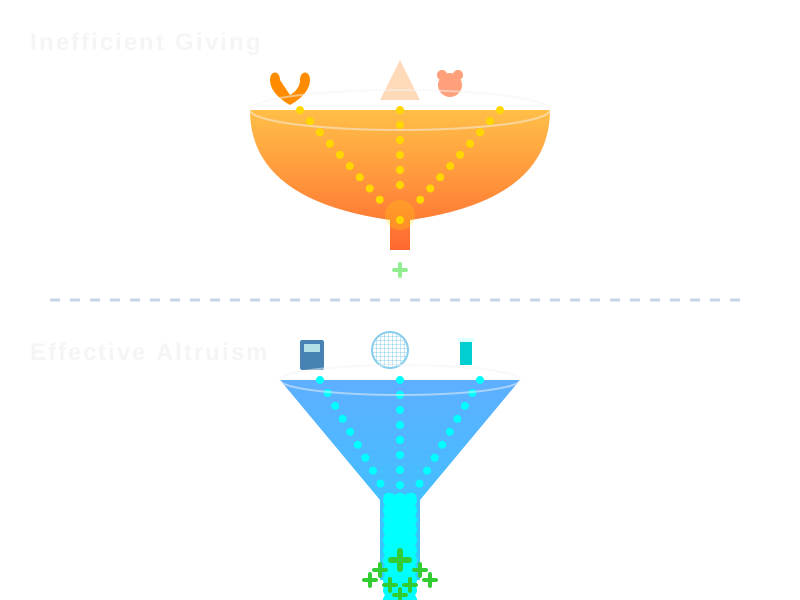
The emphasis on effectiveness is paramount. A utilitarian doesn’t just give; they calculate which charity yields the highest return on happiness. In the context of global poverty, Singer often points to simple, cost-effective interventions, like providing bed nets to prevent malaria through organizations like the Against Malaria Foundation.
Bed nets are cheap, and while no single net is guaranteed to save a child’s life, statistical certainty shows that a large donation will save multiple anonymous children who would otherwise die. This highly leveraged giving contrasts sharply with sentimental donations to less effective local causes. By prioritizing the quantifiable reduction of extreme poverty and disease, we move from emotionally satisfying but inefficient charity to morally mandated, logical altruism.
Triage Ethics: Maximizing Life Years with QALYs
The utilitarian calculus moves beyond donations and into the chilling territory of resource scarcity, famously seen during the COVID-19 pandemic when hospitals ran out of ventilators. Traditional medical ethics often defaults to “first come, first served,” but Utilitarianism demands maximizing the total years of life saved. This is often calculated using Quality-Adjusted Life Years, or QALYs.
The objective here is to prioritize outcomes that lead to the greatest remaining lifespan and satisfaction. This forces us to compare the potential loss of a young person’s 40 future years against an 85-year-old’s few remaining years.
Doctors in Italy, facing this awful dilemma, explicitly developed protocols that suggested it was acceptable to remove a ventilator from an elderly patient to give it to someone with a better overall prognosis and longer life expectancy. It’s a terrifying calculation, but one that is mathematically justified under the rule of the greatest good.
Conclusion
Utilitarianism, with its emphasis on maximizing the “greatest good for the greatest number,” presents a compelling, if often uncomfortable, ethical framework. We’ve delved into its origins with Bentham and Mill, explored its consequentialist nature where outcomes trump intentions, and grappled with its challenge to our deeply ingrained moral intuitions. Singer’s arguments highlight how our emotional responses, while powerful, can be misleading, often prioritizing identified victims over statistical ones and obscuring our responsibility to those far away.
The stark scenarios we’ve examined—from the sheriff facing a mob to the agonizing triage decisions in a pandemic—reveal the true demand of utilitarianism: a commitment to rigorous calculation and a willingness to act on its findings, even when it feels profoundly wrong. This philosophy asks us to move beyond the comfort of passive morality and embrace the active responsibility that comes with the ability to alleviate suffering. It compels us to consider not just what we do, but what we fail to do, and to recognize the moral weight of inaction.
Ultimately, Utilitarianism offers a powerful lens through which to view our ethical obligations in an interconnected world. It doesn’t necessarily provide easy answers, but it demands that we ask the right questions, prioritizing rational analysis over emotional bias to achieve the most beneficial outcomes for the largest number of sentient beings. As we navigate an increasingly complex global landscape, perhaps the most ethical action is simply to engage with this rigorous, often challenging, calculation of consequences. For in the end, when faced with the vast scale of human suffering, are we not obligated to do the most good we possibly can?


