


I used to think purpose was something you found—like a buried treasure waiting to be unearthed. But after years of chasing that myth, I realized the truth: purpose isn’t discovered. It’s cultivated.
We’ve been fed a dangerous narrative—that purpose is a singular, earth-shattering “why” that will define our entire existence. But here’s the reality: most people don’t have one grand purpose. They have many small ones, scattered like breadcrumbs across their lives.
The problem? We’re so busy searching for the “big P Purpose” that we miss the little p purposes staring us in the face. Maybe it’s the way your heart lifts when you teach someone a skill, or the quiet satisfaction of solving a problem at work. These aren’t just distractions—they’re clues.
So what if we stopped waiting for a grand revelation and started paying attention to what already lights us up? What if purpose isn’t a destination, but a path we walk every day? Let’s reframe the question. Instead of asking, “What’s my purpose?” maybe we should ask, “What makes me feel alive right now?”
Because purpose isn’t something you find. It’s something you do.
Reframing Purpose: Cultivation, Not Discovery
Why “Finding” Your Purpose Is the Wrong Goal
We’ve been sold a bill of goods about purpose. Society tells us it’s this grand “why” we must discover, something monumental that will define our entire existence. The pressure is immense, and no wonder—up to 91% of us experience what researchers call “purpose anxiety,” that paralyzing feeling that we’re missing something fundamental 1.
We’ve been conditioned to think purpose is this singular, audacious achievement—becoming a billionaire, running for president, building an eight-figure business. When we can’t find this elusive “big P purpose,” we become frustrated, anxious, and stuck. We default to scrolling through social media, searching for clues in others’ highlight reels, completely missing the point that purpose isn’t something external to be found, but something internal to be cultivated.
The Three Proven Pathways to Discovering Your Purpose
Here’s what the research actually shows: purpose doesn’t arrive through some mystical discovery. It emerges through three distinct pathways:
- Proactive cultivation—that gradual, sustained engagement with something you repeatedly return to, like a hobby that keeps calling you back during downtime.
- Reactive pathways, often triggered by a significant life event that suddenly clarifies your direction. But here’s where it gets interesting: those who follow reactive pathways tend to have crystal-clear awareness of where their purpose came from, while those who cultivate it gradually might fail to recognize when it actually began—it was just a snowball they kept pushing over time 2.
- Social learning, where we observe purpose being cultivated by others in our environment.
Purpose isn’t a destination; it’s an active process of engagement with the world around us.
Finding Purpose in Small, Daily Actions
What if I told you that purpose isn’t scarce but abundant? This is where we need to make a crucial distinction between “Big P Purpose” and “little p purpose.” Big P Purpose is that all-or-nothing, anxiety-inducing quest for a singular life-defining mission. Little p purpose, on the other hand, is the process-oriented collection of actions that light us up in the present moment.
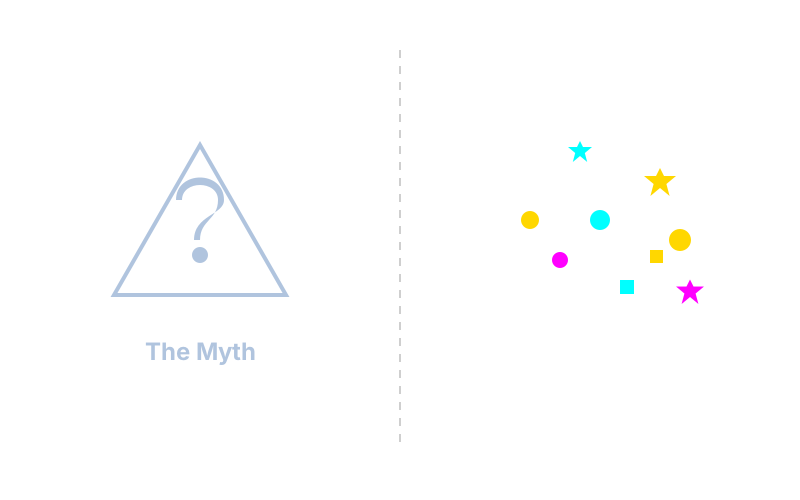
It’s about doing things that bring immediate joy, without needing external validation or explanation. When we shift our focus from chasing one grand purpose to cultivating many small purposeful activities, something magical happens.
We realize there are countless things that excite us—when we let go of the pressure to find something big, important, or socially impressive. Purpose becomes not a scarce resource to be discovered, but an abundant field to be harvested through simple, consistent action.
Learning from Others: Wisdom and Experimentation
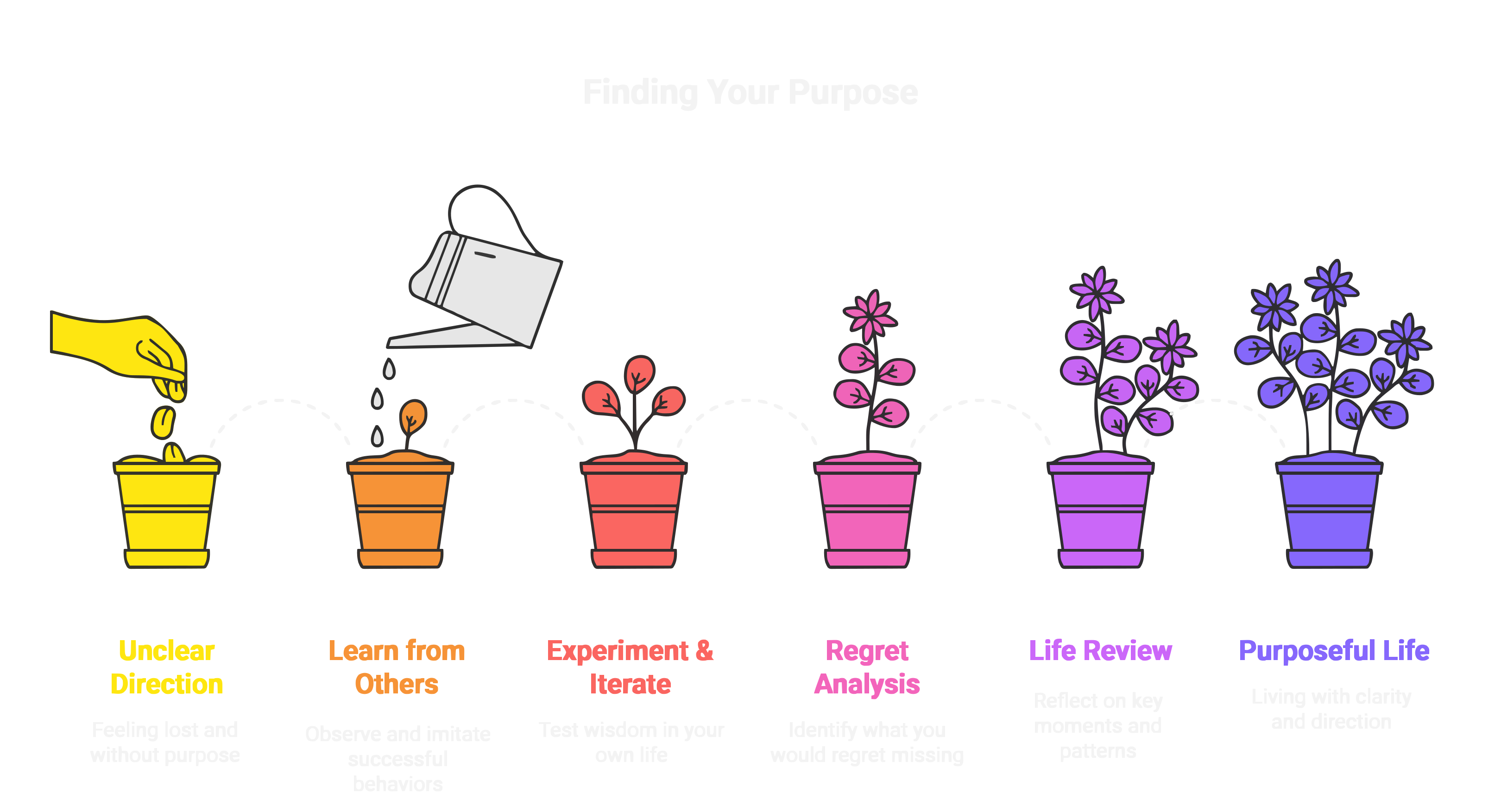
Learn from Others, Experiment to Discover Your Purpose
There’s something profoundly human about learning through observation and imitation. We’re wired to absorb lessons from those around us, whether it’s watching a parent navigate conflict or seeing a colleague handle a difficult project with grace. But here’s the thing—wisdom isn’t just about passive absorption. It’s about taking what we observe and testing it in the laboratory of our own lives.
Shankar Vedantam’s reflection on his childhood science fair experience is a perfect example. That red ribbon—second place—wasn’t just a minor disappointment; it was a revelation. He realized he had something to say, and more importantly, that the way he said it mattered. This moment of self-discovery didn’t happen in isolation.
It was shaped by the feedback of judges, the structure of the competition, and the act of teaching others. Purpose, in this case, wasn’t some grand epiphany. It was the result of experimentation, iteration, and the humbling realization that there was room to improve. This aligns with the social learning pathway to purpose, where we observe others cultivating their own sense of direction and, in turn, find our own.
But observation alone isn’t enough. We have to take what we learn and put it into practice, treating our lives as a series of experiments. Maybe you admire how a friend handles work-life balance, so you try setting boundaries in your own schedule.
Maybe you’re inspired by a mentor’s resilience, so you adopt their habit of reframing challenges as opportunities. The key is to borrow wisdom, then make it your own through action.
How to Find Your Purpose Through Regret
Regret is a funny thing. We often treat it like an enemy, something to be avoided at all costs. But what if regret is actually one of our most powerful teachers? Dr. Jordan Grumet’s work in hospice care reveals that regret isn’t just about lamenting the past—it’s about clarifying what truly matters.
When people are faced with the end of their lives, their regrets aren’t about the things they did wrong; they’re about the things they didn’t do. The risks they didn’t take, the relationships they didn’t nurture, the passions they didn’t pursue. This is where the concept of “purpose anchors” comes into play. These are the moments, activities, or relationships that light us up, the things we keep coming back to even when life gets busy.
The trick is to identify them before we’re staring down our final days. One way to do this is through a regret analysis: ask yourself, What would I regret not doing if I only had a year left? Would it be not starting that creative project? Not reconnecting with an old friend?
Not speaking up in meetings when you had something valuable to say? These aren’t just hypotheticals—they’re signposts pointing toward what truly matters to you. The beauty of this exercise is that it cuts through the noise of societal expectations.
It doesn’t matter what your Instagram feed or your family or your peers think you should be doing. What matters is what you would regret missing out on. And once you identify those anchors, you can start building a life around them, one small experiment at a time.
How the Life Review Method Reveals Your Purpose
If regret is the rearview mirror, the Life Review method is the roadmap. Developed in hospice care, this structured reflection process helps people make sense of their lives by examining key moments—the triumphs, the failures, the relationships that shaped them. But here’s the kicker: it’s not just for people at the end of their lives. It’s a tool we can use now to gain clarity and direction.
The Life Review method involves asking yourself a series of questions:
- What were my most important moments?
- What were my biggest triumphs and failures?
- Which relationships meant the most to me?
- What are my regrets?
The goal isn’t to dwell on the past but to extract lessons that can inform the present. Maybe you realize that your proudest moments all involved teaching others, which could point you toward mentorship or education. Maybe you notice that your biggest regrets involve not speaking up, which could inspire you to practice assertiveness in your daily life. What’s fascinating is how this method reveals patterns.
You might think your life has been a series of random events, but when you lay it all out, you start to see themes. Maybe you’ve always been drawn to creative problem-solving, or maybe you thrive in collaborative environments. These patterns aren’t just interesting—they’re clues to what gives your life meaning and purpose.
And the best part? You don’t have to wait until you’re on your deathbed to start using them. You can begin today, right now, by asking yourself: What moments in my life have felt the most meaningful, and how can I create more of them?
Experimentation Over Introspection: Prototype Your Life
Prototype Your Way to Clarity
We’ve long been trained to believe that meaningful change requires deep introspection—hours of journaling, soul-searching, or therapy sessions. But what if the path to clarity lies not in looking inward, but in stepping outward? The GripTape program offers a compelling alternative. Young participants engage in ten-week learning challenges, working alongside “champions” who aren’t experts but willing collaborators.
These champions simply check in, ask, “What did you learn this week? What did you do?” and share the insights publicly. This isn’t mentorship; it’s prototyping—testing ideas in the real world, gathering data from experience rather than theory. It flips the script: instead of asking “What should I do?” we ask “What have I tried, and what did I learn?” This approach mirrors what psychologist Anthony Burrow calls escaping “languishing”—that disconnected feeling where life lacks direction.
Prototyping disrupts this stagnation by forcing engagement. When we act, even imperfectly, we generate feedback loops. Did that new hobby spark joy?
Did that side project teach valuable lessons? These aren’t abstract questions; they’re empirical ones, answered through doing. I’ve found this myself: when I stopped over-analyzing a career pivot and simply volunteered for cross-functional projects, clarity emerged far faster than any meditation session ever could.
How to Find Your Purpose Through Small Experiments
Prototyping doesn’t require grand gestures. Think of it as micro-experimentation—testing hypotheses about your values and interests through tiny, low-stakes actions. The key is to treat life like a lab: run controlled trials, observe outcomes, iterate. Maybe you suspect you’d enjoy writing, but the thought of a book feels overwhelming.
Instead, commit to writing one blog post a week for a month. Or perhaps public speaking terrifies you, but you value influence. Join a local Toastmasters chapter and give one speech. The goal isn’t immediate mastery; it’s information gathering.
What makes this effective is its built-in feedback mechanism. Each experiment yields data: energy levels, emotional resonance, skill improvement. Over time, patterns emerge.
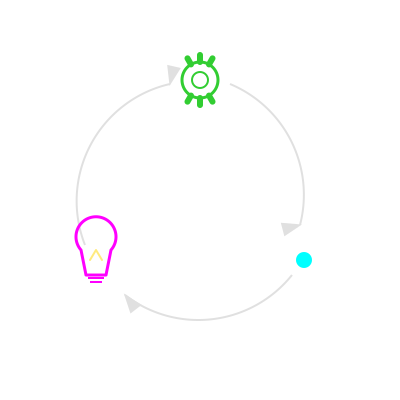
I once worried I lacked a “passion,” until I started trying new activities weekly—gardening, coding meetups, volunteer tutoring. Within two months, teaching emerged as a consistent energy multiplier.
The magic isn’t in the activity itself, but in the act of trying. As Shankar Vedantam notes, purpose isn’t discovered; it’s cultivated through repeated, deliberate action.
How to Find Purpose Through Action
Enter the “spaghetti method”—toss numerous ideas against the wall and see what sticks. This isn’t reckless experimentation; it’s strategic casting. If you’ve hit a wall trying to pinpoint your purpose through reflection alone, this approach embraces chaos as a catalyst. Say “yes” to invitations you’d normally decline.
Attend that networking event. Take that impromptu road trip. The criterion isn’t grand significance; it’s “Did this light me up?” The beauty of this method is its permission structure. You don’t need certainty—just curiosity.
I applied this after a career transition, saying “yes” to everything from art classes to startup pitch meetings. Some were duds; others revealed unexpected passions. One evening volunteering at a community garden led to a deep interest in urban sustainability—a thread I’d never have pulled had I not embraced the mess.
The spaghetti method acknowledges that purpose often emerges after action, not before. As Vedantam argues, we’re wired to learn through doing, not deliberating.
Use Design Thinking to Solve Personal Problems
Why should Silicon Valley’s design thinking frameworks remain confined to startups? These principles—empathy, definition, prototyping, testing, iteration—apply beautifully to personal purpose. Consider how purpose buffers stress: research shows that purposeful individuals experience fewer negative impacts from daily challenges because their “eyes remain on the horizon.” Translating this into practice means framing life as a series of prototypes. Define a problem (“I feel unfulfilled in my current role”), empathize with stakeholders (yourself, peers, mentors), then build low-fidelity solutions (a side project, skill course).
Test rigorously—maybe a one-day workshop—or iterate based on feedback. This method transforms abstract longing into actionable steps. When I applied it to my own “stuckness,” I mapped user journeys—my own—not as passive experiences but as design problems.
The result? A series of rapid experiments: a weekly podcast, an online course draft, a mentorship exchange.
Each prototype revealed insights the inner monologue never could. Purpose, it turns out, isn’t found—it’s engineered, one tested hypothesis at a time 3.
Overcoming Obstacles: Gravity Problems and Multiple Paths
How to Spot a Gravity Problem
We often feel “stuck” in life—trapped by jobs, relationships, or circumstances that seem impossible to escape. But what if the solution isn’t about grand escapes, but about clarity? Shankar Vedantam’s podcast explores an idea from Silicon Valley: reframing our struggles as “gravity problems.” These are issues that feel immovable, like Earth’s gravity, but which actually reveal critical insights when examined closely 3. For instance, imagining a mission to the nearest star might seem impossible with current technology, yet this thought experiment forces us to confront what we must change now to survive challenges, rather than focusing on distant, unchangeable realities.
The brilliance here is diagnostic. By asking, “What must we do today to prepare for this journey?” we shift from helplessness to agency. Psychologist Anthony Burrow suggests this mirrors how purpose functions: it isn’t about solving cosmic problems, but about aligning our actions with actionable steps.
When I’ve felt paralyzed by career dissatisfaction, breaking it down into “gravity problems”—like skills to learn or relationships to nurture—turned abstraction into momentum. Purpose, in this light, isn’t discovery; it’s distillation of what’s within our gravitational pull to change.
The Myth of One Perfect Life Path
Society peddles a dangerous myth: there’s a single “right” path to purpose. We’re pressured to choose a career early, adopt parental expectations, or chase societal benchmarks of success. But as Vedantam notes, most of us inherit purpose rather than invent it. Take the story of someone raised to become a doctor to “fix” family trauma—a noble goal, but one that may clash with personal truth.
The reality? Most people pivot. They start with borrowed purpose, then gradually peel back layers until they find what genuinely ignites them. This isn’t failure; it’s evolution. I’ve seen clients waste years chasing “the one” path only to thrive when they allowed themselves multiple experiments.
Purpose isn’t a diamond to mine but a mosaic to assemble—from fragments of curiosity, skill, and passion. The pressure to find a singular destination stifles growth; embracing multiple viable paths keeps options alive and anxiety at bay.
Why Having Multiple Plans Reduces Anxiety
Here’s a counterintuitive truth: more options reduce anxiety. When we cling to a single plan, setbacks feel catastrophic. But when we cultivate multiple pathways, we build resilience. Consider a restaurant worker who hates customer service but loves organizing stockrooms.
Instead of quitting, they might negotiate Thursday mornings dedicated to stocking—a small but meaningful claim to purpose. This isn’t compromise; it’s strategic curation. Research by Anthony Burrow shows purposeful people weather stress better—their “eyes on the horizon” stabilizes their emotional seas 2.
By designing multiple micro-paths—side projects, skill-building, social engagements—we create a safety net of purpose. I’ve used this approach when facing career crossroads: pursuing freelance writing, volunteering, and taking online courses simultaneously.
Each “plan” wasn’t a distraction but a probe, and one eventually lit up with unexpected clarity. Anxiety shrinks not when we find the answer, but when we stop demanding a single one.
Time and Purpose: Activity Selection Over Time Management
Focus on Activities, Not the Clock
We’ve been sold a lie about time. Society tells us to “manage” it, to squeeze every second for productivity, as if time were a commodity we could hoard or trade. But here’s the brutal truth: time passes regardless. You can’t buy it, sell it, or slow it down.
The only thing you can control is what you do with it as it slips through your fingers. This realization hits hard when we chase “Big P Purpose”—that grand, life-defining goal we think will bring eternal happiness. But research shows even monumental achievements deliver fleeting joy. We adapt, habituate, and soon we’re back to baseline.
The real game isn’t about reaching some distant summit; it’s about filling the climb with activities that light you up right now. Purpose isn’t the destination—it’s the trail mix you snack on along the way. The secret? Abundance.
Most people treat purpose like a rare diamond, but it’s actually more like wildflowers—everywhere once you start looking. When you drop the pressure to find something “important” or socially impressive, you’ll notice countless small things that spark joy.
Maybe it’s gardening, tinkering with code, or teaching a friend a skill. These “little p purposes” aren’t stepping stones to something bigger; they’re the whole point.
Subtract What Drains You to Find What Matters Most
Dr. Jordan Grumet’s hospice work reveals a counterintuitive truth: purpose often emerges through subtraction. He didn’t find fulfillment by adding more to his plate, but by ruthlessly cutting away what drained him—owning a practice, nursing home shifts, weekends on call. What remained? Hospice care, the one thing he’d do for free.

That’s your anchor: the activity so meaningful you’d pay to do it. This isn’t just about quitting your job. It’s about auditing your life like a ruthless editor. Open your calendar and ask: What would I eliminate if I could?
Maybe it’s pointless meetings, soul-sucking commutes, or obligations that exist only out of guilt. Every “no” to something you loathe creates space for a “yes” to something that lights you up. The beauty of subtraction is its immediacy.
You don’t need to wait for permission or a grand plan. Start small: decline one dreaded invitation, automate a tedious task, or delegate something that drains you. As Grumet found, when your calendar fills only with things you’ve chosen, autonomy becomes happiness.
How to Audit Your Calendar for Purposeful Living
Your calendar isn’t just a schedule—it’s a moral document. It reveals what you truly value, not what you say you value. Most people treat it like a prison, but what if it became your playground? Here’s the exercise: Block time this week to audit your calendar.
Highlight activities that energize you in green, drain you in red. The goal isn’t perfection—it’s awareness. Notice patterns: Do you light up during creative work but dread administrative tasks? Do certain people leave you feeling inspired or exhausted?
Then, start swapping. Replace one red activity with something green, even if it’s just 15 minutes. Maybe it’s a walk instead of a scroll, a creative project instead of a Netflix binge.
Small shifts compound. Over time, you’ll cultivate a life where most of your time aligns with your “little p purposes.” Remember: Purpose isn’t found in grand gestures. It’s built through daily choices—what you say yes to, what you say no to, and how you spend the hours you’ll never get back.
Conclusion
The cultivation of purpose isn’t a single discovery but a lifelong practice of noticing what sparks joy in the present moment. Throughout our journey together, we’ve seen how purpose emerges not through grand revelations but through small, consistent actions and experiments.
When we shift from searching for one “Big P Purpose” to nurturing countless “little p purposes,” we transform our relationship with meaning. Purpose becomes not something we find but something we live, not a destination but the path itself.
The liberating truth is we don’t need clarity before taking action—clarity emerges through doing, not contemplating. Each experiment, each new experience, each small “yes” adds another thread to the tapestry of a purposeful life.
Purpose isn’t scarce—it’s abundant. We don’t need to manufacture meaning; we only need to remove the blinders and recognize what’s already there, waiting to be nurtured.
What if purpose isn’t something we discover, but something we become through the choices we make each day? Purpose isn’t a mountain to climb; it’s the trail we leave behind us as we wander through life’s beautiful, messy terrain.


