


I’ve spent years chasing success, believing that happiness would follow. But what if I’ve had it backwards? What if happiness isn’t the reward for success, but the foundation of it?
This isn’t just a personal revelation; it’s a cultural paradox. We’ve been sold a lie that success leads to happiness, but the truth is far more complex. The goalposts keep moving, and even the most successful among us are left questioning whether it was all worth it.
This isn’t just about individual struggle; it’s about how modern society defines worth, success, and the good life. From the boardroom to the bedroom, from our bank accounts to our relationships, we’re caught in a web of invisible trade-offs. It’s time to question the narrative and explore a different path.
The Success-Happiness Paradox: Why We Sacrifice Today for Tomorrow
The Flawed Success-Happiness Equation
We’ve all been sold a lie: that happiness is the reward for success, not the foundation of it. Naval Ravikant cuts through this illusion with surgical precision—we sacrifice the very thing we want (happiness) for the thing we believe will deliver it (success). It’s a paradox that leaves us chasing a mirage. The equation is flawed because it assumes happiness is a destination, not a state of being.
Ravikant’s own experience flips this script: happiness isn’t the byproduct of success; it’s the fuel for it. When you’re aligned with what truly matters, success follows naturally, not as a trade-off but as a consequence of living well. Morgan Housel’s obituary thought experiment drives this home. Imagine your life distilled to a few lines—what would you want them to say?
No one dreams of their net worth or square footage making the cut. Yet, we spend our days chasing metrics that won’t matter in the end. The disconnect is staggering.
We admire the lifestyles of the ultra-successful, but as Housel points out, their divorces and fractured relationships reveal the hidden costs. The question isn’t just what we’re chasing, but why we’re chasing it. If the answer is external validation or a deferred happiness, we’ve already lost. 1 2
Happiness: A Daily Choice, Not a Distant Dream
Happiness isn’t something you stumble upon after checking off enough boxes. It’s a choice, a daily commitment. Ravikant’s anecdote about the man who decided to be the happiest person in the world is a masterclass in reframing. “Why not me?” is a question that dismantles the myth of happiness as a distant prize.
It’s not about denying ambition or lowering standards—it’s about recognizing that joy and success aren’t mutually exclusive. In fact, they’re symbiotic. The happier you are, the more you gravitate toward work that aligns with your strengths and values, which, ironically, makes you more successful. Rob Henderson’s observation about the “platform problem” adds another layer.
The voices amplifying success narratives are often outliers—people whose paths to happiness are atypical. Their advice, while well-intentioned, can be misleading. Most people find fulfillment in relationships, community, and quiet consistency, not viral fame or billion-dollar exits.
The danger lies in assuming their blueprint is universal. Happiness isn’t a one-size-fits-all equation; it’s a personal algorithm you refine through trial, error, and self-awareness. 3
The Hidden Costs of Extreme Success: Divorce Rates Among the Wealthy Reveal the True Price of Ambition
The divorce rates among the world’s richest men aren’t just statistics; they’re cautionary tales. Extreme success often demands extreme sacrifice—time, relationships, health. Morgan Housel’s point about the “shop window” of success is chilling. We see the jets, the headlines, the accolades, but not the tornado of chaos behind the scenes.
Elon Musk’s warning—“You might think you want to be me, but you don’t”—should be a billboard in every ambition-fueled city. The irony? Many of us admire these figures precisely because we don’t want their lives. We want the outcomes without the costs.
But you can’t cherry-pick success. If you want the rewards, you must accept the trade-offs—sleepless nights, strained relationships, relentless pressure. The question isn’t whether you’re willing to work hard; it’s whether you’re willing to live with the consequences of that work.
For most, the answer is a resounding no. And that’s okay. Success isn’t about emulating outliers; it’s about defining what matters to you and building a life that reflects it. 2 1
Embrace the Full Journey to Achieve Authentic Success
Here’s the uncomfortable truth: you can’t admire someone’s success while rejecting their struggles. Ryan Holiday’s Stoic lens reminds us that regulation—emotional, mental, physical—is the price of sustained achievement. The open loops, the 4 a.m. wake-ups, the relentless focus—these aren’t bugs in the system; they’re features. If you’re not willing to embrace the full journey, you don’t actually want the destination.
Naval’s insight about alignment is the key. The “happy version of you” isn’t lazy or unambitious; they’re just selective. They pursue success on their own terms, not society’s.
The mistake isn’t wanting more; it’s wanting the wrong things for the wrong reasons. When you strip away the noise—external validation, comparisons, deferred joy—what’s left is a life that feels authentic. And that’s the only kind of success worth chasing. 4

The Psychology of Unhappiness: Where Our Pain Really Comes From
Understanding Mental Illness as Unprocessed Emotions
Alain de Botton’s perspective on mental illness as “stored emotion that hasn’t found a way out” reframes how we understand psychological distress. The idea that unprocessed feelings manifest as physical symptoms—back pain, insomnia, anxiety—is both intuitive and unsettling. We’re not broken; we’re just avoiding the conversation with ourselves. The body, in its stubborn wisdom, refuses to be ignored.
A clenched jaw, a knot in the stomach, a racing heart—these aren’t random glitches. They’re messages. The real work isn’t medicating the symptoms but decoding them. Consider the “post-traumatic broke syndrome” example.
Trauma isn’t just about what happened; it’s about what we didn’t let ourselves feel. The fear of scarcity lingers, not because the money isn’t there, but because the emotional imprint of lack was never acknowledged. The same applies to relationships.
Clarity and inquisitiveness—the willingness to say, “This is what I’m feeling,” and to ask, “What are you feeling? “—are antidotes to the emotional gridlock that fuels anxiety and depression. The alternative? A life of guessing games, where resentment festers because no one’s brave enough to name the elephant in the room. 5
Why We Can’t Sleep: The Cost of Avoiding Our Thoughts
Insomnia isn’t just a sleep disorder; it’s a rebellion. De Botton’s framing of it as “revenge for all those thoughts you were so careful not to have in the day” is a wake-up call. The mind doesn’t forget what we suppress—it just waits until we’re vulnerable to ambush us. That 3 a.m. panic isn’t random; it’s the emotional conscience demanding its due.
The solution isn’t a better mattress or melatonin. It’s a pre-bedtime audit: What did I avoid today? What’s still unresolved? This aligns with the broader theory of trauma.
Unprocessed childhood emotions don’t disappear; they burrow deeper, resurfacing as adult dysfunction. A 5-year-old can’t articulate grief, but the body remembers. The same principle applies to our daily lives. The open loops—unfinished conversations, unresolved conflicts, ignored fears—don’t vanish when we distract ourselves.
They fester. Stoicism offers a counterbalance: the discipline of deciding what to think about, of closing loops intentionally.
But even Stoicism requires acknowledging the emotions first. You can’t regulate what you refuse to feel.

Why Chasing Constant Happiness Backfires
Modern culture’s obsession with the present moment is a trap. We’re told to chase happiness now, as if it’s the only metric that matters. But this hyper-focus on personal bliss creates a paradox: the more we demand happiness, the more elusive it becomes. Life isn’t meant to be a series of peak experiences.
It’s messy, imperfect, and often unsatisfying. The pursuit of constant happiness is a setup for disappointment. The Stoic approach—focusing on what you control, accepting uncertainty—isn’t about suppressing emotions. It’s about choosing where to direct your energy.
Open loops, like unanswered emails or unresolved conflicts, drain us because we let them. The practice of deciding, “I’m not thinking about this until tomorrow,” is a form of emotional sovereignty. It’s not denial; it’s strategy.
The goal isn’t to be happy all the time. It’s to be engaged, to wrestle with life’s unpredictability, and to find meaning in the struggle. Happiness, then, isn’t the destination but a byproduct of living authentically.
Embracing Imperfection for Authentic Connections
Perfection is a myth, and the pursuit of it is a loneliness trap. The most successful people often struggle to form genuine connections because they’ve built their identities on invulnerability. But vulnerability is the price of admission for real relationships. The person who admits, “I’m flawed, but I’m managing,” is far more relatable than the one who claims perfection.
It’s not about lowering standards; it’s about embracing humanity. This acceptance of imperfection is liberating. It takes the pressure off. If we’re all broken in our own ways, then the goal isn’t to fix ourselves but to navigate our flaws with honesty and humor.
The alternative—a life spent curating an image of flawlessness—is exhausting. And lonely. The people who seem to have it all together are often the most isolated.
The real connection happens when we drop the act and say, “This is me, scars and all. ” That’s where trust begins. That’s where happiness, the real kind, takes root. 5
Meritocracy’s Dark Side: When Individualism Becomes a Trap
From “Unfortunate” to “Loser”: A Societal Shift
The word “unfortunate” once carried a sense of external fate—bad luck, the whims of Fortuna, the Roman goddess of chance. But today, we call people “losers,” a term that implies personal failure. This shift isn’t just semantic; it’s psychological. When we label someone a loser, we’re saying their struggles are their fault.
This is the dark side of meritocracy: it turns misfortune into moral failing. Alain de Botton nails it—meritocracy sounds fair until you realize its hidden toll. If success is earned, then failure must be too. The winners feel entitled; the losers feel ashamed.
But life isn’t that binary. Luck, timing, and privilege play massive roles, yet we pretend they don’t.
The result? A society where people blame themselves for systemic issues, and the successful dismiss empathy as unnecessary.
The Link Between Shame and Suicide
Suicide isn’t just about pain—it’s about shame. When people believe their suffering is entirely their fault, they internalize it as a personal defect. De Botton’s insight is chilling: in an individualistic world, we assume total control over our lives. If things go wrong, it must be our failure.
This mindset is lethal. Historically, people attributed misfortune to external forces—gods, fate, bad luck. Now, we’ve eliminated that buffer.
If you’re poor, unemployed, or struggling, society whispers, “You did this to yourself. ” That’s why suicide rates climb among those who feel like failures.
The antidote? Recognizing that life is a mix of effort and circumstance. 5
Does Meritocracy Punish the Unsuccessful?
Meritocracy’s logic is seductive: hard work equals success. But the flip side is brutal—if you’re not successful, you must not have worked hard enough. This ignores systemic barriers, luck, and the fact that many “successful” people had head starts. The winners of meritocracy often lack empathy because they believe they earned everything.
Meanwhile, those at the bottom internalize shame, thinking they’re inherently flawed. The truth? Success is rarely purely self-made.
Even Elon Musk’s life, when examined holistically, reveals trade-offs—loneliness, family strain, relentless pressure. The question isn’t just who deserves what, but what are we willing to sacrifice for success? 2
What Your Relationship With Money Reveals About You
Money isn’t the root of all evil, but it’s the clearest mirror. How people spend, save, or chase it reveals their deepest insecurities and aspirations. Morgan Housel’s reverse obituary exercise is telling—no one wants their net worth in their eulogy. Yet, we spend lives chasing it.
The obsession with money isn’t about the money itself. It’s about what we think it will fix—shame, fear, inadequacy. But money can’t heal what’s broken inside.
The real work is emotional regulation, as Stoicism teaches. Recognizing that feelings aren’t facts, and that success—however you define it—comes with trade-offs.
The Lifestyle Mismatch: Are You Chasing Someone Else’s Dream?
Financial Trauma Persists Despite Success
The idea that money solves everything is a myth that crumbles under scrutiny. Alain de Botton’s insight about unprocessed emotions lodging themselves in our systems applies just as much to financial trauma as it does to childhood grief. Consider the phenomenon of “post-traumatic broke syndrome”—the lingering fear of scarcity even after achieving financial stability. A 5-year-old who experiences deprivation doesn’t have the tools to process it.
That child grows into an adult who, despite a healthy bank balance, still flinches at the thought of spending money on anything beyond necessities. The trauma isn’t about the money itself; it’s about the emotions tied to it—fear, shame, the gnawing sense of never being enough. This syndrome reveals a deeper truth: financial success doesn’t automatically rewrite our emotional programming. The body keeps the score, as they say.
That knot in your stomach when you check your account isn’t just about numbers; it’s about the story you’ve told yourself for years. The solution isn’t more money—it’s processing the pain that money can’t touch. It’s about sitting with the discomfort and asking, What am I really afraid of? Until you do that, no amount of wealth will feel like enough.
The Visibility Bias: Envy for Outcomes, Not Processes
We’re all guilty of it—scrolling through someone’s highlight reel and thinking, If only I had what they have. But here’s the kicker: nobody’s jealous of the grind. The visibility bias distorts our perception. We see the Lamborghini, not the sleepless nights.
The mansion, not the strained marriage. The book deal, not the years of rejection. This bias isn’t just about envy; it’s about the stories we tell ourselves to justify our own dissatisfaction. The truth is, most people curate their lives to hide the struggles.
It’s a survival mechanism. Who wants to admit they’re lonely in their penthouse or anxious despite their six-figure salary? The danger lies in assuming that what’s visible is the whole picture. The antidote?
Clarity and inquisitiveness—asking the hard questions, both of ourselves and others. What’s the cost of that lifestyle? Would I actually want to pay it? Because, often, the things we think we want aren’t aligned with our true values or needs. The moment you start digging beneath the surface, the illusion shatters. 3
What You Really Want: The Desert Island Test
Here’s a litmus test for what you actually want: the desert island scenario. If no one could see your house, your car, or your job title, what would you choose? Would you still want the Lamborghini, or would a reliable pickup truck suffice? The answer reveals the difference between utility and status.
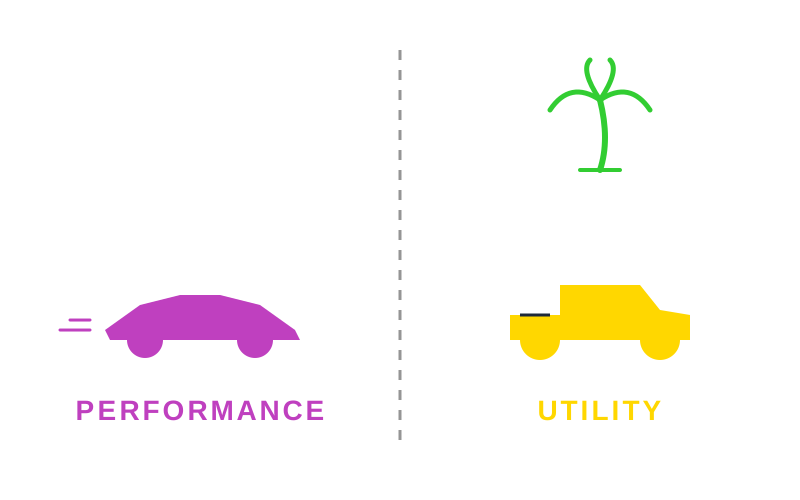
Most of us, when stripped of the audience, would opt for what’s practical, what brings genuine comfort. Yet, in the real world, we chase status symbols because we’re convinced they’ll make us happy—or at least, make us look happy. The desert island test exposes the flimsiness of external validation.
It’s not that status is inherently bad; it’s that it’s often a substitute for deeper fulfillment. The real work is figuring out what you’d want if no one were watching. That’s where authenticity lives.
What Matters Most When Everything Else Falls Away
Morgan Housel’s reverse obituary exercise is a gut check. Imagine your life distilled to a few lines—what would you want them to say? The exercise forces you to confront the gap between what you’re chasing and what you actually value. No one’s obituary mentions their net worth or the square footage of their home.
Yet, we spend our lives optimizing for metrics that won’t matter in the end. The reverse obituary isn’t about morbidity; it’s about clarity. It’s a tool to strip away the noise and focus on what’s essential.
For most people, that’s relationshipscategory/interpersonal-relations), experiences, and the quiet satisfaction of a life well-lived. The irony?
The things that matter most are often the ones we neglect in the pursuit of success. The exercise isn’t just about reflection—it’s about realignment.
Emotional Regulation: The Key to Life That Nobody Teaches
Mastering Emotions Through Stoicism
Stoicism isn’t about suppressing emotions—it’s about mastering them. The misconception that Stoicism advocates for emotional detachment is a dangerous oversimplification. The truth is far more nuanced: it’s about recognizing anger, frustration, or anxiety without letting them dictate your actions. This is the essence of emotional regulation, and it’s the key to navigating life’s uncertainties.
Consider the metaphor of physical training. When you’re tired, cold, or unmotivated, you don’t let those feelings derail your workout. You acknowledge them and push forward anyway. The same principle applies to emotional regulation.
It’s not about ignoring what you feel; it’s about deciding what to do with those feelings. This practice is a muscle—one that strengthens with intentional use. The more you exercise it, the better equipped you are to handle life’s inevitable challenges. 4 The alternative is impulsivity—reacting to every emotional whim, which often leads to regret.
Stoicism offers a framework to pause, assess, and choose a response rather than being ruled by knee-jerk reactions. It’s not about eradicating emotions but about channeling them constructively. This is where true resilience is built.
Close the Loop: Mastering Intentional Thought
The modern mind is cluttered with “open loops”—unresolved thoughts, unfinished tasks, and lingering anxieties. These loops drain mental energy because they demand attention without resolution. The solution isn’t to eliminate them entirely but to manage them intentionally. Deciding when to think about something is as important as deciding what to think about.
Surprise and unpredictability are part of what make life engaging. Yet, the obsession with control—scheduling every minute, scripting every outcome—diminishes our capacity for joy. Life isn’t meant to be a perfectly orchestrated performance. It’s messy, unpredictable, and often better for it.
The key is finding the balance between structure and spontaneity. Too much control leads to boredom; too little leads to chaos. The sweet spot lies in embracing the unpredictability while maintaining the discipline to close loops when necessary. This balance is especially crucial in relationships.
Clarity and inquisitiveness—the willingness to ask hard questions and address unresolved issues—prevent emotional gridlock. The alternative is a life of passive-aggressive guesswork, where resentment festers because no one is brave enough to name the problem. Emotional regulation isn’t just an individual practice; it’s a relational one.
Why Practical Wisdom Outperforms Raw Intelligence
Intelligence is often conflated with wisdom, but they’re not the same. Raw intellect can lead to overthinking, paralysis, or even stupidity when not tempered by practical wisdom. The ability to regulate emotions, make decisions under uncertainty, and navigate life’s ambiguities is far more valuable than sheer brainpower. Stoicism, in this sense, is a form of practical wisdom.
It’s about developing the discipline to act effectively even when you don’t have all the answers. The world doesn’t reward those who overanalyze; it rewards those who can make sound judgments and move forward. Intelligence is useful, but without emotional regulation, it can become a liability.
The real test isn’t how much you know but how well you apply what you know—especially when the stakes are high. 4 This is why Stoicism resonates across disciplines. Whether you’re an artist, entrepreneur, or parent, the ability to regulate emotions and focus on what matters is the ultimate competitive advantage. It’s not about being the smartest person in the room; it’s about being the most resilient.
Main Quest vs. Side Quests: Getting Life’s Priorities Right
Choosing Between Startup and Capstone Marriages: The Importance of Timing

The metaphor of the lamp and the house is a powerful one. If you buy a lamp before you move into a house, it’s easy to find a place for it. But if you’ve spent decades building the perfect house, finding a lamp that fits becomes nearly impossible. This is the difference between a startup marriage and a capstone marriage.
In a startup marriage, you’re building a life together from the ground up. You’re young, flexible, and willing to adapt. The lamp and the house grow together, each shaping the other. In a capstone marriage, you’ve already built your life—your career, your habits, your identity—and you’re trying to slot someone into that pre-existing structure.
The problem? People aren’t lamps. They’re not static objects to be placed neatly into your life. They’re dynamic, evolving, and often unpredictable.
The capstone approach assumes that you know exactly what you want, but the truth is, most of us don’t. We think we know, but we’re often wrong. The startup marriage allows for growth, discovery, and mutual adaptation. It’s messy, but it’s real.
The key here is clarity and inquisitiveness. A healthy relationship isn’t about finding someone who fits your preconceived notions; it’s about being open to the possibility that your notions might be wrong. It’s about asking, “What am I feeling?
What are you feeling?” and being willing to listen to the answers. This kind of honesty is rare, but it’s the foundation of lasting love. The alternative is a life of guesswork, where resentment builds because no one is brave enough to name the problem. 3
The Trade-Off: Career Success vs. Marital Bliss
The math is simple: a great career and a shitty marriage equals a pretty shitty life. An average career and a great marriage equals a pretty awesome life. This isn’t just a feel-good sentiment; it’s a hard truth. We’ve been sold a lie that success is measured by career achievements, but the reality is that relationships are the bedrock of happiness.
The problem is that we often prioritize the wrong things. We chase promotions, salaries, and status symbols, thinking they’ll bring us fulfillment. But when we get there, we realize that something is missing. The issue isn’t that career success is unimportant; it’s that it’s often overvalued.
The visibility bias distorts our perception. We see the Lamborghini, not the sleepless nights. The mansion, not the strained marriage. The book deal, not the years of rejection.
We admire the outcomes without considering the costs. The truth is, most people would be happier with a fulfilling relationship and a decent job than with a high-powered career and a broken marriage. The challenge is to recognize this before it’s too late. This is where the concept of the main quest vs. side quests comes into play.
The main quest is the person you’re going to spend the rest of your life with. The side quests are the parties, the career milestones, the material possessions. It’s not that the side quests don’t matter; it’s that they shouldn’t overshadow the main quest.
The problem is that we often mistake the side quests for the main story. We think that if we just get that promotion, buy that house, or achieve that status, we’ll be happy. But the reality is that happiness is found in the relationships we build, not the things we accumulate.
Is a Conventional Life the Key to Happiness?
Jordan Peterson’s observation is worth repeating: for most people, living a conventional life is actually your best shot at happiness. This isn’t a popular sentiment in a culture that glorifies individualism and non-conformity, but it’s a truth that bears repeating. The conventional life—getting married, settling down, having kids, building a family—isn’t just a relic of the past. It’s a path to fulfillment that has stood the test of time.
The problem is that we’ve been sold a different narrative, one that equates happiness with career success and material wealth. The issue isn’t that unconventional lives can’t be fulfilling; it’s that they’re often held up as the ideal, even though they’re the exception, not the rule. The people who have platforms and audiences are often the ones who’ve taken unconventional paths. They’re the outliers, the exceptions.
But they’re not the norm. Most people aren’t like that. Most people don’t have extraordinary talents or abilities that justify delaying marriage and family.
Most people would be happier with a conventional life. The challenge is to recognize this and to resist the pressure to conform to a different standard.
It’s to understand that happiness isn’t found in the pursuit of status or material wealth, but in the relationships we build and the lives we create. It’s to realize that the main quest isn’t about achieving some external measure of success, but about finding fulfillment in the everyday moments of life.
Don’t Copy Successful Outliers: The Selection Bias of Public Advice
The problem with public advice is that it’s often given by successful outliers. These are the people who’ve taken unconventional paths and achieved extraordinary success. They’re the ones with platforms and audiences, and they often attempt to justify their own lives by saying, “Well, it worked for me. This is a great life.
You should prioritize your career. This is how you get to where I am.” The issue is that most people aren’t like that. Most people don’t have the same talents, abilities, or circumstances that allowed these outliers to succeed. The danger is that we take this advice as gospel, thinking that if we just follow the same path, we’ll achieve the same results.
But the reality is that success is rarely purely self-made. Even Elon Musk’s life, when examined holistically, reveals trade-offs—loneliness, family strain, relentless pressure. The question isn’t just who deserves what, but what are we willing to sacrifice for success? The truth is that most people would be happier with a conventional life, one that prioritizes relationships and family over career and status.
The key is to recognize the selection bias in public advice. It’s to understand that the people giving this advice are often outliers, and that their paths to success are not universal.
It’s to realize that happiness isn’t found in the pursuit of external validation, but in the relationships we build and the lives we create. It’s to resist the pressure to conform to a different standard and to embrace the path that’s right for us, even if it’s not the one that’s being sold to us.
Conclusion
So here we are, at the end of a conversation that’s really just the beginning. The insights from Ravikant, de Botton, Housel, and others aren’t just observations—they’re tools. Tools to dismantle the myths we’ve been sold about success, happiness, and what it means to live a good life.
The lie that happiness is the reward for success? Debunked. The idea that meritocracy is purely fair? Exposed.
The belief that more money or status will fix what’s broken inside? Shattered.
But here’s the thing: knowing these truths isn’t enough. The real work is in the application. It’s in the daily choice to prioritize what matters—relationships over status, authenticity over performance, presence over distraction. It’s about asking yourself, What am I really chasing, and why? And being brave enough to listen to the answer, even if it’s inconvenient.
The conventional life isn’t a cop-out; it’s often the wisest path. The startup marriage, the steady job, the quiet moments with family—these aren’t consolation prizes. They’re the main quest.
The side quests (the promotions, the material wins) are fun, but they’re not the story. And if you confuse the two, you’ll end up with a life that looks impressive on paper but feels hollow in practice.
So what’s the takeaway? It’s not that ambition is bad or that success is meaningless. It’s that both need to be aligned—with your values, your relationships, and your own definition of fulfillment.
The happiest people aren’t the ones who’ve checked the most boxes; they’re the ones who’ve chosen their boxes carefully. And who’ve learned to close the loops—the emotional, the relational, the existential—so they can actually enjoy the life they’ve built.
The final question isn’t How do I get everything I want? It’s What do I actually want, and what am I willing to trade for it? Because here’s the uncomfortable truth: you can’t have it all. But you can have enough. And enough, when chosen wisely, is more than sufficient.
So as you walk away from this conversation, take this with you: The goal isn’t to win the game of life. It’s to play a game you actually want to win. (And maybe, just maybe, to enjoy the playing more than the prize.)
Footnotes
-
44 Harsh Truths About The Game Of Life - Naval Ravikant (4K) ↩ ↩2
-
The Savings Expert: Passive Income Is A Scam! Post-Traumatic Broke Syndrome Is Controlling Millions! ↩ ↩2 ↩3
-
Why Women Say They Want One Thing But Date Another - Rob Henderson ↩ ↩2 ↩3
-
The Love Expert: The REAL Reason We’re Lonely, Loveless, Depressed - Alain De Botton, School Of Life ↩ ↩2 ↩3


