


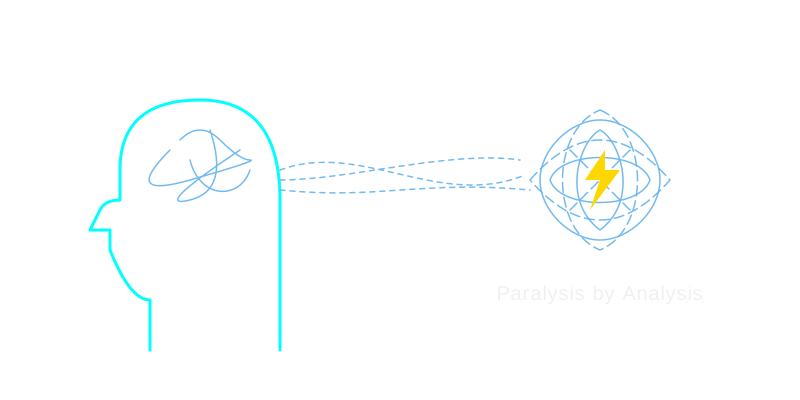
I have a terrible confession to make: I think being too smart might be actively sabotaging your life goals. It’s a genuine paradox. When we are truly intelligent, our brains become ruthlessly efficient prediction machines, capable of visualizing every catastrophic outcome before we even lift a finger. This is the core of the “Smart Person Paradox”—we analyze ourselves into paralysis.
Why would you ever ask for that raise, or pitch that wild idea, when your brain has already scripted the agonizing rejection? We default to the comfortable available option because the pursuit of the best option seems computationally too risky.
But what if that fear of failure isn’t a sign of weakness, but a symptom of over-thinking? What if boldness is not some mystical gift, but a skill we simply need to learn how to practice? We need a system designed to force action, regardless of fear, regardless of the fear of looking foolish.
The Real Barrier: Why Smart People Get Stuck in ‘Default Mode’
Why Smart People Get Paralyzed by Success
It’s one of the great cognitive ironies of modern life: often, the brighter you are, the more paralyzed you become. This is the insidious trap of the Smart Person Paradox, where exceptional analytical skill feeds directly into profound self-doubt 1. Intelligence equips us with an incredibly precise prediction engine; we become masters at simulating reality, which unfortunately means we are devastatingly effective at charting every possible negative outcome—rejection, humiliation, failure. That detailed map of potential suffering is often enough to keep us rooted firmly in place.
We call ourselves out before the game even starts. This is where intelligence stops being an advantage and starts acting as a heavy, weighted vest, smothering the necessary spark of action. Why subject ourselves to the risk of attempting something bold when our highly functioning brains can already visualize the perfect scenario where it all falls apart?
Boldness is actually a stronger indicator of success than intelligence precisely because it allows you to override that internal risk assessment and step into the unknown. Look at something as simple as asking for what you deserve: a survey showed that while 160,000 people felt they deserved more money, two-thirds never even bothered to ask for a raise.
But the 70% of people who did ask, got it . This isn’t a coincidence; it is the fundamental proof that the biggest hurdle isn’t the difficulty of the request, but the self-doubt that prevents the utterance.
Escaping “Default Living” by Practicing Boldness
If the Smart Person Paradox explains the cause of paralysis, “Default Living” describes the resulting lifestyle. Default Living is the easy route, the convenient compromise; it means taking what’s available on LinkedIn instead of designing the job you truly crave, or settling into a mediocre relationship simply because it’s there. We acquiesce to what’s in front of us, mistakenly believing that avoiding the uncomfortable pursuit of the best thing is better than risking the loss of the merely available thing. What I find fascinating about this state is the gross misconception of boldness itself.
Most people assume boldness is an innate quality, something you either possess or you don’t—a character trait reserved for high-achievers and public speakers. This is patently false. Boldness, like physical strength or rhetorical ability, is a skill that must be practiced and harnessed.
The structure of the 10% Target Mindset is designed specifically to break this cycle of defaulting. It’s not just about succeeding once; it’s about making ten attempts and getting deeply comfortable with the idea of failing 90% of the time. This intentional exposure to failure trains the boldness muscle, making the inevitable rejection or negative outcome a data point rather than a death sentence, thereby overriding the smart person’s fear of predicted catastrophe.
Why You Must Ask for What You Want
The entire solution to escaping Default Living hinges on one radical, simple action: you must ask for what you want, period. We live in an age of information overload, bombarded by gurus and experts pushing complex systems, flowcharts, and 12-step plans. Yet, success often boils down to stopping the deliberation, ceasing the planning, and simply acting. The difference between those who thrive and those who merely survive is the willingness to chase what they desire rather than taking what they can conveniently get.
It is the wisdom of the old adage: the squeaky wheel gets the grease. Our smartest selves want to plan the perfect, risk-free shot, but as hockey great Wayne Gretzky famously reminded us, you miss a hundred percent of the shots you don’t take. We spend so much time telling ourselves the story of self-doubt—that we aren’t good enough, that rejection is assured—that we forget the fundamental truth.
To gain the body, the job, the relationship, or the money we believe we deserve, we first have to overcome the inertia of our calculated fear and make the attempt. Stop studying the cliff edge, and just take the leap.
The Antidote: Cultivating Boldness as a Learnable Skill
Train Boldness: It’s a Skill, Not a Trait
The greatest limiting belief many of us hold is that boldness is a genetic lottery win—a fixed personality trait reserved for natural extroverts or captains of industry. If you don’t possess it, the thinking goes, you’re relegated to Default Living. This is a profound misconception. Jennifer Cohen emphasizes that boldness is nothing less than a learnable skill, a muscle that atrophies when ignored and strengthens with intentional practice.
You don’t just wake up strong; you train your body to be robust through repetition and challenge. The same regimen applies to the mind. To train your brain to be bold, you must repeatedly put yourself into situations that feel slightly uncomfortable. This practice fundamentally alters your “new normal,” shifting your comfort zone until what once felt terrifying—like failing nine out of ten times—becomes merely expected data collection.
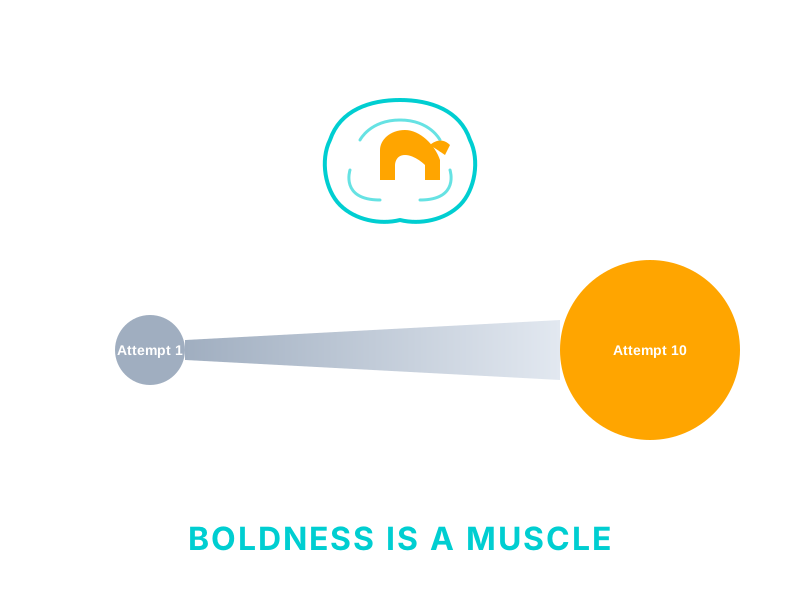
The 10% Target Mindset is the mechanism for this training. It forces you to commit to ten full attempts at whatever you want most in life. Why ten? It guarantees action.
Because it guarantees you cannot call yourself out after one inevitable rejection. It inoculates you against the sting of failure and builds the mental fortitude, resilience, and habit required to chase audacious goals instead of settling for convenient, available scraps .
The Data Proves Asking Gets Results
The previous section touched on the staggering statistic that the majority of people who feel they deserve a raise never ask for one, yet those who do successfully secure more money 70% of the time. This isn’t evidence that companies are naturally generous; it is proof that the sheer act of asking is a highly leveraged action. The 10% Target works because it builds a critical skill set beyond just dealing with rejection: it builds the confidence necessary to ask effectively . If you are comfortable with asking for the minor things in life, that habit spills over and gives you the skill and authority to demand the major things.
Think of it as incremental exposure therapy for ambition. For instance, consider the common dilemma at a restaurant: most of us passively order what is printed on the menu, acquiescing to the default options presented. But boldness, in this trivial context, means ordering off-menu—cobbling together ingredients to create exactly what you want.
While the server might find it annoying, the act of politely but firmly asking for a custom experience trains your brain to prioritize your desire. That small win, that small act of advocating for yourself, provides the low-stakes practice necessary for you to later request the massive raise or the career opportunity that isn’t publicly listed .
Your Action Plan: Commit to Ten Attempts
We have established that boldness is a muscle, and that muscle requires reps. The most crucial action you can take right now is simple, concrete, and terrifyingly direct: write down the single thing you want most in life, and commit to making ten attempts to achieve it. This commitment is non-negotiable. You are not allowed to deliberate, plan endlessly, or create a thousand flowcharts; you must simply act .
When you embrace the 10% Target, you change your relationship with failure. You accept that attempts 1, 3, 5, and 8 might result in rejection or awkwardness—but those attempts served their purpose by refining your approach and strengthening your resolve and acceptance. Whether you land the exact thing you initially desired, or perhaps gain something equally valuable that you never anticipated, the process itself guarantees success.
This active pursuit—chasing what you want, rather than settling for what is convenient—is the antidote to the Smart Person Paradox. Stop hiding behind analysis and start taking those shots. The real victory isn’t the guaranteed success rate; it’s the profound realization that you have total control over your effort, and therefore, over your destiny.
Your Action Plan: Implementing the 10% Target Mindset
The 10% Target: Embrace 9 Failures to Win

If you’re ready to move past the paralysis of the Smart Person Paradox and escape the gravitational pull of Default Living, you need a precise, non-negotiable system. That system is the 10% Target Mindset. It’s breathtakingly simple: whatever ambitious goal you have, commit to making ten full attempts at achieving it . The power here lies not in the hope of instant success, but in the radical acceptance that nine of those attempts will likely fail.
The core purpose of the 10% Target is to force comfort with a 90% failure rate. Most of us stop before we even make one attempt because the fear of that single failure is too great. But when you reframe failure as an expected outcome—a necessary data point that must be collected before the ultimate success—the emotional stakes plummet.
This mechanism immediately eliminates the biggest hurdle: calling yourself out. You can’t retreat after the first, second, or third rejection, because you signed a commitment to ten. This commitment is the strategic shift from a scarcity mindset (I must protect my ego) from failure) to an abundance mindset (I must collect ten data points to ensure one success) .
Guaranteed Wins: Success or Unexpected Discovery
What makes the 10% Target genuinely transformative is that it’s inherently antifragile; it guarantees a positive outcome regardless. When you commit to ten attempts, two outcomes are statistically certain. The first, of course, is that you will get the thing you wanted—the raise, the new job, the relationship, the finished book. As demonstrated by the 70% success rate of those who ask for raises, effort alone is a massive differentiator 1.
The second, and perhaps more profound, guaranteed outcome is that you will discover something entirely new and available that you never even knew existed. This unexpected win comes from the tangential effects of boldness. When you’re aggressively pursuing a goal, you are introducing yourself to new networks, learning new skills, and developing the resilience necessary to spot and seize opportunities that weren’t on your original flowchart.
The process of attempting something bold—whether it’s pitching a client or seeking a job not advertised on Monster.com or LinkedIn—expands your universe of possibilities. You might fail to get the exact job you hunted for, but in the process of reaching out ten times, you might meet an industry contact who offers you a consulting gig far better than the original full-time role. It’s a win-win scenario, where the risk of loss is replaced by the certainty of discovery .

Stop Planning, Start Doing: Defeating Analysis Paralysis
The greatest enemy of the bold is deliberation. Our smart brains love to analyze, plan, and create complex strategies until the window for action has long since passed. The 10% Target serves as a ruthless tool designed to short-circuit this deliberative paralysis. It demands that you stop creating flowcharts and start gathering field data.
When you decide on your goal and commit to ten attempts, the decision-making process shifts from *Should I do this? * to Which attempt number is this? The emphasis moves from theoretical success to procedural execution. This is how you reclaim control from fear.
Instead of agonizing over the ‘perfect’ pitch (Attempt #1), you just make the pitch, knowing you have nine more chances to iterate. Each failure is not a personal indictment but a diagnostic step toward refinement.
By focusing purely on the effort and commitment to the ten attempts, you immediately transcend the trap of analysis paralysis, transforming intellectual anxiety into actionable momentum. It is a powerful reminder that action, however imperfect, always trumps the most flawless inaction.
Case Study: How a ‘Failed’ Goal Led to Exponential Success
The Keanu Reeves Story: Asking for Your Dream Job
To truly understand the galvanizing power of the 10% Target, we need a high-stakes, slightly ridiculous example—the kind of story that demonstrates boldness operating at minus 40 degrees. Jennifer Cohen’s pursuit of a dream job at MuchMusic required a killer demo tape, and she decided the perfect element would be an interview with Keanu Reeves, who was coincidentally in Winnipeg performing Hamlet . Everyone laughed at her—family, friends, the entire world of Default Living. But this is where boldness separates itself from conventional wisdom.
Cohen didn’t just wish; she acted. She waited for hours in the freezing cold behind the theater until Reeves finally emerged. Brashly pushing past the media and fans, she tapped him on the shoulder and declared, “Keanu, you’re gonna be my ticket to my dream job.” He, naturally, offered an autograph.
She refused, stating clearly that an autograph wouldn’t help her at all—she needed the interview . Reeves, likely stunned by her sheer determination, gave her his number. She boldly grabbed a girl’s eyeliner and wrote her name and number on a gum wrapper.
Two days later, Keanu Reeves was sitting on her parents’ sofa, being filmed by amateur camcorders for her demo tape. She got the demo, the interview, and the audition for her dream job. This entire sequence proves the pivotal truth of success: you must ask for what you want.
Why Failure is the Real Success in the 10% Target
Here’s the plot twist that solidifies the 10% Target philosophy: despite securing the greatest demo tape of all time, the interview, and the audition, Jennifer Cohen did not get the job . On the surface, the grand, frostbitten effort seems to have failed its primary objective. But according to the 10% Target, the mission was a 100% success. The framework guarantees a win, whether it’s the original goal or “something you never even knew available.”
In this case, not getting the job was the ultimate victory because the pursuit itself taught a powerful truth and unlocked future, greater successes. Cohen learned the foundational skill of radical asking and the resilience needed to ignore ridicule. She didn’t become the VJ she planned to be, but she leveraged that learned boldness into becoming
- a bestselling author,
- an entrepreneur who sold companies for millions, and
- a charity co-founder.
The failure of the initial goal was merely a necessary pivot. That moment of highly leveraged action transformed her trajectory. It revealed that she wasn’t meant for the confines of that specific job; she was meant for the boundless possibilities unlocked by her own practiced boldness.
Happiness is in the Chase, Not Just the Win
The story’s conclusion isn’t about accolades or money—it’s about exponential happiness and fulfillment. Cohen admits she wasn’t the fastest, prettiest, or smartest person in the room, yet she achieved extraordinary success. Why? Because she chased what she wanted, rather than taking what she could get .
The 10% Target is, at its core, a formula for maximum life satisfaction. When you actively pursue a desire, regardless of the immediate outcome, you are exponentially happier and more fulfilled. The true reward isn’t the object—it’s the knowledge that you overcame your self-doubt, faced the fear of rejection ten times, and embraced the role of an agent in your own life.
This journey confirms that the 10% Target works every single time. You either secure the initial target, or you gain the courage, skill, and perspective required to secure the thing you were truly meant to do. In the final analysis, Cohen’s story is the perfect synthesis: the bold attempt, even when resulting in initial rejection, always leads to a greater, more satisfying destination.
Conclusion
So, we’ve journeyed through the clever paralysis of the “Smart Person Paradox,” the comfort of “Default Living,” and the simple, radical power of the “10% Target Mindset.” We’ve seen how boldness isn’t an innate gift, but a skill honed through consistent, imperfect action.
The core idea is elegantly simple: by aiming for ten attempts, you train yourself to embrace failure as a stepping stone. You shift from overthinking every potential pitfall to actively navigating the path forward. Remember Jennifer Cohen’s audacious quest to get Keanu Reeves on her demo tape? It wasn’t the job she ultimately got, but the sheer act of asking, of tenaciously pursuing her dream, led to a far greater and more fulfilling career.
It’s about choosing to chase what you truly want, rather than settling for what’s conveniently available. This mindset doesn’t just increase your odds of success; it fundamentally changes your relationship with the journey itself, imbuing it with more satisfaction and less self-doubt.
So, what’s the single thing you want most in life? Write it down. Now, commit to ten attempts.
Don’t wait for the perfect moment. The path to getting anything you want is paved not with certainty, but with courageous, repeated action. After all, you miss 100% of the shots you don’t take.


