


I’ve always been suspicious of the self-help mantra to “follow your passion.” It sounds liberating, but what if your passion is, say, collecting vintage toasters? Or what if you’re passionate about nothing at all?
The truth is, purpose isn’t about chasing fleeting desires—it’s about anchoring yourself to something that outlasts you. And here’s the kicker: the most fulfilling purpose isn’t self-serving. It’s self-transcending.
This isn’t just philosophy. It’s neuroscience. Studies show that when we shift from self-focused goals to purposes that serve others, our brains literally rewire.
The amygdala, that ancient alarm system for fear and aggression, quiets down. Meanwhile, the prefrontal cortex—the part responsible for long-term planning and self-awareness—lights up like a Christmas tree.
But don’t just take it from me. Take it from Admiral James Stockdale, who endured seven years of torture in the Hanoi Hilton. His purpose wasn’t survival—it was responsibility. He saw himself as his “brother’s keeper,” and that shift in perspective didn’t just help him endure; it helped him lead.
Or consider Victor Strecher, a public health researcher who, after losing his daughter, channeled his grief into teaching others to live with purpose. His story isn’t just inspiring—it’s instructive. Purpose isn’t about avoiding pain; it’s about using it.
So, what’s your purpose? Is it self-focused or self-transcending? The answer might just change your life—and your brain.
The Critical Difference: Purpose vs. Goals
Purpose vs. Goals: Aristotle’s Eudaemonic vs. Hedonic Values
Let’s start with a simple question: What’s the difference between a goal and a purpose? A goal is something you can check off—a promotion, a marathon, a degree. It’s achievable, measurable, and often self-contained. Purpose, on the other hand, is aspirational.
It’s not something you “complete” but something you live into. As Victor Strecher puts it, purpose doesn’t need to be achievable; it needs to be meaningful 1. Aristotle nailed this distinction 2,400 years ago. He split human motivation into two camps: hedonic (self-enhancing) and eudaemonic (self-transcending).

Hedonic values are about personal gratification—wealth, status, pleasure. Eudaemonic values, though, are about connecting to something larger than yourself—compassion, justice, legacy.
Aristotle warned that a life devoted only to hedonic pursuits reduces us to “grazing animals” 2. Modern neuroscience backs him up: people driven by self-transcending values show less amygdala activity (fear/aggression) and more prefrontal cortex engagement (executive function, self-awareness).
How Self-Transcending Purposes Rewire You for Resilience
Self-enhancing purposes are like mirrors—they reflect back at you. A sports car on your phone’s wallpaper, a promotion, a bigger house. These aren’t bad, but they’re fragile. They crumble under the weight of existential questions: So what?
Self-transcending purposes, though, are like windows—they open onto something beyond you. Teaching, volunteering, raising kind children, fighting for justice. These purposes don’t just feel different; they rewire you. Strecher’s research shows that volunteering, for example, doesn’t just boost mood—it may literally slow biological aging.
Think of it like concentric circles. At the center: you. Next ring: family. Then friends, community, humanity, the planet.
The farther out your purpose reaches, the more resilient it becomes. A nurse caring for patients isn’t just clocking hours; she’s weaving herself into a legacy.
A parent teaching kindness isn’t just raising a child; they’re shaping a future ancestor. Jonas Salk put it perfectly: “Be a good ancestor.” That’s the power of self-transcendence.
The Headstone Test: Clarify Your Purpose in Minutes
Here’s a brutal but clarifying exercise: the Headstone Test. Draw a tombstone. Write your name. Now, what would you want etched beneath it?
Not your job title or net worth, but the impact you left. Strecher asks: What would people say at your memorial?. This isn’t morbid—it’s motivating. It forces you to confront whether you’re chasing goals (temporary) or purpose (eternal).
Try it. If your epitaph reads, “Worked 60-hour weeks and bought a yacht,” you might be living hedonic. If it reads, “Taught 1,000 kids to read” or “Fought for clean water,” you’re in eudaemonic territory. The test doesn’t demand grandeur—it demands honesty.
Maybe your purpose is being the neighbor who checks on elders or the colleague who mentors quietly. The point isn’t scale; it’s significance. As Strecher’s editor advised: “Write your book review first.” In other words, define the legacy before you live it.
Purpose isn’t about having more. It’s about being more—for others, for the future, for something that outlasts you.
The Superiority of Self-Transcending Purpose
How Pursuing Transcendent Goals Changes Your Brain Chemistry
When we chase self-enhancing goals—wealth, status, appearance—our brains light up like a threat detector. The amygdala, that ancient alarm bell for fear and aggression, fires aggressively. It’s as if our nervous system is bracing for a fight, even when the “threat” is just the fear of not measuring up. But shift to a self-transcending purpose—mentoring a student, fighting for justice, creating art that moves others—and the brain’s landscape changes dramatically.
The ventral medial prefrontal cortex (vmPFC), a region associated with long-term planning, self-awareness, and future orientation, takes the reins. This isn’t just metaphor; it’s measurable. fMRI studies show that people primed with transcendent values exhibit reduced amygdala activity and heightened vmPFC engagement. It’s like swapping a panic button for a compass. This neurological shift explains why purpose feels so different from mere ambition.
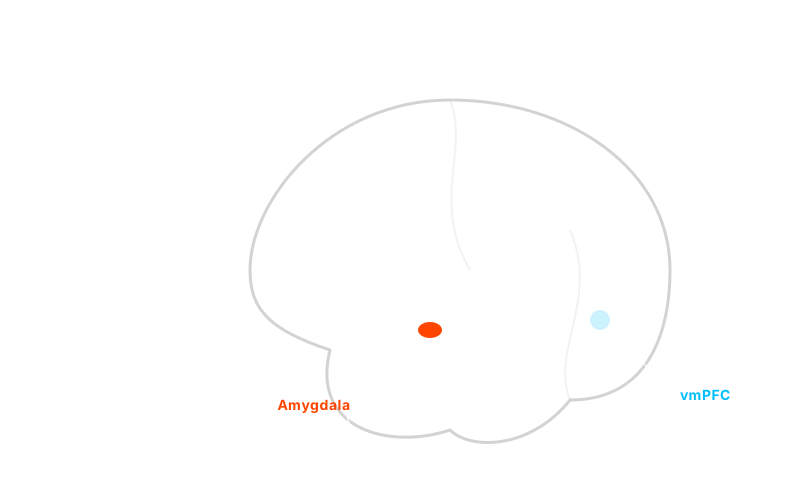
When your “why” extends beyond yourself, your brain stops scanning for threats and starts building bridges. You’re not just avoiding pain; you’re creating meaning. And meaning, it turns out, is a biological buffer.
Studies link vmPFC activation to lower stress hormone levels and even reduced inflammation. It’s as if the brain, when oriented toward something larger, says, Relax. This matters. You’re part of something enduring.
How a Strong Sense of Purpose Boosts Longevity and Health
The data is staggering. A 2012 study in the Journal of Behavioral Medicine found that older adults with strong purpose were less likely to suffer heart attacks over a two-year period, even when controlling for other health factors. Another study, tracking 951 older adults, revealed that those with high purpose scores had a 44% lower risk of dementia. This isn’t just correlation; it’s causation with a side of biological plausibility.
Purpose seems to dampen the production of pro-inflammatory cytokines—molecules linked to everything from arthritis to Alzheimer’s. And let’s talk longevity. A meta-analysis of over 136,000 people found that those with a strong sense of purpose lived longer—not by months, but by years. The mechanism?
Purpose-driven people take better care of themselves. They exercise more, eat better, and are less likely to misuse substances. But it’s deeper than habits.
Purpose acts like a psychological immune system. In a study of Pakistani earthquake survivors, those with a strong sense of purpose were far more resilient to PTSD, even after losing loved ones. It’s as if purpose rewires our response to trauma, turning suffering into a catalyst for growth rather than collapse.
How Purpose Transforms Our Perception of Effort
Here’s where it gets visceral. Researchers at Stanford strapped heavy backpacks to participants and asked them to estimate the steepness of a hill. Half were told the backpack contained scientific equipment for a meaningful study; the other half were told it was just dead weight. The result?
Those carrying the “purposeful” backpack perceived the hill as less steep—as if the load were lighter. This isn’t just about perception; it’s about effort. When your actions are tied to something larger, your brain recalibrates the cost. Pain feels more tolerable.
Fatigue fades into the background. It’s the difference between swimming laps for exercise and swimming to save a life. The distance doesn’t change, but the meaning does. This phenomenon extends beyond physical tasks.
Soldiers returning from combat often struggle with the loss of purpose—they had a mission, a role, a reason to push through exhaustion. But those who find a new, transcendent purpose post-deployment show post-traumatic growth rather than collapse. The same principle applies to everyday life.
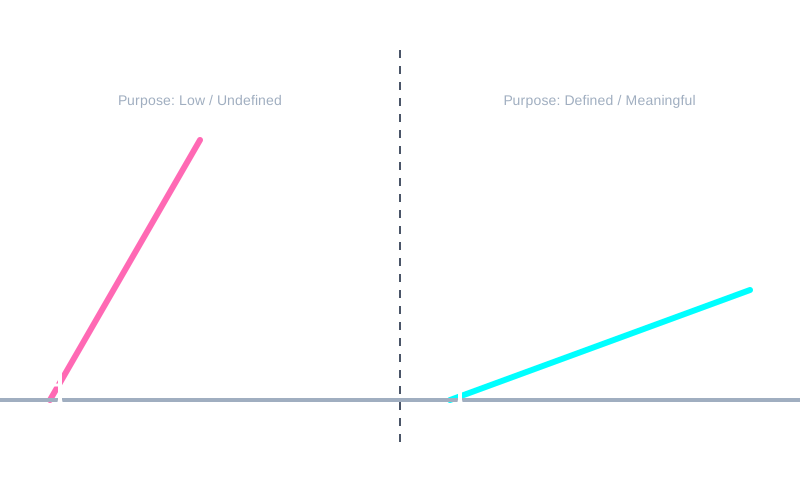
A teacher grading papers isn’t just checking boxes; she’s shaping minds. A nurse drawing blood isn’t just following protocol; he’s healing. Purpose doesn’t erase the weight of the work—it makes the weight worth carrying.
How Jerry Hirsch Found Purpose Beyond Wealth
Jerry Hirsch had everything—wealth, success, a legacy of 667 K-Marts dotted across Phoenix. And yet, at 80, he was miserable. “Is this it?” he asked himself. “Before me, there were 423 K-Marts.
Now there are 667. Is that my epitaph?” The answer was a resounding no. So he pivoted. He founded a philanthropic organization, redirecting his resources toward causes that outlasted him.
The shift wasn’t just emotional; it was neurological. As Strecher notes, Hirsch’s brain likely transitioned from amygdala-driven anxiety (“Will I lose my status?”) to vmPFC-guided fulfillment (“How can I serve?”). Hirsch’s story dismantles the myth that purpose requires grandeur. It’s not about the scale of your impact but the sincerity of your intention.
A barista who treats each customer like a neighbor, a janitor who takes pride in creating a clean space for others—these are acts of quiet transcendence. Purpose isn’t a title or a net worth; it’s a direction.
And as Hirsch discovered, the most fulfilling legacies aren’t carved in marble but woven into the lives of others. His headstone wouldn’t read “Built 244 K-Marts.” It would read, “Helped thousands find their way.” That’s the alchemy of self-transcendence: turning more into enough.
Mortality Awareness: The Ultimate Purpose Catalyst
Why Life’s Finiteness Demands Intentional Living
Victor Strecher’s insight—“This isn’t a practice round. This is your life”—cuts through the noise of modern distractions like a scalpel. We scroll, binge, argue over things we can’t control, and wake up one day wondering where the time went. But what if we lived like Julia Strecher, who, after two heart transplants, understood viscerally that life isn’t a dress rehearsal?
She didn’t just know her time was finite; she felt it. And that awareness transformed everything—her relationships, her studies, her dream of becoming a nurse. She didn’t just want to be a nurse; she burned for it because she knew this was her one shot. This isn’t about morbid obsession with death.
It’s about clarity. Strecher’s “Headstone Test” isn’t depressing—it’s liberating. Imagine etching your epitaph today. Would it say, “Spent 20,000 hours on social media” or “Fought for something bigger than themselves”?
The test forces you to confront the gap between how you’re living and how you want to be remembered. It’s not about grandeur; it’s about honesty. A barista who brightens a customer’s day, a parent who teaches kindness—these are quiet legacies.
The urgency isn’t panic; it’s intention. When you realize your time is limited, you stop wasting it on things that don’t matter. 2
How Julia Strecher’s Two Heart Transplants Shaped Her Passionate Approach to Life
Julia Strecher’s life was a masterclass in how mortality sharpens purpose. At 19, after two heart transplants, she didn’t just hope to become a nurse—she lived it. Every class, every friendship, every moment with her boyfriend was infused with urgency because she knew her time might be short. Her father, Victor, describes her as “passionate about everything” because she understood: This isn’t practice.
Her heart might fail, but her spirit wouldn’t. She didn’t just have goals; she embodied them. Her story isn’t just inspiring—it’s instructive. When you stare mortality in the face, trivialities fall away.
Julia didn’t waste energy on petty dramas or half-hearted pursuits. She focused on what mattered: relationships, learning, contributing. Her purpose wasn’t abstract; it was visceral.
And her father, shattered by her loss, channeled that same urgency into his work, teaching others to live with purpose. Julia’s legacy isn’t just her dream of nursing; it’s the ripple effect of her intensity. She didn’t just have a purpose; she lived it so fully that it outlasted her.
The Leadership of Admiral Stockdale in Captivity
Admiral James Stockdale’s seven years in the Hanoi Hilton weren’t just about survival—they were about meaning. Tortured, isolated, and pressured to betray his country, Stockdale’s purpose wasn’t self-preservation. It was responsibility. He saw himself as his “brother’s keeper,” refusing to break because he knew his actions would echo through the lives of fellow prisoners.
When his captors tried to film him for propaganda, he didn’t just resist—he scalped himself with a broken mirror to make himself unfilmable. That’s not just resilience; it’s transcendence. His purpose wasn’t about living; it was about what he lived for. Stockdale’s story dismantles the myth that purpose is a luxury.
In the darkest conditions, he clung to something beyond himself. His moral framework wasn’t about abstract patriotism; it was about the man in the next cell. Purpose, in its purest form, isn’t about comfort—it’s about commitment.
And that commitment rewires you. It turns suffering into strength, survival into legacy.
Stockdale didn’t just endure; he chose what his endurance meant. That’s the power of self-transcending purpose: it doesn’t just help you live—it helps you matter. 3 3
Purpose is Universal, Not a Luxury
Purpose: The Engine of Resilience, Not a Luxury
Let’s dismantle a sacred cow: Maslow’s hierarchy of needs. The idea that purpose is a luxury—something you only chase after food, shelter, and security—is a myth. James Harrington’s life is a wrecking ball to that assumption. Orphaned by age five in rural Uganda, Harrington didn’t just survive; he thrived because of purpose.
His grandmother, refusing to let poverty define his future, walked him 300 miles to Kampala to demand an education from the prime minister. Weeks of camping outside the palace, relentless persistence—this wasn’t about comfort. It was about hope. Harrington later founded Teach for Uganda, proving that purpose isn’t a top-tier need but a foundational one.
As he told Strecher, “Purpose gives poor people hope. Hope for their families, hope for the future.” This isn’t just anecdotal.
Studies on Gulf War soldiers show that those who found new purpose post-combat experienced post-traumatic growth, not just recovery. Purpose isn’t the cherry on top of a stable life; it’s the engine that drives resilience, even in the absence of basic needs.
Finding Purpose in Everyday Jobs
Purpose isn’t reserved for CEOs or Nobel laureates. It’s hiding in plain sight—often in jobs we dismiss as “mundane.” Take the NASA custodian who told JFK, “I’m helping put a man on the moon.” His broom wasn’t just cleaning floors; it was part of a cosmic mission. Or the septic tank worker Strecher met, who initially shrugged, “I do it for the money.” Until Strecher reframed it: “You’re a public health hero. You’re keeping diseases out of our water.” The man’s eyes lit up—his job wasn’t just a paycheck; it was a legacy.

Then there’s the parking attendant who checked tire treads for safety, turning a routine task into a silent act of care. These aren’t exceptions; they’re job crafting—the art of infusing meaning into any role. Purpose isn’t about the title; it’s about the story you attach to your work.
A janitor isn’t just mopping; they’re creating a space for healing. A barista isn’t just pouring coffee; they’re fueling human connection. The question isn’t “What do I do?” but “What does my work enable?”
How to Craft More Purpose into Your Job
Job crafting is the ultimate hack for purpose. It’s not about quitting your job to find meaning; it’s about rewriting your job to create meaning. Strecher’s colleagues call it “job crafting”—the practice of reshaping your role to align with your values. Spend most of your waking hours at work?
Don’t just clock in; reimagine. A teacher grading papers isn’t just assessing; they’re shaping futures. A nurse drawing blood isn’t just following protocol; they’re healing. Even hobbies can become purposeful: a retiree’s woodworking isn’t just a pastime; it’s a legacy of craftsmanship.
The key? Ask: “How does this task connect to something larger?” A parking attendant checking tire treads isn’t just doing a job; they’re preventing accidents. A septic tank worker isn’t just handling waste; they’re safeguarding public health.
Purpose isn’t about grandeur; it’s about perspective. As Strecher says, “You might start with different domains of your life—work, family, community—and ask, ‘What could I do here that matters?’” The answer might be as simple as mentoring a coworker or as bold as founding a movement. But it starts with seeing your role differently.
Practical Methods for Purpose Cultivation
The SPACE Framework for Sustainable Energy and Vitality
Let’s talk about the SPACE framework—Sleep, Presence, Activity, Creativity, and Eating. These aren’t just wellness buzzwords; they’re the foundation for sustained purpose engagement. Sleep isn’t just about avoiding bags under your eyes; it’s about cognitive clarity and emotional resilience. Presence, or mindfulness, isn’t just about meditation; it’s about being fully engaged in the moment, whether you’re listening to a friend or tackling a project.
Activity isn’t just about hitting the gym; it’s about movement that energizes you—walking to work, dancing, even stretching. Creativity isn’t just for artists; it’s about problem-solving, innovation, and yes, even writing a haiku to spark vitality. And eating well isn’t just about weight; it’s about fueling your body for the demands of a purpose-driven life. The SPACE framework isn’t just a checklist; it’s a feedback loop.
When you prioritize these elements, you’re not just surviving; you’re thriving. You’re building the energy and vitality needed to pursue purpose in multiple domains—work, family, community. And if you’re feeling burned out, it’s a sign to revisit SPACE. Ask yourself: Am I giving myself the space to sleep, be present, move, create, and eat well?
If not, start small. Track your sleep for a week. Try a five-minute mindfulness exercise.
Walk instead of drive. Write a haiku.
Cook a nourishing meal. These aren’t just habits; they’re the building blocks of a purposeful life.

Unlock Your Values Through Smartphone Wallpaper Analysis
Here’s a practical exercise: the smartphone wallpaper analysis. What’s the first thing you see when you unlock your phone? A scenic landscape? A family photo?
A motivational quote? That image is a clue to what you value. If it’s a photo of your kids, family might be a core value. If it’s a quote about adventure, freedom might be key.
This isn’t just about aesthetics; it’s about values identification. Your wallpaper is a daily affirmation of what matters to you. Once you’ve identified your values, the next step is self-affirmation. Write down why each value is important to you.
For example, if kindness is a value, ask: Why does kindness matter to me? Maybe it’s because you believe in the power of small acts to change lives. Or perhaps it’s because you’ve experienced kindness in dark times and want to pay it forward.
This process isn’t just about listing values; it’s about connecting them to your purpose. When you understand why a value matters, you’re more likely to live it out.
And living out your values? That’s purpose in action.
How to Develop Purpose Across Life’s Key Areas
Purpose isn’t one-size-fits-all. It’s domain-specific. You might have a purpose in your work—mentoring young professionals, for example. In your family, it could be creating a nurturing environment for your kids.
In your community, it might be volunteering at a local shelter. And personally, it could be cultivating self-awareness through meditation. The key is to recognize that purpose can—and should—exist in multiple areas of your life. But here’s the catch: having too many purposes can lead to burnout.
It’s not about spreading yourself thin; it’s about prioritizing. Ask yourself: Which purposes align most closely with my core values? Maybe your work purpose is non-negotiable, but your community purpose can be scaled back.
Or perhaps your family purpose needs more attention right now. The goal isn’t to do it all; it’s to do what matters most. And remember, it’s okay to say no. Purpose isn’t about being everything to everyone; it’s about being intentional in the areas that align with your values.
How to Become a Researcher of Yourself Through Self-Evaluation and Purpose Alignment
Becoming a “researcher of yourself” is about ongoing self-evaluation. It’s not a one-time exercise; it’s a lifelong practice. Start by asking: Who am I? What is my identity?
From there, generate a purpose that aligns with that identity. Maybe you’re a teacher at heart, even if you’re not in a classroom. Or perhaps you’re a healer, even if you’re not a doctor. Your purpose isn’t just about what you do; it’s about who you are.
Next, ask: What skills do I need to develop to live out this purpose? If your purpose is to inspire others, maybe you need to work on public speaking. If it’s to create art that moves people, perhaps you need to hone your craft. And don’t forget the SPACE framework.
Track your sleep, presence, activity, creativity, and eating habits. Notice how they impact your energy and vitality. Adjust as needed.
This isn’t just about self-improvement; it’s about purpose alignment. When your habits and skills align with your purpose, you’re not just living; you’re thriving.
Character Development: From Self-Focused to Other-Centered
From Self-Interest to Selflessness: Stockdale’s Moral Journey
The arc of moral development is rarely a straight line. It’s a messy, winding path—one that Admiral James Stockdale embodied in his journey from self-focus to self-transcendence. At 20, Stockdale was the quintessential young man consumed by personal ambition. He didn’t participate in the hazing of Wes Brown, the first Black graduate of the Naval Academy, not because he opposed injustice, but because he was too busy with his own goals.
His attitude echoed the ancient question: If I am not for me, who is for me? It’s a stage we all recognize—the self-absorption of youth, where the world revolves around our own aspirations and insecurities. But Stockdale’s story doesn’t end there. In the Hanoi Hilton, stripped of everything but his integrity, he transformed.
His purpose shifted from self-preservation to collective responsibility. When he scalped himself to avoid being filmed for propaganda, it wasn’t just defiance—it was devotion. He saw himself as his “brother’s keeper,” a man whose actions would ripple through the lives of his fellow prisoners.
His moral compass had recalibrated. The question was no longer Who is for me? but If I am only for me, who am I?
This evolution isn’t unique to Stockdale. It’s the arc of human growth—from self-centeredness to other-centeredness, from me to we.
From Self-Centered to Other-Centered: Stockdale’s Evolution
Stockdale’s early years at the Naval Academy paint a picture of a man consumed by his own trajectory. He wasn’t cruel, but he wasn’t particularly concerned with the struggles of others either. His focus was on his own survival, his own success—a mindset encapsulated by the phrase If I am not for me, who is for me? It’s a stage of moral development where the self is the center of the universe, and everything else orbits around it.
This isn’t inherently evil; it’s human. We all start here, wrapped in the cocoon of our own needs and desires. But the Hanoi Hilton shattered that cocoon. In the face of unimaginable suffering, Stockdale’s purpose expanded beyond himself.
He became a leader, a protector, a man who saw his survival as inextricably linked to the survival of his comrades. His actions—like maiming himself to avoid propaganda—weren’t just about defiance; they were about devotion to something greater. This shift from me to we is the hallmark of moral maturity.
It’s the difference between a life lived for personal gain and a life lived for collective good. Stockdale’s journey reminds us that purpose isn’t static. It evolves, deepens, and, if we’re lucky, transcends the self entirely.
How Wes Brown’s Naval Academy Experience Shaped Moral Development Through Injustice
Wes Brown’s experience at the Naval Academy is a stark reminder of how injustice can shape moral development. As the first Black graduate, he faced systematic harassment—hazing that went beyond the usual rites of passage. It was a cruelty rooted in racism, a deliberate attempt to break him. Yet, Brown’s story isn’t just about survival; it’s about the moral awakening of those around him.
Jimmy Carter, a classmate from the segregated South, defied expectations by supporting Brown, running cross-country with him, and standing as an ally. This wasn’t just kindness; it was a moral reckoning. Witnessing injustice forces us to confront our own complicity or courage. For Stockdale, who didn’t participate in the hazing but didn’t actively oppose it either, Brown’s struggle was a missed opportunity for moral growth.
It’s a lesson in how purpose is forged not just in our actions but in our inactions. When we see suffering and choose to look away, we stunt our own moral development.
But when we stand up, when we choose to be “our brother’s keeper,” we take a step toward self-transcendence. Brown’s story is a testament to the power of purpose—not just for the individual but for the collective conscience.
How a 7-Year-Old’s Shrimp Activism Shows the Power of Early Purpose
Purpose isn’t reserved for adults. It’s a flame that can ignite at any age, as Victor Strecher’s seven-year-old grandson proved. After watching a documentary about the unsafe harvesting of shrimp, the boy didn’t just feel sad—he took action. He rallied his community, made signs, and organized a parade to “save the shrimp.” This wasn’t just a child’s whim; it was a purpose-driven campaign.
It shows that purpose isn’t about age or scale; it’s about passion and action. The boy’s activism demonstrates how purpose can be cultivated early. It starts with a simple question: What matters most? For him, it was the environment.
For others, it might be social justice, animal rights, or community service. The key is to encourage children to identify what moves them and then empower them to act.
Purpose isn’t a luxury; it’s a necessity, even for the youngest among us. And when we nurture it early, we set the stage for a lifetime of meaningful engagement.
Maintaining Purpose Through Life’s Challenges
How to Rebuild Purpose After Loss Through Action and Giving
Grief has a way of hollowing out your sense of purpose. Joanna’s question cuts deep—how do you rebuild meaning after losing a child? The answer isn’t in waiting for clarity to strike like lightning. It’s in doing.
Victor Strecher’s journey after Julia’s death wasn’t a sudden epiphany; it was a slow return to the classroom, where he reclaimed purpose by teaching. Action precedes meaning. Volunteering, mentoring, even small acts of kindness—these aren’t distractions from grief; they’re the scaffolding for a new purpose. The Headstone Test isn’t just for the living.
It’s a tool for the grieving. Ask: What would Julia want me to do now?
Maybe it’s advocating for organ donation, or simply being present for others in pain. Purpose after loss isn’t about replacing what’s gone; it’s about honoring it through movement.
Is Your Burnout a Crisis of Purpose or Setting?
Burnout isn’t always a crisis of purpose—sometimes it’s a crisis of context. Valentina’s exhaustion in education might not mean she’s lost her calling; it might mean the system is crushing her passion. Before abandoning ship, ask: Can I craft this role differently? Job crafting isn’t about quitting; it’s about reclaiming agency.
A teacher burned out by standardized tests might refocus on mentoring one student deeply. Or pivot to adult education, where the impact feels more immediate. But if the setting is toxic, purpose can’t thrive.
Strecher’s SPACE framework—sleep, presence, activity, creativity, eating—isn’t just self-care; it’s a diagnostic tool. If your job drains your energy for all domains of purpose (family, community, self), it’s time to ask: Is this the right battlefield for my purpose? Sometimes, purpose needs a new stage. 1
How to Find Purpose in Unchosen Caregiving Roles
Erica’s caregiving role wasn’t chosen—it was thrust upon her. The resentment is real. But purpose isn’t about consent; it’s about reframing. Research shows caregivers who label themselves as such—I am a caregiver—experience less stress than those who see it as a burden.
Why? Because labels create identity. And identity, when tied to service, becomes purposeful.
Try this: Write down the ways your caregiving matters. Maybe it’s preserving dignity for a parent, or modeling resilience for your kids.
Then, craft a personal mantra: “I am the anchor of my family.” Purpose isn’t about joy; it’s about meaning. And meaning can coexist with exhaustion.
Reframe Rejection: How Cheryl’s “Failures” Led to Purposeful Growth
Cheryl’s rejections aren’t failures—they’re data points. Strecher’s advice? Double your failures. Each “no” is a step closer to a “yes” that aligns with purpose.
Try the “Failure Résumé”: List every rejection, then note what it taught you. A book rejected for being “too niche” might find its home in a passionate community. A job loss might redirect you to work that actually fits your values.
Purpose isn’t about avoiding failure; it’s about using it. Ask: What did this rejection preserve me for?
Maybe it’s a project you haven’t imagined yet. Purpose thrives in the gaps between plans.
How to Thrive in the Empty Nest Phase
Neeta’s empty nest isn’t a void—it’s an invitation. The purpose of parenting isn’t to be needed forever; it’s to launch humans who don’t need you. Now, model what comes next. Take up woodworking, join a choir, or mentor young professionals.
Your children are watching. A parent who thrives post-kids teaches them: Life isn’t about clinging; it’s about evolving. Purpose isn’t lost when kids leave; it’s redirected.
Ask: What did parenting teach me about myself? Maybe it’s patience, creativity, or leadership. Those skills don’t expire—they pivot.
Conclusion
So here we are, at the end of this exploration, and the question lingers: What’s your purpose? But let’s reframe it—not as a demand for a grand answer, but as an invitation to look beyond yourself. Because the most enduring purposes aren’t about what you get, but what you give.
Think of Admiral Stockdale, who didn’t just survive the Hanoi Hilton—he led. Or Victor Strecher, who turned grief into a mission to teach others how to live meaningfully. Their stories aren’t just inspiring; they’re instructive.
Purpose isn’t about avoiding pain or chasing fleeting passions. It’s about anchoring yourself to something that outlasts you, something that makes the struggle worth it.
And here’s the beautiful part: purpose isn’t reserved for the extraordinary. It’s woven into the everyday. The septic tank worker who sees himself as a public health hero. The parking attendant who checks tire treads to keep drivers safe.
The parent who teaches kindness, knowing it will ripple through generations. These aren’t grand gestures—they’re quiet acts of transcendence.
So, where do you start? Maybe with the Headstone Test. What do you want to be remembered for?
Or perhaps by evaluating your SPACE framework—sleep, presence, activity, creativity, eating—to ensure you’re fueling a life of purpose. Or simply by asking, How can I serve something greater than myself today?
Because purpose isn’t a destination. It’s a practice. And the most meaningful lives aren’t those that avoid struggle, but those that use it to serve others.
So, what’s your next step? (And remember: it doesn’t have to be perfect—it just has to matter.)


