


I’ve always been suspicious of happiness. Not the fleeting joy of a good meal or a laugh with friends, but the modern obsession with chasing it—like it’s some trophy to be won or a destination to reach. The more we fixate on happiness as a feeling to be optimized, the more it slips through our fingers.
The Founders knew this. For Jefferson, Adams, and Franklin, happiness wasn’t about emotional highs or personal pleasure. It was about excellence—a life of virtue, self-mastery, and purpose beyond the self.
This isn’t just some dusty Enlightenment ideal. It’s a radical, countercultural take on what it means to live well. The Founders drew from Cicero and Aristotle, who saw happiness (eudaimonia) as the “activity of the soul in conformity with excellence.” It’s not about feeling good; it’s about being good.
And here’s the kicker: modern thinkers like Naval Ravikant and Alain de Botton are echoing these ancient truths. They’re telling us that the more we focus on ourselves, the more miserable we become. The Founders’ happiness wasn’t found in self-obsession but in self-transcendence—through virtue, community, and purpose.
So what if we’ve been chasing the wrong thing? What if happiness isn’t something to be found but something to be lived? The Founders’ wisdom offers a roadmap, one that’s more relevant than ever in our age of loneliness and distraction.
The Founders’ Lost Definition: Happiness as Excellence of Character
How Founders Redefined Happiness Through Virtue and Tranquility
The Founders didn’t chase happiness like we do today—through fleeting pleasures or emotional highs. For them, happiness was a state of being, not feeling. It was virtue in action, a tranquility of mind earned through self-mastery. Cicero’s Tusculan Disputations was their playbook.
Written during his own exile, Cicero’s work wasn’t about avoiding pain but about governing it. He argued that true happiness comes from cultivating reason over passion, from aligning one’s soul with excellence (arete). The Founders devoured this. Jefferson, Franklin, and Adams all quoted Cicero in their letters and commonplace books because his philosophy offered a blueprint: happiness isn’t the absence of suffering but the mastery over it.
This wasn’t some abstract ideal. It was practical. When Jefferson drafted the Declaration, he had Cicero’s definition in mind—happiness as virtuous self-government.
George Mason and James Wilson echoed this in their writings, framing happiness as a duty, not just a right. The consensus was staggering: from classical sources to Christian Enlightenment thinkers, happiness meant excellence of character. It’s why Franklin’s virtues list and Jefferson’s daily self-examinations weren’t just personal quirks—they were disciplined practices to achieve this Cicero-inspired tranquility.
How the Founders Defined True Happiness Through Aristotle’s Eudaimonia
Aristotle’s Nicomachean Ethics gave the Founders their north star: eudaimonia—happiness as the “activity of the soul in conformity with excellence.” This wasn’t about feeling good; it was about being good. Arete (excellence) wasn’t a vague ideal but a daily practice of moderation, self-control, and reason directing passion. The Founders called this “faculty psychology”—using reason to temper, not kill, the passions. It’s why Franklin’s 13 virtues weren’t just a to-do list but a system to align his soul with reason.

This was radical. Modern happiness chases dopamine hits—pleasure, distraction, ego. The Founders saw that as a dead end. Aristotle (and later Naval Ravikant) nailed it: ego is the enemy of happiness.
Ravikant’s take—that detachment isn’t a goal but a byproduct of focusing on what truly matters—mirrors Aristotle’s eudaimonia. The Founders got this.
Their self-examination rituals (Franklin’s virtue charts, Jefferson’s daily reflections) were about transcending the self, not indulging it. Happiness, for them, was a duty to serve others, to fulfill potential, to live in harmony with reason.
How Franklin and Jefferson Used Daily Self-Examination to Cultivate Virtue and Happiness
Franklin’s 13 virtues—temperance, silence, order, resolution—weren’t just lofty ideals. He turned them into a daily audit. Each night, he marked where he failed, aiming for a blank chart. It wasn’t about perfection but progress.
Jefferson did the same, crafting his own 12 virtues for his daughters. Both men treated happiness as a craft, honed through discipline. Their methods reveal a shared truth: happiness isn’t found in self-obsession but in self-transcendence. Franklin’s morning question—*What good shall I do this day? *—and his evening review—*What good have I done? *—were exercises in aligning action with virtue.
This wasn’t navel-gazing; it was a radical act of accountability. The Founders knew what modern psychology confirms: the more we focus on ourselves, the more miserable we become.
Their virtue systems were antidotes to ego, tools to redirect energy outward—toward mission, community, and purpose. That’s the lost art of happiness.
The Great Reversal: From Being Good to Feeling Good
The Cultural Shift from Virtue to Pleasure in America’s Pursuit of Happiness
The 1960s and 1970s marked a seismic shift in America’s pursuit of happiness. What was once a virtue-based, character-driven ideal morphed into a hedonistic chase for pleasure and self-gratification. This wasn’t just a cultural evolution—it was a revolution against the very foundations of classical and Enlightenment thought. The Founders, steeped in Cicero and Aristotle, saw happiness as eudaimonia—a life of excellence, self-mastery, and purpose.
But by the mid-20th century, happiness became synonymous with feeling good, not being good. The disappearance of religion as a structuring force in daily life left a void. Previous generations had frameworks—rituals, community, shared meaning—that guided their pursuit of a good life. Without these, modern society defaulted to individualism and instant gratification.
Alain de Botton hits the nail on the head: we’re among the first generations trying to live good lives without the scaffolding of religion or tradition. The result?
A culture obsessed with self-actualization, yet more anxious and isolated than ever. The paradox is brutal: the more we chase happiness as a personal achievement, the more it slips through our fingers.
Is “Freedom Culture” Making Us Unhappy?
The modern obsession with freedom and independence has a dark underbelly. We’ve been sold a narrative: true happiness comes from standing alone, answering to no one, optimizing for personal liberty. But the data—and human experience—tells a different story. The most unhappy people aren’t the ones tied down by obligations; they’re the ones untethered from meaningful connections.
Independence, when taken to extremes, becomes a prison of isolation. Naval Ravikant’s insight cuts deep: detachment isn’t a goal, but a byproduct of focusing on what truly matters. The Founders understood this. Their happiness wasn’t rooted in self-obsession but in service—whether to family, community, or country.
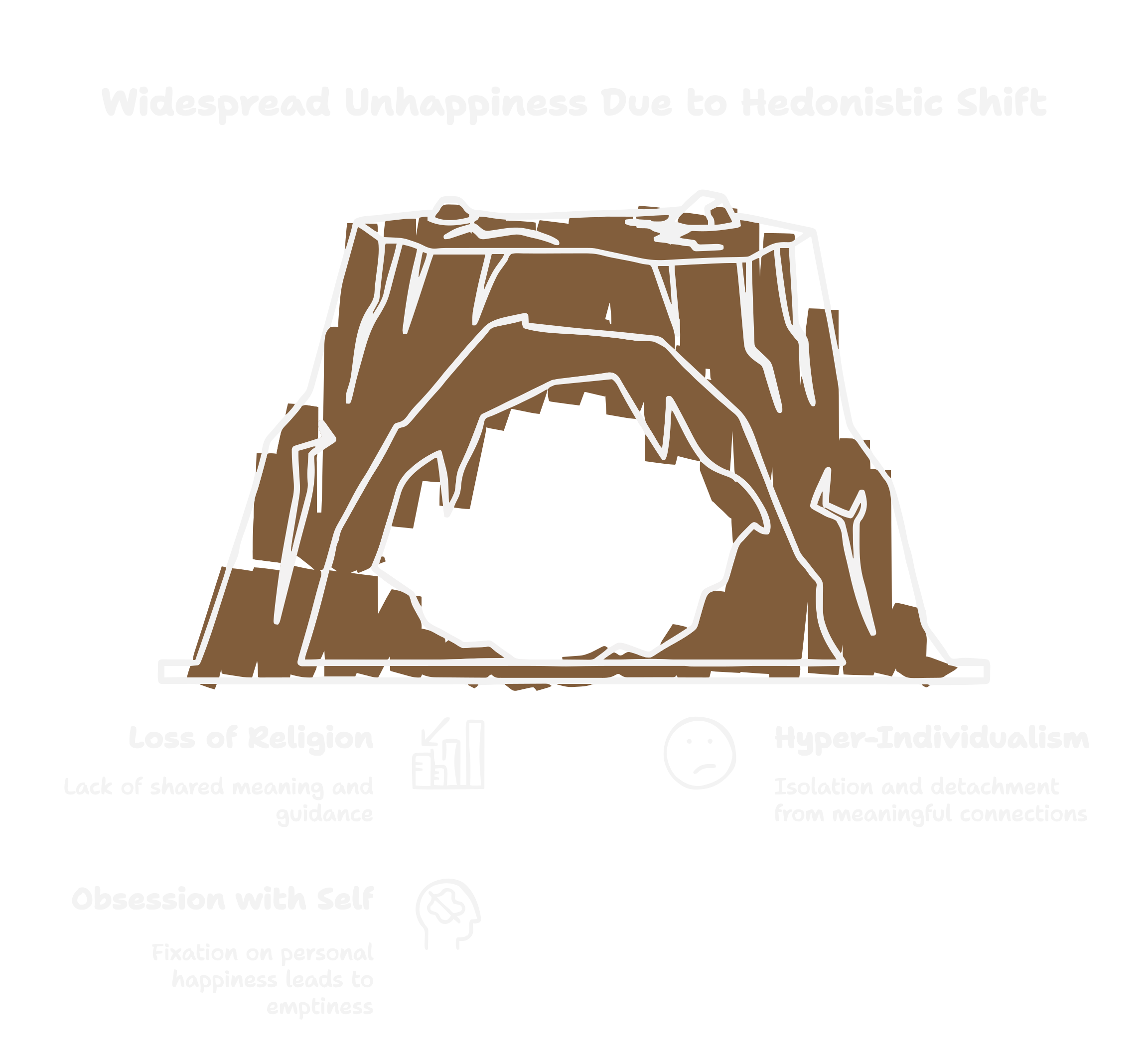
Today’s “freedom culture” flips this script. We’ve traded interdependence for hyper-individualism, and the cost is loneliness. The solution isn’t to reject freedom but to redefine it.
True freedom isn’t the absence of constraints; it’s the choice to depend on what gives life meaning—family, mission, shared purpose. The Founders’ virtue-based happiness wasn’t about chains; it was about choosing the right ones.
Alain de Botton: The Futility of Chasing Happiness
De Botton’s critique is devastating: the modern pursuit of happiness is a self-defeating prophecy. We’ve turned happiness into an idol, a personal project to be optimized, measured, and achieved. But this obsession with “now” and “me” creates the very misery it seeks to escape. The Founders’ happiness was about being—about cultivating character, serving others, and aligning with something greater.
Today’s happiness is about feeling—a fleeting, selfish high that leaves us emptier than before. The irony? The more we fixate on personal happiness, the more it eludes us. The Founders’ rituals—Franklin’s virtue charts, Jefferson’s daily reflections—weren’t about self-indulgence.
They were about self-transcendence. Modern psychology confirms this: the happiest people aren’t the ones chasing pleasure but those lost in purpose, connection, and mission.
The “freedom culture” promised liberation but delivered loneliness. The solution isn’t to abandon the pursuit of happiness but to rediscover its classical roots—where happiness isn’t a feeling to be chased but a life to be lived.
The Ego Trap: Why Self-Obsession Is the Source of All Unhappiness
Why Your Ego Is the Source of All Unhappiness
Naval Ravikant cuts to the bone: “Thinking about yourself is the source of all unhappiness.” It’s not just a quip—it’s a diagnosis. The ego, he argues, is an insatiable beast, a “recurrent collection of thoughts that are very self-obsessed and will never be satisfied.” This isn’t about healthy self-reflection. It’s about the toxic loop of woe is me, the narratives we spin about our personalities, our grievances, our unmet desires. The more we feed this beast, the hungrier it gets.
Ravikant’s insight mirrors the Founders’ distrust of unchecked passion. Jefferson and Franklin didn’t indulge their egos; they examined them, not to inflate their sense of self but to transcend it. The modern therapy culture, Ravikant warns, can become a prison where we’re both the prisoner and the guard. We’re told to dig deeper into ourselves, to analyze every slight, every insecurity.

But this obsession with the self is a trap. The Founders knew this. John Adams, for all his vanity, was acutely aware of his flaws—his wife Abigail even helped him catalog them in a Pythagorean spirit of self-mastery.
The goal wasn’t self-absorption but self-improvement. Ravikant’s advice? Redirect that energy outward: “God, kids, or mission—pick at least one, preferably all three.” The ego thrives in isolation; purpose starves it.
How Unprocessed Thoughts Fuel Depression and Anxiety
Alain de Botton frames the modern dilemma starkly: the average human has 70,000 thoughts a day. Most are fleeting, fragmentary, unprocessed. And that’s the problem. We don’t know how to process them.
These thoughts don’t just vanish—they fester. Unprocessed emotions become depression, anxiety, irritability. De Botton’s theory is that mental troubles are often “unprocessed emotion”—sadness that hasn’t understood itself, worry that doesn’t know its own cause. This is where the Founders’ virtue systems shine.
Franklin’s daily self-examinations weren’t about wallowing in his thoughts; they were about directing them. He asked: What good shall I do today? Not How do I feel today?
The Founders, steeped in Pythagoras and Aristotle, saw reason as the moderator of passion. They didn’t suppress their emotions; they channeled them.
Jefferson’s daily reflections, Adams’ fault lists—these were tools to process thoughts, not amplify them. The modern mind, bombarded by 70,000 thoughts, needs this discipline more than ever.
How Founders Used Reason to Master Ego and Cultivate Virtue
The Founders’ solution to the ego trap was simple: cultivate reason. Pythagoras drew the antithesis between reason (head) and passion (heart, stomach). The goal? Use reason to temper passion, to achieve tranquility and self-mastery.
The Founders didn’t see this as a war against emotion but as a balance—what Aristotle called the “mean.” They moderated unproductive passions (anger, jealousy) to cultivate productive ones (prudence, justice). Franklin’s virtue charts were a daily exercise in this balance. He didn’t ignore his flaws; he tracked them, not to indulge in self-criticism but to transcend it.
The modern obsession with self-analysis often does the opposite—it amplifies the ego. Ravikant’s warning and de Botton’s theory both point to the same truth: the more we focus on ourselves, the more miserable we become.
The Founders’ virtue systems were antidotes to this, tools to redirect energy from self to service, from ego to excellence. Happiness, for them, wasn’t found in the self but in rising above it.
The Self-Transcendence Solution: Finding Purpose Beyond the Self
Why Thinking Beyond Yourself Matters: Mission, Spirituality, and Caregiving
Naval Ravikant’s insight is a gut punch to modern narcissism: “Everybody craves thinking about something more than themselves.” It’s not just a preference—it’s a psychological necessity. The ego, left unchecked, is a black hole of dissatisfaction. Ravikant’s prescription? Redirect that energy outward.
Mission, spirituality, caregiving—these aren’t just noble pursuits; they’re survival strategies for the soul. Consider caregiving. The Founders, for all their Enlightenment rationality, understood the power of familial and communal bonds. Franklin’s virtues included “humility” and “justice,” not as abstract ideals but as daily practices in service to others.
Modern research backs this up: parents, despite the chaos, often report higher life satisfaction than their childless peers. Why? Because kids force you out of your own head. You’re no longer the main character in your story—and that’s liberating.
Spirituality, too, offers an escape hatch from the ego. Whether through organized religion or a personal sense of awe, it connects us to something larger. The Founders, though skeptical of dogma, saw value in this.
Jefferson edited his own Bible, stripping away miracles to focus on Jesus’ moral teachings—a guide to transcending self-interest. Ravikant’s point isn’t about blind faith but about perspective: when you’re lost in the grandeur of the universe or the urgency of a mission, your petty grievances shrink to insignificance.
The Power of Chosen Interdependence: Balancing Autonomy With Purpose
The modern myth of total independence is a recipe for misery. Ravikant frames it perfectly: “You don’t want to be 100% independent in the sense that you don’t rely on anyone and no one relies on you because then you have no purpose.” The Founders, despite their Enlightenment individualism, knew this. Jefferson’s ideal citizen wasn’t a lone wolf but a yeoman farmer—self-sufficient yet deeply embedded in community. The formula is simple: independence plus purpose.
Autonomy without connection is hollow; dependence without choice is suffocating. The sweet spot? Chosen interdependence. Ravikant’s example—his wife, his kids—isn’t about sacrifice but about selection.

He chose these dependencies because they give his life meaning. The Founders did the same. Washington’s leadership wasn’t about personal glory but about service to a cause larger than himself. Franklin’s virtues weren’t just for self-improvement but for societal betterment.
This aligns with the Founders’ belief that individual virtue enables collective flourishing. As Jeffrey Rosen notes, their experiment in self-government hinged on personal self-mastery.
A nation of ego-driven individuals can’t govern itself; it devolves into tribalism and chaos. But a society of people who’ve chosen their dependencies—who’ve aligned their independence with purpose—can achieve harmony 1.
Virtue as the Foundation of a Flourishing Society
The Founders’ vision was radical: a republic where virtue wasn’t just personal but political. Their moral philosophy wasn’t a side project—it was the foundation of the American experiment. As Brett McKay puts it, they believed that “as individuals pursued excellence, that would allow for a flourishing society.” This wasn’t naive idealism; it was hard-won wisdom. Cicero’s Tusculan Disputations, Aristotle’s Nicomachean Ethics—these weren’t dusty tomes but manuals for survival.
The Founders’ virtue systems—Franklin’s charts, Jefferson’s reflections—weren’t about self-absorption but about self-transcendence. They understood that a society of ego-driven individuals is a tinderbox. But a society where people have cultivated reason over passion? That’s a republic capable of deliberation, compromise, and progress.
Ravikant’s “independence plus purpose” formula is the modern echo of this truth. It’s not about rejecting freedom but about channeling it toward something greater than the self*. The takeaway?*
Happiness isn’t found in isolation or indulgence but in the tension between autonomy and connection. The Founders’ virtue-based happiness wasn’t a relic of the past—it’s a roadmap for the future.
Virtue as Process: The Lifelong Pursuit of Character Excellence
Franklin’s Printer’s Errors: Why Moral Perfection Is Impossible But Worth Pursuing
Franklin’s analogy of life as a series of printer’s errors is one of the most humane and demanding philosophies I’ve encountered. He imagined existence as a manuscript riddled with typos—some glaring, some subtle—where each day offered a chance to correct a few mistakes, knowing full well that perfection would always remain just out of reach. This wasn’t defeatism; it was a radical acceptance of human fallibility paired with an unyielding commitment to progress. The beauty of this metaphor lies in its practicality.
Franklin didn’t see virtue as a destination but as a daily practice, a craft to be honed. His famous 13 virtues weren’t a checklist to be completed but a framework for lifelong refinement. Each night, he’d review his chart, marking where he’d fallen short—not to indulge in self-flagellation but to identify patterns, to learn. This process-oriented approach is what modern self-improvement culture often misses.
We’re obsessed with outcomes—achieving happiness, reaching goals, optimizing our lives—while the Founders understood that the real value lies in the striving itself. As Cicero put it, “the quest is in the pursuit, not in the obtaining.” Jeffrey Rosen nails it when he describes this as a “very humane, but also demanding philosophy.” It’s humane because it acknowledges our inevitable failures; it’s demanding because it requires us to show up, day after day, and try again.
The Founders didn’t chase perfection—they chased better. And in that chase, they found a kind of happiness that modern achievement culture can’t touch.
The Founders’ Daily Self-Examination Practices for Moral Growth
The Founders’ daily self-examinations weren’t just rituals—they were tools for moral calibration. Franklin’s morning question—*What good shall I do this day? *—wasn’t a vague aspiration but a deliberate intention. It forced him to start each day with purpose, to direct his energy outward rather than inward. His evening reflection—*What good have I done? *—was equally precise, a moment to account for his actions, not his feelings.
This practice wasn’t unique to Franklin. Jefferson crafted his own 12 virtues for his daughters, and Adams, with Abigail’s help, cataloged his faults in a Pythagorean spirit of self-mastery. The Pythagorean self-examination, which inspired them, was a structured inquiry: *What duty have I neglected? What good have I done?

What bad have I done? * It wasn’t about wallowing in guilt but about course-correcting. What’s striking is how these practices contrast with modern self-help.
Today, we’re told to journal our emotions, to explore our inner worlds. The Founders, however, used self-examination to transcend the self. Their questions weren’t How do I feel? but How did I serve? This shift in focus—from self to others, from emotion to action—is the key to their enduring happiness.
Why Process-Oriented Self-Improvement Lasts
Modern self-improvement is obsessed with results—hacking productivity, optimizing habits, achieving goals. The Founders’ approach was different. They saw virtue as a process, not a product. Franklin’s virtue charts, Jefferson’s daily reflections—they weren’t about reaching a finish line but about refining the journey.
This process-oriented mindset is sustainable because it’s adaptable. Life isn’t a straight path; it’s a series of printer’s errors. The Founders understood that progress isn’t linear. Some days, you’ll mark more failures than successes.
But the act of showing up, of reviewing, of adjusting—that’s where the real growth happens. Modern achievement culture, by contrast, burns out. It’s a hamster wheel of ever-higher goals, where happiness is always just beyond the next milestone. The Founders’ happiness wasn’t contingent on external validation or personal success.
It was rooted in the daily practice of aligning action with virtue. As Brett McKay notes, much of today’s self-improvement advice feels empty because it lacks this overarching why. The Founders had their why: excellence of character, service to others, harmony with reason.
Their methods weren’t just routines; they were rituals of meaning. And that’s the difference between sustainable self-improvement and the fleeting high of achievement.
The Social Dimension: How Community Enables Individual Flourishing
How the Adams’ Marriage Became a Partnership for Mutual Growth
The Adams’ marriage wasn’t just a romantic union—it was a moral laboratory. John and Abigail didn’t just love each other; they challenged each other, using their partnership as a crucible for character refinement. Their letters reveal a relationship built on mutual accountability, where classical philosophy wasn’t just discussed but lived. Abigail, though denied formal education, devoured the same moral philosophy as John—Alexander Pope’s poetry, Lawrence Sterne’s novels, Cicero’s stoicism.
She didn’t just absorb these ideas; she weaponized them against complacency. Their dynamic was a masterclass in chosen interdependence. John’s famous faults list? Abigail helped curate it.
His struggles with vanity and ambition? She called him out. Their son John Quincy’s moral education? A joint project.
This wasn’t tough love—it was transformative love. Modern relationships could learn from their model: not just supporting each other’s feelings, but elevating each other’s character.
The 80/80 Marriage concept echoes this—where both partners give 100% to each other’s growth, not just 50% to household chores. The Adams proved that the most intimate relationships thrive when they’re also the most demanding of our better selves.
How Franklin’s Junto Proved Self-Improvement Is Contagious
Franklin’s Junto wasn’t just a book club—it was a moral gymnasium. Inspired by Pythagoras’ brotherhoods and Locke’s educational philosophy, Franklin gathered tradesmen, artisans, and thinkers into a weekly crucible of self-improvement. The rules were simple but radical: no dogma, no ego, just relentless self-scrutiny shared among friends. Members didn’t just confess failures; they dissected them, turning personal flaws into collective wisdom.
What’s striking is how Franklin’s virtue project—though abandoned in his 20s—found new life in the Junto. The club became his living “Art of Virtue” manuscript. Members didn’t just track their own progress; they witnessed each other’s struggles, creating a feedback loop of accountability.
This was the Founders’ secret: virtue isn’t cultivated in isolation but in community. Modern self-help obsesses over solo journeys, but Franklin knew better.
His Junto proves that character isn’t just personal—it’s contagious. The group dynamic turned self-improvement from a lonely slog into a shared mission.
Why Chosen Dependence Drives True Happiness
The Founders’ social dimension demolishes modern myths of rugged individualism. Their happiness wasn’t found in solitude but in chosen dependence—whether in Abigail’s moral partnership with John or Franklin’s Junto brothers. This aligns perfectly with contemporary research showing that the most resilient people aren’t the most independent but the most interdependent. They’ve selected their dependencies wisely: spouses who challenge them, friends who hold them accountable, communities that share their values.
Naval Ravikant’s insight about “independence plus purpose” finds its perfect expression here. The Adams’ marriage and Franklin’s Junto show how autonomy and connection aren’t opposites but complements. You choose your dependencies—not out of weakness, but because they amplify your strengths.
The modern happiness paradox is that we’ve never been more “free” yet never more isolated. The Founders’ model offers an escape: build your own Junto, find your Abigail, create systems of mutual elevation. Happiness isn’t a solo sport—it’s a team game where everyone keeps score.
Practical Implementation: How to Apply Founders’ Wisdom Today
Jefferson’s Classical Reading List for Modern Character Development
Jefferson wasn’t just a statesman—he was a curated syllabus. According to the podcast 1, Jefferson had a list of books that he recommended over and over again. He believed reading great books, then rereading them, was essential to personal virtue and a flourishing society.
In our age of information overload, where algorithms curate our thoughts, revisiting Jefferson’s list offers a path to intellectual independence. These aren’t just books; they’re tools for building a moral operating system.
Cicero’s Tusculan Disputations, Seneca, Epictetus, Marcus Aurelius—these Stoic philosophers offer a framework for navigating chaos, mastering emotions, and finding purpose beyond the self. I think that it’s really cool how we can look to our founding fathers for examples of how to live.
The Founders’ Blueprint for Daily Self-Mastery
The Founders weren’t just dreamers; they were disciplined practitioners. Their dedication to virtue wasn’t a matter of fleeting inspiration, but a result of meticulously structured routines. These daily habits weren’t about optimizing productivity; they were about calibrating character. Time, for them, wasn’t money—it was moral currency.
And they spent it wisely. What can we learn from this?
I think we can glean that a schedule provides a scaffolding for self-mastery. Just as Franklin used his virtue chart to examine his actions, we can use our daily routines to reinforce our intentions.
Modern Adaptations of Founders’ Wisdom
The Founders’ wisdom isn’t trapped in history—it’s a living toolkit. Modern adaptations of their approaches can thrive, even in our digital age. I believe that one of the most compelling aspects of Franklin’s Junto was its emphasis on community-driven self-improvement.
Today, we can recreate this through online masterminds, accountability groups, or even curated social media feeds – digital Juntos designed to challenge and elevate, not just entertain. Furthermore, applications for virtue in the digital age could include setting time limits on social media, or using technology to reinforce positive habits. The key is to adapt the Founders’ principles to our context, leveraging technology to serve virtue, not the other way around.
Conclusion
So here we are, full circle. We started with a suspicion—that chasing happiness might be the very thing making us miserable—and the Founders, with their Cicero-quoting, virtue-charting, self-examining ways, seem to have cracked the code centuries ago. Their happiness wasn’t a trophy to be won but a way of being, cultivated through daily discipline, not daily dopamine hits.
And the wildest part? Modern thinkers like Ravikant and de Botton, armed with neuroscience and psychology, are essentially saying the same thing: stop staring at your navel. Look up. Look out.
The Founders’ genius wasn’t in their perfection (Franklin’s printer’s errors remind us they were gloriously flawed) but in their process. They treated happiness like a garden—something that grows not from constant admiration but from consistent tending.
Their tools? Reason to temper passion, virtue to guide action, community to keep them honest. They didn’t wait for happiness to arrive; they built it, brick by brick, through small, deliberate choices.
And here’s the kicker: the moment you shift from chasing happiness to cultivating character, you stumble upon the very thing you were after. It’s the paradox at the heart of eudaimonia—happiness isn’t the goal; it’s the byproduct of a life well-lived.
So what now? Maybe we start by stealing a page from Franklin’s chart—not to obsess over our flaws but to notice them, to nudge ourselves gently toward better. Maybe we borrow from Adams and find our own Abigail, someone who loves us enough to call us out. Or perhaps we build our own Junto, a tribe that doesn’t just cheer us on but challenges us to grow.
The Founders’ happiness wasn’t found in isolation or indulgence but in the tension between autonomy and connection, between self-mastery and service. It’s a balance our hyper-individualistic, pleasure-obsessed culture has lost—and desperately needs to reclaim. The question isn’t how can I be happier? but how can I be better?—because the happiness that matters isn’t the fleeting high of a likes or a luxury purchase but the quiet satisfaction of a life aligned with virtue, purpose, and something greater than yourself.
The Founders knew it. The ancients knew it. And deep down, I think we’ve always known it too. We’ve just forgotten.
Happiness isn’t something you find at the end of the chase. It’s what finds you when you stop running and start living.


