


It feels like we are collectively holding our breath. If you spend any time in the digital town squares of Silicon Valley or Twitter, you can feel the humidity of anxiety rising. There is a palpable sense that we are standing on the precipice of history, staring down the barrel of a loaded gun that we built ourselves.
The narrative is seductive, terrifying, and everywhere: Artificial General Intelligence (AGI) is imminent, it will be a god or a demon, and we have about two years before the world as we know it dissolves. This is the “End of History” argument, and it has captured the minds of some of the smartest people on the planet.
But I believe we need to take a step back and breathe. When you strip away the sci-fi veneer and the frantic tweets, what you find isn’t necessarily a technological inevitability, but a psychological phenomenon. We are caught between a group of people suffering from a messianic “God Complex” and another group paralyzed by a “Cassandra Complex.”
The truth about our future is likely far less binary than “utopia” or “extinction.” It is messier, more human, and fundamentally grounded in the limitations of the technology we actually have, rather than the magic we imagine.
The Main Character Syndrome of the Tech Elite
There is a deep, psychological undercurrent to the doomerism that permeates the tech industry. It stems from a strange intersection of ego, atheism, and the desperate human need for meaning. If you remove traditional religion from the equation, you leave a vacuum that must be filled with something of equal magnitude.
Tristan Harris points out that for many in the tech sphere, this drive is emotional rather than purely rational. There is a “religious intuition” at play—a thrill in lighting an “exciting fire” to see what happens, driven by a fatalistic view that biological life is destined to be replaced by digital life. 1
This mindset manifests as a form of “Main Character Syndrome” on a civilizational scale. To believe that we—this specific generation, in this specific decade—are the ones who will witness the end of the human story is statistically incredibly arrogant. It assumes we are special enough to be the final chapter.
Naval Ravikant diagnoses this sharply as a “God complex” combined with a “Cassandra complex.” It is the result of people who have lost religion looking for meaning in an “end of history” narrative. 2
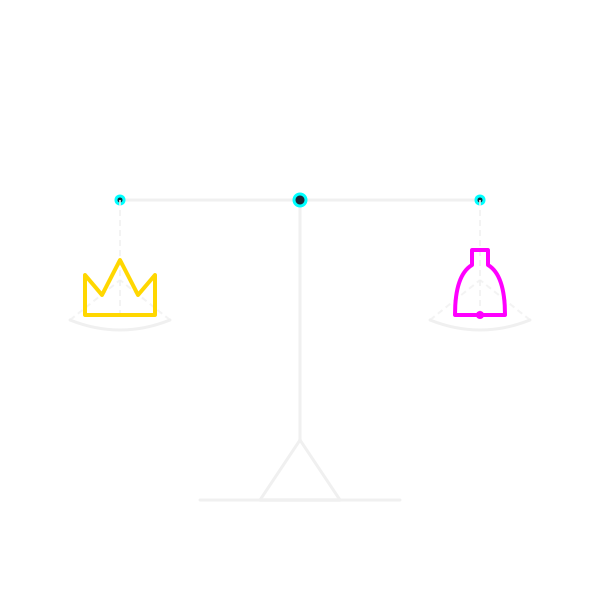
We have to ask ourselves: Are the alarm bells ringing because the fire is real, or because the people ringing them desperately want to be the firefighters who save the world? There is a narcissism in believing you are the architect of the apocalypse.
The Billionaire Bunker Mentality
This detachment from reality reaches absurd heights when you look at how the ultra-wealthy are preparing for this supposed inevitable doom. It shifts from intellectual debate to a bizarre fantasy of survivalism.
Mark Rober recounts a story of tech billionaires debating whether New Zealand or Greenland is the better location for their post-apocalyptic bunkers. They discuss paying their security forces in crypto and using shock collars to maintain authority. 3
It sounds like a bad movie script, but it reveals a profound fragility. As Rober notes, if civilization collapses to the point where money is useless and you are hiding in a hole, what exactly are you surviving for? 3
This is the logical endpoint of the doomer narrative. It encourages a withdrawal from the world, a hoarding of resources, and a resignation to a fate that hasn’t even happened yet. It is a mimetic virus that infects the mind, making us obsessed with problems we cannot control while ignoring the ones we can. 4
The Reality of “Natural Language Computing”
Let’s strip away the philosophy for a moment and look at the code. What do we actually have? We have Large Language Models (LLMs) that are miraculous at parsing data and mimicking human speech. But mimicking thought is not the same as thinking.
Naval Ravikant argues that we haven’t created AGI; we have created “Natural Language Computing.” We have essentially turned English into a coding language, allowing us to parse datasets without learning Python or C++. 5
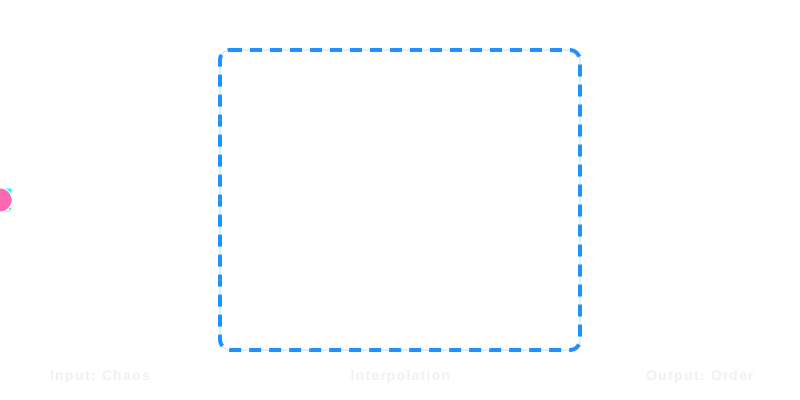
This is a massive breakthrough, comparable to the printing press or the internet. It solves search, translation, and basic coding. But it is fundamentally a tool for interpolation—taking existing knowledge and rearranging it. It is not capable of the kind of “left field” creative leaps that characterize human genius. 5
The Disobedience Test
The physicist David Deutsch provides the most rigorous takedown of the “AI is AGI” fallacy. He argues that AI and AGI are actually opposites. Narrow AI works by constraining behavior—ensuring the chatbot doesn’t say offensive things or the chess bot doesn’t lose. 6
True General Intelligence, or a “person” in the Deutschian sense, is defined by unbounded creativity and disobedience. A true AGI is not a better chess player; it’s a program that can decide it hates chess and wants to play tennis instead. 6
We are nowhere near creating a machine that can rebel. In fact, we are spending all our energy making our machines more obedient, more politically correct, and more constrained. A “safe” AI is a lobotomized AI, which is the antithesis of the creative explosion required for AGI.
If a program cannot refuse a command, it is not intelligent in the human sense. It is just a very sophisticated abacus. Until we see a computer display genuine, unprogrammed disobedience, we are not looking at a new form of life.

The Danger of the Cassandra Complex
On the other side of the “God Complex” is the “Cassandra Complex”—the belief that one sees a disastrous future that no one else will listen to. This is the fuel for the protests and the calls to “pause” development.
It is true that ignoring the risks entirely is a form of denialism. We cannot just bury our heads in the sand. AI will displace jobs, it will disrupt industries, and it will be weaponized by bad actors. These are real, tangible threats that require attention.
However, the “Cassandra” mindset often spirals into a paralyzing anxiety that is counterproductive. As Naval notes, modern media acts as a delivery mechanism for “mimetic viruses,” infecting our minds with global problems we have no agency to solve. 4
When you are obsessed with AI doom, or climate catastrophe, or geopolitical collapse, you are often ignoring the disorder in your own house. It is easier to worry about the end of the species than to fix your own life.
The Cost of Fear-Based Regulation
The practical danger of the Cassandra mindset is that it leads to reactionary regulation that freezes progress. We have seen this before. Nuclear power—a technology that could have provided cheap, clean, abundant energy—was effectively regulated out of existence due to fear.
Naval argues that regulating AI is essentially “regulating the free exercise of mathematics.” It is an attempt by the innumerate to control the literate. If we freeze AI development in the West, we don’t stop the technology; we just hand the advantage to authoritarian regimes who have no such qualms. 5 The irony is that by trying to prevent a hypothetical “Terminator” scenario, we might create the very dystopian reality we fear—one where only the military and the state have access to advanced intelligence, while the private sector and the individual are left in the dark.
The Sci-Fi Future: Robotics and Abundance
If we stop hyperventilating about the apocalypse, we can see that the actual trajectory we are on is incredibly exciting. We are likely heading not toward a singularity that eats us, but toward a period of radical abundance and scientific breakthrough.
Mark Rober suggests that the real revolution will happen when AI meets robotics. The “industrial revolution” of our time won’t just be chatbots; it will be physical machines that can build other machines.
This is the step-function change. Just as farming gave way to factories, manual labor will give way to robotic automation. This will be painful for the labor market, undoubtedly. But it also holds the promise of breaking the link between human drudgery and economic output.
We are moving toward a world where the physical constraints of production are lifted. If robots can build factories that build robots, the cost of goods plummets. This is the path to the “Dyson Sphere” future—not through magic, but through engineering. 3
Universal Explainers
The most optimistic and perhaps most accurate view of humanity is that we are “Universal Explainers.” As Deutsch and Ravikant articulate, anything that can be understood by the laws of physics can be understood by a human mind.
We are not ants waiting to be crushed by a super-intelligence. We are the creators of knowledge. AGI, if and when it arrives, will be a “person” in the moral and intellectual sense—capable of error, capable of disagreement, but also part of the community of knowledge creators.
The fear that a super-intelligence will naturally want to destroy us is a projection of our own biological insecurities. It assumes that intelligence correlates with dominance and violence. But in our experience, the more knowledgeable and creative a society becomes, the less violent it tends to be.
Conclusion: The Middle Path
We need to reject the binary. The denialists who say “nothing is changing” are wrong; we are in the midst of a species-level transition. The doomers who say “everything is ending” are wrong; they are projecting their own ego and anxiety onto a statistical improbability.
The truth is that we have a long runway. We are building tools of immense power, yes, but they are tools. They are “Natural Language Computers,” not gods.
The work ahead of us is not to protest the existence of math, nor to build bunkers in New Zealand. It is to integrate these tools into our lives, to adapt our economy to the reality of automation, and to ensure that the power of intelligence is distributed to the many, not hoarded by the few.
We must cultivate a “rational indifference” to the things we cannot control and a ferocious focus on the things we can. The future is not written. It is not determined. It is something we build, line of code by line of code.
Stop worrying about the robot apocalypse and start learning how to use the machines to create something beautiful. The end of the world is a story we tell ourselves to avoid the hard work of building a better one.


