


I’ve been thinking a lot about Australia’s new social media age limit—16, no exceptions—and I can’t shake the feeling that this is one of those rare moments where policy actually tries to keep up with reality. Not perfectly, not without flaws, but with a kind of urgency that’s been missing for years.
Here’s the thing: we’ve all watched as social media platforms, with their endless scroll and algorithmic rabbit holes, have become the default architects of childhood. And let’s be honest, they’ve done a terrible job. The data is there—rising anxiety, sleep deprivation, the quiet epidemic of teens who feel like they’re failing at life because some influencer’s highlight reel looks better than their actual one.
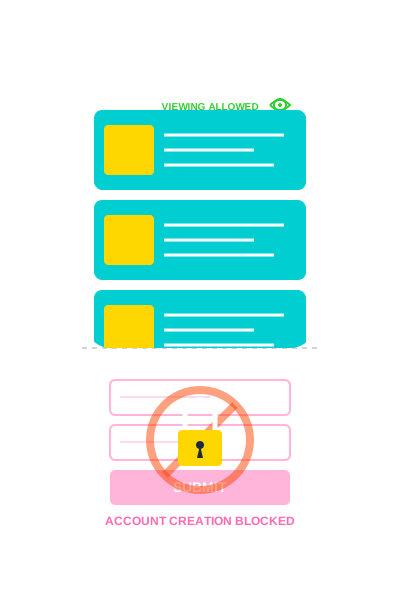
Australia’s policy doesn’t ban kids from scrolling. It doesn’t even block them from watching TikTok or YouTube. What it does is something far more interesting: it says, You can look, but you can’t log in.
No accounts. No algorithms tailoring content to keep you hooked. No data harvesting to sell you stuff you don’t need. It’s a half-measure, sure, but sometimes half-measures are the only kind that stand a chance.
Of course, the critics are already lining up. Teens will just find workarounds. It’s unenforceable. What about free speech? And yeah, they’re not wrong. Kids are already sharing phone numbers on Snapchat before their accounts get shut down. VPNs exist. Fake IDs exist.
But here’s what I keep coming back to: if even a fraction of under-16s are kept off these platforms, if even some of them avoid the worst of the algorithmic manipulation, isn’t that worth something? The real question isn’t whether this policy is perfect. It’s whether we’re finally ready to admit that letting tech companies self-regulate has been a disaster—and that maybe, just maybe, it’s time to try something else.
Understanding Australia’s Social Media Age Limit Policy
Key Distinction: Access vs. Account Creation
Let’s clear up a major misconception: Australia’s policy isn’t about blocking kids from viewing social media content. It’s about preventing them from creating accounts. Under-16s can still scroll through public posts on platforms like TikTok or Instagram without logging in.1 The policy targets platforms designed for social interaction—where users can post, comment, and connect—but it doesn’t lock out passive consumption.
This distinction is critical. Critics like YouTube have argued that the ban disrupts educational content, but that’s a straw man. Teachers can still use YouTube videos in classrooms; students just won’t be logged in. The real question is whether this half-measure—allowing access without participation—actually protects kids or just pushes them into lurker mode.
The eSafety Commissioner’s criteria for affected platforms are clear: if the service’s primary function is social interaction (posting, linking, commenting), it’s in scope. But the policy’s effectiveness hinges on enforcement. Platforms must verify ages at sign-up and beyond, yet the methods remain vague.
Will facial recognition suffice? What about VPN workarounds?
Early reports suggest some under-16s are slipping through age checks, proving that tech alone won’t solve this. The policy’s intent is noble, but its execution is already showing cracks.
Age Verification: Penalties and Platform Choices
Here’s where things get teeth: platforms face fines up to $49.5 million AUD if they fail to block underage users. That’s not pocket change, even for Meta or TikTok. But the devil’s in the details. The policy lets platforms choose their age-verification methods, from ID scans to AI estimates.
This flexibility is pragmatic but risky. A 15-year-old with a convincing fake ID or a well-timed selfie could still slip through. The eSafety Commissioner’s guidance leans on Australia’s Age Assurance Technology Trial, but let’s be real—no system is foolproof. The real deterrent might be the financial threat, not the tech.
Penalties aside, the policy’s broader impact is already visible. Platforms like Bluesky, initially deemed “low risk,” are voluntarily banning under-16s to avoid scrutiny. Meanwhile, teens are migrating to lesser-known apps like Yope and Lemon8, or worse, sharing personal info publicly to stay connected.
This cat-and-mouse game underscores a harsh truth: regulation can’t outpace ingenuity. The policy might reduce account creation, but it won’t erase demand. And as Julie Inman Grant admits, perfection isn’t the goal—just progress.
The Ban’s Impact on Social Media Platforms
The usual suspects—Facebook, Instagram, TikTok—are all in the crosshairs, but the list is fluid. The eSafety Commissioner is still evaluating platforms, and even “low-risk” ones like Bluesky are opting in preemptively. This ripple effect suggests the policy’s influence extends beyond legal mandates. Platforms are self-regulating to avoid reputational damage or future fines.
Yet, the ban’s rollout has been messy. X (formerly Twitter) hasn’t confirmed compliance, and reports of underage users bypassing checks are already surfacing. The policy’s success depends on uniform adoption, but tech giants move at their own pace. Critics argue the ban will push teens to darker corners of the internet, like VPNs or encrypted apps.
There’s merit to that fear. When Snapchat users started sharing phone numbers publicly to circumvent the ban, it highlighted a dangerous side effect: kids trading privacy for connectivity. The policy might reduce harm on mainstream platforms, but it could also fragment youth digital culture into harder-to-monitor spaces.
This isn’t just about age limits—it’s about where kids go next. And right now, no one’s fully prepared for that.
Why Australia’s Approach is Groundbreaking and Necessary
Why Self-Regulation Has Failed
Let’s be blunt: social media companies have had decades to prove they can self-regulate, and they’ve failed spectacularly. Internal documents from Meta, TikTok, and Snapchat reveal a deliberate strategy to exploit young users’ psychology, using personal data to fuel addiction. These platforms aren’t just passive spaces—they’re engineered to maximize engagement, often at the cost of mental health. Australia’s policy finally acknowledges what’s been obvious for years: corporations won’t prioritize child safety unless forced.
The EU’s Digital Services Act (DSA) offers a more comprehensive model, requiring platforms to mitigate harms through “safety by design.” But Australia’s approach is a necessary first step, especially given the urgency of the youth mental health crisis. Critics argue that blanket bans overlook the benefits of social media, but that’s a false dichotomy.
The policy doesn’t eliminate access—it delays account creation, reducing exposure to manipulative algorithms and data harvesting. The real question isn’t whether regulation is needed, but whether it’s strong enough to counter industry resistance.
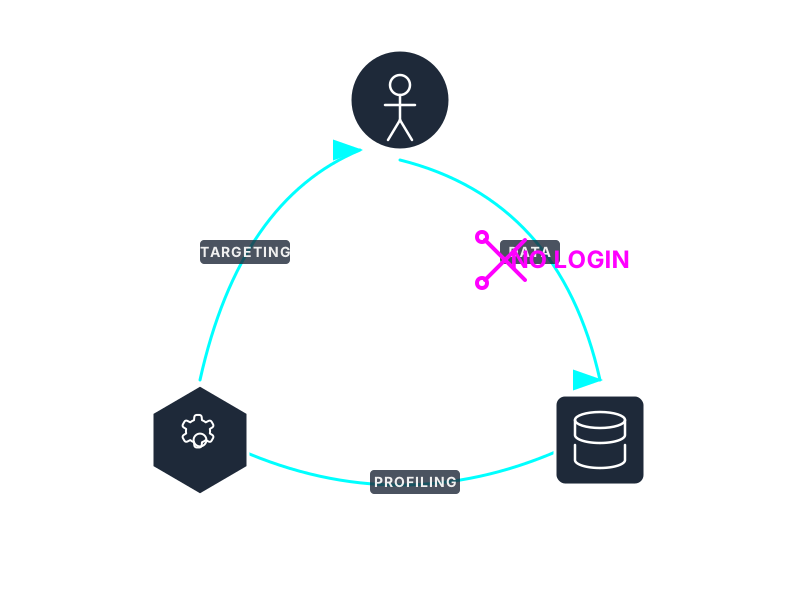
How Australia Disrupts Social Media’s Youth Targeting
The policy’s focus on account creation is strategic. Logged-in users are far more vulnerable to exploitative design practices—endless scroll, personalized ads, and algorithmic rabbit holes—that amplify anxiety and depression. Research shows that even passive use (like scrolling without interacting) can harm mental health, but active participation intensifies risks. By keeping under-16s logged out, Australia limits their exposure to these mechanisms.
Critics claim the policy is ineffective because teens can still access content, but that misses the point. The harm isn’t just in what kids see—it’s in how platforms use their data to shape behavior.
A logged-out user isn’t being profiled, targeted, or nudged into compulsive use. This isn’t about censorship; it’s about disrupting the business model that profits from youth vulnerability.
Why Small Online Harms Are a Public Health Crisis
Small individual risks become catastrophic at scale. Australia’s youth mental health crisis—with a 50% increase in disorders among 16–24-year-olds—demands systemic solutions. Social media’s influence extends beyond screens, shaping cultural norms around body image, success, and social validation. Even teens who avoid platforms aren’t immune to their ripple effects.
The policy’s critics ignore the cumulative toll of “small” harms. A 10% increase in depression rates across millions of users translates to thousands of lives disrupted.
Australia’s approach isn’t perfect, but it’s a rare acknowledgment that unchecked platform design is a public health threat. The alternative—waiting for tech giants to act responsibly—has already cost a generation.
The Complex Relationship Between Social Media and Youth Mental Health
Social Media’s Small Harms: A Public Health Concern
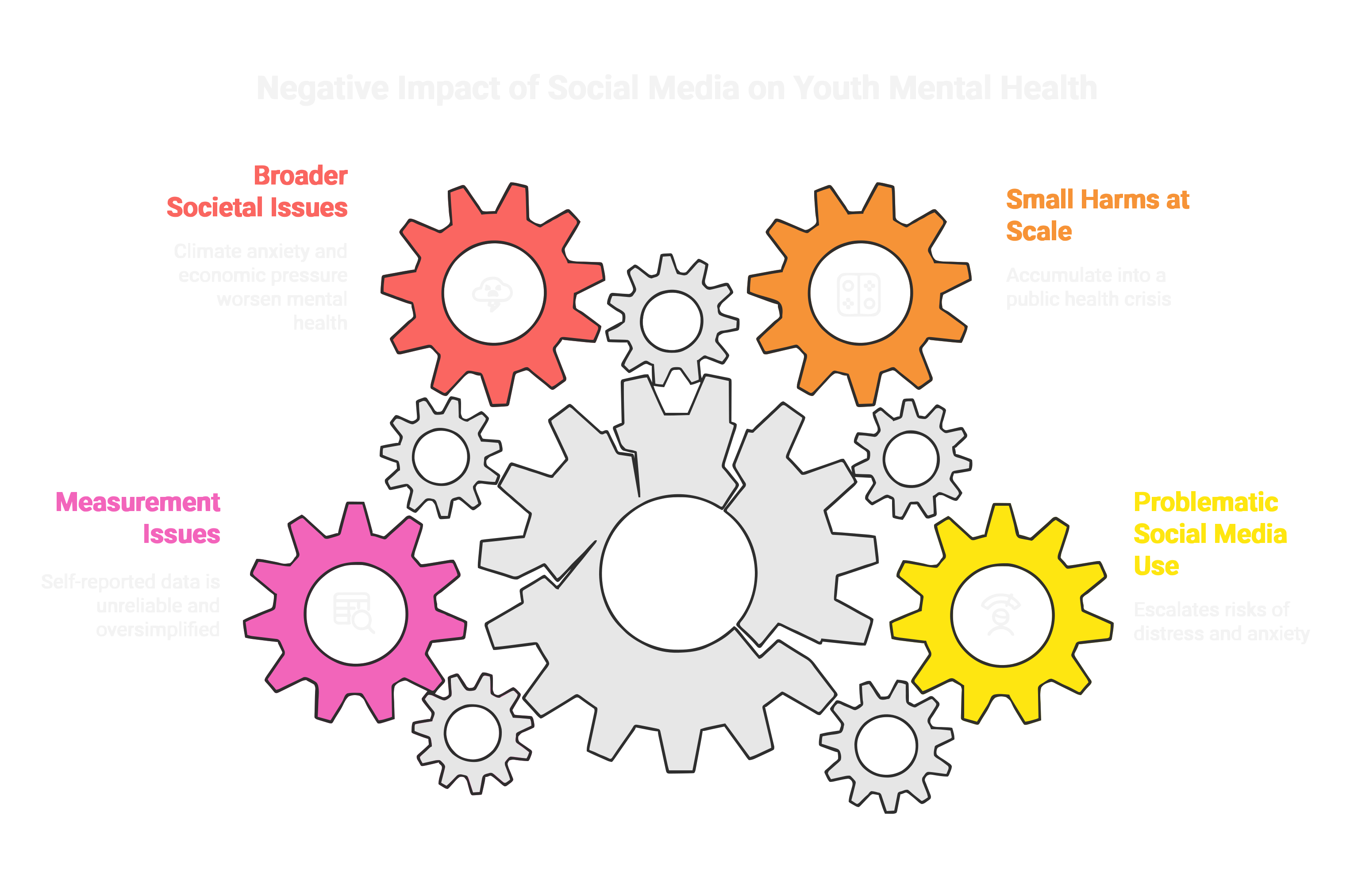
The debate around social media’s impact on youth mental health often gets bogged down in extremes—either it’s the sole villain or a harmless scapegoat. But the truth lies in the nuance. Research consistently shows that while social media use doesn’t universally doom teens to poor mental health, the risks escalate with problematic social media use (PSMU) and excessive time online. Studies link PSMU to higher odds of distress, anxiety, sleep deprivation, and even disordered eating 2.
These aren’t just isolated incidents; they’re patterns that emerge when usage spirals beyond control. Critics argue that the effects are small to moderate, cautioning against assuming causality. But here’s the thing: small harms at scale become a public health crisis.
A 10% increase in depression rates across millions of users isn’t trivial—it’s a wave of suffering. And while correlation isn’t causation, the sheer volume of studies pointing to these trends suggests we can’t afford to dismiss them. The policy’s focus on account creation isn’t about eliminating risk entirely; it’s about reducing exposure to the most harmful aspects of platform design.
The Real Roots of the Youth Mental Health Crisis
Let’s be clear: social media isn’t the only culprit in the youth mental health crisis. The rise in psychological distress among Australian teens is a perfect storm of factors—climate anxiety, economic pressure, gender-based violence, and the lingering effects of the pandemic 3. But to say social media isn’t a significant player is willful ignorance. The data shows a 50% increase in mental disorders among 16–24-year-olds from 2007 to 2021.
That’s not a coincidence—it’s a trend with real consequences. The policy’s critics often argue that focusing on social media ignores these broader issues. But that’s a false dichotomy.
Addressing one factor doesn’t mean neglecting others. If anything, Australia’s approach is a rare acknowledgment that systemic problems require systemic solutions.
Social media’s role in amplifying anxiety, body image issues, and social comparison is well-documented. Ignoring it because other problems exist is like refusing to treat a wound because the patient also has a broken bone.
The Problem with Measuring Social Media’s Impact
One of the biggest hurdles in this debate is how we even measure social media’s impact. Most studies rely on self-reported data, which is notoriously unreliable. Teens might underreport their usage or overstate its effects based on how questions are framed 3. And let’s not pretend that all screen time is created equal.
Scrolling mindlessly through TikTok isn’t the same as video-calling a friend or joining a supportive online community. Yet, many studies treat all usage as monolithic, failing to distinguish between active engagement and passive consumption. This oversimplification leads to skewed conclusions.
Research shows that active social media use—like creating content or interacting with peers—can actually boost perceived social connection. But when studies lump that in with doomscrolling, the picture gets muddy.
Australia’s policy indirectly addresses this by targeting account creation, which is more likely to lead to passive, algorithm-driven consumption. It’s not a perfect solution, but it’s a step toward recognizing that not all screen time is equal—and not all of it is harmless.
Implementation Challenges: Realities and Responses
Why Facial Age Checks Are Failing in Australia
Australia’s Facial Age Verification Faces Early Setbacks Flaws in Australia’s Facial Age Assurance Trial
Australia’s age verification rollout has hit its first snag: facial age estimation. The government’s Age Assurance Technology Trial found that while methods like ID scans and AI-based age checks are effective, facial recognition—often touted as a seamless solution—is proving unreliable. Early reports suggest some under-16s are slipping through by using older siblings’ IDs or manipulating lighting in selfies. The eSafety Commissioner’s office has emphasized that platforms must offer “reasonable alternatives” to government ID, but what counts as reasonable?
A 15-year-old with a convincing filter or a borrowed passport might still bypass checks. The policy’s flexibility is a double-edged sword—it avoids overreach but risks inconsistency. The bigger issue isn’t just the tech; it’s the incentives.
Platforms like TikTok and Instagram face fines up to $49.5 million AUD for non-compliance, but the financial threat alone won’t fix flawed verification. The trial’s findings suggest a patchwork of solutions—from credit card checks to third-party age verification services—will emerge.
Yet, without standardized benchmarks, we’re left with a system where enforcement varies by platform. Julie Inman Grant has signaled that the eSafety Commissioner will monitor compliance, but the real test will be whether platforms invest in robust checks or opt for the cheapest, most porous methods.
How Teens Are Circumventing Social Media Bans
Teens aren’t waiting around for the policy to settle—they’re already finding workarounds. Reports show under-16s sharing phone numbers publicly on Snapchat before accounts get shut down, a desperate bid to stay connected. Others are flocking to lesser-known apps like Yope and Lemon8, which shot up app store rankings post-ban. The eSafety Commissioner has sent notices to 15 companies, including these alternatives, urging self-assessment.
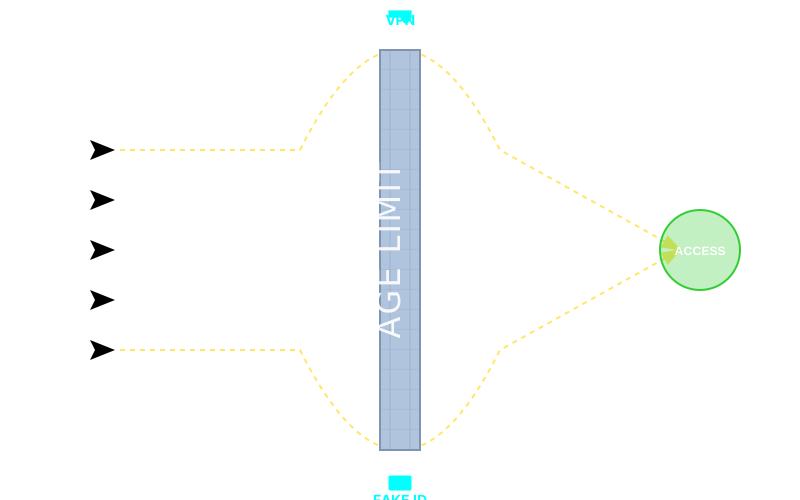
But the cat-and-mouse game is in full swing: VPNs, fake IDs, and even peer-to-peer account sharing are becoming common tactics. Parents, meanwhile, are divided. Some applaud the ban as overdue protection, while others argue it’s unenforceable and pushes kids into riskier online spaces.
The OECD’s 2025 report on children in the digital age highlights this tension—restrictions can backfire if they don’t address the root of why teens crave social media. The policy’s success hinges on whether it reduces harm or simply displaces it. Early signs suggest displacement is winning.
Is YouTube’s Ban Really a Threat to Education?
Critics like YouTube have framed the ban as a threat to education, but that’s a red herring. The policy doesn’t block content access—it targets account creation. Teachers can still use YouTube videos in classrooms; students just won’t be logged in. The real debate is whether logged-out use is sufficient for learning.
Some educators argue that interactive features—like comments or playlists—enhance engagement. But as one Substack commenter noted, much classroom YouTube use is passive, even lazy: “We can’t keep outsourcing teaching to tech.” The policy forces a reckoning with how schools rely on platforms that prioritize engagement over education. The bigger question is whether logged-out use is sustainable.
YouTube’s algorithm still shapes what unlogged users see, and ads remain pervasive. The policy doesn’t solve the deeper issue: platforms aren’t designed for learning, even when they’re used in classrooms.
Australia’s approach is a start, but it’s not a cure-all. The real work lies in rethinking how education and tech intersect—without assuming tech is neutral.
The Global Impact: Should Other Countries Follow Australia’s Lead?
The Global Ripple Effect of Australia’s Social Media Ban
Australia’s bold move hasn’t gone unnoticed. Countries like Malaysia, Denmark, and Norway are watching closely, and the EU’s Digital Services Act (DSA) already sets a precedent for broader digital governance. The Guardian’s coverage highlights how Australia’s policy is sparking global conversations about youth protection online 4. But here’s the catch: while Australia’s approach is narrow—focusing on age restrictions—other nations are considering more comprehensive frameworks.
The EU’s DSA, for instance, doesn’t just target age verification. It mandates “safety by design,” requiring platforms to assess and mitigate harms like misinformation, scams, and problematic use across all age groups 2. This raises a critical question: Is Australia’s policy too limited? By focusing solely on under-16s, it risks ignoring the broader ecosystem of online harms.
Yet, its simplicity might be its strength—easier to enforce, harder to evade. The policy’s global ripple effect is undeniable.
Countries are weighing whether to adopt similar measures or push for more sweeping reforms. The OECD’s 2025 report underscores that no single solution fits all, but Australia’s move is a necessary first step in a larger conversation 2.
Why We Must Act on Social Media Risks Now
Critics argue that the evidence linking social media to youth mental health crises is inconclusive. They’re not wrong—studies often rely on self-reported data, and the relationship between screen time and well-being is complex 3. But here’s the thing: public health policy rarely waits for perfect evidence. We don’t need absolute certainty to act when the stakes are this high.
The rapid rise in problematic social media use (PSMU) among teens is a red flag. Even if the effects are moderate, the scale of the problem demands intervention. Australia’s policy adopts a precautionary approach—better to err on the side of caution than to wait for irreversible harm.
This isn’t about banning social media outright. It’s about reducing exposure to the most manipulative aspects of platform design.
The policy’s critics often overlook the cumulative toll of “small harms.” A 10% increase in depression rates across millions of users isn’t trivial—it’s a crisis. And while correlation isn’t causation, the sheer volume of studies pointing to these trends suggests we can’t afford inaction.
EU DSA vs. Australia: Broad vs. Narrow Regulation
Australia’s policy is a targeted strike, but the EU’s DSA is a full-scale overhaul. The DSA’s “safety by design” framework requires platforms to proactively mitigate harms, not just for teens but for all users. This includes age verification, default privacy settings, and robust content moderation. Australia’s approach is narrower, focusing on account creation for under-16s.
It’s a pragmatic first step, but it leaves gaps. For instance, it doesn’t address the broader issues of misinformation or data exploitation that affect adults too. The policy’s strength lies in its enforceability—fines up to $49.5 million AUD are a powerful incentive 4.
Yet, the EU’s model offers a more holistic solution. By requiring platforms to assess and mitigate harms across the board, it tackles the root causes of online toxicity.
Australia’s policy might be a necessary first step, but the global conversation is shifting toward more comprehensive regulation. The question isn’t whether other countries should follow Australia’s lead—it’s whether they should go further.
Conclusion
Australia’s social media age limit policy isn’t just about keeping kids off platforms—it’s about forcing us to confront a truth we’ve avoided for too long: the digital world wasn’t built for them, and it’s costing them dearly. The policy’s imperfections—its workarounds, its gaps—are less a failure of design and more a reflection of how deeply these platforms have embedded themselves in young lives.
The real test isn’t whether teens find ways around the ban (they will), but whether we finally admit that the status quo is untenable. The data on youth mental health isn’t just alarming; it’s a call to action. And while Australia’s approach may feel like a half-measure, sometimes half-measures are the only kind that stand a chance in a world where tech moves faster than regulation.
So, where does this leave us? With a question that’s bigger than age limits or fines: Are we willing to accept that some problems can’t be solved by better algorithms or stricter rules alone? That maybe, just maybe, the solution starts with asking what we owe the next generation—not as consumers, but as humans.
(And if that feels like too much to ask, well, that’s probably the point.) The internet wasn’t designed with childhood in mind. It’s time we started designing it that way.
Footnotes
-
Australia’s Social Media Age Limit Policy Delays Account Creation, Not Access to Content ↩
-
Welsey‐Smith, Oonagh, and Terry Fleming. “Debate: Social media in children and young people–time for a ban? From polarised debate to precautionary action–a population mental health perspective on social media and youth well‐being.” Child and Adolescent Mental Health 30.4 (2025): 416-418. ↩ ↩2 ↩3
-
Blake, Julie A., et al. “Will restricting the age of access to social media reduce mental illness in Australian youth?.” Australian & New Zealand Journal of Psychiatry 59.3 (2025): 202-208. ↩ ↩2 ↩3
-
Millions of children and teens lose access to accounts as Australia’s world-first social media ban begins | Social media ban | The Guardian ↩ ↩2


