


I used to think that emotional control meant stiffening my upper lip, becoming a fortress against feeling anything too sharp. That’s the default setting for so many of us, isn’t it? We mistake suppression for mastery.
But the truth, as psychologist Ethan Kross frames it, is far more practical and frankly, more athletic: Emotions are ancient, incredibly useful tools—like specialized, powerful wrenches we inherited from our ancestors. The issue isn’t that we have them; it’s that they often fire in the wrong proportions.
Think about the Will Smith incident, a global masterclass in what happens when evolutionary instinct overwhelms modern composure. We saw a tool meant for defense become a wrecking ball. This is why we need what Kross calls an “emotional fitness plan.” You wouldn’t train for a marathon by only doing bicep curls; so why rely on one trick for every emotional crisis? We need a proper toolbox, and we need to learn how to use every implement inside it.
Why We Need an Emotional Toolbox: The Problem of ‘Wrong Proportions’
Why Emotions Are “Unwieldy Tools”
Charles Darwin recognized that our feelings are not bugs in the system; they are elegant features—adaptations honed over millennia to help us survive and thrive in a brutal world. Fear is a brilliant cue to avoid danger; anger is meant to gird us for conflict; and love pulls us toward the social bonds essential for cooperation and safety 1. These emotions are inherently useful, yet Kross calls them “unwieldy tools,” and I think that phrasing is perfect. The ancient problem is that these evolutionary tools are often triggered in the wrong proportions.
A mild frustration that should simply signal a boundary violation, for instance, ignites into an uncontrollable inferno of disproportionate rage that harms the person experiencing it far more than the target. When emotions are too intense or last too long, they cease being signals and become self-sabotaging anchors. This is precisely why developing emotional fitness is mandatory for modern existence.
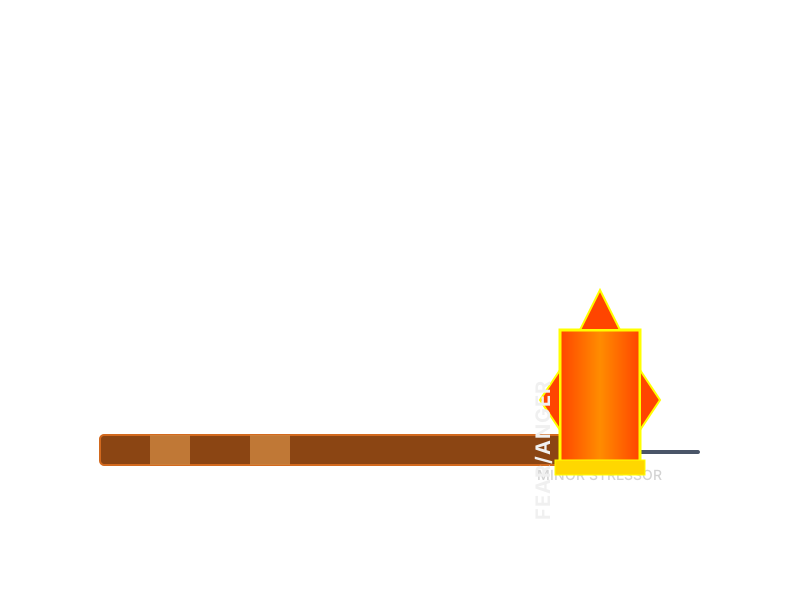
When we feel that spiral beginning, we need immediate, strategic interruption. This might mean the intentional use of sensation—playing calming music to push our nervous system away from animation—or employing techniques like “selective avoidance,” shutting down the infinite “what if” loops before they consume us entirely.
Will Smith: A Lesson in Emotional Hijacking
If you need a globally broadcast, textbook example of an emotional tool becoming tragically unwieldy, you need only recall the Will Smith incident at the Oscars. Here was a man, at the pinnacle of his professional life, who allowed an instinctual, protective surge to take over entirely. The need to defend was triggered, but the proportion was catastrophic. What made the moment so jarring—and why many initially thought it had to be rehearsed—was the sheer, unbelievable display of an ancient, visceral response overwhelming the modern, intellectual realization of consequence.
Smith went on to win the Best Actor award minutes later, yet his raw emotional reaction powerfully upstaged that monumental achievement, defining his career for years afterward. This incident is a sobering reminder of how intimately linked sensation and emotion are. the need to defend was triggered, but the proportion was catastrophic.
Our senses are the immediate triggers; they act like “satellite dishes” constantly cueing us to approach or avoid based on external stimuli. Emotional fitness is not about suppressing the signal, but regulating the volume.
Tool 1: Distanced Self-Talk - Coach Yourself Through a Crisis
Distanced Self-Talk: Coach Yourself Using Your Own Name
It is a near-universal human failure: we are magnificent coaches for others, yet pathetic students of ourselves. We can dispense crystalline wisdom to a struggling friend, yet when our own problems arrive, we panic, slam our keyboards, and break things, just as Yale’s Laurie Santos did when she broke her own equipment after a moment of frustration, despite teaching tools for a happier life 1. We know the advice, but applying it feels impossible. This is where distanced self-talk enters the chat.
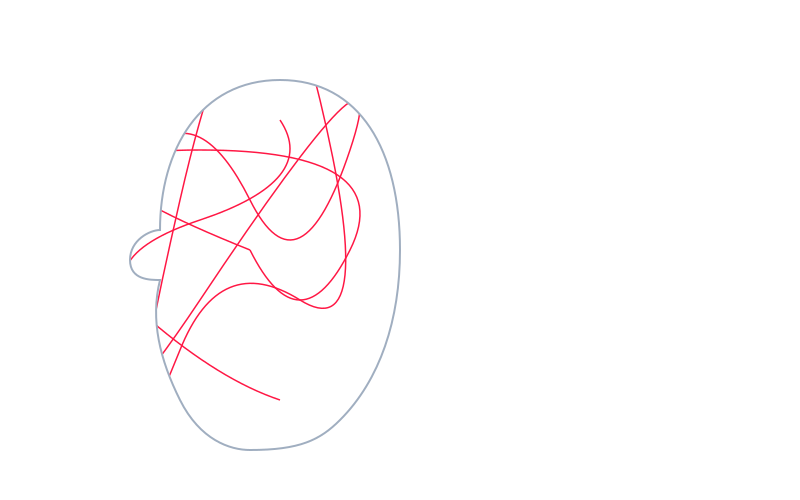
It’s an elegant cognitive hack that bypasses the emotional heat we feel when self-referencing. By simply coaching yourself—silently, in your head—using your own name or the pronoun “you,” you are essentially leveraging that massive, frustrating gap between giving and receiving advice. You turn yourself into a third-party problem that your objective, rational brain is now equipped to solve.
The psychological distance created isn’t about avoidance—that’s strategic avoidance, a different tool entirely. This is about restoring objectivity so that when you address the stressor, you do so from a calmer, more strategic viewpoint. It allows the intense emotional problem to simmer down, giving you access to the logic that vanishes under duress.
Jerry Linenger: Surviving the Mir Space Station Fire
If ever there was a moment when one needed to access objectivity, it was when astronaut Jerry Linenger was confronted with one of the worst fire catastrophes in space travel history aboard the Mir space station. His situation was literally life-or-death, and his mind immediately began to cycle through the absurd: He recalls having the fleeting, deeply irrational thought, “open a window” . This is what panic looks like: the mind desperately grabs for solutions, no matter how nonsensical.
Linenger, however, was trained to coach himself through crises. He mentally talked himself through finding a respirator, dealing with its subsequent malfunction, and ultimately fighting the fire that threatened to end the mission and his life. His ability to survive and tell the story demonstrates that in the face of maximum psychological and physical stress, distanced self-talk is not merely a coping mechanism, but a critical, operational skill.
Djokovic’s Wimbledon Reset: Self-Talk in Action
The stakes aren’t always fire and vacuum, but they often feel that intense during high performance. Consider Novak Djokovic at Wimbledon in 2022. He was struggling badly against a lower-ranked player, clearly mentally defeated. He did something brilliant: he leveraged the self-talk tool by taking a strategic break.
He went to the bathroom, gave himself a fierce pep talk, and emerged as a completely different athlete. His self-directed quote after the match was telling:
- You can do it.
- Believe in yourself.
- Now is the time.
- Forget everything that has happened.
- New match starts now. Let’s go, champ.
That isn’t self-pity; that is the perfect counsel you’d offer to your protégé.
It’s the voice of the wise mentor telling you to reset. This technique is so potent that even being bilingual can offer a related sense of distance.
Talking about emotional experiences in a second language often lessens their immediate impact, giving them less emotional weight—a linguistic form of stepping outside the echo chamber. Ultimately, the key to this first tool is simple: stop talking to yourself like a victim; start talking to yourself like a coach.
Tool 2: Expressive Writing - Narrate Your Way to Clarity
Expressive Writing: The 15-Minute Daily Clarity Tool
If Distanced Self-Talk is the quick emergency hack you deploy under extreme duress, expressive writing is the deep, surgical repair tool in the emotional toolbox. It’s deceptively simple, requiring only 15 to 20 minutes a day for a few consecutive days, where you sit down and simply document the deepest thoughts and feelings surrounding a difficult experience. I know, it sounds like standard journaling, but the power lies in the forced narrative shift.
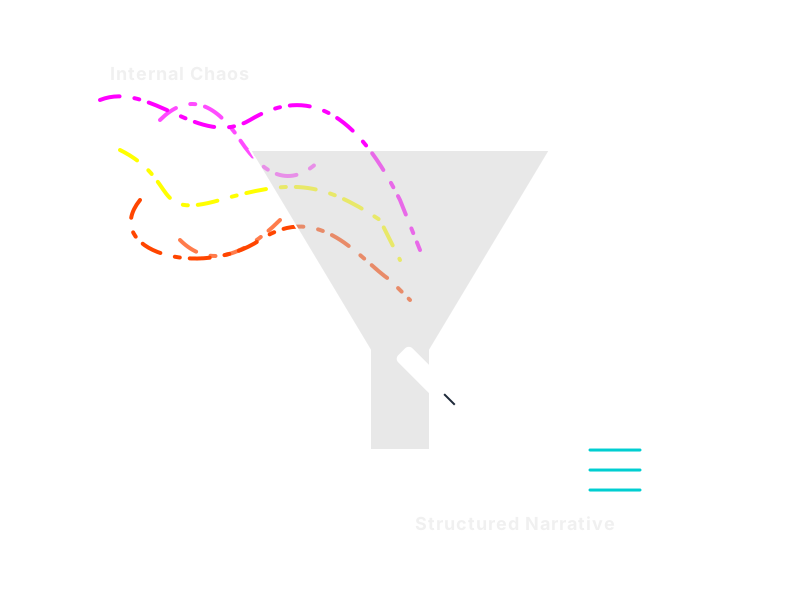
When you commit the messiness of your internal monologue to paper, you are instantly thrust into the role of narrator. You stop being the emotional fire and start describing the fire as an objective reporter.
This essential process casts “you” (the struggling self) as a character in the story you are writing about, effectively achieving the psychological distance that Kross champions as the mechanism for regulation. It’s the difference between being trapped in a confusing maze and viewing the maze from a comfortable, analytical distance.
Writing Benefits: Less Distress, Better Physical Health
The results stemming from this simple, low-cost intervention are frankly stunning. The research on expressive writing isn’t just about feeling temporarily better; it shows measurable, long-term health benefits rooted in processing trauma and struggle rather than suppressing it. People who engage in this structured writing feel less distressed about their challenges over time, shifting their perspective from immediacy to historical fact.
But here is the truly fascinating part: the benefits spill over into physical health. Studies show that participants who regularly use expressive writing are generally healthier and even visit their doctors less frequently in the months following the practice.
It seems that narrating your pain is fundamentally restorative, turning chaotic internal monologue into a contained, structured story that the body can finally stop reacting to. This confirms a central thesis: emotional regulation isn’t just a mental game; it’s preventative medicine for the whole system, proving that clarity of mind results in measurable physiological gains.
Tool 3: Sensory Engagement - Change Your State by Changing Your Input
Harness Your Senses for Instant Emotion Shifts
We’ve discussed linguistic hacks (Distanced Self-Talk) and narrative processing (Expressive Writing), but now we turn to the most immediate, effortless way to shift your emotional state: your senses. Sensation is fundamentally how we make sense of the world; it’s the input that triggers our emotional output, signaling us to approach or avoid something. Kross found that all five major senses—sight, sound, smell, taste, and touch—have the powerful, untapped potential to activate and modulate our emotions .
The simple truth is that our senses are powerful shifters, yet we rarely treat them as intentional regulatory tools. Just as we might “strategically avoid” a stimulus that triggers anxiety, we should learn to “strategically seek” inputs that trigger calm, focus, or joy. The opportunity here is profound: deliberately triggering healthy sensory inputs to achieve desired emotional outcomes.
Closing the Music Gap: Using Songs to Regulate Mood
My personal “aha” moment regarding sensory regulation mirrored Kross’s experience with his daughter, Danny. He recounted a morning where his daughter was moping ahead of her soccer game, and after trying all his usual parental tricks, he resorted to just turning up the music. Within moments, both he and Danny were energized, heads bobbing, rerouted entirely from their funk . This is what Kross calls the “Music Gap.”
When researchers asked participants why they listen to music, nearly 100% (96%) admitted they do so because they like the way it makes them feel—acknowledging its regulatory effect. Yet, when asked what they do to cope with anxiety, anger, or sadness, only 10% to 30% reported strategically using music .
We are aware of music’s power, but we fail to deploy it intentionally when we need it most. It’s a tool we acknowledge but forget to put in the box.
How Pizza and a Fight Song Control Mood
To truly understand how effective sensory regulation is, consider Kross’s classroom experiment, where he acted as a “symphony orchestra conductor” of emotions. He would manipulate his students’ moods almost instantly using various sensory inputs. He could make them feel positive by delivering pizza; he could drop them into sadness by describing a scene where a man’s wife dies; and then, he could immediately pull their positive emotions back up to the level of the pizza high by playing the rallying fight song.
Students, eyes closed, would start enthusiastically head-bopping, their emotional state reset by pure sound. This demonstration is a perfect metaphor for the toolbox: you need different tools for different emotional temperatures.
You don’t use a wrench to fix a flickering light, and you don’t use internal self-talk when what you really need is the shock of cold water. Sensory input is the fastest pathway to an emotional reset.
Tool 4: Strategic Avoidance - The Power of Stepping Away
Strategic Avoidance: When Stepping Away Helps
The word “avoidance” tastes like guilt in our productivity-obsessed, hyper-processing culture. We’re constantly told we must “lean in,” “feel all the feelings,” or “talk it out.” Yet, Kross argues that strategic avoidance is a vital tool, not a character flaw.
This isn’t the dangerous avoidance of substance abuse or reckless behavior; it’s a tactical retreat designed to shift your attentional spotlight, allowing an emotional problem to simmer down before you return to it. Sometimes, especially in the immediate aftermath of a crisis, talking about the trauma actually has no effect, or data even suggests it makes things worse.
We must reject the one-size-fits-all fallacy: if expressive writing or distanced self-talk feels overwhelming in the moment, the intelligent choice is often to back away completely for a while. Strategic avoidance gives you the necessary time to restore and approach the issue from a place of equilibrium, not panic.
Luisa’s ‘What Ifs’: Stopping Intrusive Thought Spirals
Strategic avoidance is the emergency brake for toxic rumination. Consider Luisa, who struggled for months with paralyzing “what if” loops after her daughter had a severe allergic reaction that required an EpiPen. Her mind ran endless, intrusive scenarios: What if the pen hadn’t worked? What if she eats peanuts at a birthday party next year? These thoughts metastasize, turning a past event into an enduring future catastrophe that keeps the nervous system perpetually activated . In this scenario, trying to “process” the rumination often just fuels it.
The strategic intervention isn’t to analyze the thought, but to temporarily divert attention—to shift the focus away from the problem and toward something entirely different. This is a crucial intervention when the emotional proportions are so unwieldy that the mind cannibalizes itself with infinite catastrophic hypotheticals.
Compartmentalizing Trauma: A Survivor’s Method
The high-stakes justification for strategic avoidance is best illustrated by Kross’s own grandmother, a Holocaust survivor. She witnessed unimaginable atrocities yet maintained a stoic, fulfilling life after the war by refusing to talk about her trauma—except for one designated remembrance day annually . This was a deliberate act of compartmentalization: giving the horror a small, controlled time slot so it wouldn’t pollute the rest of her existence.
This is similar to how NBA legend Dennis Rodman would famously divert his attention from championship pressure to a completely different context, restoring himself before coming back fresh to dominate the court 1. Strategic avoidance, in these cases, becomes the profound act of choosing where to spend your attention—a vital element of emotional fitness that allows you to restore your focus and live fully outside of the shadow of your deepest anxieties.
Putting It All Together: Building Your Emotional Fitness Plan
Emotional Fitness: Why Variety Beats Single Tools
If you take one concept away from this deep dive into emotional regulation, let it be this: emotional fitness is not a single muscle, but a complex regimen that requires variety and adaptation. I’m utterly convinced by the physical fitness metaphor Kross uses. You wouldn’t walk into a gym and spend all your time doing only bicep curls, expecting peak physical condition. You switch up exercises daily to meet different physical demands and goals .
The same rule applies to your inner world. In daily life, we don’t naturally restrict ourselves to one coping method. Research actually shows that people commonly use between three and four distinct strategies every single day to manage their emotional experiences.
Different situations require different tools. Distanced self-talk might work perfectly when you need a quick reset during a presentation, but expressive writing is necessary when you are dealing with profound grief. The emotional toolbox needs to be full because there is no one-size-fits-all combination.
Layering Tools: A Tiered Approach to Regulation
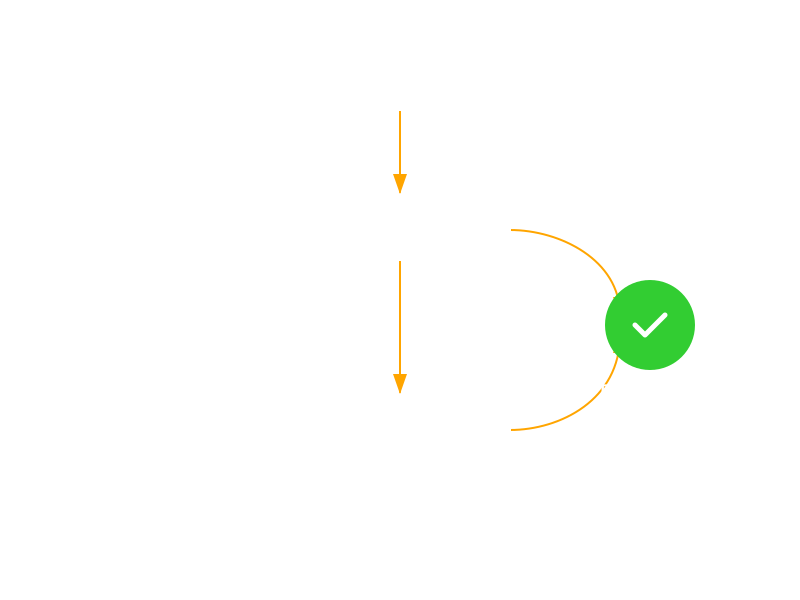
To truly be fit, you must be deliberate about how you layer your tools. Kross himself admits he is incredibly intentional about his interventions, establishing clear tiers of defense. His initial go-to is usually a combination of distant self-talk and a tool called “mental time travel.”
If those quick linguistic hacks don’t fully stabilize the situation, he escalates to a secondary layer of intervention. This next tier might involve “creating order around him,” since external organization can compensate for internal emotional chaos, or it might mean calling his “emotional advisors”—trusted people who are not clinically trained but who offer perspective and support .
The lesson here is that you need a conscious plan: If Tool A fails to modulate the emotion, you immediately move to Tool B, and so on. You don’t just stop at the first roadblock.
Customize Your Toolbox: Experiment and Adapt
Just as physical fitness routines are personalized—my wife might thrive on Pilates and yoga, while I prefer high-intensity interval training—your emotional regimen must be customized. There are dozens of verified emotion regulation tools out there, and what combination works for me might be completely ineffective for you. This is the beauty and the difficulty of the emotional fitness journey: it requires relentless, personal experimentation.
You need to test which combinations of tools “hang together” best for your unique wiring and your specific challenges. Maybe you find that combining expressive writing with calming music works best for intense grief, while strategic avoidance followed by distanced self-talk is ideal for professional anxiety. It requires careful observation.
The goal isn’t mastery of a single method; it’s mastery of the switch. Be deliberate, build your layers, and never stop adapting your toolkit to the challenges of your life.
Conclusion
We’ve journeyed through a diverse toolkit, from the precise language of distanced self-talk to the immersive power of sensory engagement, and even the strategic pause of avoidance. Each tool offers a unique way to navigate the complex landscape of our emotions. Remember, the goal isn’t to suppress feelings, but to master them, much like an athlete hones their skills.
As we’ve seen, emotional fitness is not about having a single magic bullet, but about building a diverse repertoire. You wouldn’t try to fix a car with only a screwdriver, would you? Similarly, life’s emotional challenges demand a varied approach. Experiment with these tools, discover which combinations resonate with you, and build your own personalized strategy.
Ultimately, the ability to regulate our emotions is a skill, and like any skill, it requires practice and adaptation. It’s about becoming a skilled conductor of your own inner orchestra, knowing when to play a calming melody and when to build to a crescendo.
As you continue this journey, remember that resilience isn’t about avoiding storms, but about learning to dance in the rain. The most powerful tool we possess is the awareness to choose which tool to use.


