


I used to think happiness was the ultimate goal. Then I realized I was chasing a mirage—something that kept shifting just out of reach. What if the fullest life isn’t about being happy all the time, but about being rich in experiences, perspectives, and stories? psychological richness, as Shigehiro Oishi defines it, isn’t about comfort or achievement. It’s about the thrill of getting lost on a road trip, the growth that comes from hardship, the insight gleaned from art or travel. It’s the cognitive expansion that happens when life throws you a curveball—and you catch it.
Here’s the thing: happiness and meaning are important, but they’re not the whole story. Sometimes, the most meaningful lives aren’t particularly happy in the moment. And sometimes, the happiest lives lack depth. But richness? It’s the layer that makes life endlessly fascinating.
So, what if we stopped chasing happiness like it’s the only prize worth having? What if, instead, we cultivated a life that’s layered, messy, and rich?
The Three Dimensions of a Fulfilling Life: Happiness, Meaning, and Richness
Beyond Happiness: The Pillars of a Meaningful Life
We often frame the pursuit of a good life as a choice between happiness and meaning. But Oishi’s work suggests this binary is too simplistic. Meaning isn’t just a nobler cousin of happiness—it’s a distinct dimension with its own structure. As he explains, meaning emerges from three pillars:
- significance (the belief that your life matters)
- purpose (a guiding direction)
- coherence (the sense that your roles and experiences fit together)
Yet, like happiness, meaning has its traps. The relentless pursuit of purpose can lead to burnout or a narrow, joyless existence. And here’s the kicker: some of the most meaningful lives aren’t particularly happy in the moment. Consider the Gallup data Oishi cites—over 95% of Ethiopians report their lives as meaningful, even amid low life satisfaction. This disconnect reveals that meaning and happiness aren’t just different; they can be inversely related.

The real insight? A fulfilling life isn’t about choosing one over the other but recognizing how they interact—or don’t.
What is Happiness? Life Satisfaction vs. Meaning
Happiness, in Oishi’s framework, isn’t about fleeting joy but life satisfaction—a broader, more stable assessment. Yet even this definition fractures under scrutiny. Cross-cultural data shows that life satisfaction and meaning often diverge. In America, they correlate moderately (around 0.6), but globally, the link dissolves. This suggests happiness isn’t a universal metric but a culturally shaped construct. Some define it through excitement (closer to psychological richness), others through contribution (blurring into meaning).
The takeaway? Happiness isn’t a monolith. It’s a spectrum, and where you fall depends on what you value. For some, like renowned happiness researcher Sonja Lyubomirsky, psychological richness is integral to their happiness. For others, meaning and faith are indistinguishable from it. The data doesn’t lie: these dimensions are separable, but their interplay is deeply personal.
The 3 Elements of a Meaningful Life
Meaning isn’t just a lofty ideal—it’s a measurable construct. Oishi’s former student, Mike Steger, developed the Meaning in Life Questionnaire, which breaks it down into significance, purpose, and coherence. The first two are intuitive: your life matters, and it’s guided by a direction. But coherence is the sleeper hit. It’s the glue that holds your roles—parent, friend, employee—together into a narrative that makes sense.
Without it, even a purpose-driven life can feel fragmented. Yet, as Oishi notes, meaning isn’t without its downsides. The “meaning trap” might involve sacrificing joy for duty or clinging to a purpose that no longer serves you. The key? Balance. Meaning thrives when it’s paired with self-awareness, not dogma.
What is Psychological Richness?
Here’s where Oishi’s framework gets revolutionary. Psychological richness isn’t about comfort or achievement—it’s about diversity, novelty, and perspective-shifting experiences. It’s the thrill of getting lost on a road trip and discovering something unexpected. It’s the growth that comes from hardship, the insight gleaned from art, or the empathy forged through travel. Unlike happiness or meaning, richness doesn’t demand consistency. It embraces chaos.
Oishi’s personal anecdote—his shift from frustration to curiosity when lost—illustrates this mindset. Richness is a cognitive reframe, a way to extract value from life’s unpredictability. And crucially, it’s accessible to everyone. You don’t need wealth or status; you need openness.
The real question isn’t whether to pursue richness but how to cultivate it alongside happiness and meaning. Because, as Oishi argues, the fullest lives aren’t one-dimensional—they’re layered, messy, and endlessly fascinating.
The Happiness Trap: Why Direct Pursuit Often Backfires
Stop Chasing Success: Recalibrate Your Ambitions
William James’s formula for self-esteem—success divided by ambition—is a deceptively simple equation with profound implications. Most of us fixate on the numerator, chasing more success, bigger achievements, and higher accolades. But here’s the rub: ambition isn’t static. It’s a moving target. Every time you hit a goal, your expectations inflate, and suddenly, what once felt like success now feels like the baseline.
This is the happiness trap in action—a relentless cycle where the pursuit of more leaves you feeling perpetually behind. Oishi’s insight is that we’re playing the game wrong. Instead of endlessly escalating our ambitions, we could choose to recalibrate them. It’s not about settling for less but about recognizing that happiness isn’t a linear function of achievement.
The Scandinavian countries, often topping global happiness rankings, understand this intuitively. They don’t measure success by the sheer volume of accomplishments but by the ability to find contentment in what they already have. It’s a radical reframe: happiness isn’t about having more; it’s about wanting less.
Hedonic Adaptation: The Endless Chase for Satisfaction
Hedonic adaptation is the psychological equivalent of a treadmill—no matter how fast you run, you stay in the same place. You get the promotion, the new car, the dream home, and for a brief moment, you’re euphoric. But soon, the shine wears off, and you’re back to baseline, eyeing the next milestone.
The problem isn’t the pursuit itself but the assumption that each new achievement will deliver lasting fulfillment. It’s a myth perpetuated by a culture obsessed with growth and accumulation. But here’s the twist: hedonic adaptation isn’t all bad. It’s what allows us to bounce back from setbacks and keep striving. The issue arises when we mistake the treadmill for the destination.
The key isn’t to stop running but to step off occasionally and ask, “Why am I running in the first place?” Maybe the goal isn’t to outpace the treadmill but to redefine what success looks like—whether that’s savoring small joys, cultivating gratitude, or embracing the messy, unscripted moments that psychological richness thrives on.
The Surprising Truth About Maximizers vs. Satisfiers
Maximizers and satisfiers represent two fundamentally different approaches to life. Maximizers are the perfectionists, the ones who agonize over every decision, convinced that the “best” option is out there if they just look hard enough. Satisfiers, on the other hand, are the pragmatists. They set a threshold—“good enough”—and stop there, saving themselves the stress of endless comparison.
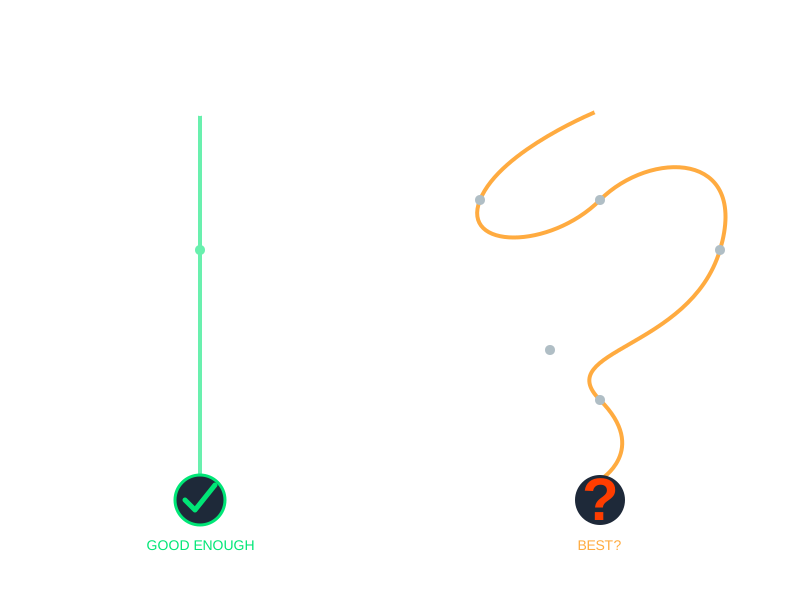
On the surface, satisfiers seem to have the upper hand. They’re happier, less anxious, and more content with their choices. But there’s a catch: if you’re always settling for “good enough,” you might never push beyond your comfort zone. Growth often happens at the edges of discomfort, in the spaces where you’re forced to stretch, fail, and adapt.
The trick is balance—knowing when to satisfice and when to maximize. Maybe the sweet spot isn’t about always choosing one over the other but about being intentional: maximizing when it matters and satisficing when it doesn’t.
How to Balance Ambition and Contentment Like Scandinavians
The Scandinavian model offers a masterclass in ambition management. These countries don’t just rank high in happiness; they’ve cracked the code on how to live well without the relentless pressure to achieve more. Their secret? They’ve collectively decided that ambition isn’t the enemy—unchecked ambition is.
It’s not about abandoning goals but about setting them in a way that aligns with well-being rather than undermining it. This approach echoes Buddhist philosophy, which distinguishes between craving (a desperate, clinging desire) and aspiration (a purposeful, detached pursuit). The Buddha wasn’t anti-ambition; he was anti-attachment.
You can strive for greatness, but you don’t have to be enslaved by the outcome. The Scandinavians embody this. They work hard, innovate, and contribute, but they also know when to stop, when to say, “This is enough.” It’s a lesson the rest of us could stand to learn: happiness isn’t the absence of ambition but the art of keeping it in check.
The Allure of Psychological Richness: Cognitive Expansion Through Experience
Collect Experiences, Not Just Possessions
Psychological richness isn’t about amassing wealth—it’s about collecting experiences that reshape your perspective. Think of it like a bank account, but instead of dollars, you’re depositing stories, challenges, and moments that force you to see the world differently. Some people have a portfolio bursting with these transformative experiences; others, not so much.
The key isn’t just having them—it’s what you do with them. Journalists, for example, thrive in this dimension. Their work immerses them in the extraordinary, the kind of events most people only read about. But here’s the catch: simply witnessing isn’t enough. The real magic happens when you process those experiences—through writing, conversation, or reflection. Without that, even the most profound moments fade into the background noise of life.
So, if you want to cultivate richness, start by paying attention. Write it down. Talk about it. Turn fleeting moments into lasting narratives.
Turn Adversity Into Growth: Reframing Challenges
Adversity isn’t just something to endure—it’s raw material for psychological richness. The difference lies in how you frame it. Take getting fired: you could spend years bitter about a bad boss, or you could see it as the push that led you to a better path. The latter turns a setback into a story of resilience, a pivot point in your personal narrative.
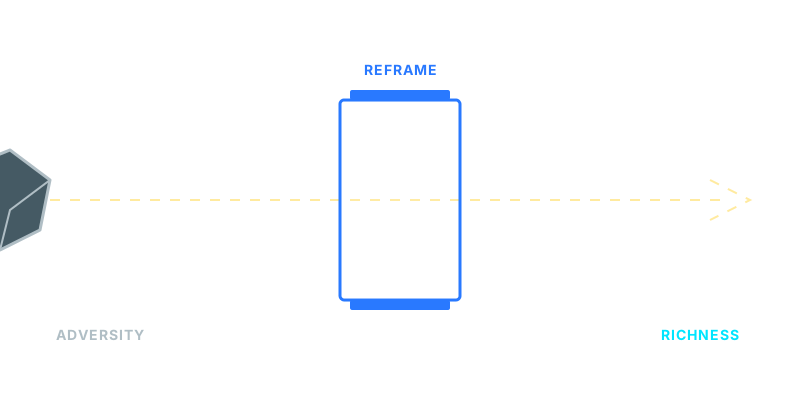
But this reframing doesn’t always come naturally. Some people instinctively extract meaning from hardship; others need to pause and deliberately ask, What did this teach me? The trick is to shift focus from the pain to the transformation. It’s not about denying the struggle but recognizing how it reshaped you. That’s how misery becomes a chapter in a richer life, not just a scar.
How to Enrich Your Life Through Vicarious Experiences
Journalists don’t just report the news—they live in the thick of it. Their work exposes them to the kind of experiences most people never encounter firsthand. But here’s the thing: you don’t need a press pass to tap into this. Psychological richness is democratic. Libraries, documentaries, even changing your daily commute can open doors to new perspectives.
The brain is wired for empathy, meaning you can vicariously absorb the lessons of others’ lives. A book, a conversation, or a detour through an unfamiliar neighborhood can spark the same kind of growth as a life-altering event. The barrier to entry isn’t money or status—it’s curiosity.
If you’re open, the world becomes a classroom, and every story is a lesson waiting to be learned.
How to Cultivate Openness to Experience
Openness to experience isn’t just a personality quirk—it’s the engine of psychological richness. People high in this trait don’t just tolerate novelty; they seek it out. They’re the ones signing up for study abroad programs, wandering into museums, or striking up conversations with strangers. And here’s the kicker: this trait correlates more strongly with richness than with happiness or meaning.
But it’s not just about doing new things—it’s about engaging with them deeply. Extroverts, for instance, thrive on social curiosity, while the open-minded might dive into ideas or art. The common thread? Curiosity. Without it, you’re stuck in the familiar, and richness withers.
The good news? You don’t have to be born with it. Start small: take a different route, pick up a book outside your usual genre, or ask someone about their life story. The more you practice, the richer your world becomes.
Making it Practical: Cultivating Psychological Richness in Everyday Life
Finding Meaning in Everyday Moments
Psychological richness isn’t about grand gestures or exotic adventures—it’s about finding depth in the everyday. Oishi’s research underscores that the most meaningful and happiness-boosting activities are often the smallest: being a good neighbor, nurturing close relationships, or simply maintaining routines that structure your day.
Samantha Hinman’s work on routines reveals that consistency in small responsibilities fosters a sense of meaning and stability. You don’t need to swing for the fences; instead, focus on the mundane moments that stitch together a life of quiet significance. The key is to engage deeply with your immediate surroundings—whether it’s striking up a conversation with a local shopkeeper or taking a new route on your evening walk. These micro-explorations can be just as transformative as a cross-country road trip.
How to Cultivate Curiosity Beyond Your Job
Curiosity isn’t a fixed trait—it’s a muscle you can strengthen, especially if your job has narrowed your focus. Specialization, while efficient, often stifles natural curiosity by training us to ignore anything outside our professional lane. To counteract this, Oishi suggests adopting a generalist mindset outside of work. Think like a child: ask questions, wander into unfamiliar topics, or even just observe the world without an agenda.
Playfulness is another underrated tool. In a world obsessed with productivity, taking a “vacation” from responsibilities—whether through spontaneous coffee chats or aimless walks—can reignite curiosity. The goal isn’t to abandon expertise but to balance it with a broader, more exploratory approach to life.
Exploration vs. Exploitation: Finding Your Balance
The tension between exploration (seeking new experiences) and exploitation (optimizing what you already know) is a classic dilemma. Oishi references the “Secretary Problem,” a mathematical puzzle that suggests the optimal strategy is to explore 37% of your options before committing to the next best one. But life isn’t a math problem—it’s messy.
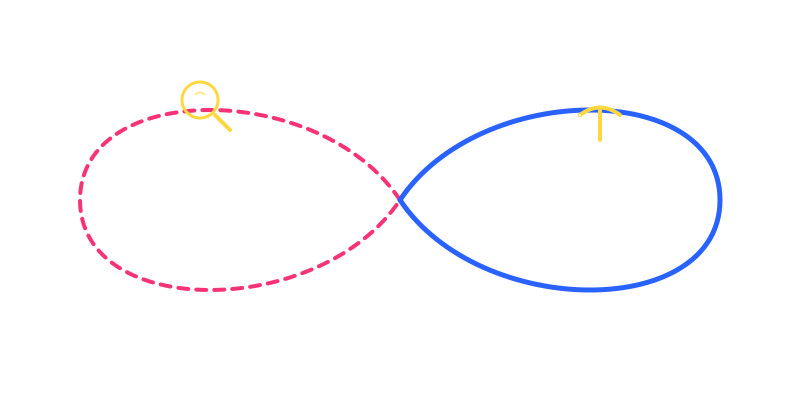
Sometimes, endless exploration leads to paralysis, while premature exploitation traps you in mediocrity. The trick is to recognize when to switch modes. Early in life, prioritize exploration: try new hobbies, travel, or pivot careers. Later, exploit your hard-earned knowledge—but leave room for occasional detours.
Balance is key. As Oishi notes, explorers and satisfiers both have their place; the art lies in knowing when to embrace each.
Unlock Psychological Wealth Through Storytelling
Experiences alone don’t create psychological richness—it’s the reflection that counts. A sensation-seeker who never pauses to process their adventures is like a millionaire blowing their fortune on fleeting parties. To truly enrich your life, you must curate your experiences.
Journaling, storytelling, or even discussing your day with a friend forces you to articulate what mattered and why. This act of narration transforms raw experiences into **lasting psychological wealth. Oishi’s analogy is spot-on: writing a review or recounting a trip solidifies its impact, ensuring it lingers in your “psychological portfolio.”
Without this step, even the most extraordinary moments fade into the background noise of life. So, pick up a pen, start a conversation, or simply pause to ask: How did this change me?
Beyond the West: Cultural Perspectives on Wellbeing
Purpose Over Happiness: A Buddhist Alternative
The West’s obsession with individual happiness as the ultimate metric of a good life risks blinding us to richer, more nuanced cultural perspectives. In many traditions, such as Buddhism, happiness isn’t the goal but a byproduct of detachment and purpose. The Buddhist approach I grew up with, for instance, is distinctly stoic—less about chasing pleasure and more about cultivating resilience through disciplined living.
Monks strive to be the “best monk” not through desire for reward but through adherence to rigorous principles that prioritize spiritual growth over emotional fulfillment 1. This mindset flips the script: instead of asking “What makes you happy?” it asks, “What gives your life purpose?”
Psychological richness emerges here not from excitement but from the cognitive expansion that comes with mastering complex roles and perspectives. The West’s focus on individual happiness, then, feels narrow—a single brushstroke in a much larger mural.
How Cultural Context Shapes Happiness and Meaning
In America, happiness and meaning coexist in a cozy, moderate correlation of about 0.6. But step outside this bubble, and the relationship dissolves into something far more fractured. Take Ethiopia: Gallup data reveals that over 95% of Ethiopians report their lives as deeply meaningful, anchored in purpose and coherence, even as life satisfaction remains low.
This isn’t an anomaly—it’s a revelation. Culture shapes how we define these dimensions. For many Americans, happiness leans toward personal excitement, blurring into psychological richness; for others, it’s tied to contribution, merging with meaning.
The takeaway? Happiness isn’t a universal currency. It’s a locally minted coin, its value shifting with cultural context. We’d do well to stop treating it as the default measure of a life well-lived.
How Crisis Can Create Deeper Meaning: Lessons from Ethiopia
Divorce or relationship breakdowns typically crash happiness scores, but their long-term impact on psychological richness tells a more complex story. Research suggests that while such events immediately drain joy, they often force introspection, resilience, and new narratives—ingredients that flesh out a richer inner world 1.
Ethiopia’s example amplifies this: despite pervasive hardship, its people report extraordinary meaning. Why? Their lives are structured around collective purpose and spiritual coherence—pillars that outlast transient comforts. This isn’t about denying pain but reframing it. When meaning is rooted in something larger than personal satisfaction—community, faith, legacy—even suffering can become a thread in a more intricate tapestry.
The West’s happiness-centric lens misses this entirely; meaning often thrives not in spite of struggle, but because of it.
Conclusion
So, what if the secret to a fulfilling life isn’t about choosing between happiness, meaning, or richness—but about learning to dance with all three? Happiness gives us joy, meaning gives us purpose, and richness gives us depth. Together, they create a life that’s not just good but interesting—one that keeps surprising us, challenging us, and reminding us why it’s worth living.
Think of it like a well-stocked bookshelf: *happiness is the lighthearted novel you pick up for fun, meaning is the profound memoir that changes how you see the world, and richness is the collection of short stories that introduce you to lives and perspectives you’d never encounter otherwise.
Would you really want to live in a world with only one kind of book? The real magic happens when we stop treating these dimensions as competing goals and start seeing them as complementary forces. A life rich in experiences can deepen your sense of meaning. A meaningful life can bring a quiet, lasting happiness. And a happy life—one where you’re present and engaged—can make you more open to the kind of novelty that fuels richness.
So, here’s your invitation: don’t just chase happiness. Don’t just seek meaning. Cultivate richness. Take the road trip even if you might get lost. Strike up a conversation with someone whose life looks nothing like yours. Let yourself be changed by art, by travel, by hardship, by love. Because in the end, the fullest lives aren’t the ones that go according to plan—they’re the ones that leave you with the best stories.
(And isn’t that what we all want, anyway? A life that feels like **a story worth telling.)


