


I’ve watched too many brilliant souls chase success they never truly wanted. They climb ladders only to realize they were leaning against the wrong wall. The quiet tragedy isn’t failure—it’s the hollow victory of arriving exactly where you’re supposed to be, according to everyone but yourself.
There’s a quiet storm brewing inside high achievers. We’re drowning in external markers of success while starving for internal purpose. The paradox is brutal: we chase happiness through paths that systematically guarantee unhappiness.
I believe the single greatest self-deception is believing that “I should” will eventually become “I want.” Means goals accumulate like spiritual junk in your soul—law degrees, promotions, status symbols—leaving you staring at your life wondering how you got somewhere you never wanted to be.
The secret is devastatingly simple: stop pursuing what looks successful and start building what feels authentic. But first, we must have the courage to admit what we’re doing isn’t working.
The Misalignment Problem: Why External Success Leads to Internal Emptiness
External Pressures: The Path to Dissatisfaction
I’ve seen it time and again—brilliant souls following paths laid down not by their own hearts, but by the invisible hands of expectation. Ken Sheldon’s story resonates deeply here. After dropping out of graduate school, he found himself “really, really not knowing what to do next,” haunted by the ghost of his Duke degree whispering that he “should be doing better.”
That dissonance between what we’ve achieved and what we feel we should achieve creates a silent torment. Parents, with the best intentions yet limited perspective, often steer us toward careers they believe will secure our future, forgetting that true fulfillment can’t be planned by proxy. We’re all swimming in this material consumer culture that equates success with money and status, conditioning us to chase symbols of achievement rather than sources of meaning. 1
The Legal Profession: Success vs. Wellbeing
The legal profession offers a sobering case study in this misalignment. Tracking law students over three years revealed something heartbreaking: their sense of wellbeing “plummeted quite dramatically” while depression rates soared. These weren’t underachievers—quite the opposite. The students who began with the most idealistic motivation tended to excel academically, achieving the highest grades.
Yet this success proved corrosive, transforming their values from helping others to chasing status. The system rewarded them for looking good, and in doing so, subtly rewired their motivations. The correlation between income and happiness existed, yes—but it was “pretty small, a surprisingly small effect.” What truly determined their happiness was whether they felt authentically engaged and contributing to something larger than themselves.
Means vs. End Goals: Escaping “Brules”
This brings us to the crucial distinction between means goals and end goals. Means goals are the detours we take because we think they’ll get us somewhere else—like Vishen Lakhiani’s initial pursuit of engineering because it seemed like “a safe way to make money.” These are the paths dictated by’brules’—those bullshit societal rules we mistake for universal truths. How many of us became lawyers, doctors, or business majors not because our hearts sang, but because we believed these professions equaled success?
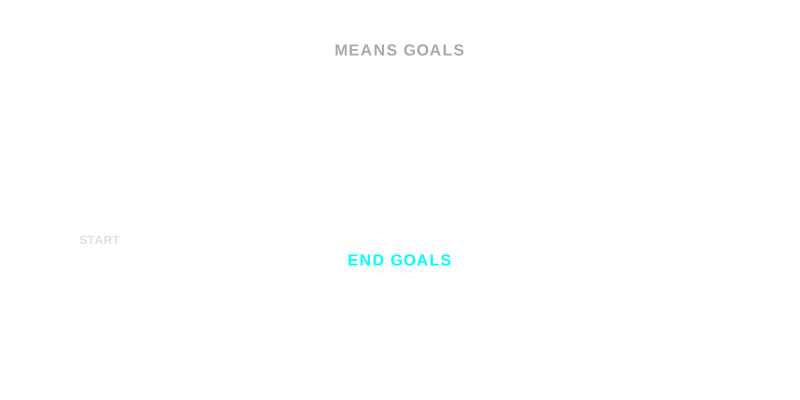
The statistics are staggering: the United States has just 5% of the global population but 50% of the world’s lawyers, and 50% of female American lawyers are clinically depressed. Means goals accumulate like clutter in your soul, leaving you staring at your life at 50 wondering how you got somewhere you never wanted to be. End goals—those that come from your authentic self—are what make your spirit vibrate with purpose. 2
The Psychology of Authentic Motivation
The Power of Intrinsic Motivation
There’s something almost magical about intrinsic motivation—it’s the spark that keeps us going when no one’s watching. Ed Deci’s research reveals that this inner drive isn’t just real; it’s fragile and precious. When we’re engaged in something purely because it interests us, that’s when we thrive. But here’s the catch: this motivation can be undermined by external rewards.
It’s like adding sugar to a perfectly ripe fruit—it ruins the natural sweetness. By the time we’re adults, we’ve been conditioned by decades of carrots and sticks. Parents, teachers, and society have trained us to respond to external incentives.
But Deci’s experiments show that even when we start doing something out of curiosity, adding rewards can destroy that intrinsic motivation. It’s a paradox: the very things meant to encourage us can end up killing our passion.
How External Rewards Destroy Lasting Passion
The undermining effect isn’t just a short-term phenomenon. Ken Sheldon’s research on athletes reveals that the damage can last decades. Varsity athletes, who played for external rewards like scholarships and fame, often lost interest in their sport later in life. In contrast, walk-ons, who played purely for the love of the game, retained their passion.
This isn’t just about sports—it’s about any activity where external rewards are introduced. The lesson here is profound: when we chase external validation, we risk losing the very joy that drew us to the activity in the first place. It’s a reminder that true satisfaction comes from within, not from the applause or rewards of others.
Why Your Conscious Desires Don’t Match Your Hidden Values
Our conscious minds are just the tip of the iceberg. Beneath the surface lies a vast, hidden mind filled with habitual inclinations and deep-seated motives. Ken Sheldon’s work highlights the importance of aligning our conscious desires with these non-conscious values. It’s like trying to navigate a ship with only a partial map—you might think you’re heading in the right direction, but hidden currents can pull you off course.
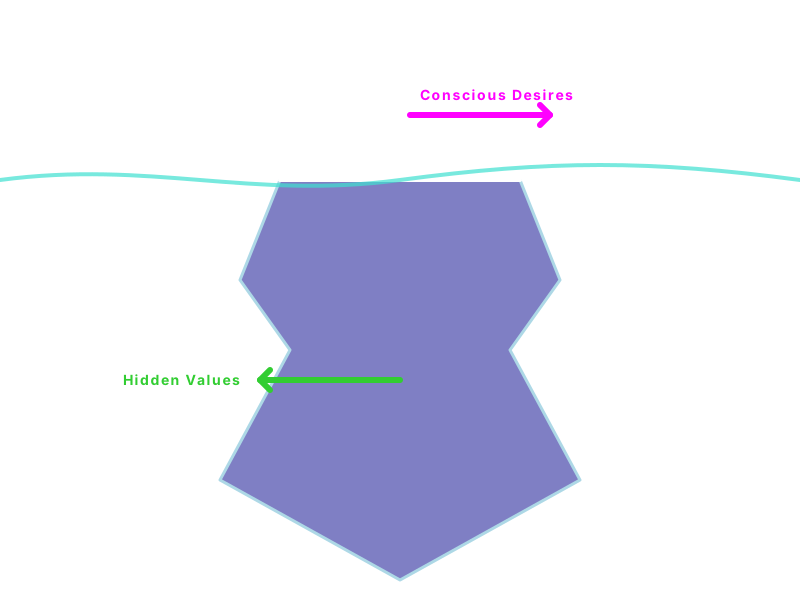
The challenge is that we often don’t even know what’s in our hidden mind. We think we’re making decisions based on our conscious desires, but in reality, we’re being influenced by forces we’re not even aware of. This misalignment can lead to a life that feels off-kilter, like wearing shoes that don’t quite fit. The key is to take the time to explore and understand these hidden parts of ourselves, to bring them into the light and align them with our conscious goals. 1
The Self-Concordance Model: Aligning Your Conscious and Non-Conscious Self
Align Your Desires With Hidden Values for Lasting Fulfillment
Ken Sheldon’s concept of self-concordance isn’t just psychological jargon—it’s the secret sauce to lasting fulfillment. It’s when what we consciously desire matches the deeper yearnings lurking beneath our awareness. The problem? Most of us chase goals that aren’t truly ours.
We’re either living out someone else’s script—what parents, partners, or society wants for us—or we’re playing a character we think we “should” be. This disconnect creates static, drowning out those subtle signals from our non-conscious mind trying to guide us toward our authentic path. True harmony happens when we consciously dance to the rhythm of our hidden values.
How a Simple Question Changed Amy’s Life Path
Consider Amy—the high-powered, miserable lawyer who had “made it” by conventional standards. Wealthy partner in a big city, drowning in success yet starved for meaning. The turning point came not through some grand epiphany, but a simple question from her brother: “If you’re so miserable, why are you still doing this?” That planted a seed in her unconscious.
Months later, a random thought surfaced—an old college friend she hadn’t considered in 25 years. Google revealed this friend ran an environmental consulting firm. Coincidence? Or was Amy’s hidden mind finally making itself heard, showing her a path that aligned with who she truly was beneath the lawyer persona?
The Rubicon Model: Overcoming Post-Decision Bias
Here’s where things get fascinating—and dangerous. Once we decide on a path, our brains cross what Peter Gollwitzer calls the “Rubicon of decision.” We shift from questioning to implementing. Suddenly, we’re not objective evaluators anymore; we’re defense attorneys building a case for our choice.
The alternative options? Dead and buried. Our minds work overtime to justify our decision, protecting us from the discomfort of “I might have chosen wrong.”
This post-decision bias is why so many people stay on paths that clearly don’t serve them—they can’t bear the cognitive dissonance of admitting they made a mistake. Breaking through requires consciously deciding to re-enter the deliberation phase, to question our own convictions. It’s uncomfortable, but necessary for realignment.
The Creative Process of Discovering Your Purpose
Discover Purpose Through a Step‑by-Step Creative Process
We live in a culture obsessed with instant gratification, where we expect answers to life’s biggest questions to arrive like a Google search result. But Ken Sheldon’s research reveals that discovering our true purpose follows the same creative process that artists and inventors use—a process that can’t be rushed. It begins with preparation: asking ourselves the right questions.
Not surface-level queries like “What should I do with my life?” but deeper, more probing ones: “What makes me feel truly alive?” or “When have I felt most authentically myself?” These questions prime our non-conscious mind to start working on the problem. The next stage—incubation—is where most of us fail.
We’re so accustomed to forcing solutions that we don’t allow space for our subconscious to process. Sheldon describes this as the period where you “go and think about something else,” trusting that your mind continues working behind the scenes. This isn’t passive waiting; it’s active trust in the process.
The breakthroughs come when we least expect them—during a shower, a walk, or in that liminal space between sleep and wakefulness. The key is creating the mental space for these insights to emerge.
How Your Subconscious Sparks Breakthrough Insights
The incubation phase isn’t just idle time—it’s where the real magic happens. Our non-conscious mind works like a background processor, connecting dots we couldn’t consciously see. This is why so many “aha moments” feel like they come out of nowhere. For Amy, the lawyer who found her way back to environmental work, the incubation period lasted months.
Her conscious mind had posed the question (“Why am I so unhappy?”), but it was her subconscious that surfaced the memory of her college friend—a connection that ultimately led to her career shift. This stage requires patience and faith in our own mental processes.
We’re not taught to value this kind of mental “downtime,” but it’s essential for meaningful insights. The challenge is resisting the urge to fill every moment with distraction.

Our phones, social media, and constant busyness short-circuit the incubation process. True breakthroughs require us to embrace the discomfort of not knowing—of living in the question rather than rushing to premature answers.
Recognizing and Testing Authentic Insights
When the insight finally comes—what creativity researchers call the “illumination” stage—it often arrives as a subtle nudge rather than a blinding revelation. For Amy, it was the sudden thought of an old friend she hadn’t considered in decades. The danger here is dismissing these quiet signals as random or irrelevant. Sheldon emphasizes that we must develop the skill of recognizing these moments, which often requires practice in mindfulness and self-awareness.
But illumination alone isn’t enough. The final stage—verification—is where we test our insights against reality. Not every “aha moment” leads to the right path.
Some ideas that feel profound in the moment don’t hold up under real-world scrutiny. This is why Amy didn’t immediately quit her job when she thought of her friend; she reached out, explored the possibility, and verified whether this path truly aligned with her values. The creative process of discovering purpose isn’t linear—it’s iterative, requiring us to cycle through these stages multiple times as we refine our understanding of what truly matters.
Practical Tools for Building Your Vision
How to Use the Three-Column Method for a Meaningful Life
Vishen Lakhiani’s three-column method offers a refreshing antidote to the bucket list mentality that often leaves us chasing hollow achievements. The first column—Experiences—isn’t about collecting Instagram-worthy moments but identifying what would genuinely make your soul sing. The key here is speed: spend just three minutes brainstorming. Why?
Because your left brain, that analytical party-pooper, will kick in and start listing reasons you can’t have these experiences. This isn’t about practicality—it’s about uncovering your authentic desires before your inner critic can sabotage them.
The second column—Growth—is where most people stumble. We’ve been conditioned to view growth as painful (thanks, school system!), but it’s actually the secret ingredient that transforms experiences from fleeting joy to lasting fulfillment.
If you want to wake up next to someone you’re madly in love with, you’ll need to develop dating skills. If you dream of cycling across South America, you’ll need physical training and perhaps language skills. Growth isn’t just a means to an end—it’s an end in itself.
The final column—Contribution—is what elevates this from personal development to purpose. Experiences and growth can make you happy, but fulfillment comes from giving back. The Dalai Lama’s wisdom echoes here: “The secret to being happy is to make other people happy.”
This could mean donating income, mentoring others, or creating something that inspires. The three-column method isn’t just about designing your dream life—it’s about designing a life that matters.

How to Use the 3-Minute Rule to Silence Self-Doubt
The three-minute rule is your shield against self-sabotage. When you spend too long analyzing your desires, your left brain activates its “reality check” mode, flooding you with doubts and limitations. This is why Vishen insists on the three-minute time limit for the Experiences column. It’s not about rushing—it’s about accessing your authentic desires before your inner critic can censor them.
This principle applies beyond just brainstorming experiences. When you’re considering growth opportunities or ways to contribute, the same analytical overthinking can creep in. “I’m not qualified,” “I don’t have time,” “What if I fail?”—these are the thoughts that kill dreams before they can take root. The three-minute rule helps you bypass this mental resistance, allowing your true aspirations to surface.
Jim Carrey’s $10M Check: Vision & Belief
Jim Carrey’s story about writing himself a $10 million check for “acting services rendered” before he was famous isn’t just a cute anecdote—it’s a testament to the power of written vision. The act of putting your desires on paper does something profound: it moves them from the realm of abstract wishing to concrete intention. When you write down your vision, you’re not just dreaming—you’re declaring to the universe (and to your subconscious) that this is your path. But here’s the crucial part: belief.
Carrey didn’t just write the check—he carried it in his wallet for years, a constant reminder of his vision. This isn’t about magical thinking; it’s about programming your reticular activating system to notice opportunities that align with your vision.
When you truly believe in your vision, you start seeing possibilities everywhere. The check wasn’t what made Carrey successful—it was the daily reinforcement of his belief in that success.
Sustaining Authentic Goals Through Life’s Challenges
Find Motivation When the Joy Fades
There’s a quiet hero in the story of motivation that doesn’t get enough airtime. We’ve all experienced that initial spark of intrinsic motivation—the sheer joy of doing something because it lights us up inside. But what happens when that spark dims? When the novelty wears off and the journey becomes painful?
That’s where identified motivation steps in. Ken Sheldon’s research reveals this powerful force that keeps us going even when the fun fades. It’s not about chasing pleasure; it’s about aligning with what truly matters to us. Think of it as the difference between falling in love with the idea of being a writer (intrinsic) and committing to the daily grind of writing because expressing your truth matters more than comfort (identified).
The Pacific Crest Trail hikers in Sheldon’s study experienced this firsthand. After months of blistered feet and endless desert, their intrinsic motivation plummeted.
Yet those who finished didn’t do so because they were having fun—they did it because completing the trail had become part of their identity, their values. That’s the magic of identified motivation: it transforms “I want to” into “I must” without external pressure.
How Pacific Crest Trail Hikers Found Purpose When Fun Faded
Imagine walking 2,600 miles through deserts, mountains, and forests. Now imagine doing it when every step feels like a chore rather than an adventure. That’s exactly what happened to Pacific Crest Trail hikers in Sheldon’s study. Their intrinsic motivation—initial excitement and curiosity—crashed hard as the reality of the trail set in.
What kept them going wasn’t some superhuman willpower. It was identified motivation. They weren’t hiking because it was fun anymore; they were hiking because finishing had become meaningful. It expressed who they were and what they valued.
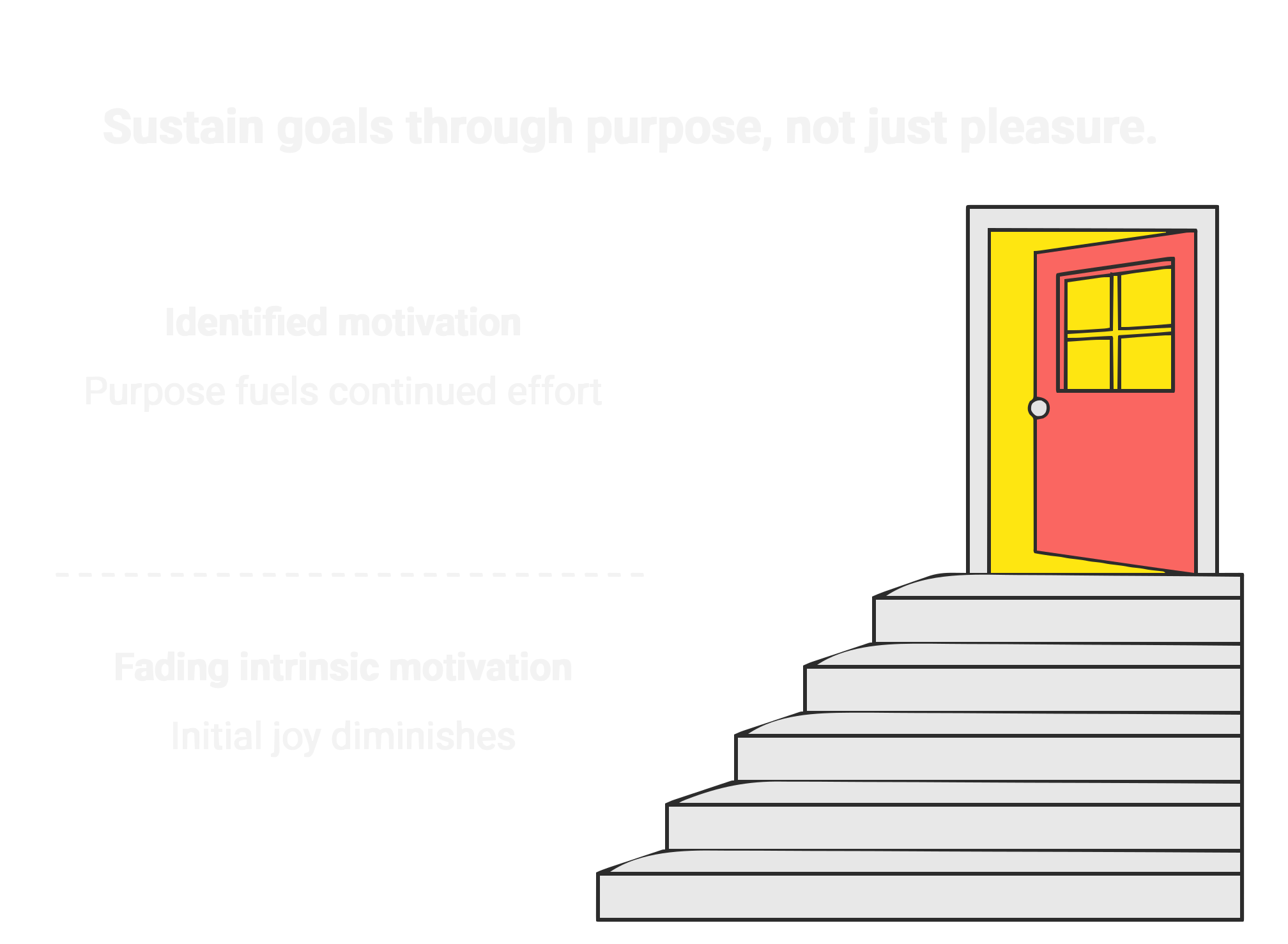
This shift from “this is enjoyable” to “this matters” is crucial for any long-term endeavor. The lesson here isn’t just about hiking—it’s about any goal worth pursuing.
Whether it’s building a business, raising children, or creating art, there will be moments (or years) when the joy fades. That’s when identified motivation becomes your lifeline, pulling you forward not with the promise of pleasure, but with the power of purpose.
Why Contribution Completes True Fulfillment
We’ve been sold a lie that happiness is the ultimate goal. But Sheldon’s research suggests something deeper: fulfillment requires three dimensions—happiness, meaning, and contribution. You can be happy watching Netflix all day, but that happiness is hollow without meaning. You can find meaning in your work, but without contribution, it feels selfish.
The gratitude visit exercise from positive psychology illustrates this beautifully. Writing 350 words thanking an unsung hero doesn’t just make the recipient happy—it creates a ripple effect of fulfillment for both parties. This is why lawyers who shift from chasing status to helping clients experience such dramatic improvements in wellbeing. Contribution transforms personal success into something that matters beyond ourselves.
The three-column method we discussed earlier—experiences, growth, contribution—isn’t just a planning tool. It’s a fulfillment framework. Without that third column, we’re just collecting experiences and skills for our own benefit.
But when we add contribution, we complete the circuit of human flourishing. That’s when we move from mere happiness to deep, sustainable fulfillment.
Taking Action: From Vision to Reality
How One Human Connection Changed a Life Forever
Azim Shariff’s story about his English teacher Daryl Wakeham is one of those quiet miracles that reminds us how a single human connection can reroute an entire life. At 15, Azim was drowning—family chaos, mental health struggles, that particular teenage conviction that no one could possibly care. Then Daryl stepped in with words that cut through the noise: “You are important enough for somebody to care about this.” This wasn’t therapy or intervention—it was something more fundamental: being seen.
Daryl didn’t just notice Azim’s pain; he validated it, then did something even more powerful—he introduced him to psychology. That intellectual spark became Azim’s lifeline, eventually leading him to become a psychology professor himself. What’s striking here isn’t just the transformation, but the mechanism.
Daryl’s intervention worked because it aligned with Azim’s hidden values—his need for meaning, his intellectual curiosity. This is self-concordance in action: an external influence that didn’t impose but revealed.
The gratitude visit exercise Azim now teaches his students—writing 350 words to thank an unsung hero—isn’t just a happiness hack. It’s a way to complete the circle of contribution that gives life its deepest meaning.
Daily Mindfulness Practices for Self-Alignment
Ken Sheldon’s research reveals that discovering what we truly want isn’t about grand epiphanies—it’s about developing the skill of listening to ourselves. Mindfulness meditation isn’t just for stress relief; it’s a way to create the mental space where our authentic desires can surface. Think of it as tuning an old radio: you have to turn down the static of daily life to hear the faint signals of your deeper self. The practice is deceptively simple: sit, observe, and resist the urge to judge or follow every thought.
What emerges in that quiet space—fragments of memory, sudden insights, unexpected emotions—are clues from your non-conscious mind. This isn’t about finding answers immediately; it’s about creating the conditions where answers can find you.
Reflective questioning works the same way. Instead of asking “What should I do with my life?” (which activates your left brain’s analytical panic), try “When have I felt most alive?” or “What would I do if no one would judge me?”
These questions bypass your inner critic and speak directly to your authentic self. The key is consistency—making this a daily practice rather than a one-time soul-searching session.
How to Overcome the Fear of Social Judgment
Here’s the uncomfortable truth: most of us know what we truly want. We just lack the courage to admit it, even to ourselves. The fear isn’t just of failure—it’s of judgment. What will people think if I quit my prestigious job?
What if I’m not good enough? What if I’m wrong? This fear keeps us trapped in lives that look good on paper but feel hollow in practice. The Pacific Crest Trail hikers in Sheldon’s study faced this when their initial excitement faded.
What kept them going wasn’t external validation but an internal shift: they stopped hiking for the experience and started hiking because it expressed who they were. The same principle applies to any authentic path. When you align with your true values, the fear of judgment doesn’t disappear—but it becomes secondary to the fear of betraying yourself.
That’s when you cross your personal Rubicon, moving from “I should” to “I must.” The irony? Once you make that leap, you often find that the judgment you feared was mostly in your head—and that living authentically inspires others to do the same.
Conclusion
The journey toward authentic living isn’t about finding quick answers or following someone else’s formula. It’s a creative process of discovery that requires patience, courage, and the willingness to question everything society has taught us about success.
The science is clear: when we align our conscious goals with our deepest values, we unlock sustainable fulfillment that external rewards can never provide. Start today by asking yourself the three fundamental questions—what experiences do you want, how do you need to grow, and how will you contribute? Your authentic self is waiting to be discovered.
The real measure of a life isn’t what we achieve but what we become when we’re no longer performing for an audience. (Think about it—your obituary won’t mention your promotions or paychecks.)
That moment when you stop climbing someone else’s mountain and finally build your own—that’s when life begins in earnest. You don’t need permission to be authentic; you just need the courage to betray your own expectations. After all, what’s the point of arriving at success if you’ve forgotten who you were when you started?


