


Every time we talk about time travel, we tell on ourselves. We always obsess over the fragility of the past, harboring a deep conviction that a single misstep decades ago could ruin everything. If you’ve ever read Ray Bradbury’s classic short story A Sound of Thunder, you know exactly how this neurosis plays out 1. A time traveler goes back 65 million years, panics, steps off the designated floating path, and crushes a single, glistening butterfly in the prehistoric mud.
When the panicked traveler returns to the year 2055, he discovers the English language has been heavily mangled and a brutal fascist dictator now rules the world. Stephen King plays the exact same game in his masterful novel 11/22/63. The protagonist discovers a mysterious portal, travels back to 1958, and meticulously plans for years to stop the assassination of President John F. Kennedy.
He eventually succeeds, only to return to a modern dystopian reality utterly ravaged by massive earthquakes and global nuclear war. The devastated protagonist has no choice but to go back once more, desperate to reset the timeline and undo his own heroics. We love these stories because they illustrate a terrifying truth about the nature of complex systems. Small changes can trigger vast, non-linear, and completely unpredictable outcomes on a global scale.
But I think these narratives have accidentally programmed us with a massive, debilitating cognitive blind spot. We completely understand that a tiny, seemingly inconsequential action taken decades ago resulted in the exact reality we inhabit right now. We nod along with the idea that our present is just the compounded interest of microscopic past events.
Yet, almost no one takes the next logical, terrifying step. We rarely translate that understanding to mean that the tiny actions we take today will massively, violently alter the outcome of our entire future. We look backward with intense reverence, but we look forward with a bizarre sort of linear apathy. It’s time we stop agonizing over the past and start weaponizing the present.
I call this the Reverse Butterfly Effect. In essence, it suggests that the small actions we take now can cascade into vast, unpredictable futures.
The Science of Deterministic Chaos
A Rounding Error That Broke the World
To truly grasp how to manipulate our future, we first need to look at where this whole concept started. It wasn’t born in a science fiction writer’s basement, but in the sterile laboratory of meteorologist and mathematician Edward Lorenz in the 1960s 2. Lorenz was using primitive computers to model weather predictions because he realized standard linear models were completely ineffective. One day, he made a seemingly innocuous shortcut that shattered our understanding of physics.
Instead of entering the exact initial condition of 0.506127 into his weather simulation, he simply typed 0.506 to save time. That microscopic omission—a tiny rounding error—produced a wildly different, unrecognizable weather forecast. Lorenz deduced that the weather turns on a dime, and in complex systems, tiny variations inevitably lead to vastly different outcomes over time.
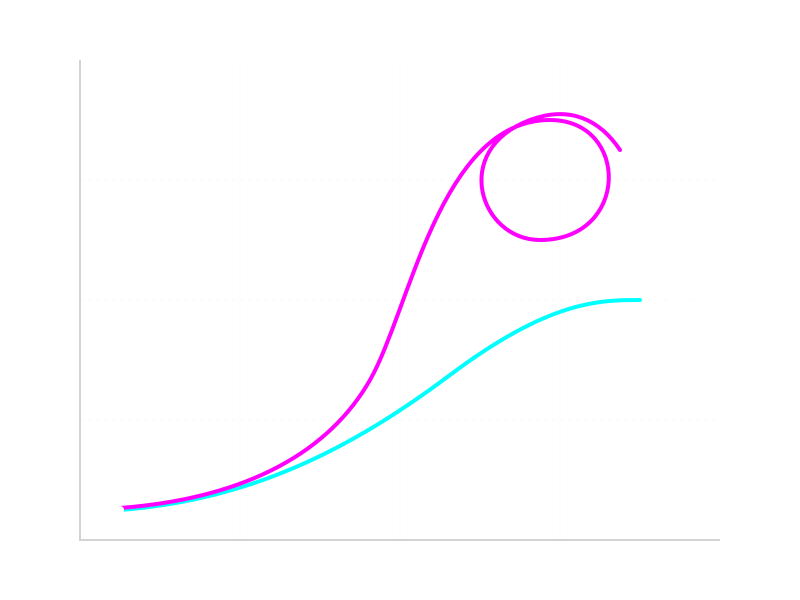
He published an award-winning paper in 1963 demonstrating that because perfect knowledge of initial conditions is fundamentally impossible, precise long-range forecasting simply does not exist. To explain this exponential growth of errors—known as deterministic chaos—to the public, he used a brilliant metaphor. He compared it to a butterfly flapping its wings in the Amazon, representing tiny atmospheric changes that could eventually alter the path of a tornado in Texas.
Before Lorenz published his work, the scientific community arrogantly believed that approximate initial conditions would naturally yield approximate, manageable outcomes. The butterfly effect was deeply humbling because it exposed the fatal flaws in our predictive models. It proved that humanity’s craving for total control over the future was nothing more than a stubborn illusion.
The Trivial Hinges of History
When you look at human history through Lorenz’s lens, you realize that major events rarely start with massive, cinematic catalysts. The bombing of Nagasaki is a prime, horrifying example of the butterfly effect in action. The original target for the atomic bomb was actually the city of Kuroko, but a simple shift in cloud cover saved it and doomed Nagasaki instead. A routine weather change entirely altered the course of human history.
Consider the spark that ignited World War I. Archduke Franz Ferdinand’s driver simply made a wrong turn, accidentally placing his vehicle directly in the path of a waiting assassin 1. Or think about the incredibly tense Cuban Missile Crisis, where the fate of the globe hung by a fragile thread. A single Russian officer named Vasili Arkhipov vetoed the launch of a nuclear torpedo, highly likely preventing World War III all by himself.
Even Adolf Hitler’s horrific rise to power was contingent on profoundly trivial variables. He was rejected twice from art school at the Academy of Fine Arts in Vienna, redirecting his path from an aspiring, mediocre artist to a genocidal dictator. These examples prove that our world is incredibly fragile, and small, seemingly disconnected events carry enormous, irreversible weight. But there’s a serious danger in how we traditionally frame this historical chaos, because it makes us feel intensely helpless.
Reversing the Equation
Escaping Retrospective Victimhood
If a random cloud or a wrong turn dictates the fate of millions, it’s easy to conclude that we are just flotsam drifting on the violent tides of chance. We treat the butterfly effect as an external force, a historical curiosity that happened to us. The Reverse Butterfly Effect flips this paralyzing paradigm completely on its head. It demands that we view ourselves not as the victims of starting conditions, but as the active, deliberate architects of them.
If a fraction of a decimal point can change the global weather, what can a fraction of a change in your morning routine do to your next decade? The butterfly effect in psychology explicitly suggests that fleeting emotions, trivial decisions, or behavioral shifts can radically alter the trajectory of your life. We mistakenly believe that monumental life shifts require monumental, exhausting actions, like moving across the country or suddenly quitting a career.
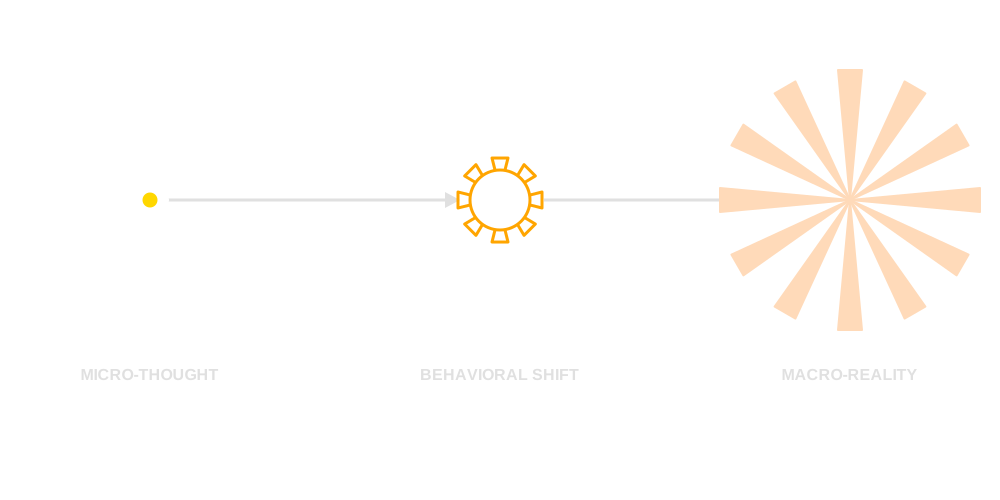
But the psychological science tells a vastly more encouraging story. Minor, everyday actions drastically impact our long-term emotional and mental states. Take the intimate way you speak to yourself inside your own head. If you deliberately choose to shift your internal monologue from harsh criticism to gentle encouragement, that subtle adjustment changes your core self-worth over time.
With a newly elevated sense of self-worth, your behavior begins to shift outward. You might feel emboldened to pursue bigger dreams, completely rewriting a future reality you previously thought was impossible.
The Subconscious Blueprint
We often underestimate how thoroughly our early, seemingly forgotten experiences dictate our current reality. Small, overlooked experiences in childhood or early adulthood continue to influence the rest of our lives, acting as the initial conditions for our psychological development. Even things we don’t consciously remember have an enormous, hidden impact on exactly who we become and how we interact with the world around us 2.
We rely heavily on deeply ingrained behavioral routines, often born from past trauma or strict childhood conditioning, and we repeat them blindly for decades. Imagine holding an unconscious belief that you are inherently unworthy of success or love. As a direct result, you will continually make tiny, self-sabotaging decisions—like refusing to apply for a promotion or staying in a toxic relationship—that perfectly reinforce that exact negative belief.
This cycle feels inescapable, but recognizing the physics of your behavior provides the key to breaking out. Therapists leverage the butterfly effect precisely because they know gradual adjustments are vastly more effective than attempting huge, overwhelming shifts all at once. They don’t aim for overnight enlightenment; they push for small, often imperceptible adjustments in daily self-compassion or boundary-setting. These tiny, intentional interventions accumulate compound interest, eventually unsticking the psyche from destructive patterns and building more meaningful relationships.
The Compounding Architecture of the Present
Fractals in Finance and Life
To truly understand how small actions scale into massive transformations, we have to look at the mechanics of complex systems. The global economy is arguably the largest interconnected system humanity has ever built, functioning much like a giant game of dominoes. A brilliant mathematician named Benoit Mandelbrot applied the butterfly effect to economics, revealing that standard financial models totally denied the existence of sudden, dramatic market shifts.
Mandelbrot noted that traditional portfolio theory estimated the probability of massive market fluctuations to be a few millionths of a millionth. In reality, massive spikes and crashes happen on a remarkably regular basis, completely defying the linear expectations of Wall Street bankers. To explain this chaos, Mandelbrot utilized fractals—geometric shapes that can be separated into parts, each of which is a perfectly reduced-scale version of the whole.
He demonstrated that market movements look fundamentally identical whether you are zooming in on a frantic hourly chart or zooming out to observe a calm weekly scale. This fractal nature means that microscopic instability can rapidly cascade into immense macroeconomic disasters. The bone-chilling 2008 financial crash, which wiped out $5 trillion globally in a matter of hours, was a dramatic demonstration of a system reacting violently to initial vulnerabilities.
Your own daily life operates as a fractal, too. The behavioral patterns you exhibit in a single, insignificant Tuesday afternoon are almost always reduced-scale versions of the patterns that define your entire decade. If your micro-habits are chaotic and reactive, your macro-life will inevitably experience its own version of a catastrophic market crash.

The Chaos of Ambition
We see this Reverse Butterfly Effect playing out aggressively in the realms of business and entrepreneurship. As General Stanley McChrystal pointed out, pop culture heavily misunderstands the butterfly effect as a tool for targeted “leverage”. People falsely assume they can find a single, specific tiny lever to pull to get a guaranteed massive result, but chaotic systems simply don’t allow for that kind of arrogant manipulation.
The stark reality is that in complex systems, your small actions might have absolutely zero effect, or they might rewrite the entire world, and it is virtually impossible to know which outcome will occur. But knowing that small actions can trigger outsized effects is exactly why elite performers obsess over minute details. Think about something as pure and simple as opening a neighborhood lemonade stand.
You make a conscious decision to genuinely smile at your very first customer, who, unbeknownst to you, happens to be the mayor’s child. That child eagerly tells their parent about your friendliness, the mayor mentions your stand in a public speech, and suddenly you are overwhelmed with lines wrapping around the block. All of that explosive growth stemmed from one tiny, instinctual micro-expression of kindness.
Massive tech monopolies were built on this exact, unpredictable premise. When Facebook first launched, it was merely a localized tool for college students to connect, completely devoid of any grand design to reshape global infrastructure. Yet, incredibly small early decisions—like adding the News Feed feature or selectively expanding to specific campuses—set off an unstoppable chain reaction with huge political and social consequences. You cannot predict which specific email will change your life, so you must treat your daily input with relentless respect.
The Effervescent Effect and The Social Web
The Ripple of Positive Contagion
If the Reverse Butterfly Effect is primarily about how your tiny actions transform your own future timeline, we absolutely must discuss how these actions bleed into the lives of others. In the realm of positive psychology, there is a powerful concept known as the “Ripple Effect”—sometimes wonderfully referred to as the effervescent effect. This term specifically expands on the social dimension of our minor, everyday behaviors.
It describes how small, intentional actions taken by just one individual can significantly impact the long-term well-being of entire communities. It’s the profound difference between chaotic determinism and intentional emotional contagion. When you practice seemingly insignificant virtues—like actively promoting kindness, expressing genuine sincerity, or holding onto basic optimism—you aren’t just boosting your own mood. You are actively altering the neurochemistry and emotional ecosystem of everyone you interact with.

Think about how human relationships actually deepen over a lifetime. They aren’t built on grand, cinematic declarations of love or massive sacrifices. They are built on the agonizingly slow accumulation of insignificant moments, like a random gesture of kindness or extending grace during a petty disagreement. If you are consistently generous, those tiny, repeated acts construct an unbreakable foundation of deep trust and mutual respect over time.
Responsibility for Our Social Exhaust
Conversely, we have to be incredibly careful with our negative outputs. Small negative interactions—a sarcastic jab, a moment of careless neglect, or a petty criticism—will inevitably and gradually erode that very same relational bond. The effervescent effect demands that we take full, unblinking responsibility for our social exhaust. You are constantly emitting signals that alter the atmospheric pressure of the rooms you walk into.
Your fleeting optimism on a Tuesday morning might be the exact tiny variable that prevents a discouraged coworker from quitting their job. That retention might subsequently save a major project, which keeps a struggling company afloat, saving hundreds of other jobs down the line. You will never, ever see the full expanse of the ripple you created.
But you are absolutely, undeniably responsible for casting the stone into the water. This shifts our perspective from a selfish pursuit of personal development into a communal obligation. The Reverse Butterfly Effect empowers you to change your life, but the Ripple Effect reminds you that your life is inextricably linked to the collective. By focusing on tiny, constructive interactions, you become a stabilizing node in a highly chaotic network.
The Time Machine is Already Running
Entropy and the Illusion of Control
We are, fundamentally, terrible at understanding the passage of time. Physicists often discuss the “Arrow of Time,” which is heavily linked to the concept of entropy’s irreversible progression. As time advances forward, matter naturally becomes more chaotic and scattered, never spontaneously reverting to its original, orderly state. A broken egg simply stays broken, giving us our tragic, linear sense of past, present, and future 1.
Because time is a one-way journey towards chaos, small changes constantly amplify that chaos, forever altering the future trajectory. This is why we romanticize time machines so deeply. We are convinced that if we could just go back and lower the entropy—fix one awkward conversation, reverse one failed test, or undo one terrible investment—our lives would finally be perfect.
But this obsession with retrospective determinism is a massive psychological trap. We prefer to blame our current unhappiness on uncontrollable starting conditions because it absolves us of responsibility. As astrologer Jonathan Cainer wryly noted about the 2008 financial crash, we love the idea of secret, organized control because we hate facing the fact that our world runs on a terrifying combination of chaos, incompetence, and confusion.
Taking the Wheel
You don’t need a magical portal back to 1958. You are sitting in the pilot’s seat of a time machine right this very second. The present moment you are currently experiencing is the distant past of your future self. What you do with this exact minute is the historical hinge that will define your next decade.
If you want to radically transform your life, you have to embrace the mechanics of the Reverse Butterfly Effect. Stop waiting around for a catastrophic event or a miraculous, overnight breakthrough to force your hand. Focus relentlessly on the microscopic actions right in front of you. Shift your mindset slightly today, offer one genuine compliment tomorrow, and commit to one tiny habit that pushes you toward personal growth.
You are actively building the initial conditions for a reality you haven’t even met yet. Your future is not a fixed destination you are passively walking toward; it is a highly sensitive, complex system you are currently programming. The smallest flap of your wings today will summon the hurricane of your tomorrow.


