


I think we have fundamentally misunderstood the very nature of wasted time. Ask anyone on the street what it means to waste a precious day, and they will invariably point to a specific, unproductive behavior. They will talk about scrolling endlessly through digital feeds, binge-watching mediocre television, or lounging uselessly on a couch while chores pile up.
But this behavioral definition is entirely backward. It focuses exclusively on the external action while completely ignoring the internal state of the actor. The harsh reality is that time is never wasted by what you are doing, but solely by where your mind is while you do it.
You can waste massive amounts of time while sitting in a boardroom closing a million-dollar deal, and you can live a profoundly rich moment while simply staring at a speck of dust floating in a sunbeam. The physical action itself is completely neutral. The solitary variable that determines whether a moment is fully lived or permanently lost is the presence of your own consciousness.
The Illusion Of Killing Time
The Violent Semantics Behind Casual Phrases
Let us closely examine the language we routinely use to describe our relationship with the clock. We frequently complain about having to “kill time” when we are stuck in a drab waiting room or sitting idly at an airport gate. It is a casual, throwaway phrase that we mutter without a second thought.
But consider the incredibly violent implications of that specific idiom. If we are actually capable of killing time, it strongly suggests that time itself is something inherently alive and breathing. Every ticking second is a living, singular entity that contains the absolute entirety of reality.
Therefore, when we casually attempt to kill time, we are essentially committing a microscopic murder of our own existence. We willfully choose to induce a temporary state of non-existence simply because the present moment feels too boring or uncomfortable to tolerate. This psychological checkout is not just a brief lapse in focus; it represents a sort of temporary, self-inflicted death.
The entrepreneur Naval Ravikant captured this existential dilemma perfectly when he pointed out that each present moment simply disappears instantly. If you are stressed out, highly anxious, or thinking about something else entirely, you have completely missed the only reality that actually exists1. You might as well be literally dead because your mind is off living in some imagined simulation instead of the hard truth.
The Traffic Jam Test Of Consciousness
To truly grasp this concept, we must apply it to a deeply frustrating real-world scenario. Imagine the classic, soul-crushing rush-hour traffic jam. It is an endless sea of red taillights, unmoving metal, and the claustrophobic smell of exhaust on a humid afternoon.
The first driver is white-knuckling the steering wheel, absolutely furious at the unexpected delay. Their mind is frantically calculating how late they will be, endlessly rehearsing the apologies they must deliver, and cursing the universe for this bitter inconvenience. They are physically sitting in a vehicle, but psychologically, they are violently rejecting their current reality.
The second driver is trapped in the exact same traffic jam, perhaps sitting in the car immediately adjacent to the first. But this second driver has completely surrendered to the stubborn geometry of the situation. They are simply sitting in traffic, calmly noticing the low hum of the engine and experiencing the gridlock for exactly what it is.
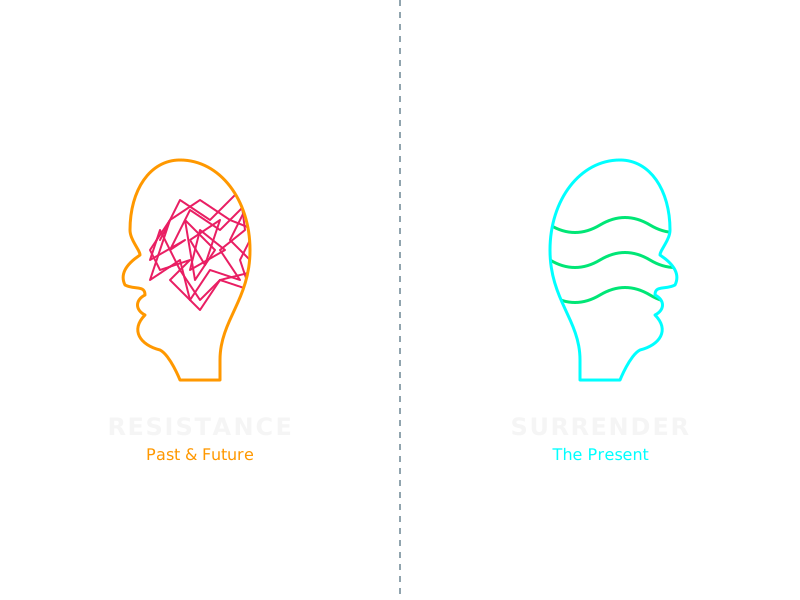
According to our standard societal metrics of productivity, both drivers are currently wasting their time. Philosophically, however, only the first driver is actively squandering their precious life. They are psychologically trapped in the illusion of past and future, which the spiritual teacher Eckhart Tolle astutely identifies as the absolute definition of wasted time. The second driver is fully alive, inhabiting the stagnant moment without an ounce of mental resistance.
The Stoic Diagnosis Of Expectancy
Squandering Hours While Guarding Our Wealth
The ancient Stoics recognized this psychological trap millennia before the invention of modern mindfulness applications. They understood that humanity suffers from a chronic, debilitating inability to simply remain where we are. We are perpetually leaning forward into the next hour, desperately hoping that tomorrow will contain whatever today currently lacks.
The Roman philosopher Seneca addressed this pathology directly in his brilliant, two-thousand-year-old treatise. He famously argued that humanity’s core problem is not that we are given a short life, but that we actively make it short by squandering it2. We treat our daily hours like they are an infinite resource, bleeding them out into the murky gutters of endless distraction.
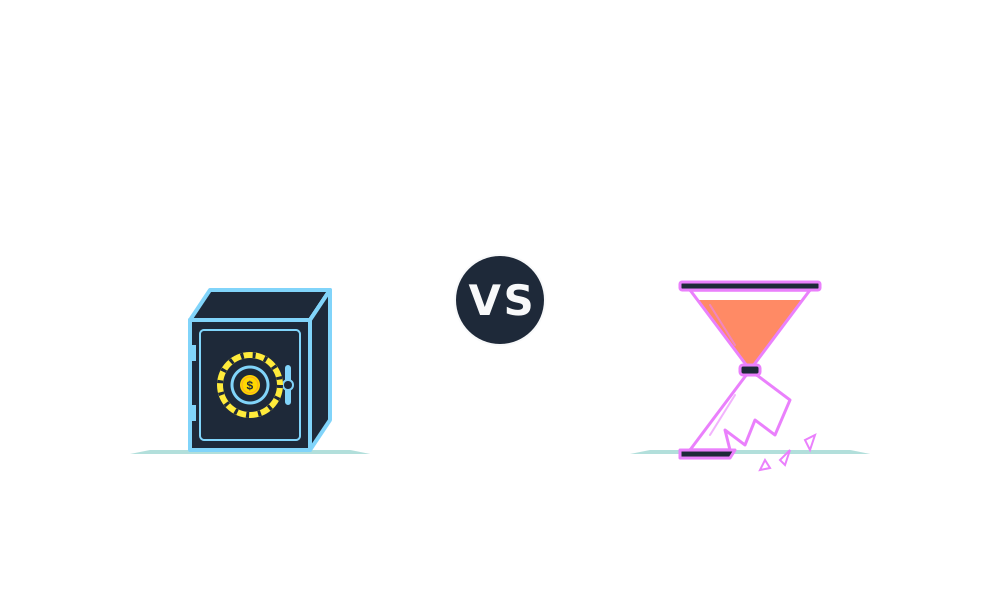
We are notoriously fiercely protective of our physical property and our financial bank accounts. People guard their money with immense, calculating frugality to ensure their security. Yet, when it comes to squandering time—our singular, non-renewable resource—we are recklessly and universally wasteful. We willingly hand our most precious commodity over to worry, regret, and the relentless pursuit of an unpredictable future.
The Immediate Danger Of Existential Procrastination
Seneca identified a highly specific cognitive disease that he accurately termed “expectancy.” He defined this as the chronic state of waiting for the future, which he believed was the primary mechanism through which we throw away our lives. “The greatest obstacle to living is expectancy, which hangs upon tomorrow and loses today,” he gravely warned.
Putting things off is the ultimate, unforgivable waste of human existence. It completely denies us the stark reality of the present by falsely promising the safety of the future. We are so obsessively busy planning out the logistics of our long-term survival that we entirely forget to engage in the immediate act of living.
Think about the profound, aching tragedy of operating this way. You are constantly arranging events that lie entirely in the unpredictable hands of fortune, while actively abandoning the only thing that actually belongs to you. The entire future lies in total uncertainty, which is precisely why Seneca forcefully implores us to live immediately.
The Danger Of Perpetual Busyness
Mistaking Frantic Motion For A Meaningful Voyage
We constantly try to mask our underlying existential dread with sheer, unadulterated motion. Modern culture worships feverishly at the altar of productivity, convincing us that as long as we remain busy, we cannot possibly be wasting time. But this relentless busyness is often just a highly sophisticated, socially acceptable form of psychological dissociation.
Being constantly preoccupied is arguably the surest possible way to lull ourselves into a passive, unthinking trance. We tragically mistake the frantic act of doing for the grounded state of being. We routinely show up for our calendar invites and fulfill our endless professional obligations, but we remain completely absent from ourselves.
Seneca used a brilliant nautical metaphor to describe this specific kind of hollow existence. He asks us to imagine a frail sailor who leaves the safety of the harbor, immediately gets caught in a massive storm, and is violently tossed around in circles by opposing winds.
That battered sailor did not actually experience a long, meaningful voyage across the ocean. He simply endured a remarkably long, chaotic tossing about. This is exactly what we are doing when we define our entire lives by our packed schedules rather than the profound depth of our daily presence.
The Double-Edged Sword Of Toxic Ambition
The pathology deepens significantly when we closely examine the actual targets of our busyness. We are perpetually chasing after new achievements, mistakenly believing that the next promotion or the next purchase will finally anchor us in reality. But this ambition is a deeply dangerous double-edged sword that cuts us repeatedly.
We spend our days steeping in a toxic cesspool of insecurity and dissatisfaction, acquiring by great toil what we must inevitably keep by even greater toil. We achieve what we want laboriously, and then we possess what we have achieved with intense, suffocating anxiety2. Meanwhile, we take absolutely no account of the precious time that is slipping away and will never return.
This endless cycle is exponentially more destructive when we are working to fulfill the mandates of others. The most wretched people are those who must regulate their own sleep by another’s schedule and match their daily walk to another’s hurried pace. If such people want to know how painfully short their lives actually are, they only need to reflect on how microscopically small a portion is truly their own.
The Architecture Of Modern Distraction
Outsourcing Our Attention To The Algorithm
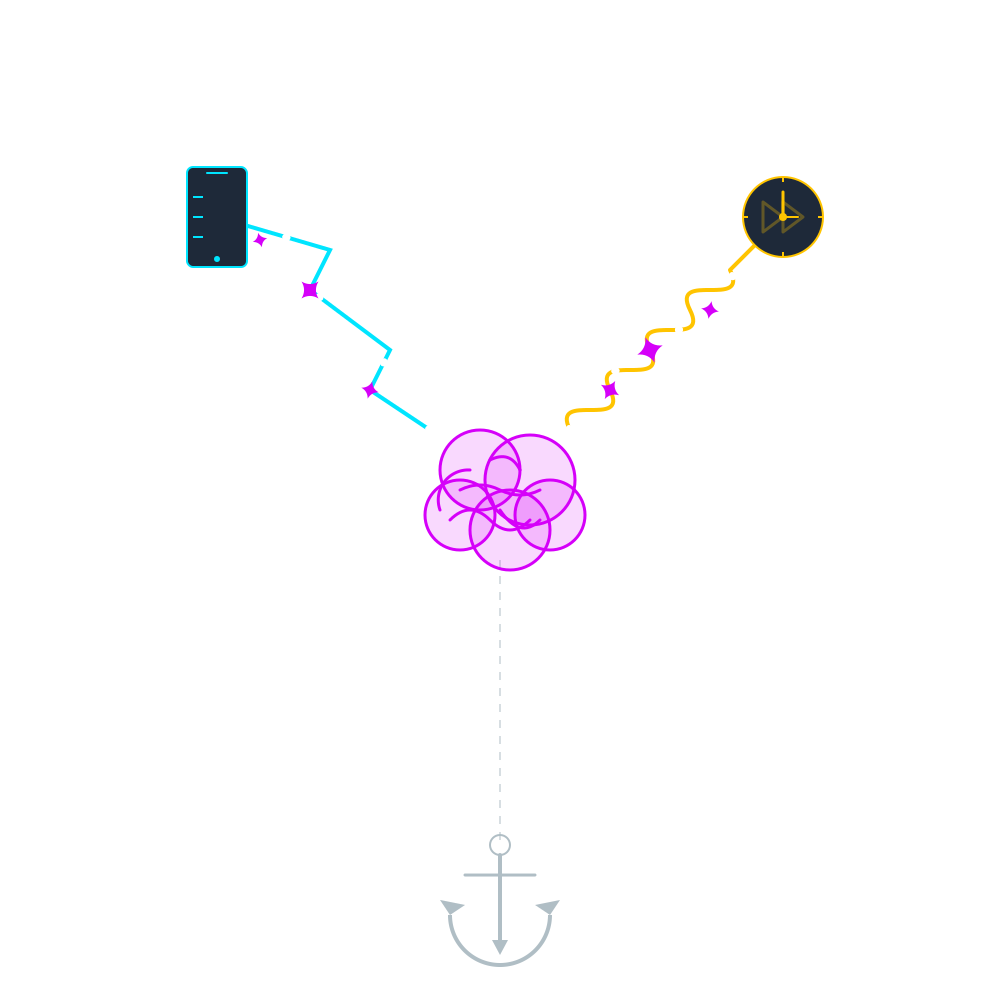
It is impossible to comprehensively discuss the modern phenomenon of wasted time without addressing the technological architecture designed to steal it. We have built a deeply interconnected society that actively and financially incentivizes our constant mental absence. The digital devices glowing in our pockets are not just tools of convenience; they are highly engineered weapons of mass distraction.
Every notification ping, every vibrating alert, and every algorithmic recommendation is a direct assault on the sanctity of the present moment. We willingly outsource our precious attention to software developers who view our human consciousness as nothing more than a monetizable commodity. When we succumb to the endless algorithmic scroll, we are entirely dead to the physical room we are sitting in.
This digital displacement is perhaps the most insidious form of time-wasting in human history. In previous generations, when a person was profoundly bored, they were at least forced to remain physically and mentally anchored in their immediate environment. Today, we have the terrifying ability to instantly teleport our minds into a million different fragmented realities, completely abandoning our physical bodies on the couch.
When your eyes are locked onto a tiny screen, absorbing the manufactured outrage of strangers, your actual life is passing you by unnoticed. The vibrant sunset happening outside your window, the subtle breathing of the person sitting next to you, and the quiet rhythm of your own heart are entirely ignored. You are technically biologically alive, but you have voluntarily opted out of the human experience.
The Exhaustion Of Living In Multiple Realities
This constant fracturing of our attention does not just waste our time; it fundamentally exhausts our human spirits. The human brain was never evolutionarily designed to process the overlapping demands of three different timelines simultaneously. Yet, we routinely ask our modern minds to navigate the physical present, stress over the impending future, and digest the digital noise of the internet all at once.
This psychic splitting creates a heavy, lingering sense of chronic fatigue that ten hours of sleep simply cannot cure. We wake up utterly exhausted because our minds have been running marathons in imagined realities while our bodies sit completely still. We are completely worn out from the sheer effort of constantly rejecting the simplicity of the present moment.
The immense psychological friction between where our bodies are and where our minds wish to be generates a massive amount of internal heat. This heat burns rapidly through our daily reserves of energy, leaving us irritable, hollowed out, and deeply disconnected from our own lives. We falsely believe we are tired from working too hard, but the undeniable truth is we are tired from the relentless effort of escaping the now.
The only reliable cure for this modern exhaustion is a radical, uncompromising return to singularity. We must forcefully demand our minds to aggressively collapse back into the exact physical space our bodies currently occupy. When we eliminate the friction of divided attention, we instantly reclaim the boundless energy required to actually live.
The Illusion Of Saved Time
The Absurdity Of Rushing Toward The Finish Line
In our desperate, frantic quest to avoid wasting time, we have developed a bizarre societal obsession with “saving” it. We hyper-optimize our morning routines, listen to heavy audiobooks on double speed, and consume our meals while answering urgent emails. We are deeply convinced that if we can just shave a few minutes off every mundane task, we will somehow stockpile enough time to finally enjoy our lives.
But time is incredibly elusive, and it fundamentally defies the strict laws of physical accumulation. You cannot bottle up the ten minutes you saved by rushing through your morning commute and casually use them later on the weekend. Time must be spent exactly as it arrives, strictly second by second, with absolutely no possibility of deferment or storage.
When we rush blindly through our daily tasks in a frantic bid to save time, we are ironically engaging in the ultimate form of wasting it. Rushing is a clear, undeniable symptom of mental absence. It is the physical manifestation of a mind that violently rejects the present moment and aggressively demands the rapid arrival of the future.
The person who sprints angrily through the grocery store is not actually saving time; they are merely ruining their current experience of reality. They have successfully convinced themselves that the destination is inherently more valuable than the journey. But life is constructed entirely of journeys, and the final destination is simply a quiet grave.
Sacrificing The Journey For A Psychological Mirage
This obsession with aggressive optimization turns our entire existence into a hollow, transactional checklist. We completely stop viewing our actions as meaningful experiences and start viewing them purely as annoying obstacles standing in the way of our real lives. But this elusive “real life” we are rushing toward is nothing more than a psychological mirage.
When you finally arrive at the glorious future you have been furiously optimizing for, you will not know how to actually enjoy it. Your brain has been rigorously trained for years to constantly look ahead to the next distant horizon. You will reach the long-awaited vacation or the distant retirement, and your restless mind will immediately begin planning for the next phase.
You cannot suddenly switch off the deeply ingrained habit of expectancy just because your external circumstances have magically improved. If you have spent a decade treating the present moment as a mere stepping stone, you will treat your eventual success the exact same way. The present moment will always feel deeply insufficient to a mind that is thoroughly addicted to the future.
The only way to genuinely save time is to completely stop trying to hoard it. You must spend it lavishly and fully on whatever task is directly in front of you. Ironically, the deepest, longest hours of our lives are the ones where we completely forget that the clock is even ticking.
The Miracle Of Completely Mundane Tasks
Washing The Dishes As A Sacred Ceremony
If frantic busyness and optimized productivity will not save us from wasting our lives, what exactly is the antidote? The profound answer lies in the radical, uncompromising embrace of the utterly mundane. Eastern philosophical traditions provide the ultimate, time-tested blueprint for this essential shift in human perspective.
Mindfulness does not require you to sit cross-legged on a remote mountaintop or chant endlessly in a silent monastery. It simply requires bringing the full, crushing weight of your consciousness to the exact thing you are currently doing. Zeroing in on the immediate present is the absolute most effective way to pull the mind out of the destructive, looping stories it constantly tells itself3.
The renowned Zen master Thich Nhat Hanh illustrated this concept perfectly using the incredibly boring, repetitive chore of washing dirty dishes. He observed that if you wash dishes purely to get them over with so you can finally sit down and have tea, you are completely incapable of living in the moment. The time spent standing at the kitchen sink is entirely wasted because you are effectively dead during that specific duration.
However, the alternative approach entirely transforms the mundane into the miraculous. If you focus entirely on the warmth of the water, the slickness of the soap, and the deliberate movement of your hands, the simple act of washing dishes suddenly becomes the most important thing in your life. Every single mundane act must be carried out in deep mindfulness, transforming ordinary chores into a deeply grounded rite or ceremony3.
Dissolving The Ego Through Absolute Immersion
When we completely immerse ourselves in the physical reality of the task at hand, we experience a strangely beautiful psychological phenomenon. The suffocating human ego suddenly vanishes. The heavy, burdensome sense of the “self”—along with all of its exhausting anxieties, bitter regrets, and soaring ambitions—temporarily dissolves into the ether.
True wasted time only occurs when your mind aggressively runs away from the present and reacts bitterly against it. But when you are fully immersed in the stark reality of the present moment, you actually stop thinking about yourself entirely1. You seamlessly become the task, merging tightly with the action until there is no separation left.
When this barrier between the observer and the action finally disappears, it becomes logically impossible for that time to be considered wasted. If you are doing something to the absolute best of your capability such that you are deeply immersed in it, you are actively reclaiming your existence1. You have successfully escaped the suffocating prison of your own distracting thoughts.
Redefining The Currency Of A Lived Hour
Escaping The Psychological Trap Of Time Illusion
We urgently need to radically and permanently recalibrate our internal ledgers regarding how we value a single day. We have been incorrectly judging the inherent worth of our time based on tangible output, brute efficiency, and visible results. This is a cold, calculated industrial metric, not a deeply human one.
A highly productive, meticulously scheduled hour spent in a state of deep, vibrating anxiety is undeniably a wasted hour. Conversely, a completely “unproductive” hour spent watching the rain hit a glass windowpane in a state of total, peaceful awareness is a fully lived hour. The sheer quality of our internal attention is the only valid, reliable currency of our existence.
Because ultimately, everything we do is strictly bounded by an uncomfortably short, unforgiving timeline. Nothing we physically build, frantically achieve, or desperately accumulate will last in the grand, cosmic scheme of things. In the ultimate sense, everything is wasted time because nothing objectively matters, yet paradoxically, in the micro-moment, what is happening right in front of you holds literally all the meaning in the world.
The daily choice we face is both terrifying and remarkably simple. You can choose to spend your brief allocation of human consciousness running away from reality, perpetually wishing you were elsewhere. Or you can stubbornly choose to show up for the singular, rapidly vanishing moment that is actually unfolding in front of your eyes.
Confronting The Ultimate Cost Of Endless Absence
The stakes of this philosophical shift are not just about achieving a fleeting sense of peace of mind. The actual stakes are the entirety and totality of your incredibly brief life. Every single time you allow your mind to wander aimlessly away from the reality right in front of you, you are surrendering a vital piece of your own existence.
We loudly mourn the dead, yet we quietly kill our own living moments with reckless, baffling abandon. We complain bitterly about how incredibly fast the years fly by, yet we desperately try to fast-forward through the countless hours we deem inconvenient or dull. It is a profound, incredibly tragic irony that defines the modern human condition.
We must stop measuring our lives by what we are frantically getting done before the clock runs out. We must start measuring our lives by how deeply and completely we are inhabiting the act of doing. When we fiercely focus on the present moment, our deepest fears, our heaviest worries, and the intense pressures we put on ourselves begin to naturally fade away3.
The exact second your mind abruptly splits from your physical body, the inevitable decay of your life begins. The precious moment is permanently gone forever, and you were tragically absent for its only universal screening. You cannot save time, and you certainly cannot cheat it. True living is simply refusing to be anywhere else.


