


I’ve spent years chasing the kind of success that looks good on paper—promotions, accolades, the kind of life that gets likes. But here’s the thing: none of it ever felt like mine. It was like wearing a suit tailored for someone else, no matter how well it fit. That’s the trap of the False Self, the polished version of us that’s designed to please, to perform, to survive—but not to thrive.
What if the emptiness we feel isn’t a sign that we’re failing, but that we’re succeeding at the wrong thing? The real work isn’t just achieving; it’s figuring out who we are beneath the masks we’ve been taught to wear. And that, I’m learning, starts with the terrifying, liberating act of being vulnerable. Not as a weakness, but as the only path to something real.
The ‘False Self’ Trap: Why Inauthentic Success Feels Empty
Winnicott’s Theory: True Self vs. False Self
Winnicott’s theory of the True Self and False Self is a profound exploration of how we adapt to survive emotionally. Imagine a child who cries out, “I want to be held!” but is met with consistent neglect. Over time, that child learns to say, “I don’t need anyone,” even though their True Self still craves connection. This adaptation isn’t just a childhood phase—it’s a survival mechanism that shapes our adult relationships and self-perception.
The False Self becomes a shield, a way to navigate a world that doesn’t always meet our needs. But here’s the catch: while the False Self might help us function, it also distances us from our authentic desires, leaving us feeling hollow even in moments of external success. What’s fascinating is that Winnicott frames the development of the self as inherently relational.
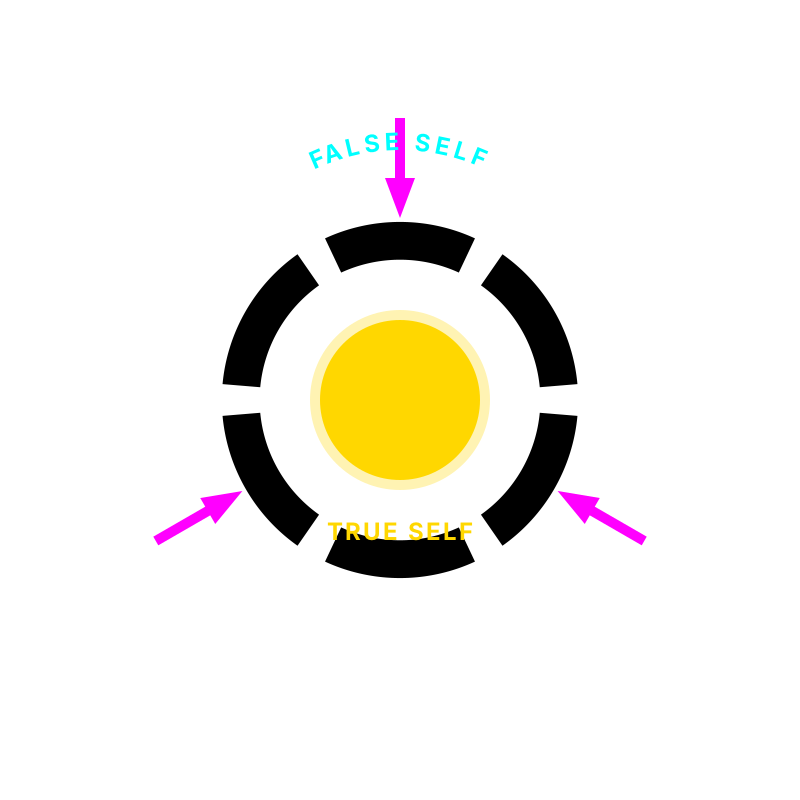
Our sense of who we are doesn’t emerge in isolation; it’s forged in the crucible of our earliest relationships. If those relationships were inconsistent or dismissive, the False Self might dominate, leading to a life that looks successful on paper but feels inauthentic.
Therapy, then, becomes a space to revisit those early adaptations, to peel back the layers of the False Self and reconnect with what we truly want. It’s not about abandoning the False Self entirely—after all, we all need some level of adaptation to thrive—but about recognizing when it’s overshadowing our True Self. 1
The Hidden Cost of Wearing a Successful Mask
The irony of the False Self is that it can lead to outward success while breeding inner emptiness. You might climb the corporate ladder, maintain a picture-perfect social life, and still feel like an impostor. Winnicott’s work suggests that this dissonance arises because the False Self, while adaptive, stifles spontaneity and creativity. When we’re constantly performing, we lose touch with the parts of ourselves that make life feel vibrant and meaningful.
The mask becomes so convincing that even we start to believe it, forgetting that beneath the polished exterior lies a True Self longing for expression. Brené Brown’s research on shame and vulnerability adds another layer to this dynamic. She argues that the fear of disconnection—of being seen as unworthy—drives us to hide behind the False Self. We perform not just to succeed but to avoid the excruciating vulnerability of being truly known.
The result? A life that looks impressive but feels like a carefully curated illusion.
The solution isn’t to discard the mask entirely but to become aware of when we’re wearing it. Authenticity, then, isn’t about radical transparency; it’s about intentionality—knowing which parts of ourselves we’re sharing and why. 1 2 3
The Key to Authenticity: Knowing When to Wear Your Mask
The real danger isn’t wearing a mask—it’s forgetting that we’re wearing one. Adam Grant and Brené Brown both highlight the costs of oversharing or performing without awareness. In professional settings, unfiltered authenticity can derail careers, while in personal relationships, it can create unnecessary conflict. The key isn’t to abandon the False Self but to use it strategically, recognizing when it serves us and when it’s time to let the True Self emerge.
Therapy, as Winnicott suggests, can be a powerful tool in this process, offering a safe space to explore the layers of our identity without judgment. Ultimately, authenticity isn’t about being the same person in every context. It’s about understanding the difference between the mask and the face beneath it.
The goal is to find those rare relationships where we can afford to be seen—where the True Self isn’t just tolerated but celebrated. Until then, the mask isn’t the enemy; it’s a tool. The question isn’t whether we should be authentic but with whom we can afford to be.
Vulnerability: The Key to Aligning with Your Internal State
Why Vulnerability Is the Key to Courage and Connection
Brené Brown’s work on vulnerability flips the script on what we’ve been taught to fear. Vulnerability isn’t weakness—it’s the raw, unfiltered courage to show up as we are, even when the outcome is uncertain. In her TED Talk, she reveals how we numb vulnerability to avoid discomfort, but in doing so, we also numb joy, gratitude, and connection. The result?
A life that’s emotionally flatlined, where we’re neither fully present in our pain nor our pleasure. It’s a vicious cycle: we feel vulnerable, so we reach for distractions—whether it’s a drink, a shopping spree, or endless scrolling—only to find ourselves more disconnected than before. The real kicker? We can’t selectively numb emotions.
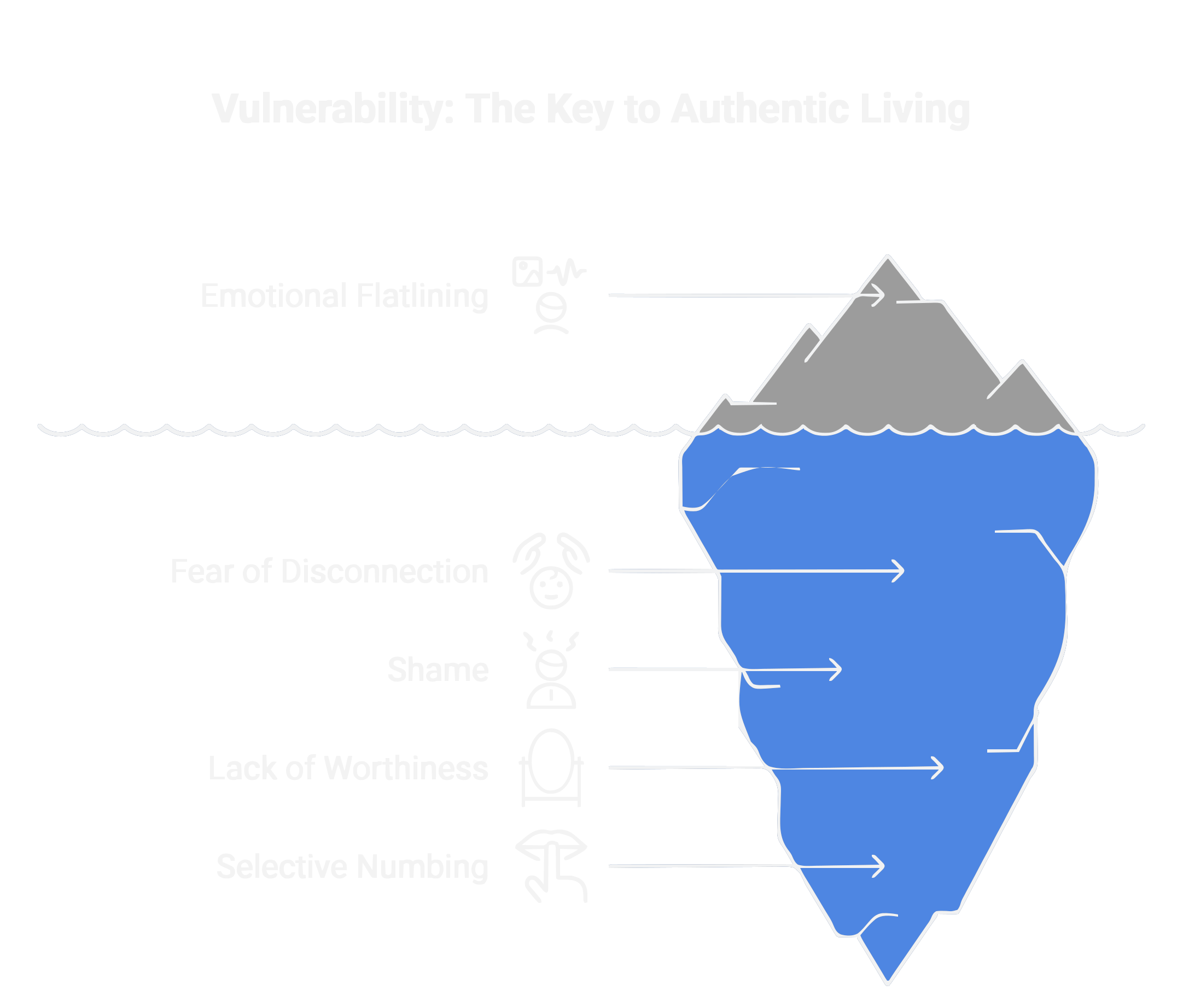
When we mute fear and shame, we also mute happiness and love. Brown’s research uncovered that the people who experience deep connection and belonging share one trait: they believe they’re worthy of it. This sense of worthiness isn’t about perfection; it’s about embracing vulnerability as the birthplace of authenticity. Yet, even in spaces designed for radical honesty—like therapy—we hesitate.
Studies show that clients often withhold their deepest truths, even when they know it’s sabotaging their growth. The barrier?
Shame. We fear judgment so intensely that we’d rather stay stuck than risk exposure.
How Shame Blocks Authenticity and Connection
Shame is the silent killer of authenticity. It whispers that we’re not enough—that our flaws make us unlovable. This fear of disconnection drives us to hide, even in relationships where we’re supposed to be safe. Consider therapy: a space where confidentiality is guaranteed, and acceptance is the foundation.
Yet, research shows that clients routinely conceal their struggles, from sexual behavior to suicidal thoughts. Why? Because shame convinces us that even the people paid to help us will reject us if they see the truth. 3 The irony is that shame thrives in secrecy.
The more we hide, the more power it holds over us. Breaking free requires vulnerability—acknowledging our struggles without the guarantee of approval. It’s a risky move, but the alternative is worse: a life spent performing, where even our closest relationships are built on half-truths.
Why Vulnerability Leads to Authentic Living
Vulnerability isn’t a one-time act; it’s a daily practice. Brown describes her own journey as a “yearlong street fight”—a messy, uncomfortable process of pushing back against the urge to armor up. The reward? Reclaiming her life.
When we drop the armor, we open ourselves to the full spectrum of human experience: the pain, yes, but also the joy, creativity, and connection that make life meaningful. 2 The key isn’t to eliminate fear but to move through it. Authenticity isn’t about having it all together; it’s about showing up even when we don’t.
It’s in those moments of raw honesty—whether it’s asking for help, admitting a mistake, or sharing a hidden struggle—that we align with our true selves. The paradox is that vulnerability, the thing we fear most, is also the path to the life we crave.
The Congruence Connection: Carl Rogers and the ‘Fully Functioning Person’
Understanding Congruence: Rogers’ Theory Explained
Carl Rogers, often hailed as the most influential psychotherapist in history, introduced the concept of congruence as the alignment between our ideal self, self-image, and actual experience. It’s a delicate balance—one that rarely achieves perfection but strives for harmony. Imagine your ideal self as the person you aspire to be: confident, compassionate, successful. Your self-image, meanwhile, is how you perceive yourself in this moment—flaws, doubts, and all.
When these two align with your lived experience, you’re in a state of congruence. But here’s the catch: most of us live with some degree of incongruence, a gap between who we think we should be and who we actually are. This misalignment isn’t just uncomfortable—it’s the root of psychological tension.
Rogers argued that congruence is essential for self-actualization, the process of becoming the best version of ourselves. Yet, achieving it requires unconditional positive regard, both from others and, crucially, from ourselves.
Without it, we’re left defending our self-image with denial or repression, shielding ourselves from the truth because, well, the truth hurts. The goal isn’t to eliminate incongruence entirely but to narrow the gap, allowing our true selves to breathe. 4
Embrace Discomfort: The Key to Congruence
Rogers’ fully functioning person isn’t someone who’s achieved perfection but someone who’s open to experience—even the messy, uncomfortable parts. This openness is key to congruence. When we suppress negative emotions—shame, fear, anger—we create a rift between our self-image and reality. The solution?
Let them flow. It’s counterintuitive, but embracing discomfort is how we grow. Consider relationships: research suggests that while high openness to experience can lead to sensation-seeking, moderate openness fosters deeper connection. The same applies internally.

If we’re only open to joy but closed to pain, we’re living a half-life. The fully functioning person, in Rogers’ view, is a work in progress—always becoming, always changing. They’re not immune to incongruence but are willing to face it head-on.
This isn’t about achieving some idealized state; it’s about the courage to be unpopular, to feel your feelings without intellectualizing them away. Authenticity, then, isn’t a destination but a practice of aligning with your true self, one raw emotion at a time. 5
Masking’s Impact: Incongruence, Anxiety, and Trust
Masking—hiding our true feelings to fit an expected mold—is the enemy of congruence. When we pretend to be someone we’re not, we widen the gap between our self-image and reality. Rogers called this incongruence, and it’s a breeding ground for anxiety. Think of it like wearing a too-tight suit: it might look polished, but it’s suffocating.
The more we mask, the more we rely on defense mechanisms like denial, which only deepens the disconnect. The problem isn’t just internal. Masking erodes trust—in ourselves and others. When we’re not honest about who we are, we invite others to love a version of us that doesn’t exist.
The solution? Stop chasing approval.
Authenticity isn’t about being your “whole self” all the time; it’s about being your best self, even when that means being unpopular. The irony is that the more we embrace our true selves, the more congruence we achieve—and the less we need the mask.
Existentialism and Authenticity: Defining Your Own Success
What Is Sartre’s ‘Bad Faith’ and Why It Matters
Jean-Paul Sartre, the quintessential existentialist, had a knack for exposing the uncomfortable truths of human existence. One of his most piercing insights is the concept of “bad faith”—the act of deceiving ourselves to conform to societal expectations. Imagine a waiter who over-identifies with his role, believing he is a waiter rather than a person who chooses to wait tables. This isn’t just about job titles; it’s about the masks we wear to avoid the terrifying freedom of defining ourselves.
Sartre’s philosophy hinges on the idea that “existence precedes essence.” Unlike a tree, whose essence is fixed, humans are born without a predefined purpose. We’re free to create our own meaning—but this freedom is daunting. Bad faith is the escape hatch.
It’s the barista who insists, “I’m just a coffee guy,” ignoring his dream of writing a novel. It’s the corporate drone who says, “I’m not creative,” because creativity isn’t in his job description. These are lies we tell ourselves to avoid the responsibility of choice. The irony?
Bad faith is a form of self-betrayal. When we let others define us—whether it’s parents, bosses, or Instagram influencers—we surrender our authenticity. Sartre’s critique isn’t just philosophical; it’s a call to wake up.
The waiter isn’t just a waiter; he’s a person who could be anything. The moment we accept that, we step into the messy, liberating work of defining ourselves. 6 5
Why Success in Bad Faith Is Hollow and Unfulfilling
Here’s the brutal truth: success built on bad faith is hollow. You can climb the corporate ladder, amass followers, or tick every societal box, but if you’re just performing a role, the victory rings empty. Sartre would argue that this kind of success isn’t yours—it belongs to the role you’re playing. The promotion, the applause, the likes—they’re all rewards for being someone else.
Consider the lawyer who hates law but stays for the prestige. Or the influencer who curates a “perfect life” while feeling like a fraud. These aren’t just career crises; they’re existential ones. Bad faith success is a house of cards—it looks impressive until a breeze of self-awareness knocks it down.
The real tragedy? The longer we live in bad faith, the harder it is to remember who we were before the role swallowed us whole. The antidote isn’t quitting your job or burning your life to the ground. It’s about reclaiming agency.
Sartre’s “Existentialism is a Humanism” reminds us that choosing ourselves isn’t selfish—it’s how we contribute to humanity. When we live authentically, we give others permission to do the same.
The lawyer might pivot to mediation; the influencer might share their struggles. The shift from bad faith to authenticity isn’t just personal—it’s revolutionary. 6
Choosing Authenticity: Embrace Your Power to Define Success
Sartre’s philosophy isn’t all doom and gloom. Yes, we’re “condemned to be free,” but that’s also our superpower. The moment we accept responsibility for our choices, we stop being victims of circumstance. This isn’t about grand gestures—it’s about daily acts of defiance against bad faith.
It’s the teacher who admits she’s bored with lesson plans and starts a side project. It’s the parent who realizes they’re mimicking their own parents’ mistakes and chooses differently. The catch? Freedom is scary.
It’s easier to blame the system, our upbringing, or “the algorithm” than to admit we’re the authors of our lives. But here’s the kicker: when we own our choices, we also own our power. Sartre’s syllogism—“In choosing myself, I choose man”—isn’t just philosophy; it’s a blueprint for living. Our choices ripple outward, shaping not just our lives but the world around us.
Authenticity isn’t a destination; it’s a practice. It’s showing up, even when it’s messy. It’s choosing vulnerability over performance, truth over comfort.
And yes, it’s terrifying—but as Sartre knew, the alternative is worse. A life lived in bad faith isn’t just inauthentic; it’s a life half-lived. The question isn’t whether you’ll stumble—it’s whether you’ll have the courage to keep choosing yourself, again and again. 7
Beyond the Self: Authenticity and Social Responsibility
Ethical Authenticity: Balancing Self and Others
Authenticity isn’t a solo act—it’s a dance between self-expression and social responsibility. While we’ve explored the personal cost of inauthenticity, there’s another layer: the ethical implications of our choices. When we prioritize our own truth without considering its impact on others, we risk slipping into a different kind of bad faith—one where our authenticity becomes a weapon. Consider unconditional positive regard, a cornerstone of Rogers’ humanistic approach.
It’s easy to romanticize the idea of total acceptance, but in practice, it’s messy. Therapists are trained to suspend judgment, yet even they struggle with the tension between authenticity and ethics. If a client confesses harmful behavior, does unconditional positive regard mean condoning it? Of course not.
The goal is to create a space where truth can emerge without shame—but that doesn’t mean ignoring the consequences of one’s actions. The same principle applies to everyday life. Being true to yourself shouldn’t come at the expense of others’ well-being. As Erich Fromm warned, narcissism—whether personal or collective—distorts our judgment, turning authenticity into self-absorption.
The challenge? Balancing self-honesty with empathy. This isn’t just about avoiding harm; it’s about recognizing that our authenticity is intertwined with others’.
Daniel N. Robinson’s reflection on Faust and Fichte hints at a deeper truth: true authenticity isn’t just about self-expression but about externalizing freedom for the collective good. When we insist on our truth without regard for others, we’re not being authentic—we’re being selfish. The paradox is that the most authentic lives are often those that transcend the self, creating space for others to do the same. 6
How to Use Authenticity for Positive Impact
Authenticity isn’t just about feeling good—it’s about doing good. The modern obsession with “being yourself” often stops at personal fulfillment, but real authenticity demands more. It’s about leveraging your truth to contribute to something larger than yourself. Think of it as the difference between radical authenticity (which often serves the privileged) and intentional authenticity (which serves the world).
The way forward isn’t about abandoning the False Self entirely but about using it strategically. As Adam Grant and Brené Brown note, authenticity isn’t a binary—it’s a spectrum. The goal isn’t to be 100% authentic in every context (that’s a fantasy) but to find the spaces where you can be 70% real, with the right people, at the right times. This isn’t hypocrisy; it’s wisdom.
It’s recognizing that authenticity isn’t a performance but a practice—one that requires discernment. The real test of authenticity isn’t how well you express yourself but how well you use that expression to uplift others. Whether it’s in leadership, relationships, or creative work, the most authentic lives are those that balance self-truth with social responsibility.
As Barbara Jordan put it, the danger isn’t just in losing ourselves—it’s in losing the collective good. Authenticity, then, isn’t just about being true to yourself; it’s about being true to the world. 3 4
The 70% Rule: Strategic Authenticity for Personal Growth

Here’s the uncomfortable truth: authenticity is a luxury. Not everyone can afford to be fully themselves in every context. The key isn’t to force radical transparency but to find the sweet spot—what I call the “70% rule.” It’s about being intentional with your authenticity, choosing the right people and the right moments to let your guard down.
This isn’t about compromise; it’s about strategy. The False Self isn’t the enemy—it’s a tool. The problem arises when we wear it without awareness, letting it dictate our lives. But when we use it deliberately, we create boundaries that protect our true selves while still allowing us to navigate the world.
The goal isn’t to be authentic all the time but to be authentic enough—to find the spaces where vulnerability feels safe and the relationships where truth is celebrated. The beauty of the 70% rule is that it’s adaptable. It recognizes that authenticity isn’t a fixed state but a fluid practice.
Some days, you might only be able to show 50% of yourself—and that’s okay. The point is to keep pushing toward that 70%, to keep finding the people and places where you can be more real.
Because authenticity isn’t about perfection; it’s about progress. And in a world that demands so much of us, that’s revolutionary enough.
Conclusion
So here we are, at the end of this exploration, and the question lingers: What now? You’ve seen how the False Self, like a well-tailored suit, can help us navigate the world—but at what cost? The promotions, the likes, the polished performances—they’re not inherently bad, but they’re not inherently you, either. The real work isn’t about burning it all down (though, admit it, the thought has crossed your mind). It’s about recognizing when the mask is wearing you instead of the other way around.
Authenticity isn’t a grand reveal, a mic-drop moment where you declare, “This is the real me!” It’s quieter than that. It’s the daily choice to peel back a layer, to say, “I don’t have it all together,” or “This isn’t what I really want.” It’s the courage to sit in the discomfort of vulnerability, knowing that’s where the good stuff—connection, creativity, you—actually lives. (And yes, it’s terrifying. If it weren’t, everyone would be doing it.)
Here’s the thing: You don’t have to be 100% authentic all the time. That’s not just unrealistic; it’s exhausting. The 70% rule isn’t about settling—it’s about strategy.
It’s knowing which relationships can hold your truth and which ones can’t. It’s understanding that some spaces require armor, but others? They’re the ones where you can finally breathe.
And maybe that’s the real takeaway. Authenticity isn’t about being flawless or fearless. It’s about being human—messy, contradictory, and still showing up. It’s about choosing yourself, even when the world (or your inner critic) insists you should be someone else.
So, where do you go from here? Maybe you start small. Maybe you tell one person the truth you’ve been hiding. Maybe you quit performing for an audience that doesn’t deserve you.
Or maybe you just pause, for once, and ask: What do I actually want? (Not what you should want. Not what would look good on Instagram. But what makes you feel alive.)
The truth is, no one can answer that for you. Not Winnicott, not Rogers, not even Sartre. This is your life, your script, your messy, beautiful, unfinished story. The only question left is: Are you ready to write it?
Footnotes
-
Understanding Dr. D.W. Winnicott’s True Self & False Self Theory ↩ ↩2
-
When Brené Brown Met Adam Grant: The Authenticity Trap | Psychology Today ↩ ↩2 ↩3
-
Why Women Say They Want One Thing But Date Another - Rob Henderson ↩ ↩2
-
Existentialism: Authenticity vs. ‘Bad Faith’ – Values of the Wise ↩ ↩2 ↩3
-
44 Harsh Truths About The Game Of Life - Naval Ravikant (4K) ↩


