


I want to talk about the particular kind of exhaustion that comes from doing everything perfectly right. You know the exact feeling I’m describing. I’ve spent years watching intensely smart, capable people—friends, colleagues, and myself—run themselves directly into the ground. We optimize our morning routines with cold plunges, track our macros, and chase every conceivable career milestone.
Yet, despite acquiring the external markers of success, we remain perpetually haunted by a quiet, gnawing dissatisfaction. It’s the modern disease of the high achiever. We operate under the dangerous assumption that if we just push a little harder, we will finally cross an invisible threshold into permanent happiness.
But that threshold is a mirage. Our cultural obsession with the “arrival fallacy”—the belief that the next promotion, the next relationship, or the next tax bracket will permanently fix us—has left an entire generation spiritually bankrupt. When the existential exhaustion becomes too heavy, our instinct is to turn to the shallow waters of contemporary self-help. We download another habit-tracking app, hoping it will act as a quick neurological reset button for our souls.
What if the antidote to our intensely modern anxiety requires a technology that is over two millennia old? I am not talking about the watered-down, corporate-retreat version of mindfulness that encourages you to take deep breaths before a stressful board meeting. I am talking about a robust, demanding, and philosophically rigorous framework that forces you to look reality directly in the eye. That framework is ancient Buddhism, and it holds the keys to dismantling the architecture of our suffering 1.
The Pathology of the Modern Achiever
The Legend of the Unhappy Prince
To understand how fiercely radical this philosophy actually is, you have to examine its origin story. Siddhartha Gautama was a prince in ancient India who possessed everything the modern world desperately tells us we should want. He had exorbitant wealth, youth, stunning good looks, and immense social privilege. Yet, despite his flawlessly curated existence, he was fundamentally miserable.
He looked around his palace and realized that his riches offered exactly zero protection against the universal truths of aging, sickness, and death. Driven by a relentless, burning curiosity, he abandoned his royal life to live as a wandering ascetic. He starved himself, meditating in the wilderness in search of profound enlightenment, only to discover that extreme deprivation was just as useless as extreme indulgence.
It was out of this profound failure that he discovered the “Middle Way.” He realized he had to study his own mind, systematically peeling back the layers of his internal and external reality. Sitting quietly beneath the Bodhi tree, he finally diagnosed the root cause of human misery, formulating the Four Noble Truths that still form the absolute bedrock of Buddhist thought today.
The Universal Condition of Suffering
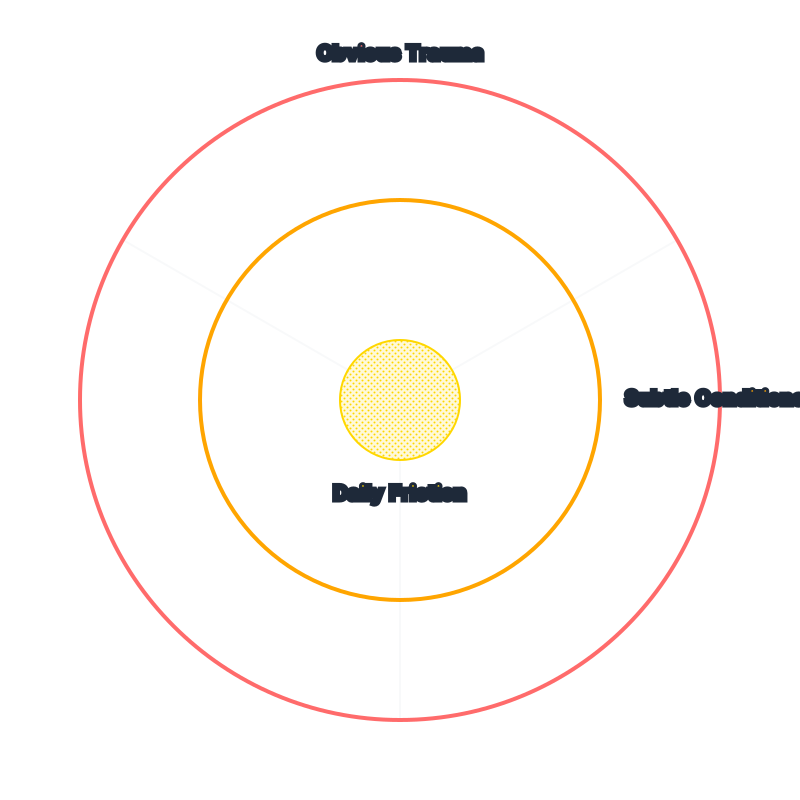
The First Noble Truth is bracingly, almost uncomfortably direct: life is suffering. This isn’t just about catastrophic, world-shattering tragedies; it’s about the pervasive, low-grade friction of simply being alive in a physical body. There is the obvious suffering of rapid change, like the agony of a romantic breakup or the shock of a sudden corporate layoff.
Then there is the subtle suffering of conditionality, which is perhaps the most relatable concept to our hyper-connected modern lives. Imagine taking your family on a spectacular, deeply relaxing vacation to Costa Rica, only to return home to a flooded inbox and instantly feel a crushing sense of dissatisfaction. Your baseline conditions abruptly shifted, and your mind violently rebelled against the new, less exciting normal.
Finally, there is the simplest, most inescapable layer: the physical and emotional aches of daily existence. Your back hurts from slouching over a laptop for a decade. A colleague makes a passive-aggressive comment in a meeting that completely ruins your afternoon. We are constantly navigating an invisible minefield of discomfort, and pretending otherwise is an exercise in pure delusion.
Decoding the Architecture of Reality
The Delusion of Permanence
If the First Noble Truth diagnoses the symptom, the Second Noble Truth identifies the pathogen. The core cause of our suffering is attachment, and this toxic attachment is entirely rooted in our fundamental ignorance of reality. We look at a world that is inherently unstable and desperately demand that it stand perfectly still for us.
We expect our carefully planned careers to offer unbroken upward trajectories. We expect our spouses to be the exact same people at fifty that they were at twenty-five. When things inevitably change—because rapid change is the only actual law of the physical universe—we suffer deeply. We grieve not just for the loss of the thing itself, but for the shattered illusion of permanence that we mistakenly clung to.
The great existential philosopher Søren Kierkegaard once famously asserted that “truth is subjective,” meaning that intellectually knowing a fact is useless unless you have emotionally internalized it. The same precise logic applies to the Buddhist view of impermanence. We all intellectually know that we are going to die and that circumstances shift, but we certainly don’t live our daily lives as if we truly believe it.
The Web of Interdependence
Because everything is impermanent, it naturally follows that nothing exists in a vacuum. Buddhism places a massive emphasis on the concept of interdependence, the idea that every single event arises from an infinite web of preceding causes and conditions. We like to view ourselves as self-made, isolated individuals charting our own course, but this is yet another ego-driven fantasy.
Your current success in business is inextricably linked to the mentors who guided you, the economic conditions of your youth, and the stability of your society. Even your physical pain is interdependent. A chronic backache doesn’t just appear out of nowhere; it is the direct result of a ten-year habit of hunching over a keyboard.
Understanding this web of interrelatedness fundamentally shifts how we interact with the world. When a marriage begins to fall apart, it isn’t an isolated, sudden explosion. It is the cascading result of not actively listening to a spouse for five consecutive years. Recognizing interdependence keeps us intensely accountable for our micro-actions.

The Radical Concept of No-Self
This brings us to a fascinating, highly debated divergence between Buddhism and Western philosophies like Stoicism. Both intellectual traditions are immensely practical, focus heavily on daily ethics, and urge us to remember our own mortality—the Stoic concept of memento mori. But they part ways violently on the concept of core identity.
Stoicism generally affirms the existence of a rational self or an eternal soul, aiming for a life well-lived through the application of logic and virtue. Buddhism, conversely, leans into the unsettling, radical concept of “no-self.” It argues that there is absolutely no permanent, unchanging core identity for us to protect or cling to.
Consider the stark biological reality: the cells in the human body completely regenerate roughly every seven years. You are literally not the same physical entity you were a decade ago. If your physical matter is entirely impermanent, it is incredibly arrogant to assume your mind, feelings, and identity are somehow magically carved in stone.
The Gym for Your Mind
Redefining the Purpose of Meditation
Let’s clear up the biggest cultural misconception about meditation right now. We mistakenly treat it like a spa retreat for the brain, expecting to sit on a velvet cushion, close our eyes, and instantly float into a cloud of serene relaxation. When we inevitably encounter a chaotic, noisy swarm of stressful thoughts instead, we assume we are doing it wrong and promptly quit.
But the Tibetan word for meditation is gom, which directly translates to “being familiar with”. The goal isn’t to violently force your brain into peaceful submission; it’s to quietly study the erratic, wild nature of your own thoughts. It is about actively creating a laboratory environment to watch exactly how your mind reacts to nothingness.
Even for advanced practitioners with a decade of daily experience, meditation can remain frustrating, turbulent, and decidedly un-peaceful. But we don’t go to the gym because lifting heavy weights feels relaxing; we go to intentionally build the resilience necessary for the rest of our lives. Meditation is exactly the same mechanism—it is the heavy, unglamorous lifting of mental discipline.
The Two Faces of Human Consciousness
Buddhist thought suggests that our minds effectively operate on two entirely different, competing frequencies. There is sem, which is the ordinary, chaotic, monkey mind that most of us are permanently trapped in all day. It is the anxious part of you that plots, schemes, catastrophizes about the future, and picks petty fights with your friends 1.
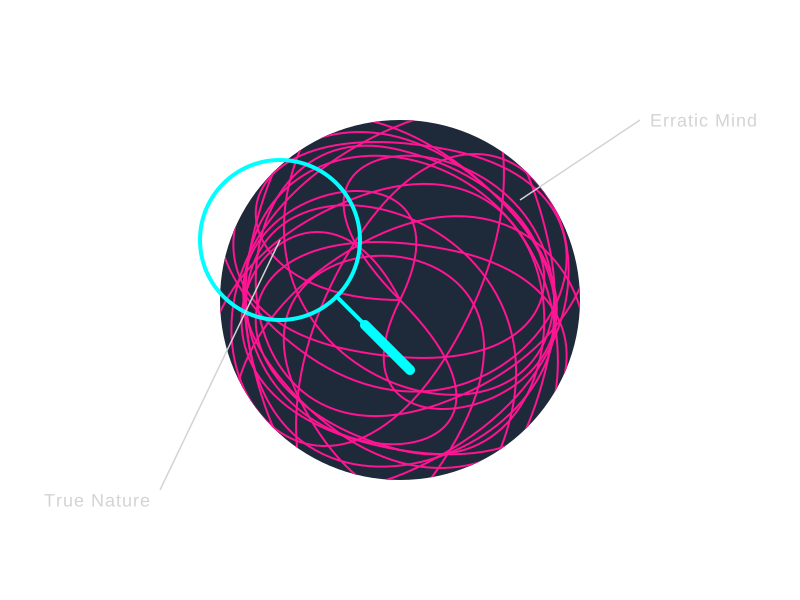
Beneath that unbearable noise lies rigpa, the true, unclouded nature of the mind. Imagine the sheer clarity you feel in the final moments of a grueling, long-distance run, where your complicated problems suddenly seem insignificant and your awareness is totally unburdened. That spacious, free, and luminous state is rigpa, and the entire project of Buddhist practice is attempting to strip away the noise to uncover it.
To get there, beginners are often taught Shamatha meditation, otherwise known as “calm abiding,” which involves hyper-focusing on a single, boring point like the breath. Once the erratic mind finally begins to settle, one can transition to Vipassana, or insight meditation, where the profound goal shifts to perceiving the true, impermanent nature of reality without focusing on anything specific at all.
The Clinical Case for Consistency
You don’t have to take these spiritual implications purely on blind faith, because the modern clinical data is staggering. Researchers have placed highly advanced Buddhist monks inside fMRI machines to intensely monitor their brain activity. These subjects, who had accumulated tens of thousands of hours of meditation, showed measurable psychological evidence of significantly lower stress and higher baseline happiness compared to average humans.
But you don’t need to dramatically quit your job and move to a remote monastery to see a serious return on investment. The hidden key is relentless consistency, not extreme daily duration. Studies indicate that just three to five minutes of daily meditation can dramatically reduce your stress levels, provided it is treated like an uncompromising daily ritual. You brush your teeth every single morning without fail; you must also brush your mind.
Weaponizing Compassion Against Chaos
Creating the Gap Between Stimulus and Response
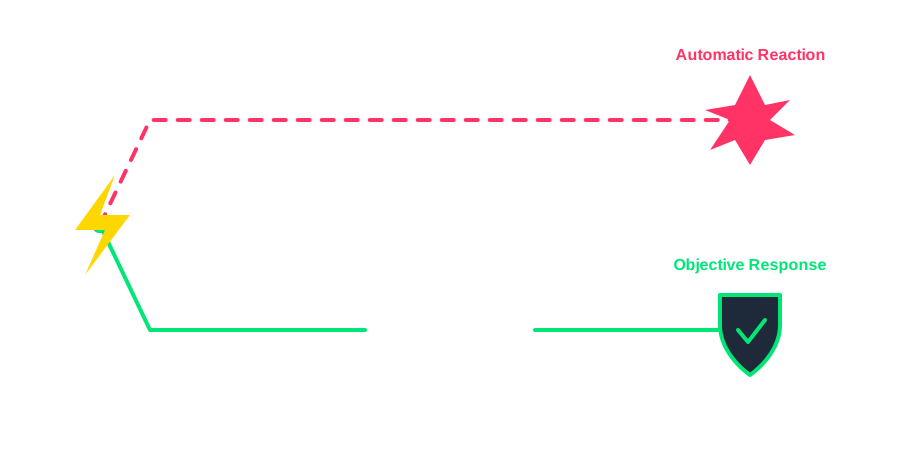
Once you establish a consistent meditative practice, you rapidly start to develop a tangible psychological superpower: the gap. In our ordinary, highly reactive state, an external trigger immediately causes an uncontrollable emotional explosion. Your boss unfairly criticizes you, and you instantly spiral into defensive, white-hot rage.
Mindfulness inserts a vital, microscopic fraction of a second between the external stimulus and your internal response. This brief pause allows you to witness your own turbulent emotions objectively rather than being utterly consumed by them. You stop saying “I am angry,” which falsely fuses your core identity with a fleeting emotion, and begin to say “I am feeling angry,” which rightly frames the emotion as a temporary storm passing through you.
When that semantic perspective isn’t quite enough, you can deploy the brilliant intellectual framing of the great monk Thich Nhat Hanh. He suggested a brutally effective mental trick for dealing with infuriating people: picture them three hundred years in the distant future, and then immediately picture yourself. You will both be nothing but silent ash. It is a wonderfully dark, humorous reminder of our shared, inevitable end that effortlessly dissolves petty anger.
The Alchemy of Taking on Pain
This shared vulnerability is the absolute foundation of karuna, the ancient Sanskrit word for a genuine wish to alleviate the suffering of others. Compassion in Buddhism is not merely a soft, warm, sentimental feeling. It is an active, demanding technology used to aggressively mature the mind.
One of the most potent tools for cultivating this is Tonglen meditation. In this uniquely Tibetan practice, you intentionally visualize breathing in the acute suffering and pain of another person, and then actively breathe out purified relief and comfort to them. It feels entirely counterintuitive to the modern mind—why on earth would you willingly invite someone else’s toxic pain into your own psyche?
The subtle magic of Tonglen is that by acting out of pure, unselfish empathy, you essentially short-circuit your own fragile ego. Alternatively, you can utilize Loving-Kindness meditation, a practice popularized by the prominent psychologist Rick Hansen. You silently repeat powerful mantras like “may you be safe, may you be happy,” starting with a close loved one, progressing to a neutral stranger, and eventually daring to direct it toward your worst enemy.
The Relentless Demand for Action
Bridging the Gap Between Thought and Deed
If Buddhism was purely an esoteric intellectual exercise, it would be entirely useless for real life. The ultimate goal of the Third Noble Truth—ending our suffering—requires us to actively walk the Eightfold Path, which is essentially a strict blueprint for radical ethical action. You absolutely cannot meditate your way out of being a terrible person.
The Eightfold Path specifically mandates right speech, right action, and right livelihood as core components of an ethical life. This means fiercely evaluating whether you speak truthfully, whether your physical actions inadvertently harm others, and whether the way you earn your daily paycheck is fundamentally ethical. Having a fleeting, generous thought to donate to a charity is effectively meaningless if you don’t actually pull out your wallet and make the transfer.
The philosophy demands that we treat every mundane annoyance as a literal arena for spiritual practice. The frustratingly slow barista at the crowded coffee shop is not an obstacle in your day; they are an unexpected teacher granting you a precious opportunity to exercise real patience. If our lives were perfectly frictionless, we would never develop a single ounce of genuine self-control.
The Nightly Ledger of the Soul
To ensure you aren’t just coasting on abstract theory, the tradition requires rigorous, daily accountability. The Buddhist philosopher Patrul Rinpoche advised his dedicated students to engage in a specific, uncompromising ritual every night before falling asleep. He sternly warned against simply dropping off into unconsciousness, urging instead a quiet, brutal interrogation of the day.
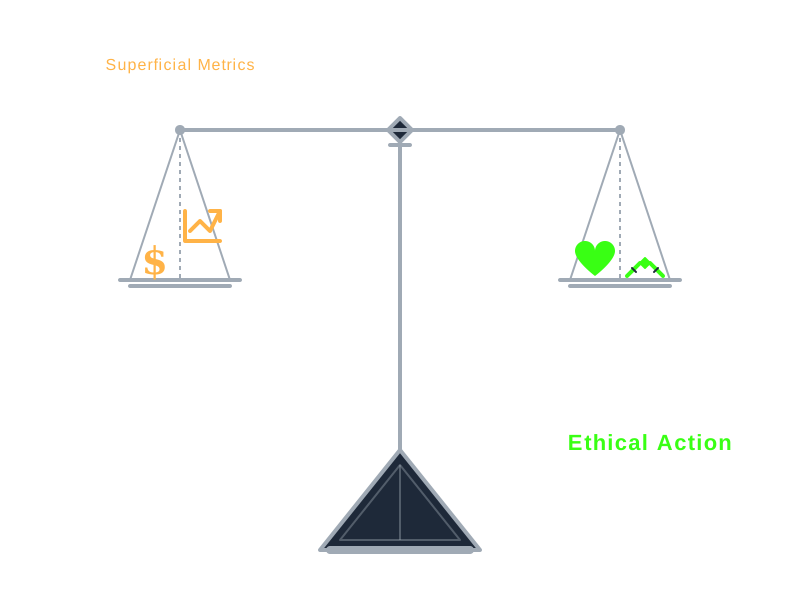
Ask yourself point-blank: “What use have I made of this day? What have I done that is positive?”. This stark reflection fundamentally redefines our modern, superficial metrics of success. Closing a massive, highly profitable sales deal might look fantastic on paper, but if you severely neglected your family and berated your staff to achieve it, the day was an objective ethical failure.
By consciously weighing your moral actions as you slowly drift to sleep, you prime your subconscious to operate with much greater integrity the following morning. It is a slow, methodical, and occasionally painful rewiring of your personal value system.
The Final Command to Strive
There is a profound, almost startling hardness at the core of this ancient worldview. When the Buddha was nearing the very end of his life, passing his final, definitive instructions down to his grieving disciples, he did not tell them to relax, let go, or simply trust the universe. His final words were an absolute, uncompromising mandate: “Strive with vigilance”.
The ancient Sanskrit word he used was apramada, which perfectly encompasses carefulness, alertness, and relentless diligence. He deeply understood that the human mind is both the root of all our intense suffering and the sole instrument of our ultimate freedom. If we drop our guard for a single moment, we inevitably slide back into reactivity, ego, and quiet despair.
Conclusion
We are exhausted because we are fighting a completely unwinnable war against reality, desperately trying to freeze an impermanent world in place. We keep searching for modern, optimized hacks to solve an ancient, structural flaw in human consciousness. But the true fix isn’t found in another productivity app, a greener morning juice, or a fatter, more secure bank account.
It is found in the deeply uncomfortable, brutally honest daily work of sitting with our own chaotic minds. It is found in looking closely at the people who absolutely infuriate us and choosing to recognize our shared, impending mortality instead of lashing out. It is found in taking radical, vigilant ownership of our thoughts, our words, and our micro-actions.
The Buddhist path is emphatically not about floating above the gritty world in a bubble of ignorant, detached bliss. It is about planting your feet firmly in the messy dirt and facing the terrifying impermanence of it all with absolute, unbreakable resolve. The mind makes an agonizingly cruel master, but if you have the fierce courage to finally tame it, it becomes an exquisite instrument of liberation.


