


I think we need to have a deeply uncomfortable conversation about what it actually costs to become the person you are meant to be. We are fed a steady cultural diet of shallow empowerment, told that personal growth is a warm, universally celebrated journey. But the reality is that evolution requires subtraction, and the first thing you usually lose is the crowd’s approval. To be fully realized is to be inherently polarizing.
For years, I’ve watched brilliant individuals intentionally throttle their own potential simply because they were terrified of becoming unlikable. They operate under the delusion that universal likability is a metric of moral goodness, rather than a symptom of cowardice. But if you are palatable to absolutely everyone, you stand for nothing. You are merely a psychological mirror, reflecting the unexamined expectations of whatever room you happen to inhabit.
This isn’t just a philosophical musing; it is a structural psychological issue that clinicians encounter constantly. The persistent habit of molding yourself to external expectations fundamentally fractures your psyche and creates profound emotional distress. When you habitually suppress your own needs, you aren’t actually being kind; you are performing. Constant people-pleasing prevents authentic communication and traps you in a cycle of silent resentment 1.
The Pathology of the Pleaser
The High Cost of Incongruence
Humanistic psychologist Carl Rogers gave us a brilliant framework for understanding this misery when he coined the concept of “congruence.” He argued that mental health requires a tight alignment between your ideal self, your internal self-image, and your actual lived experience. When you obsess over pleasing others, you create a massive gulf between who you really are and the avatar you present to the world. You are inevitably loved for a complete projection, which is arguably lonelier than being actively despised.
It is far better to be genuinely disliked for who you actually are than adored for a phantom you manufactured to appease strangers. The moment you decide to align your actions with your core convictions, you will inevitably disappoint people who benefited from your previous malleability. This isn’t a glitch in your social matrix; it is the feature. Setting new boundaries forces a recalibration of every relationship you hold.
Separating Yourself From the Crowd
This brings us to a fascinating concept from Murray Bowen’s family systems theory, known as the “differentiation of self.” A highly differentiated person possesses the rare ability to separate their own intellectual and emotional functioning from the collective hysteria of the group. They can hold their ground and remain entirely true to their convictions, even when the most important people in their life express deep disapproval.
Conversely, individuals with low differentiation experience what Bowen called “fusion,” a toxic enmeshment where you unknowingly adopt the anxieties of others. You compromise your own integrity just to keep the peace, absorbing the neuroses of the room until you no longer know where you end and they begin. Breaking this cycle demands that you stop being nice just to regulate other people’s unregulated emotions 1.

We see this beautifully illustrated in clinical case studies of couples trapped in appeasement cycles. Consider the typical dynamic where one partner continually conforms to the other’s desires simply to avoid a fight. Over time, this pacification leads to the appeaser feeling entirely unheard and increasingly anxious about ever expressing their genuine wishes. They mistakenly believe their submission is an act of love, when in reality, it is self-erasure.
These habits are almost always forged in the crucible of our early family dynamics. A child who is praised solely for prioritizing their siblings’ needs quickly learns that self-abandonment is the only reliable currency for securing basic affection. They carry this broken algorithm into adulthood, bending to every whim because they are terrified of abandonment. To heal, you must radically recognize that saying no is not an attack on someone else; it is an act of self-care.
The Resentment of the Crowd
Understanding the Crab Mentality
Here is the most predictable law of human dynamics: the moment you begin to actualize your potential, someone is going to try to cut your legs out from under you. This isn’t because you did something wrong, but because your sudden improvement inadvertently highlights their comfortable stagnation. They feel the painful awareness of what they lack, and instead of improving themselves, they channel that shame into devaluing your achievement 2.
We see this everywhere, beautifully captured by the phenomenon of Crab Barrel Syndrome, or crab mentality. If you place a group of crabs in a bucket, you never need a lid, because the moment one crab makes progress toward the rim, the others will violently pull it back down into the mass. This behavior is rooted in pathetic, zero-sum thinking—the delusion that your success somehow diminishes their inherent value.
The Hidden Dangers of Tall Poppy Syndrome
In human society, we call this Tall Poppy Syndrome, a term tracing back to the ancient Roman historian Livy. The story goes that the tyrant King Tarquin the Proud was asked by his son how to control a newly infiltrated city, and the king replied by silently walking through his garden and slicing the heads off the tallest blooming flowers. Today, this manifests when high achievers are relentlessly attacked or sabotaged simply because they dared to stand out 2.

This cultural leveling is particularly virulent in environments that value extreme egalitarianism, where cutting down the ambitious is seen as ensuring a “fair go” for everyone else. A comprehensive Canadian workplace report revealed that nearly ninety percent of surveyed individuals felt their achievements were intentionally undermined by peers and supervisors. Instead of celebrating excellence, these cultures enforce a toxic mediocrity that aggressively stifles innovation and growth.
Victims of this phenomenon experience severe, far-ranging psychological effects that can derail a promising life. According to the clinical data, these highly capable individuals often endure severe emotional distress:
- A sudden, general loss of professional and personal confidence that bleeds into their daily operations.
- Physical stress manifestations, including chronic insomnia, uncontrollable neurological tics, and persistent digestion problems.
- Debilitating symptoms of generalized anxiety, clinical depression, and in extreme cases, complex relationship problems. Instead of shining brighter, they inevitably shrink to survive 2.
When you encounter this friction, it almost never looks like cartoonish villainy; it frequently disguises itself as counterfeit concern. Critics driven by their own low self-esteem or Type A competitive anxiety will project their insecurities onto you, framing their backhanded criticism as necessary “humility checks.” You must learn to recognize that their commentary is entirely about their own psychological deficits, and absolutely nothing about your actual trajectory.
The False Idol of Absolute Independence
The Dangers of Unfiltered Self-Belief
However, we need to be incredibly careful here, because the modern self-care movement has severely mutated the concept of independence. In our rush to reject the people-pleasing trap, a massive contingent of people have adopted the toxic philosophy that “nothing anyone says matters” and that following your gut is the only valid metric. This weaponized version of “just be yourself” is a fast track to delusional narcissism.
You do not have all the answers, and operating as a completely closed system is just as dangerous as being a total pushover. The goal is not to block out the world in a fit of arrogant self-sufficiency, but rather to develop a highly sophisticated filtration system for external input. You need a mechanism to weigh critique without letting it fundamentally threaten your sense of intrinsic worth.
Processing Criticism as Impersonal Data
This is where the Stoic philosophy of Marcus Aurelius becomes incredibly practical, specifically his concept of the Inner Citadel. Aurelius understood that praise and criticism are merely external events, meaningless noise that cannot actually touch your character unless you voluntarily surrender the keys to your mind. When you build this psychological fortress, you stop viewing criticism as a personal injury, and you begin to process it strictly as data.
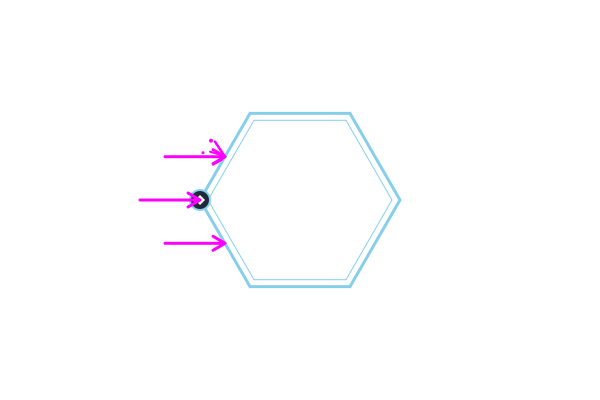
By treating feedback as raw information rather than an indictment of your soul, you maintain your psychological sovereignty. You can look at a vicious piece of criticism, extract whatever small utility it might contain, and simply discard the emotional venom it was wrapped in. This takes immense discipline, but it is the only way to evolve without becoming a hostage to public opinion.
The Architecture of the Arena
Who Is Actually in the Arena With You?
To process that data correctly, you have to strictly qualify the source of the information before you internalize a single word of it. Author Brené Brown popularized a magnificent framework for this, borrowing heavily from Theodore Roosevelt’s famous “Man in the Arena” speech. The core premise is fiercely simple: if you are not in the arena getting your ass kicked on occasion, I am not interested in your unsolicited feedback 3.
We can categorize the people in our lives into three distinct geographic locations: the balcony, the basement, and the arena. The balcony people are the ones cheering you on from a safe distance, wanting the best for you but fundamentally disconnected from the grit of the work. They provide validation and support, but they lack the granular context to offer truly transformative insight.
Then you have the basement people, the cynical spectators who reach up from the dark to drag you down with their unexamined baggage. They exist entirely to critique your technique without ever taking a swing themselves, acting out their own pre-determined script of negativity. You have to remember that they are perfectly entitled to dislike your work, but you have no obligation to give them a single ounce of your energy 3.
Curating Your ‘Square Squad’ of Critics
The only ones uniquely qualified to critique your technique are the ones down in the mud doing the hard work with you. This forces a harsh but necessary auditing of your social circle, establishing what Brown refers to as the Square Squad. You need to write down the names of the few people whose opinions truly matter on a tiny, one-inch square of paper, and if a critic isn’t on that list, their loudest opinions are just static noise.

But here is the crucial caveat: if they are on that list, you must listen to them with terrifying intensity. The people in the arena with you might not always be nice, and they might act more like a demanding lion tamer than a comforting friend. Their job isn’t to unconditionally validate your feelings; their job is to push you toward excellence, even when it draws blood.
The Alchemy of the Second Score
Overriding Your Defensive Instincts
So, how do we actually receive this highly qualified feedback without letting our fragile egos ruin the interaction? We turn to organizational psychologist Adam Grant and his utterly brilliant concept of the Second Score. Normally, when someone hands us an evaluation, we fixate entirely on the first score—the judgment of our actual performance—which immediately triggers our defensive fight-or-flight mechanisms 4.
Because criticism feels like a biological threat, our brains are hardwired to reject it, missing out on vital opportunities to iterate and improve. Grant’s solution is to decouple our identity from the critique by consciously giving ourselves a second score based entirely on how well we took the feedback. By evaluating our own receptiveness, we shift our focus from protecting our bruised pride to demonstrating that we are coachable.
How to Extract Value From Any Feedback
This subtle psychological trick prevents the trap of narcissistic projection, where you blindly dismiss everything just because you didn’t like the tone of the delivery. The mastery of the second score lies in your ability to sift through a critique that might be ninety percent absolute trash, just to extract the ten percent that is true. You learn to separate the behavior from your worth, and find the hidden value 4.
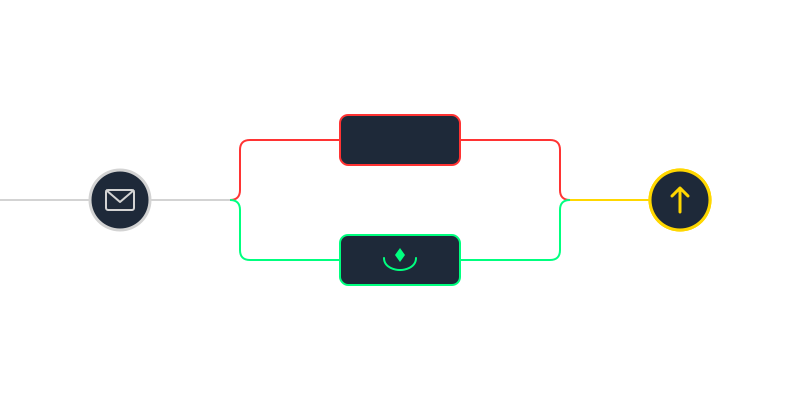
To operationalize this approach, you must systematically train yourself to override your initial emotional reflexes. Mastering this framework requires implementing a specific sequence of cognitive circuit breakers whenever you are confronted with difficult commentary:
- Pause before reacting to disrupt the immediate surge of defensiveness and shift into a thoughtful posture.
- Ask clarifying questions to demonstrate intellectual curiosity and pull specific, actionable examples from vague criticisms.
- Thank the person giving the feedback, using gratitude to build trust even when the words sting.
- Apply the valid elements of the critique and follow up later to close the loop on your development. By utilizing these steps, you fundamentally transform a perceived attack into a collaborative diagnostic exercise.
It allows you to stand your ground with intellectual honesty, retaining your differentiation of self while still remaining entirely open to growth. You can look at an imperfect critique and confidently conclude, “I reject your central premise, but I fully accept that my execution of this idea was confusing.” That is what radical accountability actually looks like—it is the ultimate synthesis of having a spine and keeping an open mind.
The Filtered Life and the Final Verdict
We live in a culture that is desperately addicted to immediate validation, and stepping outside of that paradigm feels like walking into the wilderness. But you have to realize that the people who demand you stay small are not doing it for your safety; they are doing it for their own psychological comfort. When you stop pandering to their insecurities, you aren’t betraying them; you are emancipating yourself.
The mechanics of becoming your best self are brutally straightforward, yet incredibly difficult to execute in real time. You must ruthlessly identify the basement dwellers trying to pull you down, while simultaneously checking your own ego to ensure you aren’t ignoring the vital arena coaches. It is a relentless balancing act between ferocious self-belief and profound intellectual humility.
If you want to reach your full potential, you must decide exactly what you stand for, knowing full well that taking a stand acts as a lightning rod for the haters. Their vitriol is not a sign that you are failing, but rather the clearest indicator that you are finally doing something right. The friction you feel is just the atmospheric resistance of your own upward trajectory.
You will face the crabs, you will encounter the basement dwellers, and you will endure the passive-aggressive cuts aimed at the tallest poppies. But you will also build your Inner Citadel, retreating to a place where external praise and external malice are equally irrelevant to your core. You will finally learn to curate your Square Squad, listening only to those whose faces are marred by the dust of the arena.
This is the only path that actually leads anywhere worth going. You stop bending to fit the mold, you stop plugging your ears in arrogant defiance, and you start engaging with the world on your own uncompromising terms. Truth is a lonely terrain, but it is the only ground solid enough to build a masterpiece on.


