


The car skidded, tires screeching against wet pavement. Steve Taylor, a psychologist who had spent years studying time perception, suddenly found himself in the middle of his own research. As the vehicle spun, something extraordinary happened: time slowed. Not in the way we casually describe it—everything slowed.
The shards of glass from the shattered windshield hung in the air like suspended diamonds, glinting in the sunlight. The sound of the crash muffled, as if the world had been wrapped in cotton. In those seconds, Taylor didn’t panic.
Instead, he felt an eerie calm, a detachment that allowed him to think with impossible clarity. He later described it as if his mind had stepped outside of time itself, observing the chaos from a place of stillness.
This wasn’t just a trick of memory. It was a phenomenon he had read about in the accounts of mountaineers, soldiers, and accident survivors—moments where the brain, faced with imminent danger, shifts gears. Time doesn’t just feel different; it becomes different. The rules bend.
Time is not a river. It’s a mirror. And what you see in its reflection depends entirely on how you choose to look.
Time is Not Real: The Four Laws of Psychological Time
Why Time Seems to Accelerate as We Age
Have you ever noticed how the summers of childhood seemed endless, while the years now blur together like a fast-forwarded movie? You’re not alone. Steve Taylor highlights that about 90% of people feel time accelerates as they age, a phenomenon observed across cultures and continents. The French philosopher Paul Janet proposed the “proportional theory” in the 19th century, suggesting that as we age, each year becomes a smaller fraction of our total life.
For a five-year-old, a year is 20% of their existence, making it feel vast. But by 50, that same year is just 2%, barely a blip on the radar. It’s a mathematical explanation, but it doesn’t fully capture the human experience. Enter William James, the American psychologist who argued that novelty is the real culprit.

Children are constantly bombarded with new experiences—first steps, first days of school, first crushes—each moment packed with fresh information. Our brains, hungry for stimulation, stretch time to accommodate the influx. But as adults, routine takes over.
The daily grind of commutes, meetings, and chores becomes a loop of familiarity. There’s less to process, so time compresses.
It’s not just about memory; it’s about the richness of the present moment. When life becomes predictable, time slips through our fingers like sand. 1 2
How to Slow Time by Embracing Novelty
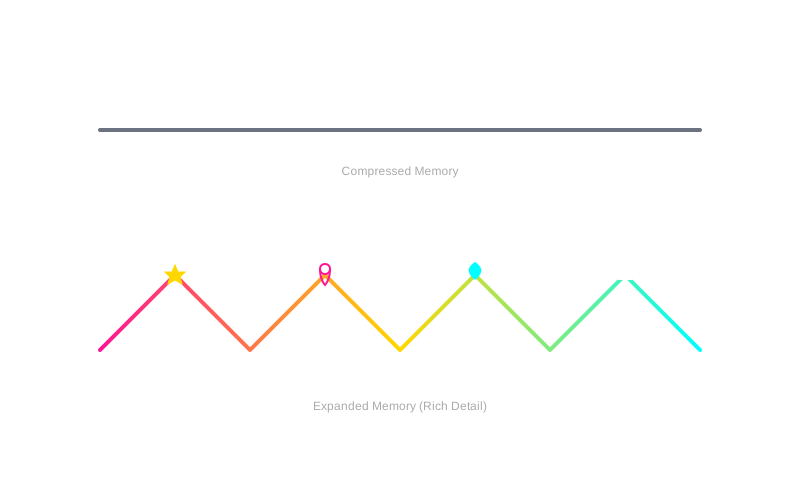
If familiarity breeds contempt, it also breeds a warped sense of time. Steve Taylor recounts his trip to India, where six weeks felt like six months. The sights, sounds, and smells were so foreign that his brain had to work overtime to process them. Research backs this up: unfamiliar noises or environments make time feel longer, while repetition shrinks it.
It’s why a week-long vacation in a new country feels more expansive than a week at home binge-watching the same shows. This law isn’t just about travel. Think back to your adolescence or early adulthood—those years feel stretched because they’re packed with “firsts.” First jobs, first heartbreaks, first real responsibilities.
Each experience is a data point your brain files away, creating a dense tapestry of memories. But as life settles into routine, the tapestry thins. The key?
Inject novelty. Take a different route to work, try a new hobby, or strike up a conversation with a stranger. Your brain will thank you by slowing the clock.
How to Master the Flow State and Control Time Perception
Ever lost hours in a good book or a creative project, only to blink and realize the sun has set? That’s absorption at work. When we’re fully engaged, time dissolves. Steve Taylor calls this the “flow state,” where our attention is so laser-focused that the outside world fades away.
It’s not just about enjoyment—even stressful tasks can warp time if they demand our full concentration. But there’s a catch. While absorption makes time fly in the moment, it can also make life feel shorter in retrospect.
If you spend years in a job that consumes your attention but lacks novelty, you might look back and wonder where the time went. The trick is balancing absorption with awareness.
Mindfulness practices, like meditation, can help. By training your brain to stay present, you can enjoy the flow without losing track of time entirely.
How to Bend Time Through Altered States
Time doesn’t just stretch—it can shatter. In near-death experiences or extreme emergencies, people report time slowing to a crawl. Steve Taylor’s research suggests this is tied to altered states of consciousness. Athletes, meditators, and even accident survivors often describe moments where time seems to pause, allowing them to react with supernatural speed.
These experiences aren’t just anecdotal. Neuroscience hints at the brain’s ability to shift “frame rates,” like a camera switching from standard to slow motion. Meditation, psychedelics, and even intense focus can trigger these shifts, aligning different streams of perception into a single, elongated moment. It’s why some people seem to live in a perpetual state of time expansion—their minds are wired to bend time.
So, how do you harness this? Start small. Mindfulness meditation can train your brain to slow down.
Seek out novel experiences, even in small doses. And when life feels like a blur, pause.
Breathe. Remind yourself that time isn’t a fixed line—it’s a river, and you’re the one holding the oars.
When Seconds Become Minutes: The Phenomenon of Time Expansion
What Is Time Expansion and How Does It Work?
When time expands, it’s not just about the clock slowing down—it’s about the mind entering a state of heightened awareness. Steve Taylor’s research reveals that during these moments, people often experience a profound sense of calmness, almost as if they’re observing the situation from outside themselves. This calmness is paradoxical, especially in life-threatening situations like car crashes or falls, where one might expect panic to dominate. Yet, many report feeling detached, serene, and even beautiful perceptions of their surroundings.
For instance, one individual described shards of glass floating in the sunshine as “diamonds glinting beautifully,” a testament to how heightened awareness can transform even brutal scenarios into something awe-inspiring. Another striking feature is the muffling of external sounds, creating a cocoon of awareness where nothing exists outside the immediate experience. This sensory shift allows individuals to focus entirely on the present moment, often leading to the ability to take preventative action.
Whether it’s a pregnant woman strategizing how to protect herself and her baby during a fall or a driver calmly assessing how to minimize damage in a crash, the expanded time provides a window for deliberate, life-saving decisions. These experiences suggest that time expansion isn’t just a perceptual quirk—it’s a survival mechanism that sharpens our focus when it matters most. 2 1 1
Why Our Brains Slow Down Time: An Evolutionary Advantage
The phenomenon of time expansion might have deep evolutionary roots. Steve Taylor proposes that our ancestors, facing constant threats from predators and natural disasters, developed this ability as a survival tool. In moments of extreme danger, slowing down time would have allowed them to react with precision, increasing their chances of survival. This theory aligns with the idea that time expansion isn’t just a random neurological glitch but an adaptive response honed over millennia.
However, it’s not limited to life-or-death situations. Time expansion also occurs in moments of deep calmness, such as during meditation or in nature, suggesting that the brain’s ability to alter time perception is more complex than a simple fight-or-flight response. Neuroscientifically, the surge of noradrenaline in the brain during emergencies might play a role, but it doesn’t fully explain the calmness and clarity reported in these experiences.
The brain’s ability to shift into a slower “frame rate” could be a way to process information more efficiently, allowing for quicker reactions and better decision-making. This evolutionary advantage might be why some individuals, like elite athletes or meditators, can access time expansion more easily—their brains are wired to enter these states under specific conditions, giving them a unique edge in performance and awareness. 3
Why Some People Experience Time Expansion Differently
Not everyone experiences time expansion, even in high-stress situations. Steve Taylor’s research highlights that individual differences play a significant role. For example, during his car accident, Taylor experienced time expansion, while his wife, sitting beside him, felt only panic. This suggests that personality traits, neurological diversity, or even prior experiences might influence susceptibility.
Some elite athletes, like Lionel Messi or Ted Williams, seem to have a natural ability to enter these states, possibly due to unique cognitive or neurological traits. These individuals might have brains that are more adaptable to shifting into altered states of consciousness, allowing them to perceive time differently under pressure. Mindfulness practices, such as Vipassana meditation, can also train the brain to enter these states more readily.
Dr. Sam Harris notes that meditation helps dissolve the dualistic setup of subject and object, allowing individuals to experience time more fluidly. Those who practice mindfulness regularly might be more likely to experience time expansion because their brains are accustomed to shifting attention and perception.
However, for most people, these experiences remain rare, occurring only in moments of extreme stress, novelty, or deep presence. Understanding these individual differences could help us cultivate time expansion intentionally, turning fleeting moments of clarity into a more consistent way of experiencing life.
How Near-Death Experiences Reveal Time’s True Nature
Near-death experiences (NDEs) represent the most dramatic form of time expansion. In these moments, seconds can stretch into hours, and individuals often report incredibly detailed and complex experiences. Some describe a life review, where their entire existence replays in vivid detail, while others feel time dissolve entirely—a phenomenon Steve Taylor calls “time cessation.” These experiences challenge our linear understanding of time, with some reporting that time becomes spatial, as if the past, present, and future coexist in a single, expansive landscape.

This spatial perception of time suggests that our usual sense of time as a straight line might be an illusion, one that breaks down in altered states of consciousness. The profound nature of NDEs highlights the brain’s remarkable capacity to distort time under extreme conditions.
Whether through meditation, psychedelics, or near-death scenarios, these experiences reveal that time is not a fixed entity but a fluid construct shaped by our perception. By exploring these states, we can begin to understand how to cultivate time expansion in everyday life, turning fleeting moments of clarity into a more enduring sense of presence and awareness.
Peak Performance and the Zone: Time Expansion in Action
The Science Behind Ted Williams’ Legendary Batting Vision
Imagine stepping into the batter’s box, staring down a 95-mph fastball, and suddenly, the world slows. The ball grows larger, the stitches become visible, and the roar of the crowd fades into silence. This wasn’t just a metaphor for Ted Williams—it was his reality. One of baseball’s greatest hitters, Williams described moments where time seemed to stretch, giving him the uncanny ability to see the ball with impossible clarity.
This phenomenon, known as time expansion, isn’t just a quirk of perception; it’s a peak performance state where the brain shifts into overdrive. Athletes like Williams often report that during these moments, external sounds become muffled, and their focus narrows to a laser-like precision. It’s not just about seeing the ball better—it’s about having more time to react, anticipate, and execute. This isn’t just a retrospective illusion; studies show that 87% of people who experience time expansion in high-stakes situations believe it’s happening in real-time.
The brain, in essence, hits the slow-motion button, allowing for split-second decisions that feel like they unfold over minutes. For Williams, this meant the difference between a strikeout and a home run. But here’s the kicker: time expansion isn’t just for the naturally gifted.
It’s a skill that can be cultivated. While Williams may have had a natural knack for entering this state, modern research suggests that practices like meditation and mindfulness can train the brain to access these moments more consistently.
Dr. Sam Harris, a neuroscientist and meditation expert, notes that long-term meditators often report more expansive time perception, hinting that the key to slowing down time might lie in quieting the mind. So, whether you’re swinging a bat or just trying to savor life’s moments, the lesson is clear: the more present you are, the more time you have.
How to Train Your Mind to Slow Down Time
If time expansion sounds like a superpower reserved for elite athletes or near-death survivors, think again. The truth is, this ability can be trained, and some of the most effective methods come from ancient martial arts traditions. Take Mushin, a concept from Japanese martial arts that translates to “no-mind” or “empty-mind.” In this state, practitioners describe a dissolution of the ego, where the boundaries between self and surroundings blur, and time slows to a crawl.
It’s not just philosophical—it’s a tactical advantage. When a martial artist enters Mushin, they gain precious milliseconds to anticipate an opponent’s move, turning what would normally be a blur of motion into a series of deliberate, calculated actions. But you don’t need to be a black belt to harness this. The principles of Mushin align closely with modern mindfulness practices.
Research shows that long-term meditators experience time more expansively, suggesting that regular meditation can rewire the brain to perceive moments with greater depth. This isn’t about escaping reality; it’s about diving deeper into it. By training the mind to stay present—whether through meditation, breathwork, or even simple daily rituals—you create the conditions for time expansion to emerge naturally. So, how do you start?
Small steps. Try incorporating mindfulness into your routine, whether it’s a five-minute meditation session or a walk in nature where you focus solely on your surroundings. The goal isn’t to force time to slow down but to create the mental space where it can.
Over time, these moments of presence add up, turning fleeting experiences of time expansion into a more consistent way of living. After all, if Ted Williams could see the stitches on a fastball, imagine what you could see—and do—with a little practice.
The Neuroscience of Presence: How Mindfulness Alters Your Frame Rate
The Brain’s Frame Rate: How We Perceive Time
Imagine your brain as a high-definition camera, capable of capturing life in slow motion or fast-forward. The “frame rate” of your perception determines whether time feels like a blur or a rich, detailed experience. Neuroscientist Andrew Huberman and Dr. Sam Harris discuss how our brains process time differently depending on context—like a camera adjusting its frame rate to capture motion. For instance, objects in the distance appear to move slower than those up close, even if they’re traveling at the same speed.
This isn’t just an optical illusion; it’s a glimpse into how our brains prioritize and process sensory input. Our perception of time isn’t uniform. When you’re on a train, the fence posts whizzing by seem to move faster than the distant mountains, even though they’re stationary relative to the train.
This phenomenon reveals that our brains use multiple “frame rates” to interpret the world. In high-stress or novel situations, the brain can shift into a slower frame rate, stretching seconds into what feel like minutes.
This adaptability isn’t just about survival—it’s about how deeply we engage with the present moment. By understanding these streams of attention, we can begin to train our minds to slow down time intentionally, turning fleeting moments into expansive experiences. 3
Mastering Vipassana: Enhancing Your Sensory Perception
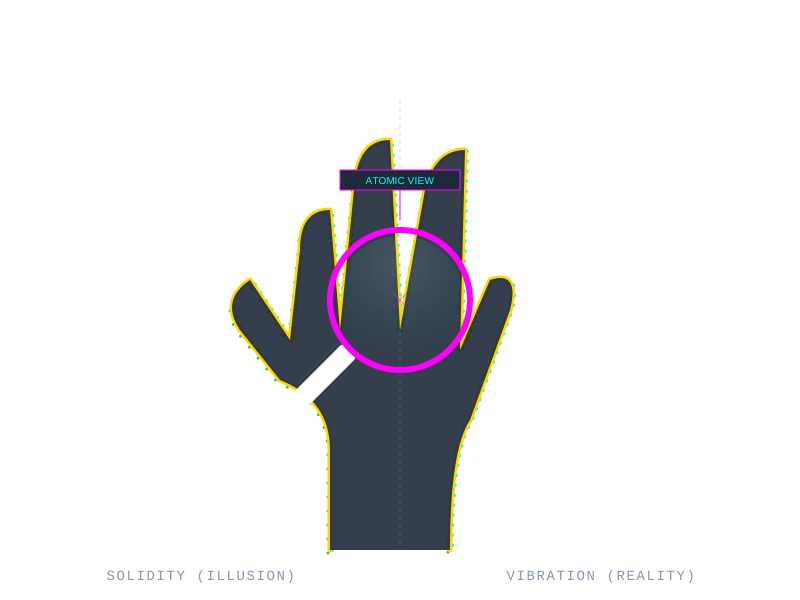
Vipassana meditation offers a powerful way to hack your brain’s frame rate(/blog/speed-read#establish-your-baseline-reading-speed)**. This ancient practice involves breaking down sensory experiences into their smallest components—what Dr. Sam Harris calls the “atoms of experience.” Instead of perceiving a hand as a single, solid object, Vipassana teaches you to notice the myriad sensations of pressure, temperature, and movement that make up the illusion of a hand. This granular focus shifts your brain into a higher frame rate, where time feels more expansive and detailed.
The magic of Vipassana lies in its ability to dissolve resistance. When you fully attend to a sensation—even pain—it loses its emotional charge. A neck ache, for example, transforms from a source of suffering into a dynamic cloud of shifting sensations.
This shift isn’t just philosophical; research shows that after intensive meditation retreats, practitioners can make finer-grained sensory discriminations, effectively slowing down their perception of time. The key is to approach meditation without dualism—avoiding the trap of seeing yourself as the “watchman” of your thoughts. Instead, you become the experience itself, free from the distortions of resistance and judgment.
Attention: Your Most Valuable Non-Renewable Resource
Attention is the currency of time. Dr. Sam Harris emphasizes that while time itself is finite, how we allocate our attention determines the richness of our experience. You can safeguard your time or squander it, but attention is what truly shapes your reality. Even in less-than-ideal circumstances, the right focus can reveal joy and equanimity.
The challenge? Our minds are wired to chase goals, but happiness isn’t found in the achievement—it’s in the process. The hedonic treadmill keeps us running toward the next milestone, only to realize that the satisfaction is fleeting. The solution lies in cultivating presence.
Mindfulness practices, like Vipassana, train you to notice the incremental loss of attention—the moments when you’re lost in thought instead of engaged with the present. By treating attention as a non-renewable resource, you learn to invest it wisely.
Whether through meditation, deep work, or simply savoring small moments, the goal is to reduce the “dualistic dance” of distraction and refocus. The more you practice, the more you realize that time isn’t just passing—it’s expanding, one mindful breath at a time.
Conclusion
We’ve explored the four laws of psychological time, from the way novelty stretches seconds into hours to how mindfulness can dissolve the illusion of time altogether. Steve Taylor’s research on time expansion experiences reveals that our brains are capable of extraordinary shifts in perception—whether in moments of crisis, deep meditation, or even the flow state of an athlete like Ted Williams. The key takeaway? Time isn’t something that happens to us; it’s something we actively shape through attention, presence, and intention.
The neuroscience backs this up. Dr. Sam Harris and others show that practices like Vipassana meditation can rewire our brains to perceive time more richly, turning fleeting moments into expansive landscapes of awareness. Even small shifts—seeking novelty, cultivating mindfulness, or simply pausing to breathe—can slow the relentless march of routine and make life feel fuller, deeper, and more alive.
But here’s the truth: You don’t need a near-death experience or a meditation retreat to bend time. You just need to show up—fully, deeply, without resistance. The more you practice presence, the more you’ll realize that time isn’t slipping away. It’s waiting for you to step into it.
So, where do you go from here? Dive deeper. Explore other posts on mindfulness, peak performance, or the science of consciousness. The journey doesn’t end here—it’s just beginning.
After all, the only way to slow time is to stop chasing it.


