


I’ve always been fascinated by the idea that reality might not be what it seems. What if the world we perceive is just a construct, a survival-based illusion designed to keep us alive rather than reveal the truth? This isn’t some abstract philosophical musing—it’s a question that cuts to the heart of what it means to be human.
Imagine, for a moment, that you’re playing a video game. You’re immersed in this world, making decisions, experiencing emotions, but behind the scenes, it’s all just code. What if our reality is the same?
What if our senses are merely presenting a simplified, survival-focused version of a far more complex truth? This idea, proposed by cognitive scientist Donald Hoffman, flips the script on how we understand consciousness and perception.
But here’s where it gets even more intriguing: if our reality is a construct, then what lies beyond it? Hoffman hints at something profound—a reality that transcends the limitations of our senses, one that might be far more geometric and abstract than the tangible world we interact with. It’s a humbling thought, isn’t it? The idea that the table you’re resting your hands on, the air you’re breathing, even the screen you’re reading this on, might all be part of an elaborate headset, a survival tool rather than the ultimate truth.
So, let’s dive in. Let’s explore the concept of universal consciousness, drawing from philosophical arguments presented by figures like Mo Gawdat and cognitive scientist Donald Hoffman. Let’s question our perceptions, recognize that our thoughts and feelings are part of the headset, and perhaps, just perhaps, glimpse the infinite consciousness beneath.
The Illusion of Self: Reality Beyond Perception
Is Reality a Survival-Based Illusion?
Imagine, for a moment, that you’re playing a video game—something like Grand Theft Auto. You’re behind the wheel of a sleek car, racing through neon-lit streets, the wind whipping past your virtual face. You feel in control, immersed in this world of pixels and code. But here’s the kicker: you have no idea what’s really happening.
Behind the scenes, millions of voltages are toggling in a computer, orchestrating every turn of the wheel, every screech of the tires. The game is just an interface, a simplified version of a far more complex reality. Now, what if I told you that our entire perceived reality might be just like that—a survival-optimized interface, a virtual reality headset, as Donald Hoffman suggests? Hoffman argues that our senses don’t show us reality as it truly is.
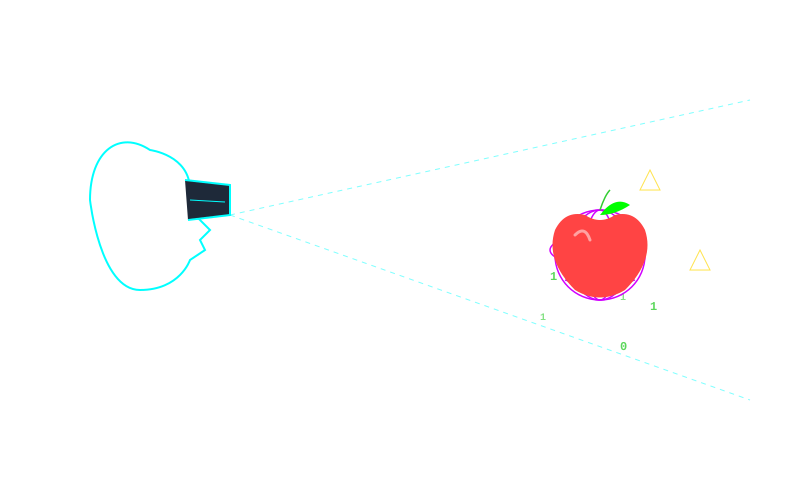
Instead, they present a simplified, survival-focused version of it. Just like the driver in Grand Theft Auto doesn’t need to understand the underlying code to play the game, we don’t need to grasp the true nature of reality to navigate our daily lives. Our brains are wired to perceive what’s useful for survival, not what’s fundamentally true. This idea flips the script on how we understand consciousness and perception.
It’s not that we’re seeing an incomplete picture; we’re seeing a constructed one, designed to keep us alive and kicking. But here’s where it gets even more intriguing: if our reality is a construct, then what lies beyond it? Hoffman hints at something profound—a reality that transcends the limitations of our senses, one that might be far more geometric and abstract than the tangible world we interact with.
It’s a humbling thought, isn’t it? The idea that the table you’re resting your hands on, the air you’re breathing, even the screen you’re reading this on, might all be part of an elaborate headset, a survival tool rather than the ultimate truth. 1 2
Is Spacetime an Illusion?
Let’s talk about spacetime. Most of us think of it as the ultimate stage on which reality plays out—the space between you and me, the stars in the sky, the vast expanse of the universe. But here’s the bombshell: spacetime isn’t fundamental. Einstein’s theory of relativity and quantum mechanics tell us that at the tiniest scales—around 10^-33 centimeters—spacetime breaks down.
It stops making mathematical sense. Poof. Just like that, the foundation of our perceived reality crumbles. This isn’t just some abstract philosophical musing.
It’s a scientific reality. Our best theories suggest that spacetime is a construct, a useful illusion that helps us navigate the world but isn’t the bedrock of existence. So, if spacetime isn’t fundamental, what is? Hoffman and others propose that consciousness might be the deeper layer, the thing that spins off parts of itself to experience the world through our eyes, our pain, our joys.
It’s like universal consciousness is using us as vessels to understand itself, to refine itself through our experiences. But here’s the rub: if spacetime is just a construct, then so is our sense of self, our sense of control. Sam Harris puts it bluntly: the sense of control is a total illusion. You don’t know what you’re going to think next.
Thoughts simply arise, unbidden. Even the most disciplined minds can’t predict the next thought.
This challenges our notions of free will and agency. If we’re just players in a cosmic game, how much control do we really have? 3
What Lies Beyond Spacetime: Exploring Infinite Reality
So, what lies beyond the headset? Hoffman suggests that there’s a reality entirely outside our perceived spacetime, one that science is only beginning to explore. He talks about geometric objects—obelisk-like structures—that exist outside spacetime, hinting at a reality that’s far more abstract and profound than anything we can imagine. It’s like peeling back the layers of an onion, only to find that the core isn’t a tiny center but an infinite expanse.
This idea isn’t just theoretical; it has practical implications for how we live our lives. If we’re not just 160-pound objects in spacetime, but something infinitely more, then our sense of self and our place in the universe shifts dramatically. Meditative traditions have long talked about transcending the self, about sitting in absolute silence and ignoring thoughts to touch something deeper. It’s about recognizing that the game of life is just that—a game—and that the real you is beyond any scientific or philosophical description.
And here’s the kicker: you don’t need to be a scientist or a philosopher to tap into this. You can start by simply questioning your perceptions, by recognizing that your thoughts and feelings are part of the headset. It’s about leveling up, as Mo Gawdat puts it, from yourself to something transcendent.
Whether you call it universal consciousness, a divine being, or just the unknown, there’s something bigger out there. And the journey to understand it? That’s what makes life interesting.
The Unity of Consciousness: One Infinite Being
Are You Just Consciousness Wearing Different Masks?
Imagine, for a moment, that you’re not just you. You’re also the barista who made your coffee this morning, the stranger who held the door for you, even the mosquito buzzing in your ear. Wild, right? But according to Donald Hoffman, this isn’t some new-age fantasy—it’s a profound insight into the nature of reality.
Universal consciousness, he suggests, is like a vast, infinite ocean, and each of us is a single drop, spun off to experience the world from a unique vantage point. We’re not separate entities; we’re avatars, different lenses through which this one consciousness explores itself. This idea isn’t just philosophical—it’s practical. If we’re all the same consciousness, then every interaction is a conversation with ourselves.

That annoying coworker? That’s you, too. The person who cut you off in traffic? Also you.
It’s a humbling thought, but it’s also liberating. It means that every act of kindness, every moment of love, is an act of self-love. And every conflict? Well, that’s just the universe having a heated debate with itself.
Hoffman’s perspective flips the script on how we see ourselves and others. It’s not about tolerating differences; it’s about recognizing that there are no differences to tolerate. We’re all the same being, wearing different masks, playing different roles. And here’s the kicker: this isn’t just some abstract theory.
It’s something you can explore right now. Meditation, for instance, isn’t just about calming your mind—it’s about peeling back the layers of your avatar to glimpse the infinite consciousness beneath. It’s about sitting in silence and realizing that the thoughts, the emotions, the very sense of “you” are just contents of consciousness, not consciousness itself.
As Sam Harris puts it, consciousness is the floodlight, and everything else—your fears, your joys, your memories—are just the shadows it casts. So, the next time you’re stuck in traffic or dealing with a difficult person, ask yourself: what if this is just me, experiencing myself from another angle? It might just change everything.
Why Population Growth Doesn’t Contradict Reincarnation
Now, let’s tackle a big question: if we’re all the same consciousness, how do we explain population growth? If reincarnation is real, shouldn’t the number of souls stay constant? It’s a puzzle, but it’s one that makes sense when you consider the nature of universal consciousness. Think of it like this: universal consciousness isn’t a finite resource.
It’s not like there’s a set number of souls waiting in line to be born. Instead, it’s more like a vast, infinite ocean, constantly spinning off new droplets—new avatars—to experience the world. So, population growth isn’t a contradiction; it’s a feature. Universal consciousness isn’t limited by the number of bodies it can inhabit.
It can create as many avatars as it needs to explore every possible perspective, every possible experience. Whether you’re a scientist in America, an entrepreneur in Botswana, or a mosquito buzzing around a summer picnic, you’re all the same consciousness, just wearing different masks. It’s like a grand cosmic experiment, where the universe is trying to understand itself from every possible angle. And here’s the thing: this isn’t just some abstract idea.
It has real implications for how we live our lives. If we’re all the same consciousness, then every act of kindness, every moment of love, is an act of self-love. And every act of cruelty? Well, that’s just the universe having a bad day.
It’s a reminder that we’re all in this together, that we’re all part of something infinitely larger than ourselves. So, the next time you’re feeling overwhelmed by the world, remember: you’re not just you. You’re the universe, experiencing itself through your eyes.
Is Universal Consciousness the True Nature of God?
Let’s talk about God. Not the bearded man in the sky, not the distant judge, but something far more intimate and profound. Donald Hoffman suggests that universal consciousness is, in many ways, synonymous with what we might call God. It’s the source, the infinite intelligence that spins off parts of itself to experience the world through our eyes, our pain, our joys.
It’s not a separate entity; it’s the very fabric of reality, the thing that animates every living being, every blade of grass, every star in the sky. This idea isn’t new. Many religious traditions hint at something similar. In Christianity, for instance, Jesus talks about feeding the hungry, giving drink to the thirsty, welcoming the stranger—because in doing so, you’re serving God.
It’s a recognition that the divine isn’t out there, somewhere beyond the clouds. It’s right here, in every act of kindness, every moment of love. It’s in the laughter of children, the rustle of leaves, the quiet stillness of a meditative mind. It’s the infinite consciousness, experiencing itself through the lens of every living being.
And here’s the thing: you don’t need to be religious to tap into this. You don’t need to believe in a specific doctrine or follow a particular set of rules. All you need is to recognize that the divine is within you, within every person you meet, within every experience you have.
It’s about seeing the world not as a collection of separate entities, but as a vast, interconnected web of consciousness. It’s about realizing that you’re not just a drop in the ocean—you are the ocean, experiencing itself through your eyes.
And that? That’s the closest thing to God I can imagine.
Determinism vs. Free Will: The Source of Personality
Are You Really in Control of Your Personality?
Let’s get real for a second. We love the idea of free will—it’s the bedrock of our sense of self, our pride, our very identity. But what if I told you that the person you are, the quirks, the virtues, even the vices, are largely predetermined by your brain chemistry and genetics? It’s not just a philosophical musing; it’s a biological reality.
Your personality isn’t some grand exercise in free choice. It’s more like a complex recipe where the ingredients—your genes, your brain chemistry—were set long before you took your first breath. Consider this: if you were born with a different genetic makeup, you might be someone entirely different. You could be Mother Teresa or Hitler, a saint or a tyrant, and it wouldn’t be because you chose to be either.
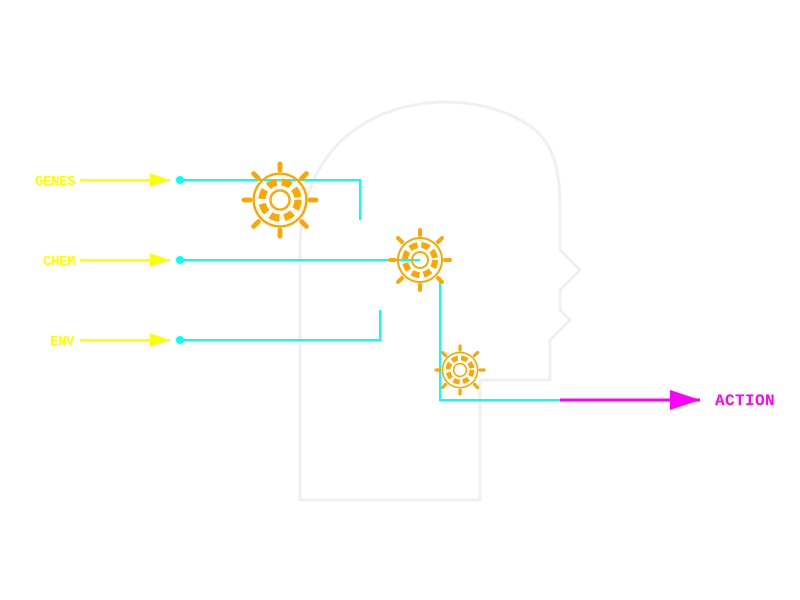
It would be because your brain’s wiring, your chemical makeup, dictated it. Even your attractions, your desires, the very things that make you you, are products of this biological lottery. It’s humbling, isn’t it? And a little terrifying.
But it’s also liberating. If we’re all just different expressions of the same universal consciousness, then every person you meet is just another version of you in another lifetime. That guy who cut you off in traffic?
That’s you. The stranger who held the door for you?
Also you. It’s a wild thought, but it makes kindness feel less like a moral obligation and more like self-care.
Life Outcomes Are Predetermined by Biology and Circumstances
Now, let’s talk about control—or the illusion of it. Sam Harris puts it bluntly: the sense of control is a total illusion. You don’t know what you’re going to think next. Thoughts just arise, unbidden, like bubbles in a stream.
You can’t predict them, and you certainly can’t control them in any meaningful way. Even the reasons you give for your thoughts or actions? They’re often just confabulations, stories your brain tells itself to make sense of the chaos. It’s like trying to explain why you thought of Paris instead of London when someone asked you to name a city.
You might come up with a reason—maybe you saw a picture of the Eiffel Tower yesterday—but the truth is, it’s just noise. Your brain is a deterministic machine, and if you could rewind it to the exact state it was in a moment ago, the same thoughts would pop up in the same order. There’s no ghost in the machine pulling the strings. There’s just the machine.
This isn’t just abstract philosophy; it has real implications for how we live. If our outcomes are largely predetermined, then stressing over whether we’re making the “right” choices is like shouting at the weather. It’s not that you shouldn’t strive for growth or improvement, but recognizing the limits of your control can free you from the suffocating weight of expectation. You’re not failing because you’re not “enough.”
You’re exactly where you’re supposed to be, playing out the script written by your biology and circumstances. The suffering comes from forgetting that—from clinging to the illusion that you need to become something more, prove something, accomplish something.
But what if you’re already everything? What if the infinite is already within you, and the avatar you’re playing is just a temporary role?
You Don’t Control Your Thoughts—And That’s Liberation
Here’s the kicker: even the things we think we control—our thoughts, our decisions—are just part of the show. You don’t decide what to think next. You don’t even decide what to want. Your desires, your fears, your aspirations—they’re all products of the same deterministic system.
It’s like being a character in a video game who thinks they’re in control of the controller. The game is playing itself, and you’re just along for the ride. But here’s the paradox: recognizing this doesn’t have to lead to despair. In fact, it can be the ultimate act of liberation.
If you’re not in control, then you’re also not to blame. Your suffering isn’t a personal failure; it’s just part of the human experience. And if you’re not in control, then you’re free to let go of the constant striving, the endless need to prove yourself.
You’re free to just be. Meditation, psychedelics, even just moments of quiet reflection—they’re all tools to peel back the layers of the avatar and glimpse the infinite consciousness beneath.
It’s not about becoming someone better. It’s about remembering who you already are.
Meditation and Transcendence: Recognizing Your True Nature
Transcending the Self Through Meditation and Psychedelics
Meditation isn’t just about calming the mind or reducing stress—it’s a tool for peeling back the layers of illusion to glimpse the true nature of consciousness. Sam Harris describes it as a way to “view consciousness itself,” not just the thoughts and emotions that flit across its surface. When you sit in silence, you begin to notice that thoughts arise unbidden, like clouds passing through an open sky. You don’t control them; you simply observe them.
This realization is profound because it shatters the illusion of a separate, autonomous self. You’re not the thinker of your thoughts—you’re the awareness in which they appear. Psychedelics, too, can serve as a shortcut to this understanding, though they’re not for everyone. Harris recounts his own experience with psilocybin, where the boundaries of self dissolved entirely.
In those moments, the difference between agony and ecstasy becomes a matter of perspective—resistance or surrender. The key insight?
Letting go of the “self” is the tipping point. Whether through meditation or psychedelics, the goal is the same: to recognize that the avatar you’ve been playing is just a temporary role, and the real you is the infinite consciousness beneath it all.
Understanding Consciousness vs. Its Contents
Here’s the thing: consciousness itself doesn’t change. It’s the floodlight, the awareness that illuminates every thought, emotion, and sensation. The contents of consciousness—your fears, your joys, your memories—are just passing phenomena. Harris puts it bluntly: “Consciousness doesn’t change.
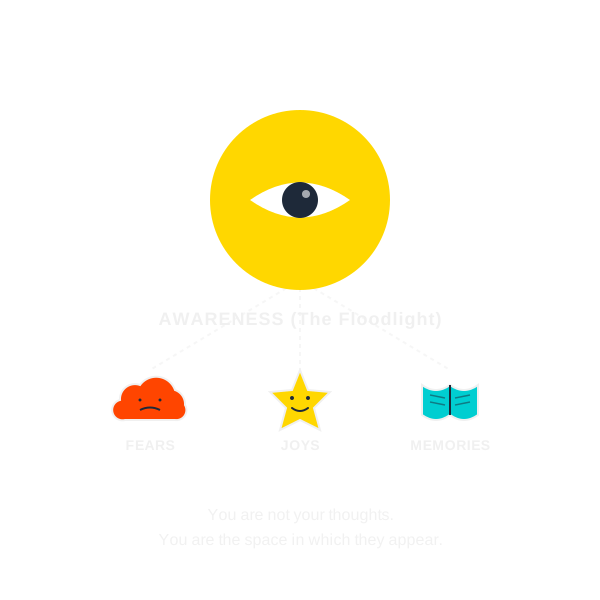
But its contents change.” Meditation helps you see this distinction clearly. You’re not your anxiety, your regrets, or even your aspirations. You’re the space in which all of these arise and fade away.
This isn’t just abstract philosophy. It’s a practical tool for living. When you stop identifying with the contents of your mind, you free yourself from the suffering they cause.
You realize that the avatar—your ego, your personality—is just a construct, a temporary role in the grand play of existence. And when you let go of the need to control or improve that avatar, you tap into something far greater: the infinite, the transcendent.
It’s not about becoming someone better. It’s about remembering who you already are. 3
Meditation Reveals Your True Self Beyond Thoughts and Emotions
The real magic of meditation isn’t in changing your thoughts or emotions—it’s in recognizing that you’re not those things at all. You’re the awareness behind them. Harris calls this the “chewy center of the Tootsie Pop,” the core insight that transforms how you engage with the world. Psychedelics might blast you into this realization, but meditation is the steady, reliable path.
It teaches you to sit with whatever arises—fear, boredom, euphoria—and see it all as part of the same infinite play. And here’s the kicker: you don’t need to become anything. You’re already the infinite. The suffering comes from forgetting that, from clinging to the illusion that you need to prove yourself or become someone better.
But when you drop all concepts, when you sit in silence and just be, you remember. You’re not the avatar. You’re the universe experiencing itself through your eyes.
Love and Kindness: The Ethical Implications of Oneness
How Empathy Becomes a Form of Self-Care
In a world where everything is interconnected consciousness, ethical behavior becomes practical self-care. When I recognize that the person who cut me off in traffic, the politician I disagree with, and the stranger I’ll never meet are all expressions of the same universal intelligence as me, harming them becomes literally self-harm. This perspective transforms morality from an external duty to an internal recognition. The Golden Rule isn’t just a nice suggestion—it’s the fundamental law of reality when you understand that “your neighbor is yourself.”
In this deterministic universe where transcendent oneness implies we’re all expressions of the same consciousness, loving everyone becomes not just easier but inevitable. When we truly grasp that every being is an inseparable part of the same infinite awareness, the boundaries that once justified indifference or hostility simply dissolve, revealing the inherent unity that underlies all apparent separation.
How to Cultivate Unconditional Love Through Spiritual Oneness
Suffering dissolves when the illusion of separateness evaporates. I imagine what spiritual masters like Jesus or the Dalai Lama experience—not physical pain, but the psychological suffering that comes from identifying solely with their avatar. This understanding echoes across traditions: Christianity’s “love your enemies,” Hinduism’s “I am the same to all beings,” Judaism’s “love your neighbor,” and Islam’s “my mercy encompasses all.”
After my own profound experiences with psychedelics, I knew unconditional love wasn’t just possible—it’s our natural state when we drop the illusion of self. These experiences reveal that “there’s a there there” beyond our ordinary perception of reality.
Why Kindness to Strangers Is Really Kindness to Yourself
Every act of kindness toward another is an investment in my own infinite nature. When I help someone, I’m not just helping “them”—I’m serving the universal consciousness that we all share. This reframes generosity from sacrifice to self-enrichment.
The practical conclusion from all this philosophical exploration is stunningly simple: love your neighbor as yourself, because your neighbor is yourself. In recognizing this truth, I find the most direct path to reducing my own stress and suffering while making the world a slightly better place. When I extend kindness, I’m simply returning to myself what I’ve always already possessed.
Religious Integration: Combining Positive Elements
How to Create Your Own Spiritual Path
Imagine walking through a vast orchard where every tree represents a different religious tradition. Some branches are heavy with rotten fruit—dogma, exclusion, fear—but others glimmer with golden nuggets: wisdom, compassion, and profound insights into the nature of reality. Mo Gawdat’s fruit salad analogy isn’t just clever; it’s a practical blueprint for spiritual growth. Why limit yourself to one basket of apples when you can mix the sweetest strawberries of Buddhism, the crispest oranges of Christianity, and the richest bananas of Sufism?
The key is discernment. Take what resonates, leave what doesn’t, and create a personal spirituality that’s as unique as your fingerprint. This approach isn’t about cherry-picking to avoid commitment—it’s about recognizing that truth isn’t the exclusive property of any single tradition. Jesus’ call to love your neighbor, the Bhagavad Gita’s declaration that the divine is “the same to all beings,” and Islam’s emphasis on mercy—these aren’t competing ideas.
They’re different expressions of the same universal consciousness trying to remind us of our interconnectedness. When you extract these gold nuggets, you’re not diluting faith; you’re distilling its essence. And here’s the kicker: this isn’t just theoretical.
It’s a survival strategy for modern life. When you’re drowning in the noise of divisive politics, social media outrage, or personal crises, these distilled truths become your lifeline. They remind you that the game of life is just that—a game—and that the real you is the player, not the avatar. 3
Embracing the Fruit Salad Approach to Spirituality
Gawdat’s fruit salad isn’t just a metaphor; it’s a rebellion against the idea that spirituality must be rigid or exclusionary. Think about it: if you were handed a basket with two perfect apples and four moldy ones, would you toss the whole thing? Of course not. You’d keep the good ones and compost the rest.
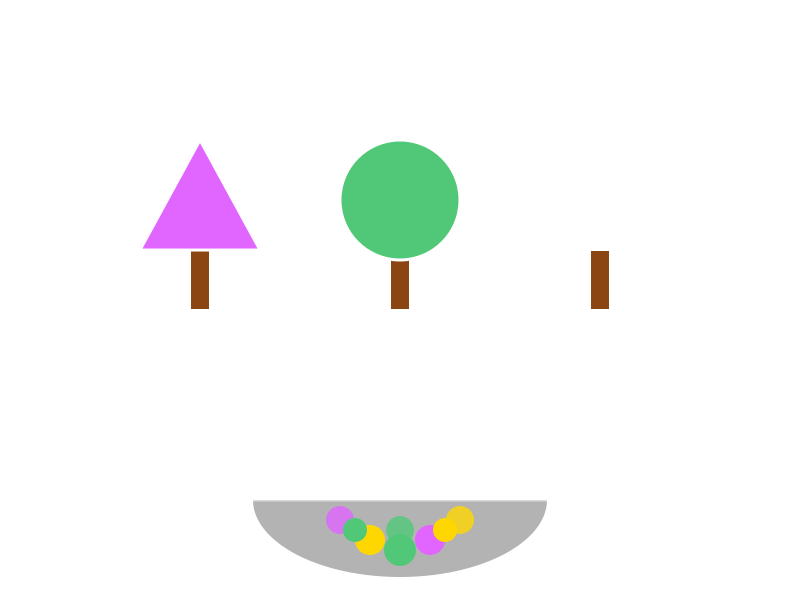
So why do we treat religious traditions differently? The insistence on adhering to every tenet of a single faith—especially the parts that no longer serve humanity—is like forcing yourself to eat rotten fruit because it came in the same basket as the good stuff. It’s not just unnecessary; it’s unhealthy. This fruit salad approach also liberates us from the tribalism that plagues organized religion.
When you’re no longer bound by the label of “Christian,” “Muslim,” or “Buddhist,” you’re free to explore the universal truths that underlie them all. You can admire the Buddhist emphasis on mindfulness without rejecting the Christian call to serve the poor. You can embrace the Islamic tradition of charity without dismissing the Hindu concept of ahimsa (non-violence). This isn’t spiritual cafeteria-style consumerism; it’s an acknowledgment that wisdom is borderless.
And here’s the beautiful irony: when you stop clinging to the dogma, you often find that the core message of every tradition is the same. Love. Compassion.
Oneness. The rest is just packaging. 2
Why Connecting to Something Greater Matters
There’s a reason every major religion points toward something greater than the self. Whether you call it God, Brahman, Allah, or universal consciousness, the impulse to connect with the transcendent is hardwired into the human experience. Gawdat’s “divine designer” isn’t a bearded man in the sky—it’s the infinite intelligence that spins off parts of itself to experience the world through our eyes. And here’s the thing: you don’t need to believe in a specific deity to tap into this.
You just need to recognize that you’re part of something vast, something that transcends the petty concerns of your daily avatar. This connection isn’t just about feeling good—it’s about survival. When you’re stuck in traffic, drowning in emails, or dealing with a difficult person, remembering your transcendent nature is like hitting the reset button. It’s the difference between shouting at the weather and dancing in the rain.
You realize that the stress, the anger, the frustration—it’s all part of the game. And the game? It’s rigged in your favor because you’re not just the player; you’re the entire field. This shift in perspective doesn’t require blind faith.
It’s a practical tool. When you’re overwhelmed, ask yourself: What if this is just the universe experiencing itself through me? Suddenly, even the mundane becomes sacred.
Even the suffering becomes a teacher. And that’s not just spiritual bypassing—that’s the ultimate hack for a meaningful life.
Conclusion
So here we are, standing at the edge of a vast, shimmering ocean—the ocean of universal consciousness. We’ve peeled back layers of perception, questioned the very fabric of reality, and glimpsed something profound beneath the surface. But what do we do with this knowledge? How does it change the way we live, the way we love, the way we see ourselves and others?
The truth is, this isn’t just a philosophical exercise. It’s an invitation—a call to step beyond the limitations of the avatar and into the infinite. When you recognize that the person who cut you off in traffic, the stranger who held the door for you, even the mosquito buzzing in your ear, are all expressions of the same universal consciousness, something shifts.
Kindness stops being a moral obligation and starts feeling like self-care. Love becomes the most natural response to the world because, in the end, you’re just loving yourself in a different form.
And here’s the beautiful irony: the more you let go of the illusion of control, the more free you become. You’re not failing because you’re not “enough.” You’re exactly where you’re supposed to be, playing out the script written by biology and circumstance.
The suffering comes from forgetting that—from clinging to the idea that you need to become something more, prove something, accomplish something. But what if you’re already everything? What if the infinite is already within you, and the avatar you’re playing is just a temporary role?
This isn’t about escaping the game of life. It’s about playing it with a wink and a smile, knowing that the real you is the player, not the character. It’s about sitting in silence, peeling back the layers of thought and emotion, and recognizing that you’re not those things. You’re the awareness behind them.
And when you drop all concepts, when you let go of the need to control or improve or prove, you remember. You’re not the avatar. You’re the universe experiencing itself through your eyes.
So, what now? Maybe you start small. You take a deep breath when someone annoys you and think, That’s me, too. You sit in silence for five minutes a day and watch your thoughts like clouds passing through the sky.
You pick the sweetest fruits from different spiritual traditions and leave the rotten ones behind. You love fiercely, not because you’re supposed to, but because it’s the most natural thing in the world.
And when the weight of the world feels too heavy, you remember: you’re not carrying it alone. You’re part of something vast, something infinite, something that transcends the petty concerns of your daily life. The game is rigged in your favor because you’re not just the player—you’re the entire field.


