


There is a cultural sickness infecting high performers, and it revolves around a fundamental misunderstanding of what fuels greatness. We have been conditioned to believe that ambition and gratitude are engaged in a zero-sum war. The intuition is straightforward, if flawed: if you are perfectly content with what you have, you will inevitably lose the fiery drive to acquire more. We think that remaining perpetually hungry is the only way to avoid the slow, agonizing death of mediocrity.
But this conflict between gratitude and ambition is largely a false dichotomy. It forces us into a psychological corner where we must choose between ruthless forward momentum and blissful, lazy stagnation. What if the very thing we avoid out of fear of getting soft is actually the ultimate performance enhancer? Psychological evidence strongly indicates that gratitude is not a brake pedal, but rather the highest-octane fuel for sustainable ambition 1.
The Treadmill of Endless Wanting
Dopamine Is the Chemical of Wanting
We fundamentally misunderstand the neurochemistry of our own desires. Dopamine, often incorrectly labeled as the “happiness hormone,” is actually the chemical of wanting and pursuing. Consider the terrifying laboratory experiment where scientists removed the dopamine receptors from a rat’s brain. The researchers placed food just two inches from the rat’s mouth, but without dopamine to motivate the pursuit, the rat literally starved to death 2.
Dopamine doesn’t care if you are actually enjoying your life. It only cares that you are relentlessly chasing the next hit, pushing you further onto a treadmill of dissatisfaction. When you rely solely on this chemical to fuel your ambition, you are virtually guaranteed to become a victim of the “arrival fallacy.” This is the delusion that closing the gap between where you are and your next goal will finally bring lasting peace.
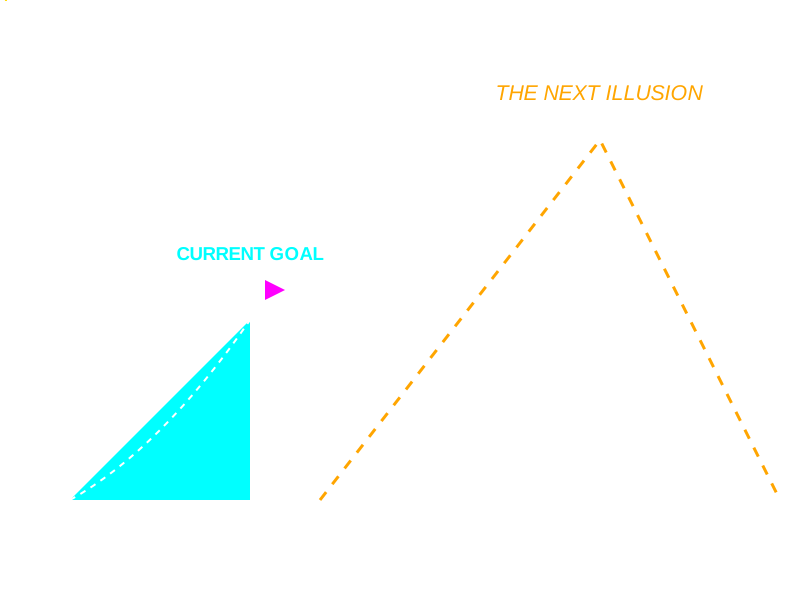
As soon as you reach the mountaintop, the dopamine resets, and another peak instantly appears in the distance. We are biologically wired to want what we don’t have, a mechanism that drives the relentless progress of human civilization. Society desperately needs ambitious, unfulfilled people to invent new technologies and build better systems. But on an individual level, relying entirely on a sense of lack to drive your daily actions is a recipe for deep psychological torture.
The Math of Shifting Expectations
To understand the relationship between ambition and misery, you have to look at the underlying math of human emotion. Happiness is rarely determined by objective reality; rather, it is when your expectations of how life is supposed to go are met. Consider the fascinating phenomenon of the Amtrak “quiet car.” Passengers enter the quiet car expecting absolute, library-level silence, and as a result, they become furious at the slightest whisper or rustling newspaper.
Meanwhile, people in the regular train cars, surrounded by chaotic phone calls and crying children, are often perfectly relaxed. Their expectations are calibrated to the noise, meaning they don’t carry the heavy psychological debt of an unmet demand. As our wealth and status increase, our expectations inevitably balloon, neutralizing any joy we might have gained from the new reality. Studies show that people across the entire wealth spectrum consistently believe they need exactly two to three times their current income to finally be happy 2.
This intentional creation of an expectation gap is pure, self-inflicted misery. If you start out as an anxious, depressed person, acquiring a massive fortune will not miraculously cure you. Money and success simply act as leverage, amplifying the core personality traits that were already driving your existence.
Stripping Away the Illusion of Status
The Desert Island Utility Test
Our drive to achieve is deeply entangled with an obsession over what other people think of us. A brilliant thought experiment to separate authentic ambition from status-seeking is the “desert island test.” If you lived completely isolated from society, with absolutely no one to witness your lifestyle, your consumption habits would instantly shift away from status and toward pure utility. Without an audience, you wouldn’t buy a Lamborghini; you’d buy a durable pickup truck and a home with a calming view.

We exhaust ourselves trying to impress strangers who are entirely too consumed with their own insecurities to care about our achievements. The comedian Jimmy Carr wisely noted that in your twenties, you worry about what everyone thinks of you. In your thirties, you stop caring what people think, and in your forties, you finally realize nobody was ever thinking about you at all.
This brutal truth exposes the emptiness of a life driven by social signaling. People often display their material wealth as a subconscious trophy to prove they have overcome past struggles. Tiffany Aliche coined the term “Post-Traumatic Broke Syndrome” to describe how the financial trauma of poverty can dictate a person’s behavior long after they have achieved extreme wealth. When your ambition is a reactionary defense mechanism against past trauma, no amount of success will ever make you feel secure.
The Problem With Blind Admiration
We also have a terrible habit of idolizing the outlier successes without understanding the horrific costs of their achievements. Young entrepreneurs casually say they want to be the next Elon Musk or Jeff Bezos, looking only at the shiny shop window of extreme wealth. But you cannot selectively extract the billions of dollars while ignoring the brutal reality of the whole package. Among the top ten richest men in the world, there are currently a staggering thirteen divorces, highlighting a life often devoid of holistic balance.
To get the extreme outcome, you have to eagerly swallow the extreme trade-offs. You have to sacrifice your health, your peace of mind, and the relationships that actually sustain human joy. A solitary life in a massive mansion is functionally a psychological prison, whereas a modest middle-class home filled with laughing friends is a triumph.
This brings us to the ultimate clarifying tool: the reverse obituary. When writing down how you want to be remembered after death, it quickly becomes absurd to imagine listing your highest annual income or the horsepower of your car. You instantly drift toward the virtues that actually matter—being a good friend, a loving partner, an honest worker. Ambition that ignores the final draft of your obituary is simply a tragic misallocation of human energy.
The Active Power of Real Gratitude
Shifting from Complacency to Contentment
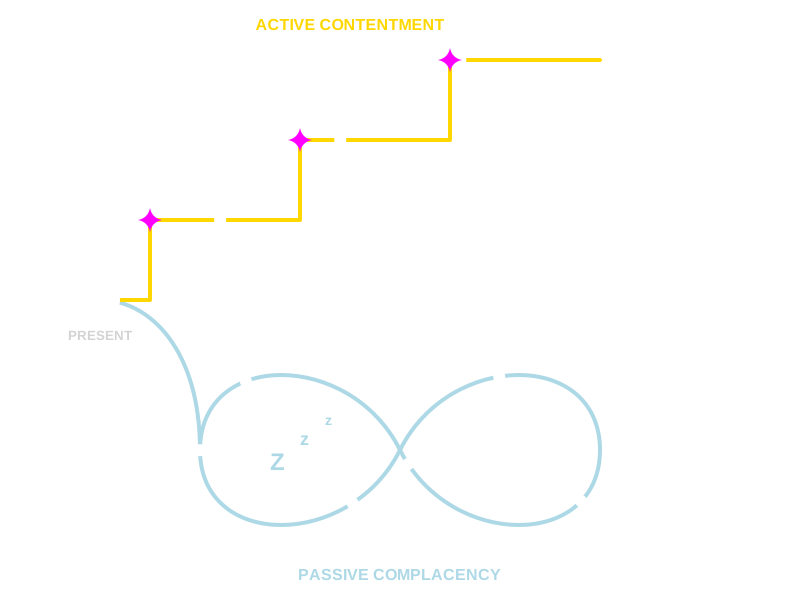
The core argument against gratitude is that it breeds a soft, passive satisfaction with the status quo. To dissect this myth, it is absolutely crucial to distinguish between complacency and contentment. Complacency is a deeply passive state of stagnation, a lazy surrender where you convince yourself you don’t need to do anything else.
Contentment, however, is a fiercely active appreciation of the present moment. It is the empowering realization that you already possess the resources necessary to take the next bold step forward. Rather than acting as a sedative, gratitude functions as a highly activating social emotion. It generates a profound sense of positive indebtedness, a compelling urge to pay the good fortune forward through disciplined effort.
The data thoroughly demolishes the starving achiever myth. In a study conducted by Dr. Robert Emmons and Dr. Anjali Mishra, participants who actively practiced gratitude reported feeling significantly more energized and alive. Furthermore, over a ten-week period, the grateful individuals actually made more measurable progress toward their personal goals than those who did not practice gratitude.
The Danger of Toxic Gratitude
There is, of course, a dark side to this practice if applied incorrectly. “Pallid contentment,” or toxic gratitude, occurs when you weaponize the concept of thankfulness to rationalize staying in a fundamentally bad situation. Telling yourself you should just be grateful to have a job while enduring a highly abusive work environment is a fast track to ruin.
This toxic form of gratitude suppresses the exact type of “healthy dissatisfaction” that is absolutely vital for initiating necessary life changes. Gratitude should never be used as a spiritual anesthetic to numb the pain of a broken reality. It must be employed as a lens of clarity, allowing you to appreciate the good while ruthlessly excising the cancerous elements of your life.
Fortifying the Mind for the Long Game
Building Psychological Safety
One of the greatest hidden benefits of gratitude is its ability to alter our relationship with time and risk. Ambition driven entirely by lack makes us frantic, desperate for quick wins to fill the emotional void. Gratitude, however, dramatically reduces “temporal discounting,” which is our cognitive bias toward valuing immediate, smaller rewards over larger, future ones 1. By increasing our patience, gratitude installs the iron-clad, long-term discipline required for truly massive, ambitious goals.
More importantly, it provides the ultimate layer of psychological safety. If your entire self-worth is hanging by the fragile thread of your next achievement, a single failure becomes an existential identity crisis. You will inevitably play it safe to protect your ego. But if you possess an unshakable gratitude for the life you already have, a failure is instantly downgraded to a mere logistical setback.
Because a grateful person is no longer terrified of losing their foundational worth, they can afford to take massive, asymmetric risks. Ambition paired with gratitude is infinitely bolder than ambition driven by a fear of insufficiency. You are playing with house money, and the freedom of that state is unmatched.
Focusing on the Deep Work
When you successfully untangle your ambition from an endless need for external validation, the nature of your work transforms. The goal shifts from acquiring the byproduct of success—the bestseller list, the money, the praise—to mastering the actual craft. True joy is found inside the agonizing, invigorating daily process of solving complex problems 3.
The worst thing that can happen is allowing the reward for succeeding to drag you away from doing the actual work you love. Achieving a number one ranking is an external event that you ultimately cannot control; it is a byproduct, an extra. The stoic approach is not to eradicate your desire to win, but to rigorously regulate your emotional attachment to the outcome 3.
You control the effort, the focus, and the discipline. A perfectly calibrated mind recognizes that getting good news about your work should not ruin your ability to stay present any more than bad news should 3. If the work itself is the reward, the external validations are just pleasant noise on the periphery of a meaningful life.
Navigating the Tension Between Being and Becoming
The Urgency of Recognizing Dessert
There is a profound philosophical tension between simply being in the present and relentlessly striving to become something more. If you have a roof over your head and relative health, you have already won the cosmic lottery. There are billions of people who would view your current mundane reality as their wildest prayers magically answered 4.
We need a persistent mindfulness alarm to go off in our heads the moment we start expecting the next material change to make us happy. If you cannot settle into your life and enjoy the present moment, then the hard truth is that all your future achievements will be completely wasted on you. The struggles are over; dessert has finally arrived at the table.
Happiness simply cannot be a matter of constantly changing your external experiences. It must be an internal recognition of the profound nature of conscious experience right now, preceding the next inevitable change 4. You cannot buy your way out of the human condition.
Preparing for the Inevitable Tragedy
It is tempting to dismiss this call for presence as the luxurious whining of the extremely privileged. It is easy to say “be grateful” when your life is an unbroken string of tremendous victories. But reality is a brutal equalizer. No matter how healthy, wealthy, or cautious you are, no one escapes the arena without a direct encounter with Greek-level tragedy.
Even if you live to be an incredibly healthy centenarian, your reward will simply be sitting by the phone listening to voicemails confirming that everyone you have ever loved is gone. The normal human mode is to scramble for enough luck and money to pretend that this darkness doesn’t apply to us. We try to extract as much impermanent pleasure from the latest sports car as possible, ignoring the ticking clock.
But that frantic avoidance simply does not scale over a lifetime. We need another gear entirely—a spiritual wisdom or enlightened tranquility—where our foundational well-being is not completely contingent on the fluctuating circumstances of our lives. We must build a mind capable of embracing both the ecstasy and the horror of existence with total equanimity.
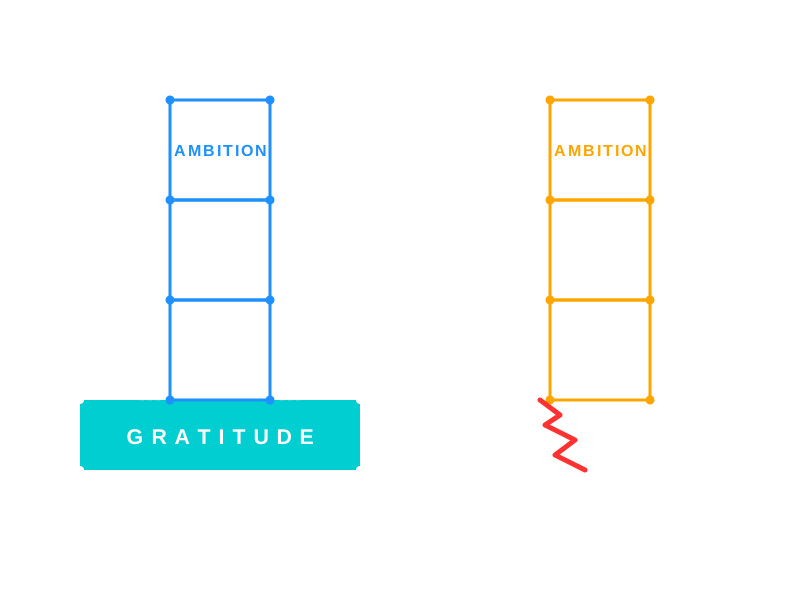
The game is not about shutting off your drive. It’s about shifting the source of that drive from a toxic, desperate scarcity to a powerful, grounded abundance. Ambition without gratitude is a tragic sprint toward a mirage. Gratitude is the bedrock that makes the towering architecture of ambition actually stable enough to inhabit.


