


I’ve spent years chasing happiness like it’s a destination—only to realize it’s more like a shadow, always just out of reach when I turn to face it. The harder I pursued it, the more it seemed to evaporate. It turns out I’m not alone in this paradox.
Research from UC Berkeley’s Iris Mauss shows that people who value happiness most intensely often end up less happy, more lonely, and more depressed. It’s like we’ve been sold a lie: that happiness is something we can achieve if we just try hard enough.
But what if the very act of chasing happiness is what’s making us miserable? What if happiness isn’t a goal to be pursued, but a byproduct of how we live? The more I’ve dug into this, the more I’ve realized that our cultural obsession with happiness might be the biggest obstacle to actually finding it.
The Science Behind the Happiness Backfire Effect
Why High Expectations Lead to Disappointment
There’s something almost cruel about how our minds work when it comes to happiness. We set these lofty expectations—tenure at a dream university, a picturesque Italian vacation, the perfect New Year’s Eve celebration—and then reality inevitably falls short. Iris Mauss’s research reveals a brutal truth: 83% of people were disappointed with their millennial New Year’s Eve celebrations, and the more they expected to enjoy it, the worse they felt. It’s like we’re wired to sabotage our own joy.
The problem isn’t just that expectations are high—it’s that happiness, unlike other goals, is self-defeating when pursued too aggressively. If you aim for a promotion and fall short, the disappointment might fuel future effort. But if you aim for happiness and fall short, the disappointment is the failure.

You can’t be happy while simultaneously feeling disappointed about not being happy enough. It’s a paradox that turns our natural goal-setting instincts against us. 1 2
Meta-Consciousness: The Enemy of Happiness
Happiness thrives in the absence of self-scrutiny. Think about flow states—those moments when you’re so absorbed in an activity that you lose track of time. Mihaly Csikszentmihalyi’s research shows these are some of our happiest experiences, yet they’re also moments when we’re not thinking about how happy we are. The second you pause to ask, “Am I happy right now?” you’ve already disrupted the state.
As John Stuart Mill observed, “Ask yourself whether you are happy and you cease to be so.” This meta-consciousness—this constant checking in on our emotional state—is like trying to enjoy a sunset while staring at your own reflection in a window. The act of observation changes the experience.
Meditation and similar practices work because they reverse this dynamic, allowing fulfillment to exist independent of circumstances. As Sam Harris notes, it’s about being “fulfilled before anything happens,” not waiting for the next achievement to validate your existence. 3
The Cultural Key to Happiness
Here’s the fascinating twist: the backfire effect isn’t universal. Mauss’s cross-cultural research reveals that in more socially-oriented cultures (like Japan or Taiwan), valuing happiness actually increases well-being because happiness is conceptualized as interconnectedness rather than individual achievement. The American obsession with personal happiness often isolates us, while collective happiness paradigms create positive feedback loops.
This suggests the problem isn’t pursuing happiness per se, but how we define it. When happiness means connection rather than personal achievement, the pursuit becomes self-reinforcing rather than self-defeating.
It’s why Naval Ravikant’s observation about money rings true—more resources amplify who you already are, they don’t transform you. The key is building a foundation of contentment first, then letting external factors enhance rather than define your happiness.
Why Your Brain Is Wired for Dissatisfaction
Why Your Brain Prefers Certainty Over Happiness
Here’s the uncomfortable truth: your brain isn’t wired for happiness—it’s wired for certainty. As Anne-Laure Le Cunff points out, “Humans never genuinely pursue happiness. They only pursue relief from uncertainty.” Happiness is merely a fleeting byproduct when uncertainty briefly disappears.
This explains why we’d rather imagine catastrophic outcomes than sit with unpredictability. Our minds create nightmare scenarios because, twisted as it sounds, a terrible certainty feels better than no certainty at all. 4 This certainty-obsession creates a paradox: the more we chase happiness as a destination, the more elusive it becomes. Research shows that valuing happiness too highly actually predicts increased depression symptoms.
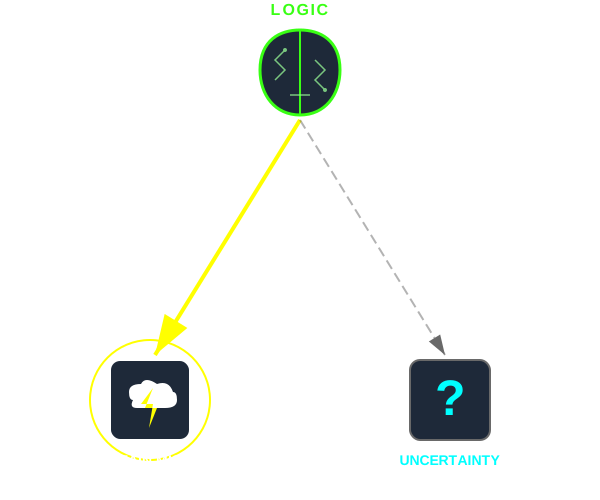
It’s like trying to grab smoke—the harder you squeeze, the faster it dissipates. The solution isn’t to stop wanting happiness, but to stop making it a conditional achievement.
Why We Catastrophize: Your Brain’s False Sense of Control
Our brains have a perverse coping mechanism: when faced with uncertainty, we invent worst-case scenarios. This isn’t just pessimism—it’s our mind’s attempt to regain control. As Sam Harris notes, our dopaminergic system thrives on anticipation, not achievement.
The build-up to an event often feels better than the event itself because uncertainty creates a tension that our brains interpret as excitement. 5 This explains why we catastrophize: imagining disaster gives us a false sense of preparedness. The irony is that these nightmare scenarios are almost always worse than reality, yet we prefer them to the discomfort of not knowing. It’s like choosing to watch a horror movie instead of sitting in a dark room—at least with the movie, we know what to fear. 4
Why More Money Doesn’t Buy Happiness
The pursuit of happiness often becomes a moving target. As Naval Ravikant observes, “Happiness is just being okay with where you are. Not wanting things to be different.” Yet our culture trains us to always want more—more money, more status, more experiences.
The problem isn’t ambition itself, but the belief that these external markers will finally make us happy. 6 Research shows that valuing happiness too highly can actually increase loneliness and depression. The solution isn’t to stop pursuing goals, but to decouple them from our sense of worth.
As Warren Buffett wisely noted, “Success in life is when the people who you want to love you do love you.” True contentment comes from acceptance, not accumulation.
The External Achievement Trap: Why Success Doesn’t Satisfy
Why Money Can’t Buy Happiness
There’s a cruel irony in how we equate wealth with happiness. Naval Ravikant puts it bluntly: “If you won’t be happy with the coffee, you won’t be happy on a yacht.” Money doesn’t create happiness—it amplifies what’s already there. Imagine a miserable person in a mansion with a Ferrari in the driveway.
The house and car don’t matter if they wake up every morning dreading work, feeling lonely, and battling personal demons. Conversely, someone in a modest home with a 10-year-old Honda Civic but surrounded by love, meaningful work, and strong relationships is far richer in what truly matters. The mansion becomes a gilded cage when it’s empty of connection. This isn’t just philosophical—it’s backed by research.
Studies show that people on their deathbeds don’t regret not making more money. They regret not spending more time with loved ones, not being kinder, not being present. As one study found, not a single person out of a thousand interviewed said, “I wish I made more money.”
Instead, they wished they’d been more loving, more present, more connected. The pursuit of wealth as a means to happiness is a mirage—it’s the relationships and moments we cultivate along the way that truly fulfill us.
Money Amplifies Your Inner State
Money is like a magnifying glass—it makes what’s already there bigger, but it doesn’t change the essence. If you’re unhappy, more money won’t fix that. It might make your problems easier to manage, but it won’t erase them. The key is to find joy in the small things, to cultivate contentment in the present moment.
Naval Ravikant calls this “progressive underload”—chipping away at the need for external stimuli to feel happy. It’s about finding fulfillment in washing dishes, walking the dog, or waiting in traffic. The alternative is a life where you’re incapable of happiness even when you have every reason to be happy—a life where you’re constantly looking elsewhere, waiting for the next thing, ruminating about the past. This is why the “keeping up with the Joneses” mentality is so toxic.
Status is a game that never ends, and the rules keep changing. At a certain level of success, the signs of status—nice cars, fancy watches—become meaningless.
The richest people often drive the shittiest cars because they’ve realized the game is rigged. True status comes from being above the game, from finding contentment in what you have rather than always striving for more. 6
The Trap of Perpetual Status Games
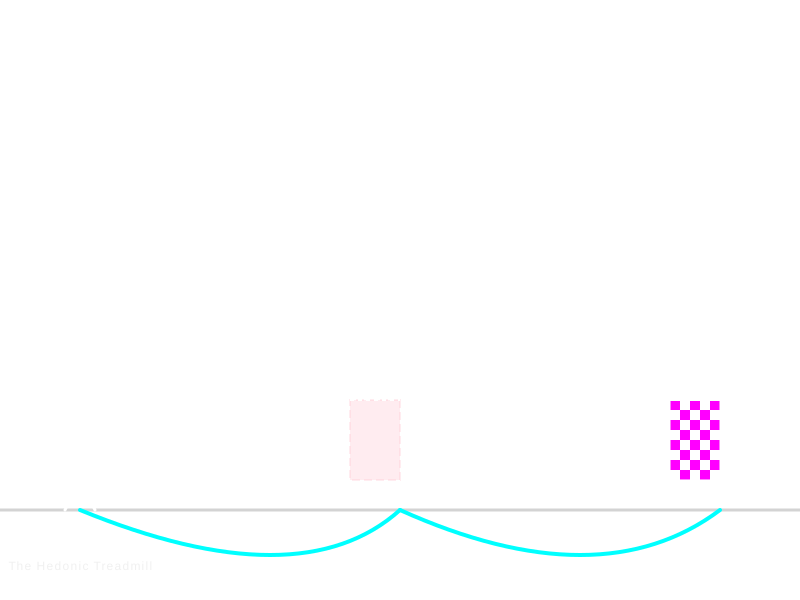
Status games are a trap. They’re a perpetual competition where the goalposts keep moving. As Naval Ravikant observes, “It’s never enough. I always want more.”
Whether it’s money, social opportunities, or relationships, the pursuit of more can become an endless cycle. The only time we feel sated, the only time we feel “this is enough,” is in moments of genuine connection—when our kids are safe, when our partner is happy, when we’re simply present with those we love. The solution isn’t to stop pursuing goals but to decouple them from our sense of worth.
It’s about finding good enough reasons to let our attention fully rest in the present. It’s about recognizing that happiness isn’t a destination but a byproduct of acceptance, connection, and being fully engaged in the process of living. As Sam Harris notes, it’s about being “fulfilled before anything happens,” not waiting for the next achievement to validate our existence. 7
The Power of Emotional Acceptance Over Suppression
How Negative Meta-Emotions Intensify Suffering
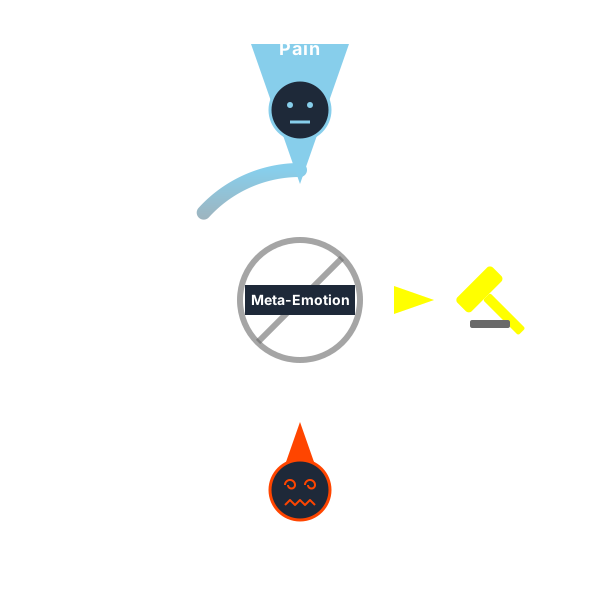
There’s a cruel irony in how we handle negative emotions. The initial feeling—anxiety, sadness, frustration—is often just the beginning. What truly amplifies our suffering is the second layer: the judgment we place on those emotions. Iris Mauss calls these “negative meta-emotions,” and they’re the mental commentary that turns pain into suffering.
Imagine giving a stressful presentation. The anxiety you feel is natural, even expected. But then comes the self-criticism: “I shouldn’t be nervous. What’s wrong with me?”
This internal dialogue doesn’t just add to the distress—it creates a feedback loop that intensifies it. Research shows that people who suppress these emotions don’t just harm themselves; they damage their relationships too. In one study, couples who suppressed their feelings during arguments reported lower relationship satisfaction.
The act of pushing away emotions doesn’t make them disappear—it makes them fester. The solution isn’t to eliminate negative emotions but to stop judging them. Acceptance doesn’t mean resignation; it means acknowledging what you feel without letting it define you.
As Mauss’s research reveals, people who accept their emotions experience less anxiety and depression over time. They don’t avoid stress—they navigate it with less internal resistance.
Acceptance vs. Resignation: Key Differences
Acceptance is often misunderstood as passive resignation. But there’s a world of difference between saying “This is how things are, and I’m okay with it” and “This is how things are, and I’m powerless to change them.” The former is liberation; the latter is defeat. Mauss’s work shows that acceptance isn’t about tolerating injustice or settling for less.
It’s about recognizing emotions without letting them dictate your actions. In her studies, people who accepted their negative emotions didn’t just feel better—they functioned better. They responded to stress with less turmoil and more clarity.
This aligns with ancient wisdom, from Buddhist mindfulness to Stoic philosophy, which teaches that suffering comes not from events but from our judgments about them. The key is to shift from “I need this to be different” to “I prefer this to be different.” Preferences are flexible; needs are rigid.
When we cling to the latter, we set ourselves up for disappointment. But when we hold our desires lightly, we create space for contentment—even in imperfect circumstances.
How to Find Contentment by Shifting Your Mindset
The language we use with ourselves matters. Saying “I need this to happen” creates a mental contract that reality often fails to honor. But “I prefer this to happen” leaves room for life’s unpredictability. This shift isn’t about lowering standards—it’s about reducing suffering.
When we treat preferences as absolute needs, we turn every unmet expectation into a personal failure. But when we recognize that life rarely aligns perfectly with our desires, we free ourselves from constant disappointment. Sam Harris describes this as being “fulfilled before anything happens.”
It’s not about suppressing ambition but about decoupling happiness from specific outcomes. This mindset allows us to find joy in the process rather than fixating on the result. Whether it’s a birthday party in the rain or a career setback, acceptance doesn’t mean giving up—it means engaging with life on its terms, not ours. And paradoxically, that’s where true contentment begins. 2
Process Over Achievement: Finding Contentment in the Journey
Why Achieving Goals Doesn’t Guarantee Happiness
There’s a cruel irony in how we approach happiness through goal achievement. Sam Harris puts it bluntly: “Most of your life is spent in the process.” That moment of triumph when you finally achieve something? It’s fleeting.
The second you reach it, the satisfaction begins to fade because new goals immediately appear on the horizon. It’s like climbing a mountain only to see another peak in the distance. This perpetual cycle explains why we’re never truly satisfied. As Harris notes, “If you’re focused on goals, you can never arrive.”
The problem isn’t ambition itself—it’s the belief that these external markers will finally make us happy. Research shows that valuing happiness too highly can actually increase loneliness and depression. The solution isn’t to stop pursuing goals, but to decouple them from our sense of worth. The key is to find joy in the process rather than fixating on the result.
Whether it’s a birthday party in the rain or a career setback, acceptance doesn’t mean giving up—it means engaging with life on its terms, not ours. And paradoxically, that’s where true contentment begins.
The True Source of Happiness Is Your Attention
Our lives are finite, but within that finite continuum of time, we have an even more precious resource: free attention. Sam Harris describes this as “the even more precious resource of free attention that can find our fulfillment in the present.” The problem is that we often squander this resource by constantly regretting the past or anxiously expecting the future, never truly making contact with the present moment. The key is to shift our focus from external achievements to internal awareness.
As Harris notes, “You can be in a shitty situation where nothing has really gone the way you expected and still be radiantly happy.” It’s all about what you’re doing with your attention. This aligns with ancient wisdom, from Buddhist mindfulness to Stoic philosophy, which teaches that suffering comes not from events but from our judgments about them.
The solution isn’t to eliminate negative emotions but to stop judging them. Acceptance doesn’t mean resignation; it means acknowledging what you feel without letting it define you.
Transform Exercise: Find Peace Through Effort
Exercise can be more than just a physical activity—it can be a form of meditation. When you’re pushing yourself to the limit, you’re not just building physical strength; you’re also cultivating mental resilience. As Sam Harris notes, “You can be straining, and I’m sure physiologically showing a lot of stress, but you really can be deeply equanimous and at peace.” This is because exercise allows you to transform a classically negative experience into something intrinsically positive.
The key is to bring the right attitude to the effort. When you understand what you’re doing and why it’s happening, you can find peace even in the midst of struggle. This mindset allows us to find joy in the process rather than fixating on the result. 8
Whether it’s a birthday party in the rain or a career setback, acceptance doesn’t mean giving up—it means engaging with life on its terms, not ours. And paradoxically, that’s where true contentment begins.
Peace as the Sustainable Alternative to Happiness
Why Happiness and Sadness Are Inseparable
There’s a fundamental flaw in how we conceptualize happiness. Shi Heng Yi captures it perfectly: “If there’s happiness, there is sadness. If something can rise, something must fall.” This duality is baked into our human experience.
The more we chase happiness as a permanent state, the more we invite its shadow—disappointment, loss, and sadness. Sam Harris amplifies this point with a stark observation: it’s entirely possible to have everything and still be miserable, just as it’s possible to have nothing and radiate joy. The wealthy and famous often embody this paradox, their lives a testament to how external circumstances don’t dictate inner peace.
Conversely, those who’ve spent years in solitude, like meditators emerging from caves, often glow with contentment. This suggests happiness isn’t about what we have or don’t have—it’s about how we relate to our circumstances. 3 The “keeping up with the Joneses” mentality only deepens this duality.
We’re trapped in a cycle where each new achievement or possession briefly satisfies us before becoming the new baseline for comparison. The neighbor’s bigger house, the colleague’s promotion—these become benchmarks that perpetually move, leaving us in a state of perpetual wanting. 5
The Art of Being Content While Growing
Contentment isn’t about lowering standards or resigning to mediocrity. It’s about recognizing that happiness isn’t a destination but a way of traveling. As Naval Ravikant notes, the real high status isn’t about outward displays of wealth but about being above the game entirely. The richest people often drive modest cars because they’ve realized the futility of status symbols.
True contentment comes from being satisfied with where you stand, even as you continue to grow. This doesn’t mean we shouldn’t have ambitions or strive for improvement. It means we should decouple our sense of worth from external validation. The key is to shift from “I need this to happen” to “I prefer this to happen.”
Preferences are flexible; needs are rigid. When we cling to the latter, we set ourselves up for perpetual disappointment. But when we hold our desires lightly, we create space for contentment—even in imperfect circumstances. 1 3
The Quiet Confidence of True Security
True fulfillment isn’t about the absence of challenges but about the presence of security—both external and internal. Money can contribute to happiness, but only to the extent that it facilitates meaningful connections and experiences. As one study revealed, a big house only makes you happier if it becomes a space for gathering loved ones.
The location matters less than what it enables—uninterrupted time with family, freedom from stress, or the ability to create memories. This protective fulfillment comes from knowing that even in hard moments, we have a foundation of security—whether that’s financial stability, strong relationships, or inner resilience.
It’s not about avoiding negative emotions but about accepting them without letting them define us. As Iris Mauss’s research shows, accepting our emotions doesn’t mean resigning to bad situations; it means acknowledging our feelings while still taking action to improve our circumstances. In the end, peace—not happiness—is the sustainable alternative.
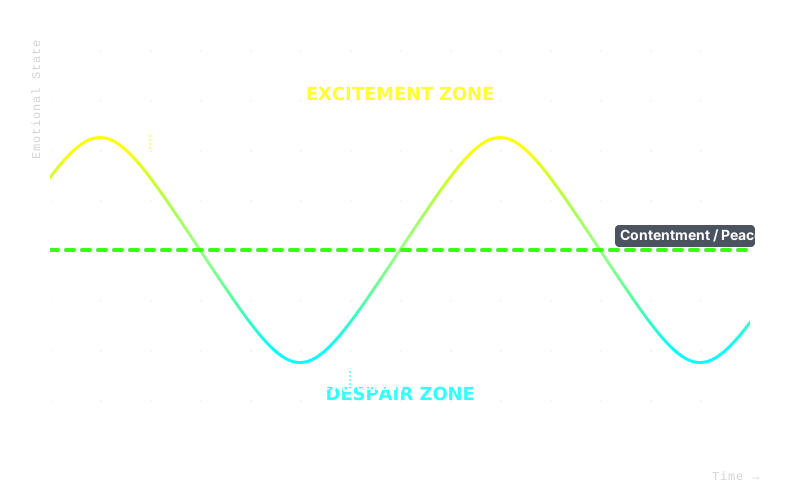
Peace doesn’t depend on external conditions. It’s the quiet confidence that comes from knowing you’re enough, right where you are. 7
Practical Integration: Making Contentment Your Default State
Meditation: Finding Fulfillment Beyond Circumstances
Meditation isn’t just a practice—it’s a complete reversal of how we approach happiness. Sam Harris describes it as being “fulfilled before anything happens,” a radical shift from our usual pattern of waiting for external circumstances to validate our existence. The key insight is that happiness isn’t something we achieve—it’s something we uncover by removing the mental barriers we’ve constructed. The beauty of meditation lies in its ability to dissolve the artificial boundary between practice and daily life.
As Harris notes, “your life is your practice.” Those 20 minutes on the cushion aren’t banking happiness credits for later—they’re training your mind to recognize that fulfillment exists independent of circumstances. The real work happens in the thousand daily moments when you choose awareness over autopilot. This practice reveals our two default modes of suffering: grasping at pleasure and resisting pain.
Mindfulness offers a third option—open receptivity to whatever arises. The relief comes not from successfully manipulating our experiences, but from recognizing we’re the mirror of awareness itself.
Mindfulness in Every Moment
Every moment becomes a meditation when you realize your attention is your most precious resource. Sam Harris describes this as “the even more precious resource of free attention that can find fulfillment in the present.” The challenge is that we’re constantly squandering this resource by regretting the past or anticipating the future.
The solution is to treat your entire life as the practice. Whether you’re washing dishes, stuck in traffic, or having a conversation, the opportunity for mindfulness is always present.
The key is noticing when you’re contracted—either grasping at pleasant experiences or pushing away unpleasant ones—and returning to open awareness. This isn’t about achieving some perfect state of constant presence. It’s about recognizing the fluctuation between awareness and distraction, and gently returning to the present moment—again and again.
Finding Joy in Ordinary Moments
The real work of contentment is what Naval Ravikant calls “progressive underload”—systematically lowering the threshold for what makes us happy. If you can’t find joy in a simple cup of coffee, you won’t find it on a yacht. The goal is to chip away at our dependence on external stimuli until we can appreciate the ordinary. This practice reveals how much of our pursuit is actually about creating good enough reasons to be present.
Whether it’s the shock of a whip or the awe of a starry sky, we’re constantly seeking experiences that force us into the moment. But true mastery comes when we can find that presence in washing dishes or waiting in line. 5 Gratitude becomes the ultimate tool for lowering this bar. When we zoom out to appreciate the miracles we take for granted—antibiotics, clean water, the absence of pain—we realize how much happiness is already available.
The billionaire who always wants more is no different from someone with $10,000 dreaming of $20,000. Both are trapped in the same expectation gap. Contentment isn’t about settling—it’s about recognizing the abundance that already exists in ordinary moments. The practice is simple: keep chipping away at your expectations until you can find joy in the coffee, the traffic jam, and the rain-soaked birthday party.
Conclusion
So here we are, at the end of this exploration, with a truth that feels both liberating and unsettling: happiness isn’t something we chase—it’s something we uncover by stopping the chase. The more we cling to it as a destination, the more it slips through our fingers like sand. But when we shift our focus—when we accept our emotions, embrace uncertainty, and find joy in the ordinary—the shadow of happiness finally stops running ahead of us.
The real magic happens when we realize that contentment isn’t about having everything go our way. It’s about being okay with the way things are, even as we work to make them better. (Yes, that’s a paradox, and yes, it’s the whole point.) The billionaire who can’t enjoy a simple cup of coffee and the person who finds joy in a rain-soaked birthday party aren’t separated by circumstances—they’re separated by perspective.
So here’s the question to sit with: What if happiness isn’t the next achievement, the next purchase, or the next milestone? What if it’s already here, hiding in plain sight, waiting for us to stop long enough to notice?
The answer isn’t in lowering your standards—it’s in raising your awareness. Because in the end, the pursuit of happiness was never about getting more. It was about seeing what was already there. Happiness isn’t the destination—it’s the art of wanting what you already have.
Footnotes
-
The Savings Expert: Passive Income Is A Scam! Post-Traumatic Broke Syndrome Is Controlling Millions! ↩ ↩2
-
Using Meditation to Focus, View Consciousness & Expand Your Mind | Dr. Sam Harris ↩ ↩2 ↩3
-
How To Live Freely In A Goal-Obsessed World - Anne-Laure Le Cunff ↩ ↩2
-
44 Harsh Truths About The Game Of Life - Naval Ravikant (4K) ↩ ↩2


