


Every dollar you hold in your hand is a crystallized fragment of your finite existence. We rarely think of currency in such macabre terms, but money is essentially something you trade your life energy to acquire. When you impulsively buy a pair of designer shoes or an upgraded smartphone, you aren’t just handing over paper or plastic. You are literally trading away the irretrievable hours of human consciousness you sacrificed to earn that specific amount.
I often think about the sheer delusion required to survive the modern corporate landscape. We constantly lie to ourselves about our true wealth by obsessing over a gross annual salary, conveniently ignoring the massive, hidden taxes levied against our actual time. To find the truth, you have to run a much darker, more unforgiving calculation.
The Invisible Tax on Your Existence
Calculating the True Cost of Your Desires
Consider the brutal, unrelenting reality of your real hourly wage. If you want to know what your life is actually worth to the market, you cannot just divide your salary by forty hours a week. You must actively factor in the unpaid daily commute, the expensive mandatory work clothes, and the sheer hours of evening decompression required to recover from a soulless job.
Once you run that unforgiving math, the illusion shatters completely. You suddenly realize exactly how many actual hours of your life a single, fleeting impulse purchase truly costs. A dinner out isn’t just a hundred dollars; it is four hours of your finite existence dealing with a boss you likely despise. We willingly lock ourselves inside a gilded cage of our own making, literally dying just to earn a living.
People voluntarily sacrifice their most precious, non-renewable resource—time—because they frantically desire the temporary dopamine hits that shiny things and manufactured experiences can buy them. We have been conditioned to believe that consumption is the only reliable cure for the exhaustion caused by our endless labor. It is a perfectly engineered, self-sustaining doom loop. The more exhausted you are, the more you buy to feel alive, which forces you to work more hours to pay for the escape.

Rewiring Your Baseline for Ultimate Freedom
There is a devastatingly simple alternative to this modern madness, though few have the stomach for it. You could choose to drastically save your time by finding profound satisfaction with what you already possess. If you successfully rewired your desires to only require money for absolute baseline necessities, you could entirely reclaim your daily schedule.
Suddenly, the desperate need to perform for the corporate machine evaporates. You would only require a fraction of your current income, drastically lowering your real hourly wage threshold. You would finally have the freedom to spend your time doing the things you actually want to do, rather than constantly serving an economic system that views you as entirely replaceable.
This isn’t about forced poverty or rejecting the modern world. It is about actively deciding whether you own your desires, or whether your desires own you. When you artificially inflate your lifestyle with every promotion, you aren’t getting richer. You are just increasing the ransom you must pay to eventually buy back your freedom.
The Ancient Diagnosis of Temporal Bankruptcy
Seneca and the Absurdity of Wasting Life
Over two millennia ago, the brilliant minds of antiquity had already diagnosed this chronic human sickness. In his blistering essay On the Shortness of Life, the Roman Stoic philosopher Seneca argues that life is not inherently short, but rather that we are remarkably adept at wasting it. We confidently act as if we are immortals, squandering our precious days on trivialities, petty dramas, and the endless demands of total strangers.
Seneca explicitly critiques a glaring psychological paradox that remains entirely unsolved in the twenty-first century. He sharply observes how aggressively people protect their physical wealth, yet how remarkably careless they are with their fleeting calendars. As he flawlessly put it: “People are frugal in guarding their personal property; but as soon as it comes to squandering time they are most wasteful of the one thing in which it is right to be stingy.”

Think about the sheer, undeniable absurdity of our daily behavior. We lock our doors at night, aggressively monitor our credit scores, and ruthlessly negotiate a few dollars off a car purchase. Yet, we will mindlessly hand over two hours of our irreplaceable life to a completely pointless meeting or an endless doom-scrolling session on a glowing rectangle. We desperately guard the replaceable abstraction of cash while freely hemorrhaging the only asset we can never, ever earn back.
The False Dichotomy of Status and Wealth
To actually escape this temporal trap, we have to fundamentally redefine the vocabulary we use to describe our ambitions. There are two major, competing games happening in society at any given moment, and most people don’t even realize which one they are playing. Status is simply your perceived rank in the social hierarchy, representing a brutal, zero-sum game where one person moving up inherently requires someone else to be pushed down 1.
People who vehemently attack the concept of making money are usually just playing a highly sophisticated status game. They publicly virtue signal to the world that wealth creation is evil, attempting to artificially elevate their own moral standing in the eyes of their peers. It is an incredibly transparent tactic once you learn to look for it. Deep down, many of these individuals secretly believe they cannot succeed in the financial arena, so they attempt to actively destroy the very concept of the enterprise.
This virtue signaling is a defense mechanism masquerading as righteousness. It allows people to feel morally superior while remaining entirely trapped in a cycle of financial dependency. They win the temporary applause of the crowd, but they secretly lose control of their own mornings.
The Architecture of Capital and True Wealth
How Society Tracks Your Historical Value
Money, stripped of its emotional baggage, is merely how we transfer tangible value among ourselves. It represents social credits; a formalized IOU from society explicitly acknowledging that you did something valuable in the past and are owed something in the future. When you provide a service or build a product that improves someone’s life, they hand you this voucher as proof of your contribution.
Of course, this system is inherently flawed and highly susceptible to manipulation. Governments routinely print extra IOUs and bad actors constantly try to steal them, which inevitably debases the underlying currency you worked so hard to collect. This constant debasement is exactly why storing your life energy in fiat currency is a guaranteed path to long-term suffering. You are trusting a central authority not to dilute the hours of your life you already spent.
Building Automated Assets That Earn While You Sleep
Because cash is a melting ice cube, the ultimate prize you should be relentlessly seeking isn’t money or status at all. True wealth is fundamentally comprised of assets that earn while you sleep. It is the automated factory of robots continuously cranking out products, or the resilient computer program running late into the night serving global customers.
Wealth is capital in the bank relentlessly reinvesting itself into other thriving businesses, multiplying without your direct physical labor. A house can technically be a form of wealth since it generates rental yield, though it remains a far less productive use of land than operating a thriving commercial enterprise. The distinction is absolutely vital: money is how you transfer value, but wealth is the permanent engine that generates it.
If we accept that wealth is the ultimate operational goal, we must urgently ask ourselves why we actually want it. The popular media constantly tries to convince us that the grand purpose of wealth is unbridled, flashy consumption. We are relentlessly fed hollow images of fur coats, pristine Ferraris, sprawling yachts, and private Gulfstream jets crisscrossing the globe 1.
I can assure you, that kind of relentless material consumption gets incredibly boring and stupid, really fast. The sole, unadulterated purpose of wealth is absolute freedom. You desperately want assets working for you so you never have to wear a suffocating tie like a collar around your neck ever again.
Deploying Your Capital for Maximum Sovereignty
The Positive Sum Game of Human Creation
True wealth allows you to become your own sovereign individual, entirely detached from the exhausting grind of the corporate machine. Freedom means waking up naturally, completely avoiding the soul-crushing 7:00 a.m. alarm, and skipping the miserable gridlock of morning commute traffic. Money effectively buys you freedom in the material world, allowing you to ruthlessly eliminate the mandatory tasks you despise doing.
To achieve this elusive level of sovereign individuality, you must recognize that wealth creation is inherently a positive-sum game. Just because one person figures out how to build a beautiful house, it does not somehow diminish your ability to build one. In fact, the shared knowledge generated by that process makes it remarkably easier for everyone else in society to successfully build their own homes.
The absolute highest utility of capital is ensuring you do not have to be in a specific place, at a specific time, doing anything you don’t want to do. You are essentially buying back the hours of your life that you previously sold to the market. It is the only transaction in the modern world that actually matters.
Avoiding the Trap of Mindless Consumerism
However, once you actually manage to extract yourself from the time-for-money trap and build real wealth, you face an entirely new, deeply complex problem. You have to actively figure out the most effective ways to deploy that accumulated capital. There are spectacularly bad ways to spend your hard-earned money, mostly revolving around endless, mindless consumption 2.
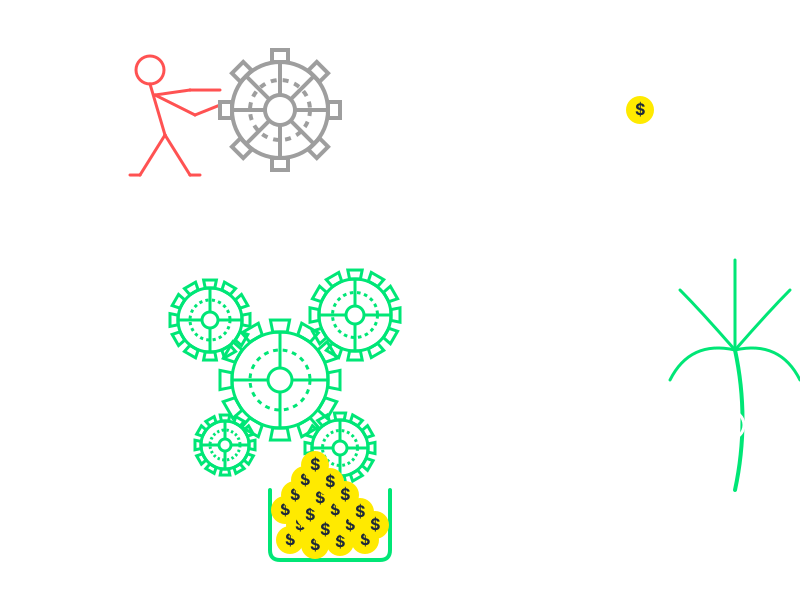
There is an old, deeply cynical industry quote that perfectly summarizes the worst places to park your cash. As the famous saying warns: if it flies, floats, or fornicates, you are much better off renting it. Buying rapidly depreciating liabilities just to blindly signal your status to total strangers is a foolproof recipe for returning to the very wage slavery you just fought so fiercely to escape.
The Grift of Traditional Philanthropy
Bypassing Bureaucracy With Highly Targeted Giving
The traditional routes of high-society philanthropy aren’t much better, as they often devolve into mere status-seeking behavior that entirely lacks any real philanthropic impact. A vast majority of prominent non-profits are grifty operations run by bureaucrats who didn’t actually earn the capital, and they sorely lack the tight operational feedback loops necessary to guarantee a positive societal effect. For instance, donating vast sums to Ivy League schools is objectively foolish; they already possess astronomical endowments and generally have absolutely no idea how to efficiently allocate those funds.
Instead, one incredibly effective avenue is to fund hyper-targeted, highly specific initiatives that entirely bypass the bloated bureaucratic machine. Imagine using your capital to quietly underwrite a dedicated little school exclusively for young, brilliant physicists, ensuring the money directly fuels raw intellectual potential without the administrative waste. True philanthropy often works best when it remains completely anonymous, deliberately stripping away the addictive social validation and focusing entirely on the concrete outcomes.
Buying Back Your Schedule From the Market
Beyond anonymous giving, there are highly practical, everyday ways to deploy capital to immediately improve your baseline physical existence. You can definitively close out your short housing position by simply buying yourself a nice home. This anchors your living costs and provides a baseline of security that allows you to take more aggressive intellectual risks.
More importantly, you can aggressively hire help to instantly free up your remaining hours, ensuring you stop doing the trivial tasks that other people can do better than you. The operational rule here is incredibly simple: always overpay for the best talent, strictly expect the best work in return, and fiercely protect your calendar. Every dollar spent buying back your time from menial labor is a dollar incredibly well spent.
Escaping the Matrix of Industrial Retirement
Reinvesting in Your Unique Intellectual Talents
Beyond targeted charity and buying back your time, the absolute best use of capital is to violently reinvest it into your own unique talents to build the next great thing humanity needs. Think about the massive, tangible value created by ruthless entrepreneurs who plow their personal fortunes back into their own visions 2. Visionaries like Elon Musk and Steve Jobs intuitively understood this principle, relentlessly funneling their own resources into their businesses to attempt vastly bigger and better things for the world.
A genuinely good business is inherently philanthropic because it successfully creates a beautiful product that people voluntarily choose to buy, extracting real, immediate value from it. Having personal wealth fundamentally grants you the permission to bypass gatekeepers and ignore the timid, conventional opinions of the masses. It gives you the raw, unadulterated freedom to start wildly ambitious businesses without having to warp your original vision to satisfy outside investors seeking a safe, predictable return.
You can literally self-fund the manifestation of something beautiful into reality purely because you possess a burning desire to see it exist. This level of autonomy is intoxicating. It transforms the act of creation from a stressful obligation into a pure expression of your specific knowledge.
Leveraging the Ruthless Power Law of Business
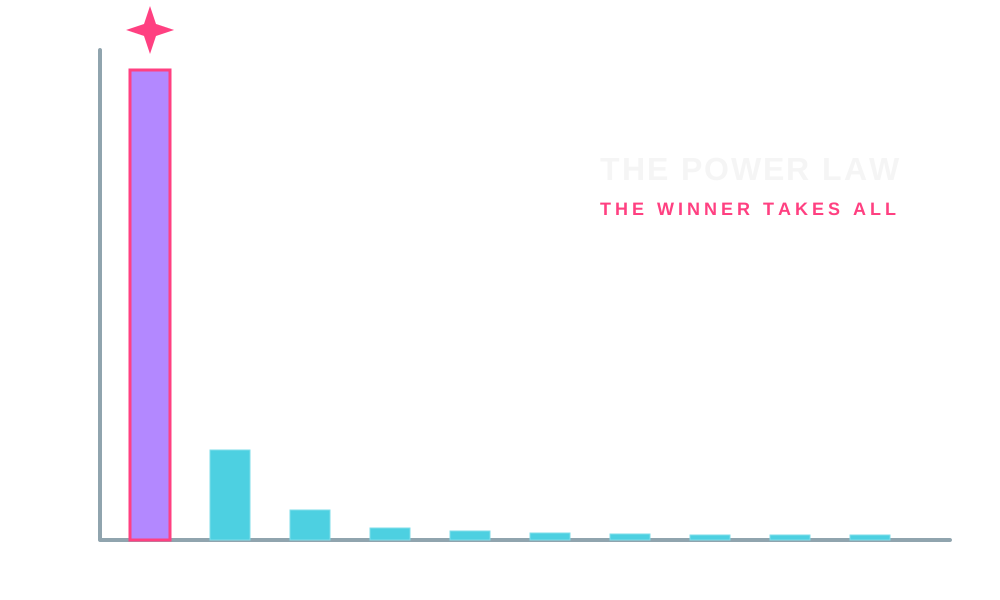
This kind of immense value creation operates on a severe power law distribution, meaning the outsized, non-linear outcomes of a highly leveraged intellectual domain will always aggressively reward the absolute best execution. Consider how these brutal power law distributions dictate reality, where the absolute winner invariably takes vastly more than the rest combined. Peter Thiel famously co-founded PayPal, yet the overwhelming lion’s share of his historic, world-altering wealth was generated by his single early investment in Facebook.
In any non-linear game, the number one position will inevitably return infinitely more than the second through the millionth positions put together. Navigating this highly leveraged landscape is extraordinarily complex because business strategy is ruthlessly contextual. You have to carefully dissect a specific enterprise, deeply analyze the unique founders, and actively predict what might work long before the broader market sees it.
It is essentially like playing a chaotic lottery where you happen to know a few of the winning numbers in advance, and you genuinely only need to be right once to secure the ultimate financial score. Because the landscape is so fraught with nuance, aspiring founders fail constantly for incredibly specific, easily avoidable reasons. They pursue action A merely as a desperate, misguided stepping stone to get to point B, rather than just directly attacking point B from the very start 2.
Entrepreneurs constantly raise toxic capital from the wrong investors, align themselves with mismatched co-founders, or mistakenly start companies entirely driven by the desire for cash rather than a genuine, obsessive love for the product. If you are only in it for the money, you will eventually be beaten by the obsessed competitor who authentically loves the relentless daily struggle of the arena.
The Ultimate Luxury of a Perfectly Blank Calendar
This finally brings us to the profound realization that traditional retirement is a fundamentally broken, industrial-era concept. Choosing to sit totally idle on a beach is a tragic, uninspiring waste of whatever remaining time you happen to have left on this spinning rock. Work is really just a mandated set of things you have to do that you don’t actually want to do.
If you are consistently doing things you deeply enjoy without financial coercion, it no longer feels like work, meaning you have already entered a blissful state of perpetual retirement. The goal isn’t to stop producing value. The goal is to stop producing value on someone else’s terms.
We tragically spend the first half of our lives blindly trading our irretrievable time for money, mistakenly believing that a larger bank account will somehow organically cure our internal dissatisfaction. We play the exhausting, zero-sum game of social status, eagerly showing off our depreciating material liabilities to strangers we don’t even genuinely like. Yet, true wealth was never about the mindless accumulation of shiny objects or the fleeting applause of the crowd.
It has always been about the quiet, absolute sovereignty of your own unbothered schedule. When you finally stop squandering your time to impress others and start ruthlessly building assets that earn while you sleep, you permanently step out of the suffocating matrix of modern wage labor. You seamlessly transition from a desperate seller of life energy into an autonomous, fiercely independent creator of value. We die aggressively guarding our vaults, entirely forgetting that the only currency that ever truly mattered was the ticking clock.


