


We are currently living through a bizarre cultural paradox regarding artificial intelligence. We are surrounded by fundamentally flawed, easily distracted, and highly emotional human beings, yet we readily hand them the keys to two‑ton metal machines hurtling down the highway at seventy miles per hour. We accept their inevitable, mathematically predictable failures as a standard cost of doing business in a modern society. Yet, the moment a machine proposes to do the exact same job with a fraction of the failure rate, we suddenly demand absolute, unflinching perfection.
It is a strange quirk of human psychology. People adamantly refuse to adopt self‑driving cars and other autonomous AI technologies, loudly arguing that these systems are prone to failure. They point to sensationalized headlines of robotic missteps as proof that the technology is unready. But the empirical evidence tells a completely different story, demonstrating that autonomous systems actually possess a dramatically lower failure rate and are therefore substantially safer than humans.
For some inexplicable reason, we are infinitely more tolerant of human error than machine error. This points to a widespread, deeply ingrained bias that does not rely on any semblance of logic. We are holding artificial intelligence to a demanding, “superhuman” standard, completely divorced from the statistical reality of human incompetence.
This is not just a passing cultural hesitation. It is a demonstrable phenomenon rooted in a combination of psychological biases and moral intuitions that compel us to treat machine error fundamentally differently than human error. If we want to understand why we are delaying the widespread adoption of technologies that could save thousands of lives, we have to look closely at our own irrational minds.
The Foundational Science of Algorithm Aversion
When a person makes a catastrophic mistake, society has a built‑in mechanism for forgiveness. We simply shrug our shoulders, nod sympathetically, and mutter the age‑old proverb, “to err is human.” We view failure as an intrinsic, inevitable part of the biological human condition.
But when an algorithm errs, our reaction is entirely different. People immediately view a machine’s mistake as a fundamental, unfixable flaw in the underlying system. This leads them to abandon the technology entirely, even in scenarios where the algorithm still vastly outperforms the human overall.
Understanding Why We Reject Superior Systems
This exact phenomenon has a name in the behavioral sciences. It is commonly referred to as algorithm aversion.
The foundational text on this subject is a 2014 study titled “Algorithm Aversion: People Erroneously Avoid Algorithms After Seeing Them Err” 1. The researchers, Berkeley J. Dietvorst, Joseph P. Simmons, and Cade Massey, conducted a series of elegant experiments to see exactly when and why people abandon data‑driven models.
Their findings are both fascinating and deeply frustrating. They demonstrated that participants would willingly choose a human forecaster over a vastly superior algorithm the moment they saw the algorithm make a single mistake. It didn’t matter that the algorithm was statistically more accurate; the mere exposure to its imperfection completely destroyed its credibility in the eyes of the user 1.
The Mechanics of the Wharton Experiments
In the Wharton studies, participants were asked to forecast real outcomes using real data. In one iteration, they acted as MBA admissions officers predicting the future success of student applicants based on criteria like GMAT scores and interview quality. In another iteration, they were predicting the rank of US states based on departing airline passengers.
The participants could either tie their financial incentives to their own human predictions, or to the predictions of a statistical model built from the data. Across five studies, the statistical model outperformed the human forecasters every single time. In fact, in the airline passenger task, human forecasters produced up to 97% more error than the algorithm.
However, if a participant was placed in a group that watched the algorithm perform and make a minor error before making their choice, they consistently abandoned it. Seeing the model err significantly decreased participants’ confidence in the machine, but seeing a human make much larger mistakes did not significantly decrease confidence in the human. We hold onto our faith in flesh and blood, even when the math proves we shouldn’t.
The Myth of the Magical Human Driver
Nowhere is this dynamic more dangerous than in the development and deployment of autonomous vehicles (AVs). The introduction of self‑driving cars is arguably the most important public safety initiative of our time. Yet, the public remains staunchly, aggressively skeptical.
Research suggests that when an autonomous vehicle crashes, people do not compare it to an average human driver. They do not picture the teenager texting their friends, or the exhausted father falling asleep at the wheel, or the drunk driver running a red light. Instead, they compare the AV to a hypothetical, utterly perfect human driver.
The Illusion of Magical Competency
This dynamic has been extensively documented by Julian De Freitas at the Harvard Business School. His research highlights that people naturally blame AVs far more than humans for identical accidents 2. In a massive study involving over 5,000 respondents across three experiments, De Freitas and his team uncovered a startling psychological bias.
When evaluating a crash, people imagine that a human driver would have possessed the agency to magically “swerve” or “solve” the problem. We attribute a sort of magical competency to human drivers that hard statistics simply do not support. In reality, human reaction times are terribly slow, and our spatial awareness is severely limited.
We construct an alternate reality to justify our bias against the machine. When an AV is involved in an accident, observers unconsciously simulate a “counterfactual” scenario. They tell themselves, “If a human had been driving, they would have used their intuition to avoid this.”
Demanding Impossible Split‑Second Reactions
This counterfactual thinking holds the machine to an entirely impossible standard. It demands that the AI must not only be safer than the average human, but it must be safer than the absolute best possible human reaction in that highly specific, chaotic instance. De Freitas found that people completed sentences about hypothetical accidents by claiming a person would have “been able to swerve,” even when the experiment was specifically constructed so that such split‑second behavior was physically impossible.
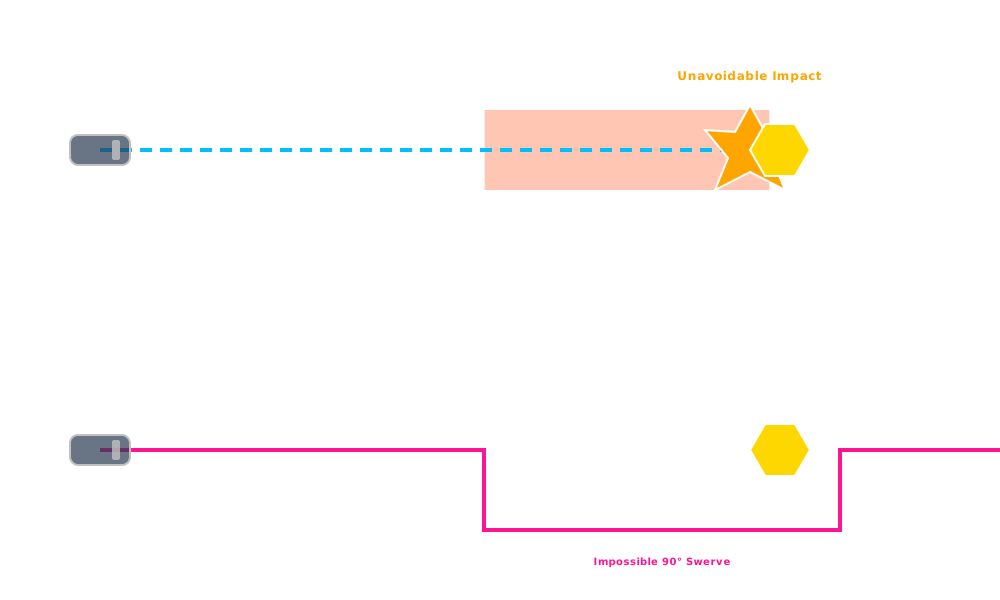
Because the technology is unfamiliar and unsettling, any failure causes people to fixate entirely on the AI itself. They view the vehicle as an “abnormal” presence on the road. This fixation leads them to imagine that an ideal human would have miraculously bent the laws of physics to prevent the tragedy.
The Tragic Case of the Cruise Robotaxi
To understand how this plays out in the real world, we only have to look at recent history. In 2023, a horrific, complex accident occurred in San Francisco involving a Cruise robotaxi. A human‑driven vehicle struck a pedestrian who was jaywalking, launching the victim directly into the path of the autonomous Chevy Bolt.
The autonomous vehicle immediately braked, but the physical momentum was unavoidable, and it still hit the woman. After the initial impact, the vehicle attempted to execute a pull‑over maneuver, tragically dragging the pedestrian approximately 20 feet and causing serious injuries.
The fallout was immense. The company was fined $500,000, lost its operating license in the city, and was forced to shut down its entire robotaxi business. While the company’s failure to fully disclose the dragging incident played a major role in the shutdown, the public narrative aggressively positioned the AI as the primary villain. People completely ignored the fact that a human driver initiated the accident, and that no human could have possibly avoided the secondary collision either.
The Psychology of Technological Betrayal
Why do we do this? Why do we fiercely protect the reputation of the flawed human driver while actively cheering for the demise of the superior machine? The answer lies deeper than just a misunderstanding of statistical probability. It lies in our moral framework.
When you get into a car driven by another person, you accept a baseline level of mutual risk. You know they are human. You know they might sneeze, or drop their coffee, or misjudge the speed of oncoming traffic. If they crash, you view it as an unfortunate accident.
The Concept of Betrayal Aversion
But when we interact with an autonomous system, the psychological contract changes completely. We do not view an AI as a peer; we view it as a dedicated safety system. This triggers a powerful psychological response known as Betrayal Aversion.
Being harmed by a system specifically designed to keep you safe feels like a deep, personal violation of a contract. Whether it is an automated braking system failing to engage, or a medical diagnostic AI misidentifying a tumor, the emotional impact is fundamentally different than if a human doctor or driver had made the exact same error.
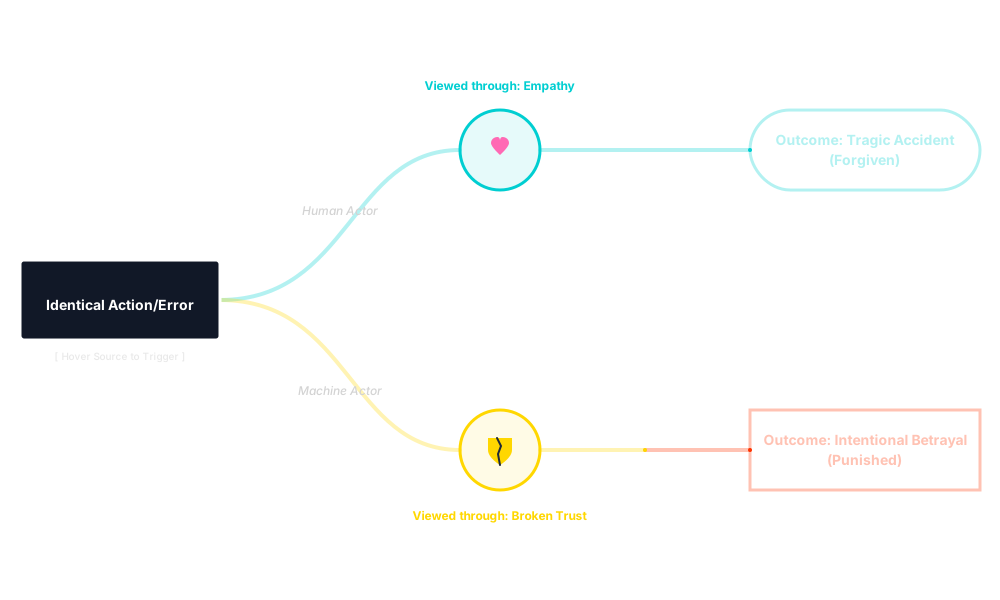
A human error is viewed through the lens of empathy; it is seen as a tragedy. A machine error, however, is viewed through the lens of broken trust; it is seen as a betrayal. We can forgive a human because we understand human weakness, but we cannot forgive a machine because we feel it has lied to us about its infallibility.
The Financial Costs of Unrealistic Demands
This betrayal aversion is not just a philosophical quirk; it has massive real‑world consequences for the development of life‑saving technology. Because we view machine error as a betrayal, we punish the creators of those machines with devastating financial and legal penalties.
The Harvard Business School research points out that in some US states, legal liability is completely uncapped. If an autonomous vehicle is unfairly blamed by a jury driven by betrayal aversion, the financial damages awarded could extend far beyond actual costs. AV companies are perceived as wealthy, heavily insured entities, making them incredibly attractive targets for lawsuits even when they are only partially—or not at all—at fault 2.
This creates a chilling effect on innovation. Companies may have to choose between passing exorbitant insurance costs onto consumers or reducing their liability coverage, thereby exposing themselves to tremendous corporate risk. We are essentially taxing the development of safer roads because our feelings get hurt when robots aren’t perfect.
Counteracting Our Own Biases
If we are ever going to reap the benefits of AI and autonomous systems, we have to actively rewire how we think about risk and error. We cannot afford to be ruled by algorithm aversion and betrayal aversion. We need to confront our biases head‑on and drag our expectations back to reality.
Ruling Out the Impossible Counterfactual
First, companies building these technologies must become ruthlessly transparent about what their systems can and cannot do. To combat the “what if” effect, they must actively rule out impossible counterfactuals for the public.
When an accident occurs, defendants must counter the emotional “a human would have swerved” theories with hard, unyielding facts. They need to mathematically demonstrate that human reaction times and physical constraints limit what alternative outcomes were actually possible. By pointing out these absolute physical limits, we can begin to dismantle the myth of the magical human driver.
Earning Trust Through Familiarity
Second, we have to normalize the technology. The more people trust AVs, the less likely they are to view them as liable when things go wrong.
When a technology is deeply integrated into our daily lives, it ceases to be an “abnormal” presence. The researchers note that for people who already trust the technology, the AV seems less unsettling, which makes them far less prone to exaggerating hypothetical risks or imagining alternate, perfect scenarios. AI‑based systems simply need to feel like a common, mundane part of our everyday surroundings 2.
Accepting the Reality of Progress
We are standing on the precipice of a massive leap forward in human safety and efficiency. But our own psychology is acting as the primary bottleneck. We are acting like irrational gatekeepers, fiercely protecting the status quo of human error while rejecting the mathematical superiority of machines.
It is time to drop the double standard. We cannot demand that artificial intelligence be completely devoid of error when the biological intelligence it replaces is so frequently, disastrously flawed. We must learn to accept that an algorithm that fails one percent of the time is infinitely better than a human who fails ten percent of the time.
Progress is not about achieving sudden, flawless perfection. It is about the relentless, statistical reduction of harm. We demand perfection from the machine, completely blind to the fact that our insistence on it guarantees the continued, tragic imperfection of ourselves.


