


I’ve always been deeply suspicious of the cultural obsession with “living with no regrets.” It’s a bumper sticker philosophy that sounds incredibly liberating over a third glass of wine with friends. But whenever I hear someone earnestly declare they wouldn’t change a single thing about their past, I can’t help — Really? You haven’t grown at all?
We treat regret as if it were a cognitive disease that must be cured. It has become a modern psychological imperative to eradicate any lingering feelings of remorse from the human experience.
To achieve this unblemished existence, many ambitious people worship at the altar of Jeff Bezos’ famous decision-making model. The logic seems airtight when you first encounter it, offering a clean, mathematical approach to human emotion. You project yourself to age eighty, look back on your life, and aggressively optimize your current decisions to minimize the number of “what ifs” haunting your rocking chair. It sounds like the ultimate life hack for the modern high-achiever.
But this widely accepted mental model has a fatal, unspoken flaw woven into its very foundation. People citing Jeff Bezos’ “regret minimization” framework incorrectly think that you should live life such that you have as few regrets as possible, but that assumes that you don’t change across your lifetime1. It presupposes that the actions you take that are in line with your current beliefs now will be looked upon favorably in the future. That simply isn’t how human cognitive development works.
The Myth of the Perfect Timeline
The Seductive Trap of “Could Have Been”
To understand why a life without remorse is actually a tragedy, we first have to deconstruct the lie that regret tells us. At its absolute core, regret implies that you could have done differently2. It whispers seductively that if you had just been a little smarter, a little braver, or a little more disciplined, the outcome would have been flawless.
But let’s interrogate that assumption rationally for a moment. If you could somehow magically rewind the clock of reality, you would inevitably arrive at that precise historical moment as your exact same self. You would possess the exact same brain, the same physiology, the same fragmented information, and the same chaotic external circumstances.
The Architecture of a Historical Choice
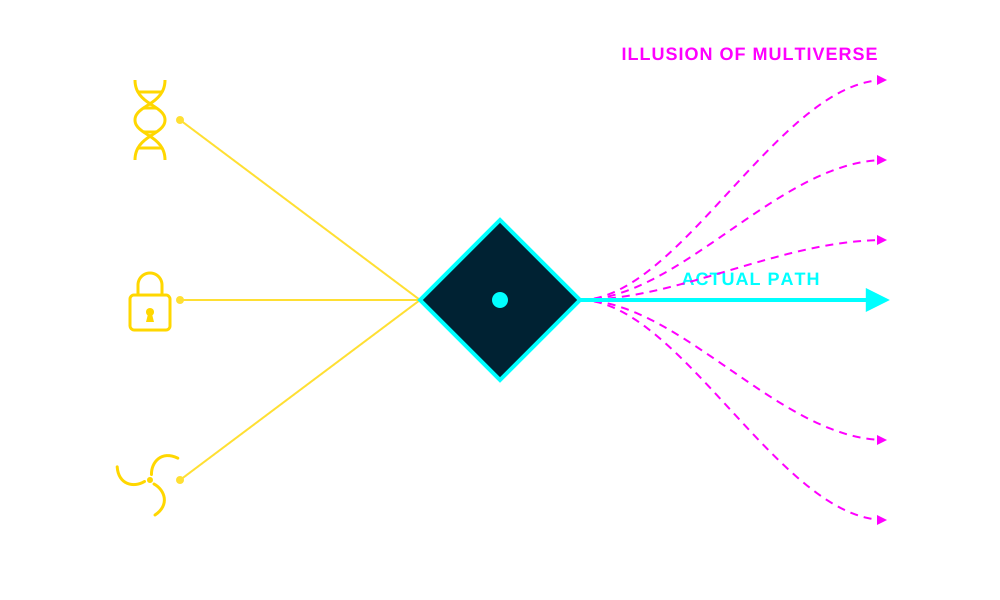
When you truly account for all those variables, the illusion of choice begins to rapidly evaporate. In reality, there’s no way you could have made any different of a decision. You were fundamentally boxed in by the biological and informational constraints of that specific moment in time.
Whether you subscribe to hard deterministic philosophy or simply acknowledge the profound limitations of human foresight, the outcome remains identical. Ultimately, regret is sort of an understandable illusion of our consciousness where it makes us feel like there’s a lot of possibilities2. It teases us with a sprawling multiverse of potential that never actually existed outside of our own heads.
The Heavy Burden of Self-Awareness
Why does consciousness play this cruel trick on us as we age? The deeper you go into self-awareness, the more you are burdened by whimsical, wistful remembering and relentless rumination. Our highly evolved brains are absolutely desperate to resolve the fundamental tensions of human existence.
We crave a pristine sense of certainty, an ultimate resolve, and the comforting illusion that we have done everything perfectly. We contort the delicate foresight-hindsight equilibrium, stretching logic to try and make sense of our current, messy reality. But there is no escaping the endless hamster wheel of desire, suffering, boredom, and anxiety.
The Silicon Valley Optimization Fallacy
The Religion of Minimizing Regret
Let’s trace the origin of our modern anxiety around regret. It largely stems from the hyper-optimized culture of Silicon Valley, specifically Bezos’ legendary origin story. When deciding whether to leave his lucrative Wall Street job to start his internet company, he developed what he termed the framework for minimizing future regret.
The premise was brilliantly simple: project yourself to the end of your life, and choose the path that yields the fewest painful “what ifs.” It quickly became the undisputed gospel of modern entrepreneurship. But like all rigid frameworks, it got completely stripped of its nuance and weaponized by a culture obsessed with achieving perfection.
The Folly of the Static Self
This brings us back to the core flaw in how high-achievers misunderstand its utility. Bezos’ regret-minimization idea is incredibly useful as a present-tense decision heuristic, but shouldn’t be worshipped as absolute truth. It is the exact psychological spark needed to get you off the couch, force you to quit the miserable corporate job, and push you to take a terrifying leap of faith.
However, it should not be mistaken for a promise that future selves will judge present actions by the same standards. Think about the things you desperately wanted ten or fifteen years ago. Now, imagine if you had aggressively optimized your entire existence to satisfy those outdated, juvenile desires.

Recognizing the Limits of Present Knowledge
It would be a living nightmare to be chained to your past desires. At the end of the day, you have to recognize and humbly accept that there is absolutely no way to know what future beliefs you will hold. Trying your best with the limited, fragmented information you have in the fragile present is quite literally all you can do. Operating under any other assumption is pure arrogance.
The Biological Function of Embarrassment
The Canary in Your Mental Coal Mine
So, if we couldn’t have acted any differently, why does the memory of a mistake still sting so badly? Why do we wake up in a cold sweat at 3:00 AM vividly remembering a catastrophically embarrassing comment we made at a dinner party five years ago?
The answer is surprisingly optimistic: regrets are necessary because they are a clear sign that you have grown as a person3. The internal dynamic is profoundly simple. Your thoughts and actions in the past cause you to feel some kind of pain or embarrassment today specifically based on the beliefs you have now.
If you don’t cringe at your past self, it means you haven’t evolved an inch socially or morally. Think of the lingering sting of a bad decision as a highly sensitive, built-in psychological diagnostic tool. It acts as a canary in the coal mine to explicitly remind you whether or not this is still an emotional area you need to intensely work on.
Transcending the Visceral Agony of Past Mistakes
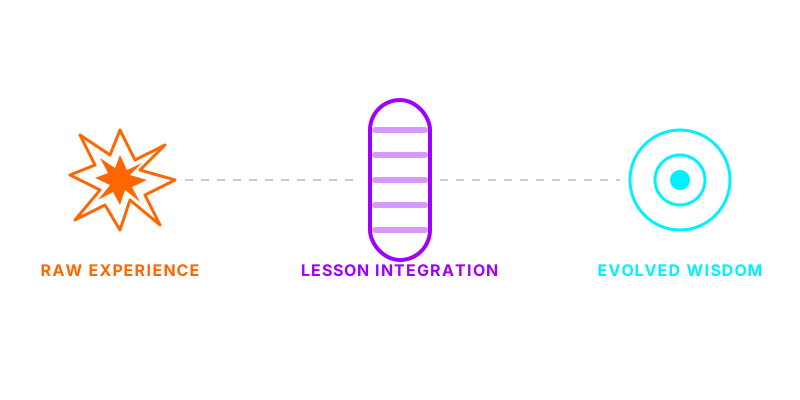
But the beautiful part of this biological mechanism is that it comes with an automatic, psychological shut-off valve. Once you completely ameliorate the situation and truly absorb its core teaching, the visceral, emotional agony simply falls away.
As behavioral experts note, the lingering pain essentially gets ejected from your psyche3. It is discarded as an unnecessary waste product of your personal evolution once the lesson is integrated3.
Recontextualizing the Pain of the Past
This forces us to completely flip our cultural narrative regarding how we view our perceived historical mistakes. Regret is not always a sign of failure; rather, it is often undeniable empirical evidence that our values, knowledge, or self-understanding have profoundly changed. In that deeply profound sense, regret is just a natural, inevitable byproduct of growth.
To see this in action, we only need to look at how humans process missed opportunities over long time horizons. Consider the story of a middle-aged woman on a cruise ship who tearfully confessed that her biggest haunting regret was failing to become a professional dancer. Her sadness wasn’t just about the physical act of dancing; it was a potent indicator that her adult self finally valued creative expression in a way her younger, safer self simply could not.
The Cruelty of Chronological Judgement
The Tragic Nature of Romantic Hindsight Bias
We are notoriously terrible at extending basic empathy to our past selves. We judge our historical actions with a ruthless, almost pathological lack of context.
Psychologists document cases like the forty-year-old man who was completely obsessed with his earlier decision not to pursue a romantic relationship with a close colleague. At twenty-one, he played it safe because of religious differences, but as an adult, he spent decades idealizing her and aggressively punishing himself for his youthful caution.
He completely failed to realize that his fantasy of what could have been was radically intensifying his attraction in the present. The regret he felt wasn’t a factual analysis of a parallel universe where they lived happily ever after. It was an emotional spotlight illuminating a lifelong pattern of passivity and his current inability to initiate action to meet his own needs.
Holding Children to Impossible Adult Standards
The hindsight bias becomes even more absurd when we look at the immense guilt carried over from childhood. There is a deeply illuminating clinical case of an adult woman who carried a crushing burden because, at age ten, she playfully urged a friend to jump into a deep swimming pool.
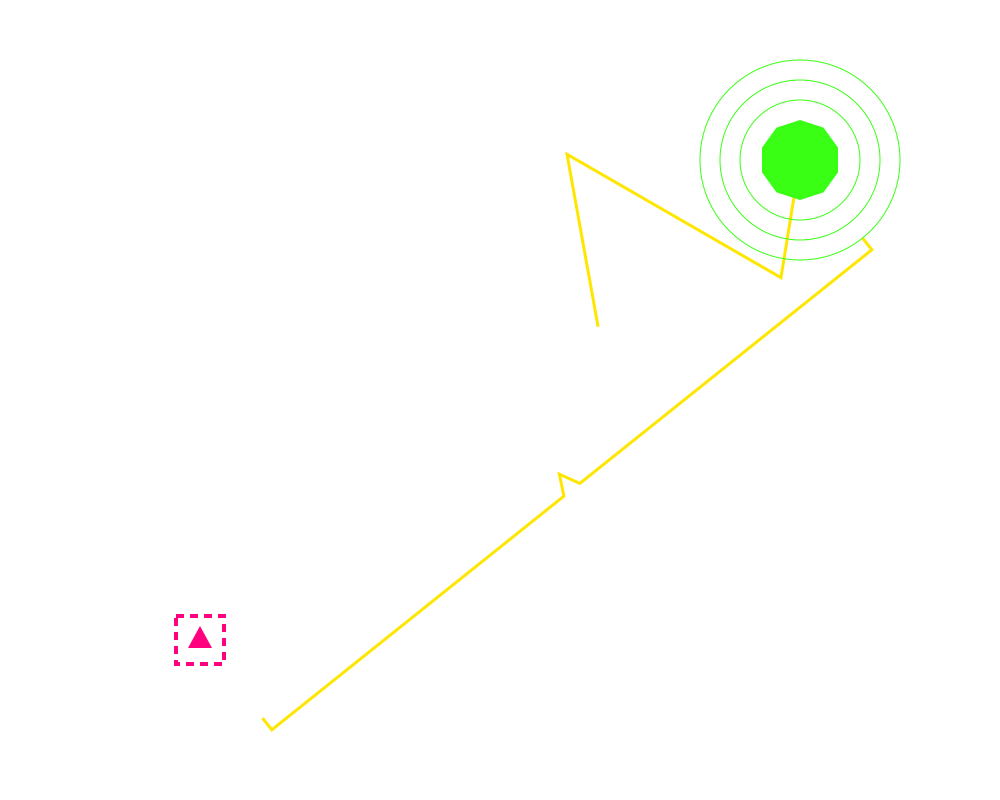
When her friend floundered and had to be frantically saved by a lifeguard, the young girl froze in shock. For decades, she blamed herself for not attempting a daring rescue, completely failing to recognize her own developmental limitations.
She flagellated her adult self for an event where she literally lacked the biological foresight and cognitive capacity to accurately judge the danger. Blaming a ten-year-old for not possessing the wisdom and emergency response skills of a mature adult is the absolute zenith of undue, corrosive self-criticism. We demand sheer perfection from a version of ourselves that was still fundamentally under construction.
The Biographies of Our Former Selves
When you finally stop weaponizing your past against yourself, you unlock a remarkable superpower. Proper, compassionate reflection on your regret can actually provide unparalleled insight into who you were in the past.
It allows you to map out the precise, messy distance between the fragile person you were and the resilient person you have painstakingly become. Past choices may look wildly different to you now precisely because you have learned significantly more about yourself and your true, underlying needs1.
If you successfully numb yourself to the pain of your historical mistakes, you simultaneously sever your connection to the vital lessons they hold. You trade the highly productive discomfort of self-awareness for the hollow, stagnant comfort of a curated memory.
Conclusion
We are all frantically trying to solve an existential equation that has no permanent mathematical solution. The burning desire to reach the end of our lives with a pristine, unblemished record of flawless choices is an impossible, neurotic standard.
The brutal, unvarnished truth is that you are going to make bad calls. You will inevitably say the wrong thing to someone you deeply love, accept the wrong job out of sheer panic, and let the absolute wrong person slip through your fingers. Those missteps are unavoidable features of the messy human condition, not preventable bugs in your personal operating system.
But those very missteps are the exact architectural blueprints for the hard-won wisdom you hold today. They are the fiery crucibles that burned away your early naivety and forced you to confront the stark reality of your own limitations. To wish away the regret is to actively wish away the wisdom it purchased.
Embrace the embarrassment. Let the sharp sting of hindsight wash over you, not as a permanent punishment, but as a graduation ceremony from your former ignorance. A life lived without regret is simply a life lived without learning.


