


We are living in the most comfortable, calorie-rich, and entertained era in human history, yet we seem to be collectively losing our minds. It’s a paradox that should haunt us: if the goal of modern life is to feel good, why do the statistics suggest we feel absolutely terrible?
The World Health Organization reports that 5% of the global population is clinically depressed. In the United States, that number has skyrocketed to a staggering 22%. 1
We aren’t just a little down; we are witnessing a catastrophic collapse of well-being. I believe the root of this crisis isn’t economic or political, but rather linguistic and biological. We have been sold a bill of goods that conflates two entirely different biological states: pleasure and happiness.
For decades, marketing and culture have told us that if we just stack enough moments of pleasure—enough sugar, enough likes, enough purchases—we will eventually arrive at happiness. This is not just a lie; it is a neurological impossibility.
The reality is that pleasure and happiness are not only different; they are often mutually exclusive. The more you chase the former, the more you biologically destroy your capacity for the latter.
The Dopamine vs. Serotonin War
To understand why we feel so empty, we have to look under the hood of the brain. Dr. Robert Lustig, a pediatric endocrinologist and expert on metabolic health, argues that the confusion stems from mixing up two neurotransmitters: dopamine and serotonin.
The Biological Signal of “More”
Dopamine is the chemical of “reward.” It is the driver of motivation, the spark that gets you out of bed, and the biological signal that says, “This feels good, I want more.” It is excitatory, meaning it stimulates the neurons to fire.
Serotonin, conversely, is the chemical of “contentment.” It is inhibitory, meaning it calms the neurons down and signals, “This feels good, and I have enough.”
Here is the terrifying part: these two chemicals fight for control. When dopamine is released in the reward center (the nucleus accumbens), it excites the neurons. But neurons are fragile; they like to be tickled, not bludgeoned.
The Mechanism of Tolerance and Downregulation
If you chronically overstimulate these neurons with dopamine triggers—like sugar, social media, or drugs—the neurons risk dying. To protect themselves, they downregulate their receptors. This is the biological mechanism of tolerance.
As you flood the system with pleasure, the brain reduces the number of receptors available to receive the signal. You now need a bigger hit just to feel “normal,” let alone good. This is the pathway to addiction.
Crucially, dopamine downregulates serotonin. The more you jack up your reward system, the more you suppress your ability to feel content. By chasing constant pleasure, we are chemically engineering our own misery.
Why Neurons Die From Overstimulation
The biological cost of this constant stimulation is severe. When dopamine receptors are constantly bombarded, the resulting excitotoxicity can lead to actual neuronal cell death.
This isn’t just a metaphor for burnout; it is physical damage to the brain’s reward infrastructure. Once those neurons are gone, the capacity to feel reward diminishes permanently, leading to the flat, gray existence characteristic of severe depression.
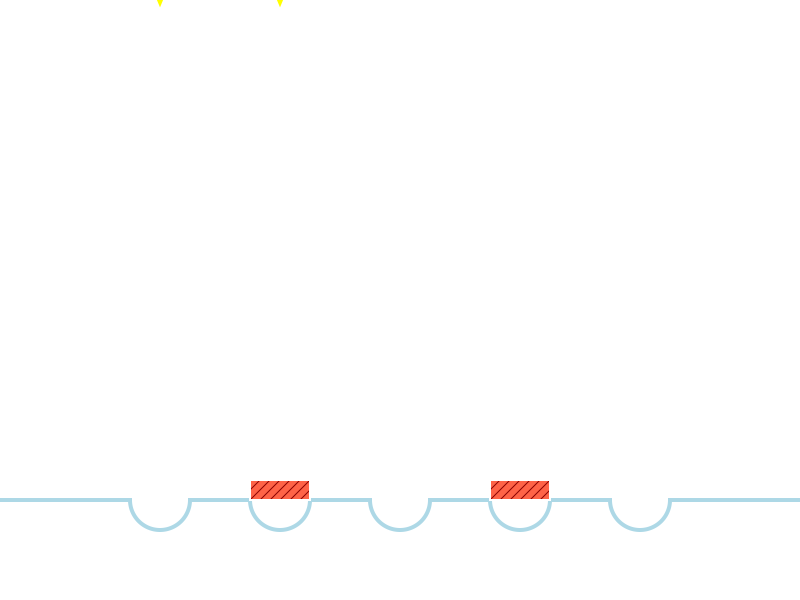
We are literally exciting our brains to death. The very thing we are using to feel alive is the thing that is killing our ability to feel anything at all.
Visceral vs. Ethereal: The Seven Differences
If we want to escape this trap, we have to learn to distinguish between these two states in our daily lives. Lustig outlines seven critical differences that help separate the signal from the noise.
Duration and Location of the Feeling
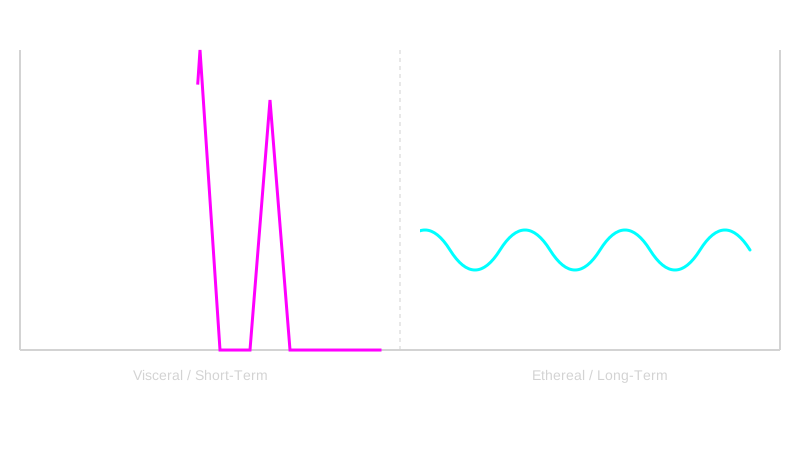
First, pleasure is short-lived, while happiness is long-lived. The slice of cake tastes good for the two minutes you are eating it, but the feeling vanishes the moment the fork is put down. Happiness is a background hum, a state of being that persists even when you aren’t actively doing anything.
Second, pleasure is visceral; you feel it in your body. It’s the rush of sugar, the buzz of alcohol, or the tactile sensation of a new purchase. Happiness is ethereal; it is felt above the neck as a sense of peace or understanding.
The Transaction of “Taking” vs. “Giving”
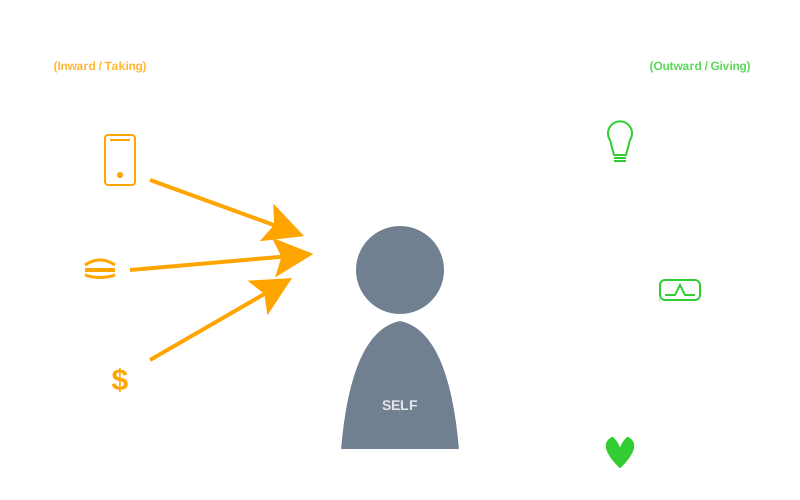
Third, and perhaps most culturally relevant, is the direction of transaction. Pleasure is about “taking”—taking from the casino, taking from the buffet, taking validation from the internet. It is a consumption-based model of well-being.
Happiness, however, is about “giving”—contributing to a cause, helping a neighbor, or raising a child. This distinction aligns with what psychologists call the “hedonic treadmill.” We run faster and faster after new pleasures, only to remain in the same emotional place. Because pleasure is rooted in external stimuli, it requires constant replenishment from the outside world.
Happiness, by contrast, is internal. It is a generated state that doesn’t rely on the next shipment of goods or the next notification on your phone. 2
Isolation vs. Social Connection
Finally, pleasure is often experienced alone, while happiness is usually experienced in social groups. You can drink alone, shop alone, and doom-scroll alone. In fact, addiction isolates us because the substance eventually replaces the need for people. 1
Happiness, however, thrives on connection. It is found in the eye contact between friends, the shared effort of a team, or the communal experience of a meal (not just the food, but the gathering).
This explains why we can be surrounded by “fun” things and feel deeply lonely. The “fun” is spiking dopamine, which is actively eroding our serotonin. We are amusing ourselves into isolation.
The Addiction to “More”
The modern economy is largely built on hacking our dopamine pathways. We have engineered food, technology, and entertainment to be “hyper-palatable,” bypassing our natural satiety mechanisms.
Hacking the Human Reward System
Consider the substances and behaviors that trigger dopamine: cocaine, nicotine, alcohol, sugar, shopping, gambling, and social media. Every single one of these has an associated addiction (alcoholic, shopaholic, chocoholic).
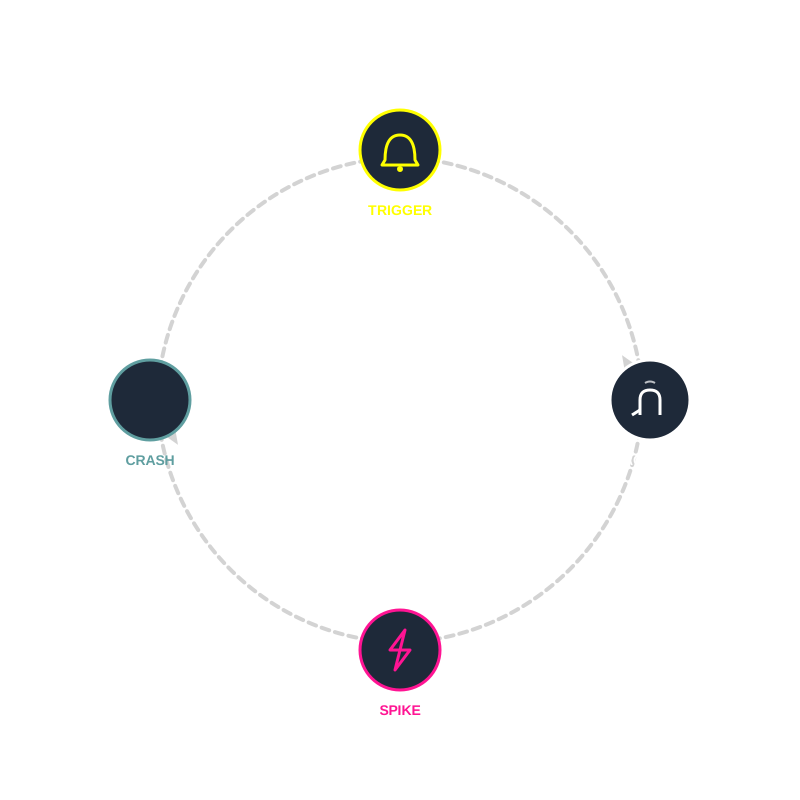
These triggers are designed to override the “stop” signals in our brain. The bright red notification badge on your phone is not a design accident; it is a dopamine trigger. It is specifically engineered to create an itch that only a click can scratch.
We are rats in a cage, pressing the lever over and over again, mistaking the relief of the itch for actual happiness. This cycle of craving and temporary satisfaction keeps us trapped in a loop where we confuse the absence of discomfort with genuine well-being.
The Myth of “Too Much” Contentment
Now, try to apply that logic to happiness. Have you ever heard of someone being addicted to “too much contentment”? Is there such thing as a “fulfillment-aholic”?
It doesn’t exist. You cannot overdose on happiness because serotonin is inhibitory; it doesn’t drive the frenzied cycle of “more.”
This explains why we can be surrounded by “fun” things and feel deeply unhappy. The “fun” is spiking dopamine, which is actively eroding our serotonin. We are amusing ourselves into a chemical depression.
Using Pleasure to Treat Unhappiness
When we confuse these two states, we start using pleasure substances to treat our unhappiness. This is the most dangerous cycle of all.
We feel the lack of serotonin (depression/anxiety) and we try to self-medicate with dopamine (sugar/screens). This is like trying to put out a fire with gasoline; the temporary relief leads to a larger conflagration. 3
We need to stop treating the symptoms of a serotonin deficiency with dopamine agonists. It is a biological error that is costing us our sanity.
Hedonia vs. Eudaimonia: The Ancient Wisdom
While neuroscience provides the mechanism, philosophy provides the context. This isn’t a new problem; the Greeks were debating this thousands of years ago.
The Paradox of Hedonism
Aristotle distinguished between Hedonia (the pursuit of pleasure and sensation) and Eudaimonia (the pursuit of meaning, virtue, and human flourishing). He argued that happiness is the ultimate end of human existence, while pleasure is merely a byproduct. 3
The “Paradox of Hedonism” suggests that the direct pursuit of pleasure often leads to its absence. If you wake up every day asking, “How can I feel good right now?”, you are trapping yourself in the dopamine loop.
True happiness—Eudaimonia—often involves struggle. It involves doing things that don’t feel “good” in the visceral sense, like training for a marathon, having a difficult conversation to repair a relationship, or working late on a project you care about.
Flow States and Gratification
Psychologist Martin Seligman expanded on this with the concept of “Gratifications” versus “Pleasures.” Pleasures have a strong sensory component but require little effort (watching Netflix). Gratifications, however, engage us fully and often lead to a state of “flow.” 4
In a flow state, you lose self-consciousness and the sense of time. You might not feel “pleasure” in the moment—you might even feel strain—but the aftermath is a deep sense of growth and psychological capital. This is the essence of building a happy life.
Struggle as a Feature, Not a Bug
We have come to view struggle as an impediment to happiness, something to be avoided at all costs. But the Eudaimonic view suggests that struggle is actually the source of happiness.
Without the resistance of the weight, the muscle cannot grow. Without the difficulty of the task, the satisfaction of completion cannot exist.
When we remove all friction from our lives in the name of convenience and pleasure, we inadvertently remove the very things that generate serotonin. We make life easy, but we make it empty.
Reclaiming Your Birthright
So, where do we go from here? The first step is to recognize that we have been duped. The things we are told to chase—money, fame, eternal youth, the perfect body—are dopamine triggers, not happiness generators.
Starving the Dopamine Beast
We need to fiercely protect our dopamine receptors. This means consciously limiting the “super-stimuli” of modern life. Put the phone away. Eat real food that doesn’t cause a metabolic explosion. Stop treating boredom as a crisis that must be solved with a screen.
When we constantly stimulate our neurons, we kill them. When we let them rest, we allow sensitivity to return. We can start to find joy in the subtle, the quiet, and the ordinary.
The Practice of Giving Back
We must prioritize “giving” over “taking.” This doesn’t just mean charity; it means giving your attention to your children, giving your effort to your craft, and giving your patience to your community.
This aligns with the “giving” nature of serotonin-based happiness. When you volunteer or help a friend, you are engaging in a pro-social behavior that boosts serotonin.
When you gamble or binge-eat, you are engaging in a self-centered behavior that spikes dopamine. We need to shift our daily actions from consumption to contribution.
Returning to Sensitivity
The ultimate goal is to re-sensitize our brains. We want to be able to feel the small joys again, rather than needing a tsunami of stimulation to feel anything.
This requires a period of withdrawal. It requires sitting with the discomfort of boredom without reaching for the phone. It requires eating plain food until it tastes sweet again.
It is not an easy path, but it is the only path back to ourselves. This journey demands patience and self-compassion as we relearn how to be present with our own thoughts and feelings.
Conclusion
The pursuit of happiness is a fundamental human right, but the pursuit of pleasure is a biological trap. They are not synonyms; in many ways, they are opposites.
If you want to be happy, you have to stop chasing the high. You have to step off the hedonic treadmill and start building a life of meaning, connection, and contribution.
It is time to stop tickling our neurons to death and start feeding our souls. Pleasure is what you take from the world; happiness is what you bring to it.
Footnotes
-
The Glucose Expert: The Only Proven Way To Lose Weight Fast! Calorie Counting Is A Load of BS! ↩ ↩2
-
The Difference Between Happiness and Pleasure — Bethan Taylor-Swaine ↩
-
The Distinction Between Pleasure and Happiness and Distinction ↩ ↩2
-
The Gratifications and The Pleasures: Knowing which fish are in which pond — Marty Cooper, PhD, MFT ↩


