


We’ve been culturally programmed to believe that if our work isn’t our calling, we are fundamentally wasting our time on earth. I think this pursuit, this modern mandate to find that singular, transcendent professional purpose, is one of the most damaging, yet pervasive, myths of our time.
It’s the same flawed romantic logic that insists your partner must fulfill every emotional, intellectual, and social need you possess. When we elevate our job to the status of a soulmate, we invite disaster.
The research, particularly from Jennifer Tosti-Kharas, shows that this zealous devotion does more than just make us better workers; it actively warps our judgment. It fosters a spectacular overconfidence that makes us ignore crucial warnings.
If you think your work is destiny, how can you possibly accept advice that suggests you’re not good enough? We need to talk about the hidden tax levied on those who are “all in” on passion.
The Modern Obsession: How the ‘Calling’ Became a Cultural Mandate
From God’s Call to Career Crusade: Calling’s Evolution
The very concept of being driven by a calling is ancient, steeped in the solemnity of religious service. For centuries, the language was reserved for those who were literally called by God, dedicating their lives to prayer, priesthood, or charity; it was about submission and a life of devotion to a purpose far grander than one’s own ego 1. The religious calling demanded sacrifice and service; the modern secular calling demands identity and personal gratification. This spiritual urgency didn’t just evaporate, however; it was cleverly repurposed.

The crucial pivot occurred during the rise of knowledge work, gathering significant momentum throughout the 1980s and 90s. With the shift toward personalized, project-based careers, we started seeking that same galvanizing force in the office. Suddenly, I wasn’t just performing a function; I was owning a project, investing my cognitive and emotional self into a deliverable.
This transformed the job from a transactional contract into a personal crusade. The resulting professional identity is “very personal, very deep,” according to researchers like Jennifer Tosti-Kharas.
When we insert ourselves—our precious “me”—into the work, the expectation naturally ratchets up: the work must now provide existential meaning. We didn’t want a job; we wanted a self-discovery process that paid the bills.
Steve Jobs’ Speech: The Peak of ‘Find Your Passion’ Culture
If the 80s and 90s built the foundation for this secularized aspiration, 2005 was the moment the whole movement reached its zenith, achieving its ultimate cultural apotheosis. That year, an intense man in cardinal red stood before thousands of Stanford graduates and delivered the gospel of passion. Steve Jobs’ commencement speech didn’t just advise the students; it codified a generation’s professional neurosis. Jobs’ central refrain—“Your time is limited.
Don’t waste it living someone else’s life”—was pure, undeniable motivational fuel. But the phrase that cemented the calling as modern dogma was his insistence that finding what you love “is as true for work as it is for your lovers”. By equating vocational satisfaction with romantic fulfillment, he instantly set the bar impossibly high, turning the career quest into a search for a soulmate.
This was no isolated incident; the data confirms Jobs was preaching to a culturally primed congregation. Google N-gram data, which tracks word usage across millions of published texts, reveals that phrases like “find your calling” or “find your passion” were on a continuous climb since the 1980s, spiking to an “insane asymptotic almost peak” right around the early 2000s.
Jobs merely provided the charismatic seal of approval on an already burgeoning cultural mandate: if your professional life doesn’t feel like destiny, you are, by definition, wasting your limited time. The pressure to live up to that impossible ideal is the dark inheritance of that 2005 sermon.
Passion’s Blind Spot: How a Calling Distorts Your Judgment
Calling Creates Overconfidence: The Competence Bias
The romantic ideal of a calling is intellectually intoxicating, but it comes with a severe cognitive defect: the blind spot of overconfidence. When I truly believe my work is my destiny—my one, irreplaceable path—I’m psychologically compelled to believe I possess the singular talent required to succeed. This isn’t just theory; Babson’s Tosti-Kharas and LSE’s Shasa Debrow tracked high school music students for over a decade in a field notorious for its risk: professional music. What they uncovered is deeply unsettling.

Unsurprisingly, the stronger the felt calling toward music, the more likely the person was to pursue it professionally. The crucial mechanism, however, wasn’t superior actual talent, but a profoundly “overinflated perception of their own ability level”. They genuinely thought they were better than they were, which is the definition of a dangerous bias when facing the brutal realities of a highly competitive industry. I call this career tunnel vision.
You’re so convinced of your unique passionate destiny that failure becomes literally unimaginable. The narrative goes something like this: How can I not break through? This is my calling!
It shields you from harsh self-assessment and encourages a dangerous faith in destiny over diligence. This passionate self-delusion pushes people onto highly risky career tracks, betting their entire future on a feeling rather than a factual appraisal of the market.
How Calling Makes You Ignore Expert Warnings
The psychological filter created by a powerful calling doesn’t just distort self-perception; it actively repels corrective external reality. What happens when those passionately overconfident musicians get objective feedback—the kind of brutal truth only a seasoned private teacher can deliver? They don’t listen. Tosti-Kharas and Debrow found a direct inverse correlation: the stronger the calling, the less receptive the musician was to following the advice of their trusted mentor.
They effectively told their seasoned experts, “Thank you very much, I disagree, I’m doing it anyway.” This tendency to disregard sage wisdom isn’t limited to the romantic world of the arts; the same researchers replicated the finding in a sample of business school students, demonstrating that a strong calling immunizes individuals against even the discouraging guidance of a trusted mentor. This is the real danger of marrying your identity to your job: you confuse objective criticism with a personal attack on your soul. When you believe you are pursuing something sacred, professional advice becomes a spiritual test.
You stop asking, “Is this advice rational?” and start asking, “Does this advice align with my internal narrative of destiny?”
The calling demands that you tune out the noise, but sometimes, that noise is the only thing standing between you and professional ruin. We end up prioritizing the euphoric feeling of passion over actual, quantifiable progress.
The Ideal Employee Trap: Why Passion Makes You Vulnerable to Exploitation
Passion Traded for Pay: The Exploitation Mechanism
The moment you equate your vocation with your ultimate purpose, you inadvertently grant permission for your employer to pay you less. This harsh truth is visible across the most prototypically “calling-oriented” professions—nonprofit work, international aid, the helping professions—which consistently tend to be poorly paid. We are implicitly asked, and often agree, to accept a significant pay cut relative to less meaningful, “big bank” alternatives, because we believe the meaning itself should be sufficient compensation.
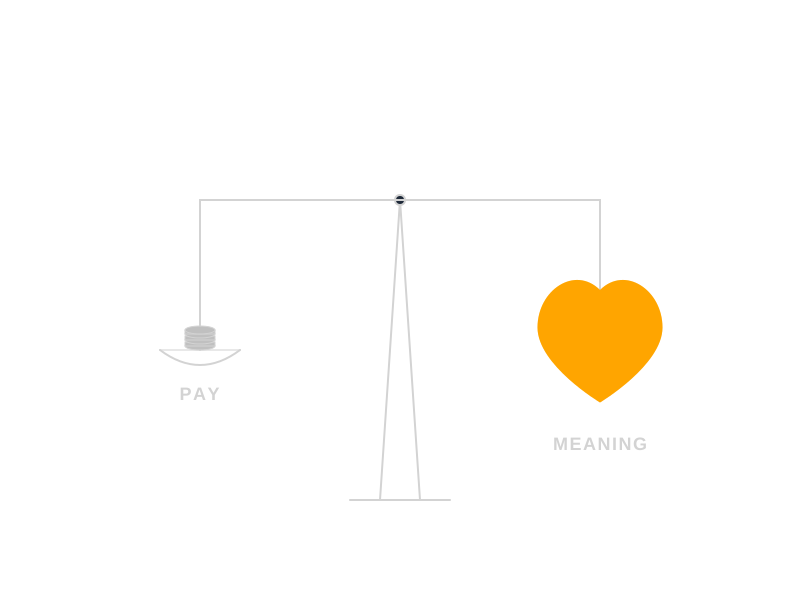
This willingness to swap financial security for existential fulfillment creates the ideal exploitable employee. Jennifer Tosti-Kharas cautions that organizations actively seek out and covet these workers because they know the passionate employee won’t fiercely demand pay increases; the “meaning” is the currency.
I’ve watched this phenomenon unfold time and again: the organization knows they can always count on you to go “above and beyond” when the mission is at stake, making the passionate individual the unwitting target for constant overwork and under-compensation. A deep calling renders the worker compliant by design, believing that sacrifice is inherent to the mission.
Calling’s High Cost: Burnout and Unrealistic Expectations
When an organization recognizes that an employee is driven by passion rather than a simple paycheck, the boundaries dissolve completely. It becomes normalized to expect you to come in “off hours, all times of day or night, always go above and beyond,” simply because, well, it’s your calling. At what point does this relentless push into personal space become unfair, depleting, and genuinely exploitative? It’s a subtle violence disguised as motivational culture.
Research confirms that this sustained violation of boundaries inevitably results in higher rates of burnout. You are, in effect, consuming your own internal emotional resources at an unsustainable rate to fuel the organizational mission.
Furthermore, Tosti-Kharas draws a poignant parallel to the work of Eli Finkel on modern romantic ideals: holding such a lofty ideal of what the perfect job should feel like—a job that must deliver transcendent meaning every day—is just as unrealistic as assuming your perfect life partner will ensure that every day is “roses and sunshine” 1. These romanticized expectations are mythological, and when they inevitably crash, they take our health and sanity with them.
The Tragic Cost: Pianist Colin Huggins’ Sacrifice
If you want to see the ultimate, heartbreaking cost of prioritizing a calling over cold economic reality, look no further than the story of Colin Huggins. Huggins, an immensely talented classical pianist, gave up a stable job as an accompanist for the Joffrey Ballet after getting “hooked” on public performance. His passion compelled him to lug a massive piano from his East Village apartment to Washington Square Park, inviting listeners to lie beneath it to truly feel the sound.
This was a deeply meaningful choice, representing pure vocational commitment—but it was, by all accounts, not a lucrative one, even pre-pandemic. The tragic irony is that his unwavering commitment to his art, his calling, led him to profound personal sacrifice, culminating in periods of homelessness.
Huggins’ tale is not an inspiring anecdote of artistic grit; it is a brutal indictment of a culture that champions reckless self-sacrifice in the name of passion, failing to acknowledge that sometimes, the calling is a demanding master that requires more than you can afford to give. It reminds us that devotion, uncoupled from practical self-preservation, is indistinguishable from self-destruction.
The ‘Soulmate Job’: Unpacking the Pressure of Modern Work
Calling vs. Soulmate: Overloading Life’s Expectations
This modern career mandate—the insistence that your work must be your calling—is a symptom of a much larger, insidious trend in our cultural life: the expectation that a single entity must provide absolute, transcendent fulfillment. I am convinced that the quest for the “soulmate job” is merely the professional mirror of the modern quest for the “soulmate partner,” a concept eloquently detailed by Eli Finkel. Finkel argues that our romantic expectations have skyrocketed over the last two centuries; marriage is no longer a prosaic institution for raising children, but a demanding quest for a soul-completing partner. When Steve Jobs urged graduates to find work they love, he made this parallel literal, stating that finding a vocation was “no less important than finding a soulmate” and that you’ll know when you find it.
He cemented the myth that the job, like the lover, should just “get better and better as the years roll on.” Jennifer Tosti-Kharas concurs that the psychological processes are frighteningly similar. Just as people in love can be blind to reason, people driven by a calling ignore realistic advice (as we’ve already seen). The bar set by this “soulmate” standard—whether for a job or a partner—is impossibly high.
It demands that your career not only pay the bills but also provide identity, meaning, passion, community, and moral purpose. This creates an unsustainable “all-in sense of performing the work” that inevitably leads to other dimensions of life—friendship, family, hobbies—suffering.
The Myth Gap: Why High Ideals Guarantee Disappointment
Here is the central paradox: for the few who successfully meet these maximalist expectations—who actually dedicate the exhaustive time and effort required to cultivate a truly great relationship or an exceptionally meaningful career—the payoff is tremendous. They may, as Eli Finkel suggests, be happier than almost anyone in human history. But for the vast majority of us who live in the messy, compromising middle, this high standard is a recipe for deep disappointment.

Tosti-Kharas notes that if everyone aspires to this very, very high standard, “lots of us are going to be disappointed”. The cultural expectation itself creates a massive psychological burden, ensuring that countless people feel like they are perpetually falling short. We look around at the mundane reality of our own work—the necessary bureaucracy, the irritating colleagues, the routine tasks—and feel the acute, painful gap between the myth and the mortgage payment.
When Callings Fail: The Psychological Cost of Regret
If pursuing a calling is emotionally high-stakes, failing at it is devastating. When your job is merely transactional, losing it means losing income. But when your job is your calling, losing it—or failing to find it in the first place—feels like losing a part of yourself. It is a profound, existential heartbreak.
This psychological aversive state is the subject of research by Justin Berg and others, who found that the inability to pursue one’s perceived calling is “deeply psychologically-aversive”. It’s not simply frustration; it is an emotional cauldron “filled with frustration, regret, and depression.” This happens because the individual has internalized the belief that work must live up to an impossibly high standard of meaning.
If that calling doesn’t materialize, or if circumstances force you out of it, the resulting grief is akin to a bereavement. You haven’t just lost a job; you’ve failed at destiny, leaving you not just unemployed, but broken-hearted.
Conclusion
The modern obsession with finding a “calling” has transformed our careers from a means of sustenance into a quest for existential validation. We’ve been conditioned to believe that our work must be our passion, our purpose, and even our soulmate, mirroring the unrealistic expectations we place on romantic partnerships. This cultural narrative, amplified by figures like Steve Jobs, sets an impossibly high bar that breeds overconfidence, renders us vulnerable to exploitation, and often leads to profound disappointment when reality inevitably falls short.
While the desire for meaningful work is entirely human, the pressure to find it within our jobs creates a dangerous blind spot. It can lead us to:
- overlook our own limitations,
- dismiss crucial advice from those who care, and
- accept untenable sacrifices in the name of passion.
The romanticized ideal of a “soulmate job”, much like the pursuit of a perfect romantic partner, sets us up for a fall, leaving many feeling like failures when life’s complexities inevitably intrude.
Ultimately, the pursuit of a calling isn’t inherently flawed, but the cultural imperative to find it in our careers is a modern invention with significant downsides. A fulfilling life can, and often should, be built from a rich tapestry of experiences, both inside and outside the workplace. The real calling might be to find balance and recognize that our jobs are but one thread in the grand design of a meaningful existence.
As we navigate our professional lives, perhaps it’s time to question the dogma that demands our work be our everything. After all, true fulfillment is rarely found in a singular pursuit, but in the diverse and often unexpected places where we find connection, purpose, and peace.


