


I think we’ve all felt that quiet, sinking realization when an hour vanishes into an Instagram spiral, leaving behind only a faint, chemical residue instead of actual memory. We tell ourselves it’s a lack of willpower, a personal failing we can fix with discipline.
But that’s a lie we tell ourselves to feel better. The truth is, you are not battling a mild habit; you are wrestling with the combined intellectual might of the world’s sharpest engineers, all laser-focused on one goal: keeping your attention monetized.
This whole ecosystem runs on engineered addiction, turning our natural reward systems against us until the dopamine starts running us, rather than the other way around. If we truly want to live a life rooted in what matters—what I’m calling ‘The Essential’—we have to stop trying to white-knuckle our way through a rigged game. We need a different kind of map entirely.
Know the Game: Why Your Willpower Isn’t Enough
Why Willpower Fails Against the Attention Economy
Let’s dispense with the myth of willpower being the ultimate shield against modern distraction. It’s a comforting idea—that we simply need to try harder—but it fundamentally misunderstands the highly professionalized, intensely capitalized game being played against us. The arena is rigged. We are not just battling simple temptation; we are pitted against the collective genius of the planet’s best social psychologists, marketers, and engineers, whose singular mission is to keep your eyes glued to the screen, clicking and scrolling 1.
Your attention isn’t just valued; it is the essential fuel required to run the ad-based machine. If you doubt the calculated, predatory nature of this system, simply observe how the algorithms treat dissent. If you dare to disconnect, if you stop posting for a week or two, the platform actively throttles your content uplift—they punish you.
Conversely, they dispense positive algorithmic support when you continue to feed the beast, confirming that the system is engineered specifically to demand continuous consumption and creation. You aren’t just a user; you are the product, and your compliance is mandatory for their exponential growth.
Dopamine Traps: How Tech Engineers Addiction
Knowing the rules of this unequal game, however, is rarely sufficient to win the psychological war. This is where the sheer force of engineered engagement comes into play, utilizing the basic wiring of our brain’s reward centers. Even Soren Gordhamer, a veteran of mindfulness, admits getting sucked into the occasional social media spiral, underscoring that we are doing battle with the smartest supercomputers known to man, armed with vast, sophisticated models of our most profound weaknesses. The chemical reality is stark: prolonged exposure quickly moves beyond genuine curiosity and interest.
After two or three hours of consumption, the dopamine starts to run us—we are no longer driving the activity; the craving is in charge. Crucially, this dynamic is escalating. We are transitioning from companies that needed proportional human growth (hiring more employees as profits rose, like the older Salesforce model) to AI-first competitors.
These new entities can scale from $1 billion to $10 billion in profit without needing to hire additional humans. What they hire instead are more Nvidia chips.
This profound shift in economic structure means the engineers of addiction are becoming infinitely more efficient at creating frictionless, infinitely engaging systems, removing the human element that previously slowed growth. Therefore, the battle for digital sanity isn’t just about managing notifications; it is about resisting a highly sophisticated mechanism designed to maximize your time-on-screen, redefining the terrain of our inner lives entirely.
The Hidden Costs of Constant Connection
Tech’s Toll: Social Media and Mental Health Decline
If history is any guide, every major technological leap—from the initial burst of the internet to the launch of the iPhone—has done an “incredible job” advancing economic models and connectivity, yet it has profoundly hurt our mental health and well-being 1. We need to face this uncomfortable truth: our collective satisfaction, connection levels, and statistics regarding loneliness have not improved with ubiquitous access. In fact, if the data tells us anything, they’ve generally trended in the wrong direction. The core question is whether the deeper integration of technology, particularly AI, will simply accelerate this decline.
The always-on lifestyle fuels mental distress by providing an endless feedback loop for our deepest, most intrusive thoughts. When you have nagging anxieties—the fear you said something offensive, the physical dread of a mild ache—the impulse is to desperately search for answers or distraction.
This mechanism is so potent that it can mimic patterns of intense psychological conditions, providing the perfect environment for persistent loops of worry. The algorithms don’t care about soothing your soul; they just need you clicking and consuming to alleviate the tension they helped create.
From Tech Neck to Digital Withdrawal
The physical costs of constant connection run much deeper than the aesthetic annoyance of “tech neck.” We are observing a genuine shift in our neurological dependence, leading to behaviors that strongly resemble addiction and withdrawal. Consider the sheer panic experienced by Eric Antinel, a former Meta employee, when he realized his phone was not on his body; he felt such intense nervousness that he realized he was an addict, leading him to create a physical proxy, the Methophone.
This is not a joke about liking your device; it is a physical manifestation of reliance on an external digital regulator. I recommend you conduct the experiment Soren Gordhamer suggests: spend one day completely on your phone and the next completely without it.
Which day offers a better quality of life? The constant availability of the digital world drives loneliness and depression higher because it replaces the profound, messy engagement of human experience with a highly efficient, yet ultimately hollow, hit of dopamine.
Eroding Focus: How Phones Pave Over Inner Space
Perhaps the most insidious cost is the erosion of our baseline cognitive capacity. Walk into any subway car or wait in any line, and the moment of boredom—that crucial empty space where creativity and self-reflection might germinate—is instantly negated by the “zombie arm” reflexively reaching for the phone. We must learn to pause in that micro-second before we tap the screen and ask: “What do I want right now?

What do I need right now?” Because the systems seeking our attention are only getting smarter. Thanks to the interconnectedness of modern AI, when one part of the super-system learns a vulnerability or improves its engagement tactic, the entire system learns it simultaneously.
This constantly iterating, self-improving intelligence is relentless. It requires an intentional, “Heartful resistance” to protect the fragile, essential space required for sustained thought and genuine presence.
The Antidote: Prioritizing the Vibrancy of the Analog World
Analog Life: Where True Vibrancy and Nurturing Occur
The fundamental design of the Algorithmic Dopamine Hit World keeps us focused relentlessly outward—chasing external validation, consuming endless streams of super content, and reacting to manufactured urgency. But the real life message, the essential spiritual work, is learning how to connect inward. I’ve personally asked people who spend four or more hours daily on social platforms to name their single greatest experience there, and the resulting awkward silence is profoundly illuminating. They usually mumble something about a viral cat video; they cannot name a moment that truly nourished their soul.
We are so often “in a zone,” scrolling compulsively, that we are simply not present. This is the digital world’s great trick: it offers constant stimulation without any genuine substance. Contrast this with the analog world.
If I ask you to recall the most amazing analog experience you’ve had recently—a moment watching your child smile, a heartfelt conversation with a friend, a restorative walk outside—you likely have half a dozen memories immediately ready. The “juice,” the vibrancy of life that nurtures our system, is almost exclusively derived from this messy, beautiful, real-time engagement.
Dopamine Hits Versus Essential Fulfillment

The key to regaining control lies in learning to differentiate between a fleeting, chemically-induced hit and lasting fulfillment. We must cultivate the internal awareness—the Heartfulness—to recognize when the initial curiosity has dissolved and we are simply being run by compulsion. For many, that mindful kick-in arrives after 15 or 20 minutes on highly addictive platforms like TikTok. A small, sane voice whispers: *This doesn’t feel great.
I would genuinely rather meditate, go outside, or talk to my partner* . This clarity—the realization that we are choosing a hollow experience over a nourishing one—is the spiritual compass we need. That compass points us toward what Soren Gordhamer calls ‘The Essential,’ a title he found almost accidentally but which perfectly encapsulates the core priority: that which truly matters in the brief span of our life.
While we can use superficial hacks, like training the TikTok algorithm to feed us only animal videos or emotionally meaningful reunions, the deeper defense is establishing an internal baseline that fundamentally rejects the cheap imitation. We must prioritize living in this moment, right here, right now, rather than perpetually projecting ourselves into the future or endlessly recalling the past.
Building Your Defenses: A Practical Toolkit for Digital Sanity
First and Last Hour: Bookending Your Day Digitally
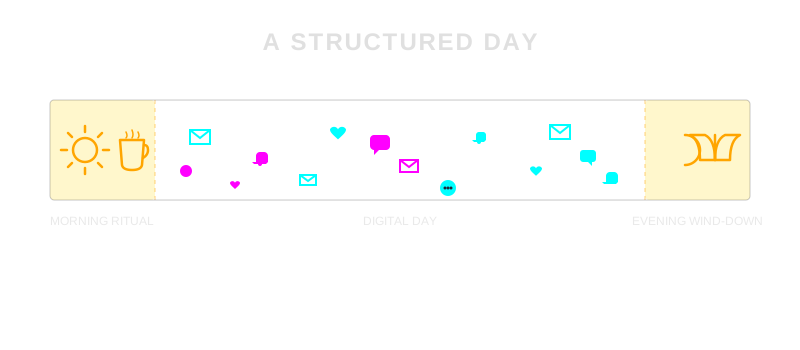
The modern world bombards us with “freaking amazing content” that keeps our nervous systems perpetually aroused, never allowing us to truly relax or regenerate . My essential first strategy is creating firm “bookends” for your day. This means dedicating the first hour and the last hour not to technology, but to connecting rather than consuming. I am not telling you to become a perfect meditator, but you must establish an intentional morning ritual—for me, it’s 30 minutes of sitting practice followed by getting my “ass outside” as quickly as possible, regardless of the weather.
This practice injects natural light, fresh air, and life force before the digital noise can infect your headspace. We consume, consume, consume, and never allow our attention to turn inward.
The same deliberate deceleration should happen in the evening: lower the lights, prepare for sleep, and provide a space for true regeneration, making sure the last memory of the day is not a dopamine hit. This simple discipline creates structural integrity against the 24/7 onslaught of content that thrives on perpetual availability.
Mastering ‘The Pause’ to Defeat the Zombie Arm
We must wage war on the “zombie arm”—that unconscious reflex that grabs the phone the second we experience a moment of uncomfortable stillness. The tragedy is that 99.9% of people struggle to simply be bored. Boredom feels like a “hollowness inside,” and we desperately reach for consumption to fill it. We must master “the pause.”
When waiting in line or standing idle, pause, look the cashier in the eye, and truly see the analog world around you. Better yet, borrow the wisdom of the Methophone—that translucent plastic device designed by an ex-Meta employee. You keep the Methophone in your pocket while leaving your real device at home.
When the inevitable anxiety hits—the “oh sh*t, my phone isn’t on me” moment—you can feel the plastic proxy, satisfying the anxious physical impulse without activating the digital trap. This practice of intentionality transforms mindless reaction into mindful inquiry: Am I being intentional?
Ask What Matters: Experiment with Impermanence
The true ultimate strategy is continuous self-inquiry, fueled by Heartfulness. This is about running the deepest experiment: asking yourself, fundamentally, “What matters to you?” How do you want to be spending the limited time we have here?
If your honest answer aligns with five hours a day on Instagram, then by all means, scroll on—but the profound reality of impermanence suggests it probably won’t. This question is the spiritual compass we need, motivating us to align our actions with our values. By maintaining a background of basic mindfulness, even if imperfect, we gain the internal clarity to pull back from the abyss.
This allows us to realize, perhaps after 15 minutes of scrolling, that we would genuinely rather be present. The goal is not perfect digital abstinence, but intentional engagement: using technology as a tool, not allowing it to become the tyrannical director of our brief, vital existence.
The Deep Game: Finding Your Ultimate Motivation
Heartfulness: Moving Beyond Narrow Mindfulness
The deepest layer of digital defense requires more than mere mindfulness, which can sometimes be reduced to a narrow focus on a particular sensation, like the pressure of a foot on the ground. We need to evolve this into Heartfulness—a concept that, while it may provoke a “gag reflex” for some, represents a necessary expansion of presence. As Jon Kabat-Zinn famously suggested, if you hear the word mindfulness but don’t also hear heartfulness, you’re missing the point.
Heartfulness is an openness and awareness—a general bodhicitta—that embraces life broadly rather than segmenting it into manageable, scientific pieces. When we lack this sense of fundamental love and caring presence in our lives, everything feels imbalanced.
This internal deficit creates a vacuum, prompting us to constantly search for something external—a new notification, a viral video, a distraction—to feed us, satiate us, or complete us. The digital noise is a symptom; the lack of Heartfulness is the root cause. The lack of Heartfulness.
Use Impermanence to Clarify What Truly Matters
If we want to build a truly robust motivation to resist the Algorithmic Dopamine Hit World, we must reflect on the ultimate boundary: impermanence. We have a limited number of heartbeats left—perhaps thirty or forty years—and the end of the journey is certain. Asking ourselves what we want to spend those heartbeats doing is, quite simply, the best possible motivation for intentional living. This reflection is infinitely more powerful than trying to clutter our lives with too many external “shoulds” or rigid rules.
When we understand our limited time, the triviality of the digital chase becomes painfully clear. We will inevitably lose the moment, lose our focus, and get sucked back in 10,000 million times. That’s okay. That’s okay.
The practice is not about achieving perfection, but Am I here now? Am I with this moment right now? The practice is not about achieving perfection.
Success Is Inner Peace, Not External Metrics
If you can connect to that deep, essential truth—the knowledge of self, unburdened by external validation—you are already living in a place of success. If we don’t know that truth, no amount of external achievement truly matters. I’ve met people with net worths exceeding a hundred billion dollars who were brilliant but entirely lacking in ease or peace.
Nothing in the external world—no applause, no bestseller, no viral fame—can satiate the inner lack created by disconnect 1. The true aim of digital sanity, therefore, is not better time management, but becoming comfortable with the “hollowness”—the empty space—that the algorithms constantly try to fill. It is in that quiet, unconsumed space that we discover what is actually true and real.
Conclusion
We’ve explored the intricate dance between our inner lives and the ever-present digital world, recognizing that willpower alone is a fragile shield against the sophisticated architecture of the Algorithmic Dopamine Hit World. The constant barrage of engineered engagement erodes our mental, physical, and cognitive well-being, leaving us feeling drained and disconnected.
However, this isn’t a story of inevitable defeat. The antidote lies in cultivating a “Spiritual Compass,” guiding us toward the vibrancy of the analog world and the depth of genuine connection. It’s about distinguishing between fleeting digital hits and the lasting fulfillment found in real-world experiences, moving beyond simple mindfulness to embrace “Heartfulness”—an open, caring presence.
Ultimately, the most potent motivator is the profound understanding of impermanence. Knowing our time is finite encourages us to invest our precious heartbeats in what truly matters, aligning our actions with our deepest values. As we navigate this new landscape, let us remember that the goal isn’t to simply manage our time, but to reclaim our attention, nurture our inner lives, and live with a quiet, profound sense of purpose. For in the end, all the external noise fades, and what remains is the steady beat of our own heart, present in the moment.


