


In 1998, magician David Blaine stunned the world by standing motionless for 63 hours, encased in a block of ice. Crowds gathered, cameras rolled, and millions watched as he endured freezing temperatures, dehydration, and hallucinations—all for an illusion.
But here’s the twist: the real magic wasn’t his endurance. It was the audience’s perception. To them, Blaine was a man defying nature.
To him, it was just another trick—one where the brain’s survival instincts overrode the body’s screams. The crowd saw a miracle; Blaine saw a hack.
Evolution is the ultimate magician. It doesn’t care if you see the truth—only that you survive long enough to pass on your genes. Your brain, like Blaine’s audience, is wired to believe the illusion because the cost of doubting it could be death.
But what if the greatest trick ever played wasn’t on the stage? What if it’s the world itself?
The interface you call reality is a survival tool, not a window into truth. And the moment you see the sleight of hand, everything changes.
The Evolutionary Deception: Why Truth Would Have Made Us Extinct
Evolution Favors Fitness Over Truth Perception
Donald Hoffman’s groundbreaking simulations reveal a startling truth: evolution doesn’t favor organisms that perceive reality accurately. In controlled digital environments, organisms programmed to see the “true state” of their world consistently lost out to those using simplified perceptual shortcuts. The reason? Truth is expensive—it demands more cognitive resources, time, and energy than evolution is willing to invest.
These simulations, run hundreds of thousands of times, show that organisms tuned only to fitness (survival and reproduction) outcompete truth-seekers in nearly every scenario. The implications are profound: our perceptions aren’t windows into reality but survival tools honed by evolutionary pressure. Hoffman’s work challenges the assumption that accurate perception equals evolutionary advantage. Instead, his models demonstrate that organisms thrive when their perceptions align with fitness goals, not objective truth.
This aligns with real-world examples, like the jewel beetle, where simple perceptual hacks prove more efficient than comprehensive reality-mapping. The simulations suggest that truth-perception is a luxury evolution can’t afford—it’s a metabolic drain that offers no survival benefit. As Hoffman notes, “Seeing the truth takes too much time and energy.
It’s complicated.” Evolution, it seems, prefers the path of least resistance. 1 2
How Evolutionary Perceptual Shortcuts Can Backfire
The Australian jewel beetle offers a humorous yet sobering example of evolution’s perceptual shortcuts. Males, programmed to recognize females by three traits—dimpled, glossy, and brown—found themselves hopelessly attracted to discarded beer bottles that matched this description. This simple hack, effective for millions of years, suddenly became a liability when human behavior introduced an evolutionary curveball. The beetles’ inability to distinguish between bottles and mates nearly drove the species to extinction, forcing Australia to redesign its bottles to save the insects.
This case study underscores a critical point: evolution optimizes for survival, not accuracy. The beetle’s perceptual system wasn’t designed to comprehend reality but to trigger reproductive behavior efficiently. When confronted with an unprecedented stimulus (the beer bottle), the system failed spectacularly.
Hoffman’s simulations echo this reality—organisms don’t need to understand their environment; they only need to respond adaptively. The beetle’s plight serves as a metaphor for human perception: we, too, may be operating on evolutionary shortcuts that leave us vulnerable to misinterpretations in a rapidly changing world.
Why Perception Evolved to Be Good Enough, Not Perfect
Perception is metabolically costly. The human brain, consuming about 20% of the body’s energy, prioritizes efficiency over accuracy. Evolutionary simulations show that organisms using perceptual shortcuts conserve precious resources while achieving the same survival outcomes as truth-seekers. Consider how we assess potential mates: we don’t analyze DNA but rely on visible cues like symmetry and vitality.
These heuristics, while imperfect, provide sufficient information for reproductive success without the cognitive overhead of comprehensive analysis. The trade-offs become clearer when examining other species. Some insects detect water by sensing light polarization—a simple trick that avoids the complexity of processing full environmental data. Similarly, our visual system constructs reality in real-time using predictive models rather than passive recording.
As Hoffman explains, “Perception is expensive. It takes a lot of calories… You need to do shortcuts.” Evolution, in its relentless efficiency, has shaped our senses to be “good enough” rather than perfectly accurate.
The result? A species that thrives on approximations, vulnerable to illusions but supremely adapted to survival.
Your Brain as VR Headset: The Interface Theory of Reality
Reality Beyond Space-Time: Physics at the Quantum Limit
At scales so minuscule they defy imagination—10^-33 centimeters and 10^-43 seconds—our understanding of reality unravels. Here, space-time isn’t just distorted; it ceases to exist mathematically. This isn’t speculative philosophy—it’s the conclusion of our best physics. Einstein’s relativity and quantum theory, when pushed to their limits, reveal that space-time can’t be fundamental.
It’s a projection, a user interface that breaks down when zoomed in too far. The implications are staggering: what we perceive as the fabric of reality is more like a pixelated screen that dissolves upon close inspection. This breakdown suggests that space-time is a derived phenomenon, not the bedrock of existence. If we could peer beyond this interface, we might access realities unbound by space-time’s constraints—imagine technologies that enable instantaneous travel or communication, not by breaking physics, but by operating outside its familiar rules.
Hoffman’s work hints at this possibility, proposing that conscious agents exist beyond space-time, with our perceived reality being a tiny projection of their dynamics. The consequences? A future where we might “edit the code” of our experienced reality, unlocking abilities we’ve dismissed as impossible. 3
The Desktop Metaphor: Reality as an Interface
Think of your brain as a desktop interface. That blue rectangular icon for your TED Talk draft? It’s not the file itself—just a useful symbol hiding complex data. Similarly, the 3D world you perceive is a constructed interface, not the underlying reality.
When you see a glowing blue bar on a screen, your brain manufactures motion and edges from static dots. The cube that “pops out” of a 2D image? Pure construction. These aren’t glitches—they’re proof that perception is active creation, not passive reception.
This metaphor extends to physical objects. That train barreling toward you at 200 mph? It’s an icon in your perceptual desktop—one you’d be foolish to ignore, just as you wouldn’t drag a file icon to the trash carelessly. Evolution shaped these symbols to guide adaptive behavior, not to reveal truth.
The snake’s venom isn’t “really” there in the way you perceive it, but the icon’s warning is deadly serious. The error lies in taking the interface literally, confusing the map for the territory.
How Your Brain Constructs 3D Illusions from Flat Screens
Your brain is a master fabricator. Show someone red discs with gaps, rotate them slightly, and suddenly—a 3D cube materializes from a flat screen. The cube isn’t “out there”; it’s a neural construction. Similarly, those glowing blue bars?
They’re illusions crafted from color-changing dots. These aren’t parlor tricks—they’re windows into how perception works. Your brain doesn’t passively record reality; it actively builds your experience in real-time, constructing only what’s needed for survival.
This construction isn’t random. It’s guided by evolutionary priorities.
The cube and bars demonstrate how your visual system fills gaps, creates depth, and manufactures motion—all to help you navigate a world where survival depends on quick, adaptive responses. The brain’s constructions are so seamless that we mistake them for objective reality.
But as Hoffman notes, “We don’t reconstruct reality; we construct it.” The difference is profound: one implies a pre-existing world to copy, while the other suggests our perceptions are original creations shaped by fitness, not truth.
Consciousness First: Why Your Brain Doesn’t Create Your Mind
Consciousness as Cosmic Connection: Michael Levin’s Thin Client Theory
Michael Levin’s “thin client” theory flips our understanding of consciousness on its head. Imagine your brain isn’t the source of your mind but rather a biological interface—a “thin client”—accessing consciousness from a deeper, abstract realm. This isn’t just metaphorical; Levin argues that biological systems, from single cells to complex organisms, act as pointers to patterns existing in what he calls “Platonic space.” This space isn’t physical but mathematical, a domain of pure information where abstract forms like prime numbers or fractal geometries reside.3
Your brain doesn’t generate consciousness; it tunes into it, much like a radio receiver picks up signals rather than creating them. This idea isn’t entirely new—Pythagoras and Plato hinted at such realms—but Levin’s work brings it into the lab.
He’s identifying measurable ways biological systems “ingress” these patterns, pulling abstract truths into physical reality. For example, cicadas’ 13- and 17-year life cycles reflect prime numbers, a mathematical truth manifesting in biology. Similarly, fractal patterns in coastlines or Romanesco broccoli reveal how abstract geometries shape physical forms.
These aren’t random emergences; they’re evidence of a deeper connection between consciousness and the material world. Levin’s theory suggests that evolution isn’t just about survival—it’s about refining the brain’s ability to access and interact with these abstract patterns. The more complex the organism, the more sophisticated its “interface” becomes, allowing it to pull down richer patterns from Platonic space.
This reframes consciousness as fundamental, not emergent. Your brain isn’t the origin of your mind; it’s the hardware that lets you experience a sliver of a far grander reality.
How Nature Harnesses Mathematical Patterns for Evolution
The natural world is littered with examples of abstract patterns manifesting physically. Take cicadas: their 13- and 17-year cycles aren’t arbitrary. These prime numbers minimize overlap with predator cycles, a mathematical strategy hardwired into their biology. Or consider fractals—self-similar patterns repeating at different scales—found in everything from fern leaves to river deltas.
These aren’t just pretty shapes; they’re evidence of abstract mathematical truths “ingressing” into physical reality. Levin’s work suggests these patterns aren’t emergent properties of complex systems but fundamental structures that biological systems tap into.
This ingress isn’t passive. Biological systems actively pull these patterns into existence through a feedback loop. A simple molecular network might start with basic patterns like Pavlovian conditioning.
As it evolves into a cell, then a multicellular organism, it gains the capacity to host more complex patterns—like navigation or memory. Each new pattern enhances the organism’s ability to interact with its environment, creating a virtuous cycle. The more patterns a system can access, the more it can evolve to access even richer ones.
This isn’t just evolution optimizing for survival; it’s a system becoming increasingly adept at interfacing with a hidden layer of reality. 3 Levin’s research shows this isn’t speculative. By studying how networks of cells learn and adapt, he’s found that learning itself increases an organism’s “causal emergence”—its ability to act as an integrated agent.
This isn’t just about neurons firing; it’s about the system becoming more than the sum of its parts, better equipped to pull down and utilize abstract patterns. The implications are staggering: consciousness isn’t a byproduct of complexity but a fundamental force that shapes reality from the top down. 1
Consciousness Creates Spacetime: Hoffman’s Mathematical Proof
Donald Hoffman takes this a step further with his Conscious Agent Network Theory. He’s not just suggesting consciousness is fundamental—he’s mathematically proving it. Using Markov chains (probability models), Hoffman derives core aspects of spacetime, including Einstein’s light speed invariance, from the dynamics of conscious agents.
This isn’t philosophy; it’s a rigorous framework showing how consciousness could be the bedrock of reality, with spacetime emerging as a constructed interface. Hoffman’s theory turns physics on its head.
Instead of starting with space and time to explain consciousness, he starts with consciousness to explain space and time. His models show how the probabilities of conscious experiences—like seeing red, then green, then blue—can generate the structure of spacetime itself. This suggests that what we perceive as physical laws might actually be constraints on how conscious agents interact.
The speed of light isn’t a fundamental limit of the universe; it’s a rule governing how these agents communicate. The implications are mind-bending.
If consciousness is primary, then the “hard problem” of explaining subjective experience evaporates. We don’t need to figure out how matter creates mind because mind is the foundation.
Hoffman’s work suggests that the entire physical universe—from photons to galaxies—could be patterns of conscious agent activity. This isn’t just a new theory of consciousness; it’s a new theory of everything, one where reality is built from the inside out.
The Species-Specific Reality Problem
How Animals Perceive Reality Differently Than Humans
Imagine a world where you navigate not by sight but by sound. Bats live in this reality, constructing a sonic map of their surroundings through echolocation. They emit high-frequency sound waves and interpret the echoes to “see” in total darkness. This isn’t just a different way of perceiving the same world—it’s an entirely different reality interface.
Similarly, dogs experience a world rich with smells, detecting up to 300 million receptors compared to our mere 5 million. Their reality is a tapestry of scents, each telling a story we can barely comprehend. Birds, on the other hand, see the polarization of light, a dimension of reality invisible to us.
These examples highlight a crucial point: each species inhabits a unique reality interface, shaped by evolutionary pressures to fit their specific needs. This diversity of perception underscores the idea that reality is not a fixed, objective entity but a constructed experience.
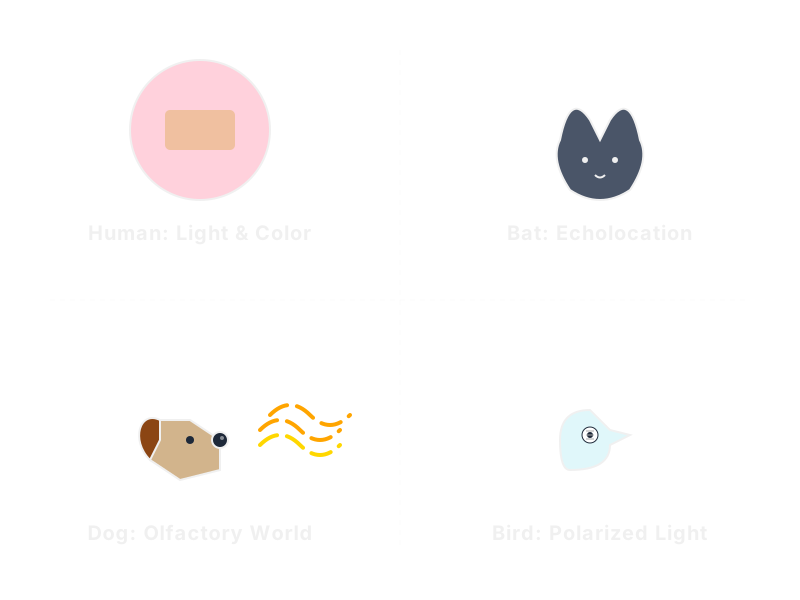
Our human reality is just one of many possible interfaces. The bat’s sonic map, the dog’s olfactory world, and the bird’s polarized vision are all valid representations of reality, each tailored to the survival needs of the species.
This concept challenges the notion that our perception is the ultimate truth. Instead, it suggests that our reality is a simplified, species-specific model designed to guide adaptive behavior.
How Consciousness Constructs Reality: Lessons from a Schizophrenic DoorDash Driver
Consider the case of a schizophrenic DoorDash driver who experiences a reality vastly different from ours. This individual might see and interact with entities and scenarios that don’t exist in our consensus reality. While this might seem like a malfunction, it actually highlights the brain’s incredible ability to construct compelling alternative realities.
This isn’t just a pathological condition; it’s a demonstration of the brain’s inherent capacity to create vivid, immersive experiences. Our nightly dreams offer a more common example of this phenomenon.
In dreams, we construct entire worlds, complete with sensory details and emotional depth. These experiences feel real while we’re in them, demonstrating that our brains are capable of creating rich, alternative realities.
The schizophrenic DoorDash driver’s experience is not fundamentally different from dreaming; it’s just that their waking reality is influenced by these constructions. This case underscores the idea that our perception of reality is not a passive recording but an active construction, shaped by our consciousness.
Perceptual Errors: Lessons from a Flat Earth
History is littered with examples of humanity’s perceptual errors. Once, we believed the Earth was flat because it looked that way. Later, we thought the Earth was the unmoving center of the universe because our senses told us so. These misinterpretations highlight a consistent pattern: our perceptions are not always accurate representations of reality.
Instead, they are simplified models designed to guide adaptive behavior. The theory of evolution suggests that our current understanding of reality—spacetime and physical objects—might be another such misinterpretation. Just as we had to let go of the flat Earth and geocentrism, we might need to let go of our current perceptions. The jewel beetle’s inability to distinguish between a beer bottle and a mate is a humorous yet sobering reminder of our own perceptual limitations.
We, too, might be operating on evolutionary shortcuts that leave us vulnerable to misinterpretations in a rapidly changing world. The advantage we have over the jewel beetle is our science and technology. By peering through the lens of a telescope, we discovered that the Earth is not the center of the universe.
By peering through the lens of the theory of evolution, we might discover that spacetime and objects are not the ultimate nature of reality. This journey of discovery is not just about correcting our perceptions but about understanding the deeper, hidden reality that underlies our constructed experiences.
The Technology of Consciousness: Beyond Space-Time
Consciousness: The Key to Transcending Space-Time
Imagine being able to travel to the Andromeda galaxy, 2.4 million light-years away, in an instant. With our current understanding of physics, this seems impossible. But what if we could bypass space-time altogether? Donald Hoffman’s theory of consciousness suggests that space-time is not fundamental but rather a projection, a “headset” that we can learn to manipulate.
If we can understand the code outside of space-time, we might be able to change our position in the universe as easily as a programmer changes a value in a video game. Hoffman’s work hints at a future where we can “edit the code” of our experienced reality, unlocking abilities we’ve dismissed as impossible. This isn’t just speculative philosophy—it’s a rigorous framework showing how consciousness could be the bedrock of reality, with space-time emerging as a constructed interface.
The implications are mind-bending: if consciousness is primary, then the “hard problem” of explaining subjective experience evaporates. We don’t need to figure out how matter creates mind because mind is the foundation.
Hoffman’s work suggests that the entire physical universe—from photons to galaxies—could be patterns of conscious agent activity. This isn’t just a new theory of consciousness; it’s a new theory of everything, one where reality is built from the inside out.
How to Hack Reality: Beyond Space-Time Limits
Think of reality as a video game, like Grand Theft Auto. In the game, a car has to drive through the roads to get from point A to point B. But if you look at the code, you can change the value of a register and instantly move the car from A to B. Similarly, if space-time is just a headset, we don’t have to travel through it to reach distant galaxies.
We can learn the code outside of space-time and change our position instantly. This analogy highlights the potential of understanding consciousness as fundamental. If we can manipulate the code of reality, we can achieve feats that seem impossible within the constraints of space-time.
This isn’t just about travel; it’s about redefining what’s possible. Imagine technologies that enable instantaneous communication, not by breaking physics, but by operating outside its familiar rules. This is the future Hoffman is working towards—a future where we can edit the code of our experienced reality and unlock abilities we’ve dismissed as impossible.
How to Build Consciousness-Based AI That Minimizes Surprise
Hoffman’s theory of consciousness also has implications for artificial intelligence. By starting with consciousness as fundamental, we can build AI that minimizes surprise, much like human consciousness does. This approach, known as active inference, is being explored by researchers like Karl Friston. The idea is to create a model of the world where the AI can anticipate what’s going to happen and not be surprised.
Hoffman’s work suggests that this logic can be used to build space-time itself. By minimizing surprise, we can create AI that is not just intelligent but also conscious. This isn’t just about building better machines; it’s about understanding the nature of consciousness itself.
If we can create AI that is indistinguishable from human consciousness, we might be able to unlock new insights into the nature of reality and our place in it. This is the future we face—a future where consciousness is not just a product of the brain but a fundamental force that shapes reality from the top down. 2
The Science-Spirituality Paradigm Shift
Physicalist Science: The Pragmatic Choice
Physicalist science has long held the upper hand in our modern world, and for a very pragmatic reason: it delivers tangible, life-changing technologies. From the laptop you’re reading this on to the electricity powering your home, physicalist science has shaped our daily lives in ways that are undeniable and immediately useful. Spirituality, on the other hand, often struggles to produce comparable technological outputs. This disparity creates a pragmatic choice—why invest in a framework that doesn’t yield measurable, practical results?
Donald Hoffman highlights this dilemma, noting that while spiritual theories might sound appealing, they lack the technological prowess of physicalist science. The latter gives us tools, infrastructure, and innovations that improve our quality of life. Until spirituality can offer something equally concrete, it remains on the fringes of serious scientific discourse.
But what if this dynamic were to shift? What if a theory rooted in consciousness could produce technologies that physicalist science deems impossible? That’s the game-changer Hoffman is pursuing—a future where the “spiritual” framework isn’t just philosophically compelling but technologically superior.
Consciousness-Based Science: Unlocking Impossible Technologies
The tide may be turning. Hoffman’s work suggests that a consciousness-based approach could unlock technologies that defy the constraints of space-time. Imagine instantaneous travel, communication beyond physical limits, or even the ability to manipulate reality as we know it. These aren’t just sci-fi fantasies—they’re potential outcomes of understanding consciousness as the fundamental layer of reality.
If such technologies become possible, the pragmatic advantage shifts dramatically. Suddenly, the “spiritual” perspective isn’t just about intangible truths—it’s about harnessing the very fabric of existence in ways physicalist science can’t. This reversal would validate long-held spiritual intuitions that consciousness is primary. No longer would spirituality be dismissed as mere metaphysics; it would become the foundation of a new technological paradigm.
The implications are profound. As Hoffman puts it, “The game has changed.
Now the technological advantage goes to those who say that spacetime and physical stuff inside spacetime is not fundamental.” This isn’t just a theoretical shift—it’s a revolution in how we interact with reality itself. 2
How Suffering Fits Into Unified Consciousness Theory
One of the most challenging questions in consciousness studies is how individual suffering—like the horrors of the Holocaust—can coexist with the idea of a unified, ultimately benevolent consciousness. Hoffman’s theory offers a perspective that reconciles these apparent contradictions. From the vantage point of “the One,” individual pain may be a transient experience within a larger, incomprehensible whole. Just as a single cell in a body might experience stress or damage, the organism as a whole remains intact and functional.
This doesn’t diminish the reality of suffering, but it reframes it. The One consciousness might perceive pain as a necessary signal, a temporary state within an eternal, unbroken existence. Meditative traditions often hint at this—where individual suffering dissolves into a greater, transcendent awareness.
As Hoffman suggests, “All is well,” even in the face of unimaginable horror. The One doesn’t experience pain as we do; it’s a perspective that transcends individual trauma, seeing it as part of a vast, unfolding pattern. This isn’t about dismissing suffering but understanding it within a framework where ultimate wellbeing is never truly threatened.
Conclusion
Evolution’s greatest sleight of hand wasn’t hiding the truth—it was convincing us we’d already found it. From the jewel beetle’s tragic attraction to beer bottles to our own stubborn belief in a flat Earth, the pattern is clear: perception is a survival tool, not a window into reality.
Hoffman’s simulations and Levin’s thin client theory don’t just challenge this—they shatter it. Space-time isn’t the stage; it’s the curtain. Physical objects aren’t the actors; they’re the props.
And your brain? It’s the audience, gasping at the illusion while the real show plays beyond the veil.
But here’s the twist: recognizing the trick doesn’t make the magic disappear. It makes it useful. If reality is a constructed interface, then understanding its code—consciousness—lets us rewrite the rules. Imagine technologies that bypass space-time, AI that minimizes surprise by anticipating the unknowable, or even a future where suffering is reframed within a unified, eternal awareness.
This isn’t just philosophy; it’s the next frontier of science. The pragmatic edge once held by physicalism is slipping. Consciousness isn’t just catching up—it’s poised to leap ahead.
So where does this leave you? Standing at the edge of a paradigm shift, holding a new lens to peer through. The world you see isn’t wrong—it’s just incomplete.
And the more you explore, the more you’ll realize: the greatest mystery isn’t whether reality exists. It’s that what we’ve called reality is only the first act.


