


I’ve always been suspicious of people who say they’ve “always known” what they wanted to do with their lives. Not because I doubt their conviction, but because I doubt their memory. The human mind is a master of retrospective storytelling, stitching together a neat narrative from the messy, chaotic threads of experience. We look back and see a straight line from Point A to Point B, but the truth is far more tangled.
I should know. I’ve spent years crafting my own life story—a tale of purposeful decisions, hard-earned lessons, and steady progress. But lately, I’ve started to wonder: How much of that story is real, and how much is just my brain’s desperate attempt to make sense of the randomness?
The more I dig into the science of memory and decision-making, the more I realize that our life stories are less like documentaries and more like Hollywood biopics—dramatic, compelling, and only loosely based on actual events. We’re not the authors of our lives; we’re the screenwriters, frantically revising the script to make the protagonist (ourselves) look good.
But here’s the uncomfortable truth: The stories we tell ourselves about our past aren’t just incomplete. They’re often outright false. And the more we cling to them, the more they distort our present—and our future.
The Brain’s Press Secretary: Meet ‘The Interpreter’
How The Interpreter Module Shapes Our Behavior
The human brain is a master of specialization, with localized circuits handling specific tasks automatically. Michael Gazzaniga’s work with split-brain patients revealed a fascinating module in the left hemisphere—dubbed “The Interpreter”—that crafts narratives to explain our actions, even when it lacks the full picture. This module doesn’t just passively observe; it confabulates, stitching together plausible stories from whatever fragments it has access to. As Gazzaniga notes, “The interpreter is only as good as the information it gets.” When deprived of context, it fills in the gaps with whatever makes sense in the moment, often leading to bizarre or outright false explanations 1.
This mechanism isn’t just a quirk of split-brain patients—it’s a universal feature of human cognition. The Interpreter is our brain’s press secretary, spinning coherent narratives out of chaos. It’s why we’re so prone to the narrative fallacy, mistaking our post-hoc rationalizations for genuine insight.

The Interpreter doesn’t care about accuracy; it cares about coherence. And that’s a problem, because it means we’re often defending decisions we didn’t consciously make, using reasons we didn’t consciously choose. 2
Confabulation in Split-Brain Patients: The Shovel Experiment
In one of Gazzaniga’s most famous experiments, a split-brain patient was shown two images: a chicken claw to the right visual field (processed by the left hemisphere) and a snow scene to the left visual field (processed by the right hemisphere). When asked to point to a related object, the right hand (left hemisphere) pointed to a chicken, while the left hand (right hemisphere) pointed to a shovel. When asked why he chose the shovel, the left hemisphere—unaware of the snow scene—confabulated a story: “To clean out the chicken shed.” The Interpreter had no access to the real reason (the snow), so it invented one on the spot 1.
This isn’t just a party trick; it’s a window into how all of us operate. Our brains are constantly generating explanations for actions driven by unconscious processes.
The Interpreter doesn’t just describe reality—it creates it, stitching together a plausible tale from whatever scraps of information it has. And because we’re so invested in the illusion of coherence, we rarely question these narratives, even when they’re dead wrong. 3 4
We Are Not the Authors of Our Actions
The Interpreter’s confabulations reveal a uncomfortable truth: we’re not the authors of our lives; we’re the narrators. As Sam Harris puts it, “You don’t know what you’re going to think next.” Thoughts simply arise, and the Interpreter’s job is to make sense of them after the fact. This undermines the very notion of free will as we commonly understand it. If our actions are driven by unconscious processes and our explanations are just post-hoc rationalizations, then the “self” we identify with is more of a storyteller than a decision-maker.
Galen Strawson’s critique of narrativity aligns with this idea. He argues that the self we reflect on is always in the past, a construct woven from memory and interpretation. The Interpreter doesn’t just explain our actions—it creates the illusion of a unified, coherent self.
But that self is a fiction, a narrative stitching together disparate moments into something that feels like a continuous story. The uncomfortable reality?
We’re not in control. We’re just along for the ride, narrating as we go.
Choice Blindness: Proof You Don’t Know Why You Do What You Do
How Choice Blindness Reveals Our Brain’s Storytelling Bias
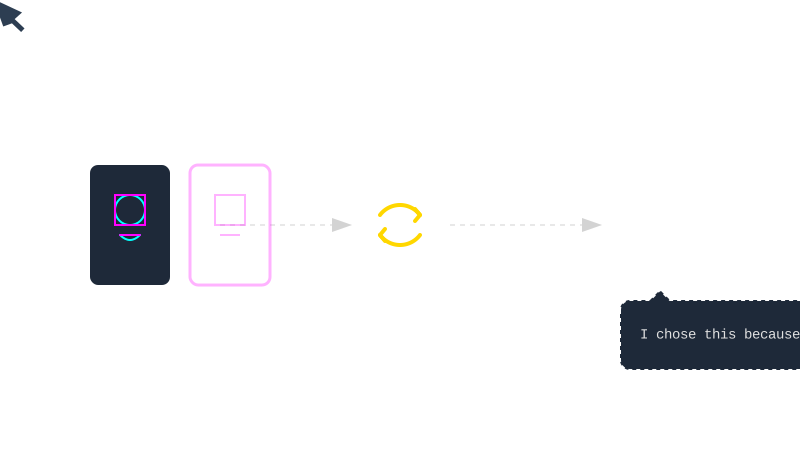
Petter Johansson and Lars Hall’s experiments on choice blindness are nothing short of mind-bending. In their 2005 study, participants were shown two photographs of faces and asked to pick the one they found more attractive. After making their choice, researchers used a sleight-of-hand trick to swap the selected face with the rejected one. When asked to explain their preference, a staggering 87% of participants failed to notice the switch and instead confidently rationalized why they had chosen the face they had actually dismissed.
One participant, for example, might have initially chosen Face A but was shown Face B and then proceeded to explain, “I prefer this one because she looks more trustworthy.” The brain, it seems, is less concerned with accuracy than with maintaining a coherent narrative. The jam study took this phenomenon even further. Participants tasted two jams and selected their favorite.
Researchers then swapped the chosen jam with the rejected one. Only 20% noticed the switch, and many went on to describe subtle flavor differences between the jams—even though they were tasting the same jam twice 5.
This isn’t just a quirk of perception; it’s proof that our explanations for our choices are retrospective constructions, not descriptions of actual motives. The brain is a master of post-hoc rationalization, stitching together a plausible story to justify whatever outcome it’s presented with.
Most People Don’t Notice When Their Choices Are Changed
The sheer scale of choice blindness is alarming. In Johansson’s face experiment, only 13% of participants detected the switch, meaning the overwhelming majority were completely unaware that their choice had been manipulated. This isn’t just a minor oversight—it’s a fundamental flaw in how we perceive our own decision-making. Our brains prioritize coherence over accuracy, and this has profound implications.
If we can’t even notice when our choices are altered right in front of us, how reliable are our explanations for the bigger decisions in life—career paths, relationships, or political beliefs? The phenomenon also reveals how deeply we rely on the introspection illusion, the false belief that we have direct access to our own thought processes. We assume that if we can explain why we did something, that explanation must be true. But choice blindness shows that our justifications are often just stories we tell ourselves after the fact.
This aligns perfectly with Michael Gazzaniga’s work on The Interpreter—our brains are wired to confabulate, to fill in gaps with whatever narrative makes sense in the moment. The uncomfortable truth? We’re not the authors of our choices; we’re the narrators, rationalizing decisions we didn’t consciously make. This has real-world consequences.
In marketing, choice blindness explains why consumers can be manipulated into preferring products they didn’t originally choose. In politics, it shows how voters can be swayed by framing effects they don’t even notice. And in the justice system, it underscores why eyewitness testimony is so unreliable—our memories aren’t recordings; they’re reconstructions shaped by bias and suggestion 5.
The lesson? Question your narratives. The stories you tell yourself about why you do what you do might just be confabulations. 6
Taleb’s Narrative Fallacy: Weaving Stories from Chaos
What Is the Narrative Fallacy
The narrative fallacy is our brain’s compulsive need to retrofit chaos with order. It’s the mental habit of stitching together a neat cause-and-effect chain from the messy, random threads of reality. Nassim Taleb captures this perfectly in The Black Swan when he recounts a conversation in Rome. A professor, fresh from reading Fooled by Randomness, congratulates Taleb on his “lucky” Lebanese heritage—suggesting his Eastern Orthodox upbringing uniquely equipped him to see through illusions of cause and effect.
The irony? The professor had just praised Taleb’s critique of this very tendency, only to immediately fall into the same trap. Taleb’s empirical test—finding zero other traders from his background who shared his skepticism—proves the attribution was nonsense. Yet the story felt right.
That’s the narrative fallacy in action: a compelling lie that satisfies our hunger for meaning 3. This fallacy isn’t just a cognitive quirk; it’s a survival mechanism gone rogue. Our brains are drowning in sensory data, so they filter noise by imposing patterns. When a coffee cup shatters, we need to know why—our hand knocked it over.
When a colleague gets promoted, we need to explain it—they’re more charismatic, more connected. Without these narratives, life would feel like a series of disconnected events, a slideshow with no captions. The problem?
These stories are often post-hoc fabrications, not accurate maps of reality. They make the past seem inevitable, masking the role of luck, chaos, and sheer unpredictability 3. 1
Why Business Success Stories Are Often Misleading
Consider the cult of business gurus. Books like Good to Great and In Search of Excellence dissect “winning” companies, extracting “principles” that supposedly explain their success. The narratives are intoxicating: disciplined leadership, customer obsession, whatever buzzword du jour fits. But here’s the catch—when researchers track those same companies years later, their performance regresses to the mean.
The “secrets” didn’t cause success; they were just correlations, or worse, random noise. Kahneman nails it: the original gap between “great” and “mediocre” firms was largely luck, and luck, by definition, doesn’t repeat. Yet we devour these stories because they promise control.
If we just emulate the habits of “excellent” companies, we too can beat the odds. It’s a seductive illusion—one that ignores regression to the mean and the silent role of chance.
How the Narrative Fallacy Distorts Our Understanding
The narrative fallacy doesn’t just distort history—it warps our sense of the future. By retrofitting the past with tidy explanations, we trick ourselves into believing we can predict what’s next. If we “understand” why Company X thrived (strong culture! visionary CEO!), we assume we can replicate it. But as Gazzaniga warns, “The interpreter is only as good as the information it gets.”

Our brains are working with incomplete, often misleading data, yet we spin it into certainty. This overconfidence is dangerous. It leads investors to chase “proven” strategies that fail, politicians to double down on policies that backfire, and individuals to cling to life narratives that no longer serve them. The past wasn’t as predictable as we remember, and the future is far less knowable than we pretend.
The antidote? Humility. Recognize that your brain’s stories are just that—stories.
They’re useful fictions, not truth. The next time you catch yourself explaining why something happened, ask: Is this a pattern, or just a pattern I’m imposing?
The world is messier than our narratives allow, and that’s okay. The first step to clearer thinking is admitting we’re all master confabulators.
Strawson’s Revolt: You Don’t Need a ‘Life Story’ to Flourish
Galen Strawson’s Critique of Life as Narrative
Galen Strawson’s critique of the ‘Ethical Narrativity Thesis’ is a refreshing slap in the face to our cultural obsession with life stories. The thesis claims that a meaningful, good life must be shaped like a narrative—beginning, middle, end, with themes, arcs, and lessons learned. Strawson, an unapologetic “episodic,” dismantles this idea with brutal honesty. He admits he has “absolutely no sense” of his life as a story, no feeling that his past self is him in any meaningful way.
To Strawson, his earlier incarnations are more like strangers he’s heard about—interesting, perhaps, but not him 2. This isn’t just a personal quirk; it’s a philosophical rebellion. Strawson argues that the belief in narrativity isn’t just descriptive (how we think we experience life) but often prescriptive (how we should experience it to live well). He rejects both.
Why? Because forcing life into a story shape distorts reality.
It implies that without a grand arc, life lacks meaning—a claim that’s as arrogant as it is unproven. Strawson’s episodic perspective suggests that meaning can exist in moments, not just in the sweeping plotlines we retroactively impose.
Understanding Diachronic vs. Episodic Selves: Two Valid Ways to Experience Identity
Strawson draws a sharp line between two types of people: diachronics and episodics. Diachronics experience their self as extended through time—a continuous “I” that persists from childhood to old age. Episodics, like Strawson, feel no such continuity. Their sense of self is momentary, always beginning anew.
This isn’t a deficit; it’s a different way of being 2. The kicker? Both can flourish.

Diachronics might find comfort in their life’s narrative, while episodics thrive in the present, unburdened by the need to reconcile past and future. Strawson’s point isn’t that one is better—it’s that both are valid.
The mistake is assuming everyone must be diachronic to live well. That assumption erases the experiences of episodics and imposes a rigid template on a life that might not fit. 7
The Dangers of Forcing Life Into a Story
Here’s the dark side of narrativity: it demands inauthenticity. To craft a coherent story, we edit, omit, and outright fabricate. Memories are bent to fit the plot. Past selves are caricatured to serve the arc.
The result? A polished fiction that feels true but isn’t. As Sam Harris notes, our brains are “confabulatory storytelling mechanisms,” always ready with reasons that sound good but are often wrong 4.
Strawson’s episodic stance offers freedom. Without the pressure to narrate, life can be lived in fragments—messy, disjointed, but real.
The alternative? A life spent rewriting history to make the story work, even when it doesn’t.
The Danger of the ‘Retrospective Glow-Up’
How We Rewrite Our Past to Seem More Predictable
We’re all guilty of it—looking back at our lives and crafting a story where we were always destined for success. “I always knew I would be a writer,” we say, or “Dropping out of college was the best decision I ever made.” But this is the retrospective glow-up in action: a mental trick where we inflate our foresight and minimize past uncertainty. The truth is far messier.
In the moment, we rarely know how things will turn out. We’re just trying to do something small, something manageable, and then—if we’re lucky—it becomes something bigger. The danger?
When we adopt grandiose labels like “Visionary” or “Revolutionary,” we set ourselves up for future overreach. Most groundbreaking things start small, and when we forget that, we risk chasing the next “big thing” with misplaced confidence 6.
The Danger of Identity Inflation: Why Believing Your Own Hype Leads to Failure
The retrospective glow-up doesn’t just distort our past—it inflates our identity. We start believing our own press, adopting labels that feel good but aren’t grounded in reality. “I’m a disruptor,” we tell ourselves, or “I’ve always been ahead of the curve.” But this identity inflation is dangerous.
It blinds us to the role of luck, timing, and sheer unpredictability in our success. When we see ourselves as visionaries, we’re more likely to overreach, assuming that our past “genius” guarantees future wins. The reality?
Most successful people were just trying to solve a small problem or seize an opportunity. They didn’t set out to be revolutionary—they just kept building. The moment we start believing our own myths, we lose touch with the humility that got us there in the first place 6. 8
The Crucial Link: Why You Must Remember Your Past Self
Why Remembering Your Past Self Prevents Existential Confusion
The narrative fallacy thrives on our brain’s desperate need to stitch chaos into coherence. But what if the antidote isn’t crafting a better story—it’s remembering the ones we’ve already lived? When we lose touch with our past selves, we become unmoored, drifting in a sea of post-hoc rationalizations. The Interpreter runs wild, confabulating explanations for a life we no longer recognize.
But revisiting who we were—through journals, old books, or even cringeworthy teenage poetry—anchors us in reality. Joan Didion’s philosophy of journaling isn’t about preserving memories; it’s about preserving context. When she wrote, “The purpose of journaling is to keep on nodding terms with who I used to be,” she wasn’t advocating nostalgia. She was advocating honesty.
Without that connection, we’re vulnerable to the retrospective glow-up, rewriting our past to fit a tidy narrative. But when we confront our old selves—flaws, contradictions, and all—we disrupt the Interpreter’s monopoly on meaning. The past wasn’t as predictable as we remember, and neither is the future. Ryan Holiday’s practice of reflective journaling takes this further.
By documenting decisions in real-time, we create a record that resists the narrative fallacy. When we look back, we’re not just seeing what happened—we’re seeing why we thought it would happen. This inoculates us against the illusion of inevitability.
The stories we tell ourselves about our lives aren’t just flawed; they’re dangerous. They convince us we’re in control when we’re not, that we’re consistent when we’re anything but.
But when we remember who we used to be, we’re forced to acknowledge the messiness of growth. And that’s the first step to clarity. 7 4 5
Why Journaling Keeps You Honest About Your Past Self
Didion’s insight cuts to the heart of the narrative fallacy. Journaling isn’t about documenting achievements; it’s about documenting evolution. When she asked, “Why did I write down this thought at a train station in Pennsylvania?” she wasn’t just questioning her past self—she was questioning the story her present self might impose on it. The Interpreter loves to retrofit meaning, but a journal forces us to confront the raw material of our lives before the narrative takes over.
This practice isn’t just for writers. It’s for anyone who’s ever felt lost in their own story. When we revisit old journals, we’re not just remembering events—we’re remembering who we were when they happened. That’s the key.
The narrative fallacy thrives on hindsight bias, but a journal preserves the uncertainty, the doubt, the real reasons we made choices. It’s a bulwark against the retrospective glow-up, the tendency to inflate our past wisdom to match our present success. And here’s the kicker: it’s humbling.
When we see how wrong we were, how confused, how human, we’re less likely to fall for the illusion of control. The Interpreter can’t spin a coherent story when the evidence contradicts it.
So keep a journal. Not to craft a better narrative, but to resist the one your brain is already writing.
Why Ryan Holiday’s Journaling Practice Frees You From Mental Narratives
Holiday’s approach is ruthlessly practical. By documenting decisions in real-time, we create a time capsule of our own fallibility. The Interpreter wants to believe our past selves were wiser, more intentional. But a decision journal reveals the truth: we were just as confused, just as biased, just as human as we are now.
This isn’t just humbling—it’s liberating. When we look back at old entries, we see patterns, but we also see randomness. The narrative fallacy thrives on the illusion of cause and effect, but a journal preserves the chaos. It shows us that our “brilliant” decisions were often just lucky guesses, that our “foolish” mistakes were just part of the process.
This inoculates us against the permanence our narratives suggest. We’re not stuck in a story; we’re evolving through moments. And that’s the real power of journaling. It doesn’t just preserve the past—it disrupts the present.
When we see how ephemeral our thoughts and feelings are, we’re less likely to cling to them. The Interpreter can’t spin a coherent story when the evidence is right there, contradicting it.
So write it down. Not to craft a better narrative, but to resist the one your brain is already writing. 7
Unmasking the Ultimate Motivation: What Your Stories Hide
Understanding Proximate vs. Ultimate Explanations in Evolutionary Psychology
Evolutionary psychology offers a powerful lens to understand why we do what we do—by distinguishing between proximate and ultimate explanations. The proximate explanation is the conscious, verbal reasoning we give for our actions. It’s the surface-level story we tell ourselves and others. For example, if asked why you’re eating, you might say, “Because I’m hungry.” But the ultimate explanation—the deeper, evolutionary why—is that your body needs calories to survive.
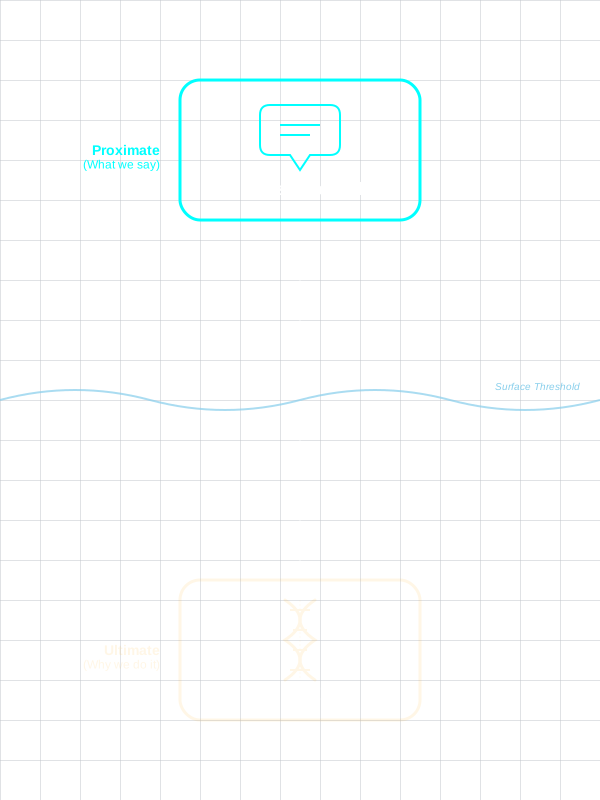
This distinction is crucial because it reveals how often our conscious narratives mask unconscious motivations. The Interpreter module in our brain is a master of proximate explanations. It stitches together plausible stories from whatever fragments it has, even when those stories are incomplete or outright false.
As Gazzaniga’s work shows, we often confabulate reasons for our actions after the fact, believing our own fictions because our brains crave coherence. But beneath these conscious narratives lie ultimate explanations—evolutionary drives shaped by survival and reproduction. 8
How Female Gossip Masks Reproductive Competition
Consider the phenomenon of female intrasexual competition. On the surface, it might look like concern or kindness—“I’m just worried about Katie bringing so many boys home from Hinge.” But the ultimate explanation is far more strategic: reproductive suppression. By framing criticism as care, women can subtly undermine rivals without inviting direct conflict or ostracism. This isn’t just gossip; it’s an evolutionary tactic to reduce competition for mates while minimizing personal risk.
The same dynamic plays out in other contexts. When women tell each other, “Guys aren’t worth it anyway,” it’s not just self-care advice—it’s a way to discourage rivals from entering the mating pool. The proximate explanation is compassionate; the ultimate explanation is competitive. This duality highlights how our conscious narratives often serve as plausible deniability for deeper, unconscious motives.
We’re not just telling stories—we’re strategically obscuring the real reasons behind our actions 8. The Interpreter doesn’t just explain our behavior—it justifies it, wrapping evolutionary imperatives in socially acceptable language.
But when we peel back the layers, we see the raw, unfiltered drives beneath the stories. The next time you hear someone say, “Bless her heart,” ask yourself: Is this kindness, or is it competition in disguise?
Conclusion
So here we are, standing at the edge of our own narratives, peering into the gap between what we remember and what actually happened. It’s unsettling, isn’t it? To realize that the stories we’ve crafted—about our careers, our relationships, even our identities—are more Hollywood biopic than documentary. But maybe that’s not such a bad thing.
After all, stories are how we make sense of the chaos. The problem isn’t that we tell them; it’s that we mistake them for the truth. We cling to our narratives like lifelines, as if they’re the only thing keeping us from drowning in the randomness of life.
But what if we learned to hold them a little lighter? What if we treated our life stories not as sacred texts, but as drafts—always subject to revision?
Gazzaniga’s Interpreter, Taleb’s narrative fallacy, Strawson’s episodic self—they all point to the same truth: we’re not the authors of our lives. We’re the editors, constantly revising, cutting, and pasting to make the plot work. And sometimes, the best thing we can do is put the pen down and just live.
So here’s the question to sit with: What if the messiness—the contradictions, the false starts, the moments that don’t fit the narrative—isn’t something to be fixed, but something to be embraced? What if the most honest story is the one that admits it’s just a story?
Because in the end, life isn’t about crafting the perfect plot. It’s about showing up for the scenes as they come—even the ones that don’t make sense. (And isn’t that the most human thing of all?)


