


I believe we are living in an era that aggressively mass-produces the aesthetic of certainty. When I observe the culture around us, I see it everywhere, from the meticulously curated highlight reels on your feed to the endlessly aggressive posturing of modern hustle culture. We are constantly taught to project a flawless, unshakeable belief in our own inevitability. But if you look closely, you’ll realize we are staring at a cheap psychological forgery.
What we culturally celebrate as confidence is usually just a highly defensive, incredibly fragile ego in disguise. I think we have fundamentally misunderstood the very architecture of true self-belief. We assume it is a loud, impenetrable fortress built on a foundation of constant winning. In reality, real confidence is a quiet, internally sourced resilience built on a fractured, repeatedly repaired relationship with failure.
The Fragility of the “Gifted” Identity
When Intelligence Leads to Avoidance
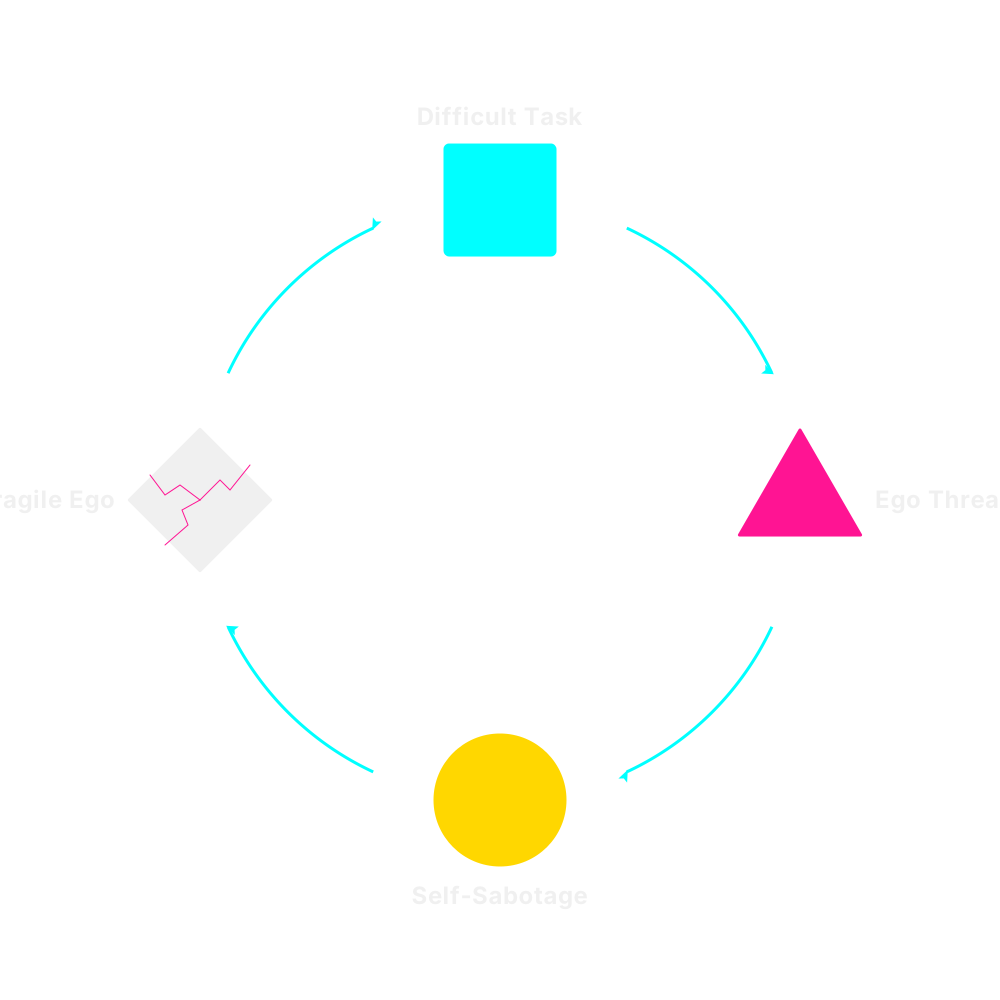
To understand how we get confidence so wrong, we have to look at the classic psychological phenomenon of the “gifted” child. When society labels a young person as exceptionally smart, their entire identity quickly becomes tied to a standard of effortless perfection. They learn early on that their absolute value is inextricably linked to their ability to understand things immediately, without breaking a sweat. This seems like a tremendous advantage on paper, but it is actually a devastating psychological trap.
As these high-achievers grow older, a bizarre and destructive behavioral pattern begins to emerge. They start subconsciously pulling away from any activity or subject that feels genuinely difficult. If a task requires grueling effort and they can’t master it instantly, their mind interprets this as a fatal threat to their core identity. Instead of pushing through the friction, they abandon the pursuit entirely to protect their reputation as a natural genius1.
This avoidance eventually mutates into active, deliberate self-sabotage. A student might intentionally wait until the night before a massive exam to study, practically guaranteeing a mediocre grade. They do this because if they give maximum effort and still fail, it proves they aren’t actually smart anymore. But if they wait until the last minute and score a “B,” they get to comfortably maintain the illusion that they are simply a brilliant, lazy prodigy.
Stacking the Deck Against Yourself
This childhood pathology follows us directly into adulthood, manifesting as a desperate need to avoid uncertainty at all costs. We mistakenly believe that confidence is the absolute guarantee of a positive outcome. Consequently, we try to stack the odds in our favor in every area of life, from our career trajectories to our romantic relationships. We purposefully only play the games we are absolutely certain we can win.
I often think about the classic archetype of the overly accommodating “nice guy” who showers a romantic interest with unearned favors. They are utterly terrified of rejection, so they attempt to artificially engineer affection, hoping to make a future romantic confession a guaranteed success. Yet, the more they try to permanently eliminate the risk of failure, the more intensely insecure they actually become.
You see the exact same psychological decay at play when someone uses cheat codes to win a competitive video game. You might officially secure the victory screen, but deep down, your psyche knows the win was utterly fraudulent. The more you rely on manipulated odds to succeed, the more your internal belief in your actual competence rots away. True confidence is fundamentally defined by the pure ability to face raw, unmitigated uncertainty.
The Core Difference in Handling Flaws
Defensive High Self-Esteem
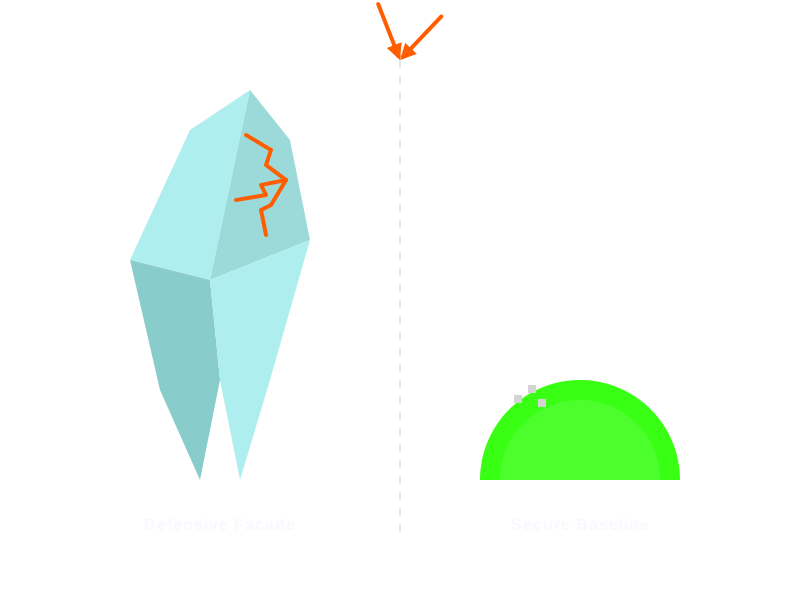
When we avoid uncertainty and construct an identity around never failing, we develop what psychologists refer to as defensive high self-esteem. On the surface, these individuals project a loud, unwavering belief in their absolute superiority. They routinely report massive self-worth, but this outward display actively masks a terrifyingly deep well of implicit insecurity. Their high regard is fundamentally brittle and reliant on constant external validation2.
Because their self-worth relies entirely on a manufactured facade of perfection, they absolutely cannot afford to admit a flaw. Acknowledging a genuine weakness wouldn’t just be a minor critique; it would be a catastrophic shattering of their entire ego structure. Consequently, when their positive self-view is inevitably threatened by reality, they don’t lean in with curiosity. They react with aggressive defensiveness, instantly shifting the blame onto anyone else to maintain the charade.
This is the precise dividing line where confidence metastasizes into toxic arrogance. Arrogant people operate from a place of profound psychological pain and fear, demanding external compliance to soothe their inner inadequacies. They are chronic perfectionists, not out of a love for the craft, but out of a desperate need to be perceived as inherently flawless. They talk endlessly about their own greatness, yet refuse to listen, because allowing another voice to dominate the room feels like an existential threat.
Secure Implicit Value
In stark contrast, individuals with genuine confidence possess what is known as secure implicit self-esteem. They hold positive self-views that are deeply ingrained, quietly confident, and fiercely realistic. Because they genuinely feel good about themselves deep down in their bones, they never feel the exhausting need to fake it for an audience. They have completely decoupled their human worth from the impossible standard of perfection.
This leads to the ultimate paradox of self-belief. True confidence is the profound ability to see yourself as fundamentally flawed, to deeply recognize your glaring inadequacies, and yet still hold yourself in incredibly high regard. When you operate from this secure baseline, negative feedback isn’t a personal attack; it’s just highly useful data. You can easily hold your hands up, admit a terrible mistake, and get to work fixing it without suffering an identity crisis.
The Pathology of Perfectionism
Confident people intuitively embrace the philosophy of “good enough.” They know their skill sets, execute the grueling work, and release it to the world without agonizing over its absolute purity. They understand that perfection is a toxic, subjective mirage that prevents actual execution. They don’t fret over what the gallery thinks because their metric of success was satisfied internally the moment the work was complete.
Arrogant people, driven by their defensive self-esteem, are often paralyzed by their own perfectionism. They are so terrified of exposing a weakness that they will work themselves to the bone out of a desperate need to maintain their flawless facade. Furthermore, they will actively weaponize this perfectionism against others. They constantly point out minor flaws in their peers’ work, instinctively pushing others down to elevate their own precarious sense of superiority.
The Scripted Psychopathy of Fake Confidence
The Limits of Faking It
We often hear the tired cultural cliché to “fake it until you make it,” and there is admittedly a grain of clinical utility to this. If someone is socially paralyzed, bitter, and entirely devoid of charm, adopting a manufactured persona can serve as a necessary set of training wheels. Feigning competence can help a chronically anxious person step out of their basement and finally engage with the real world. It successfully mimics the calmness and self-possession that usually accompany genuine expertise3.
However, I believe this strategy carries a dark, highly toxic underbelly that we rarely discuss. If you simply wear the mask without doing the grueling psychological work to integrate those traits genuinely, you are essentially practicing scripted psychopathy. You are being heavily socially rewarded for being entirely fake. Over time, actively manipulating people to view you a certain way hollows you out, leaving you deeply cynical and incredibly jaded3.
There is an undeniable allure to this false bravado, especially for young men drawn to flashy, hyper-masculine figures online. A capacity for darkness or assertiveness is definitely an improvement over harmless, neurotic dependency. But this manufactured toughness is not an optimal end state. It is merely a dangerous stepping stone that, if never organically outgrown, turns you into a highly capable but fundamentally miserable manipulator.
Stretching the Limits
Real confidence, the kind that survives winter, is rooted in concrete, undeniable evidence. It is a rational bet placed on yourself based on a historical track record of showing up and doing the hard things. You don’t just blindly believe in yourself through sheer delusion; you generate hard evidence through repeated action. You know exactly what you are capable of because you have literally seen yourself execute it before4.
This absolutely doesn’t mean you won’t feel fear when you face a new, monumental challenge. In fact, if you aren’t feeling at least a mild wave of imposter syndrome, you simply aren’t reaching high enough. Imposter syndrome isn’t a disease; it is the natural, necessary byproduct of stretching your capabilities far beyond their historical limits. True confidence isn’t the total absence of this fear, but the deep-seated trust that you are not the kind of person who quits when the path gets steep4.
The Baptism of Failure
Success Breeds the Imposter
I used to desperately want to believe that if I just strung together enough victories, I would finally feel secure. But the clinical reality of human psychology is utterly counterintuitive. Success does not inherently generate true confidence. In fact, rapid and uninterrupted success is often the primary catalyst for severe imposter syndrome.

I think about the highest-achieving medical students who arrive at prestigious hospitals with totally flawless academic records. You would assume they possess ironclad, impenetrable self-esteem. Yet, the first time a veteran surgeon aggressively reprimands them in an operating room, they frequently crumble, fleeing in tears and questioning their entire career. Their confidence was entirely theoretical, built on a fragile foundation of never having made a serious error.
The Freedom of Rock Bottom
Genuine, terrifyingly powerful confidence doesn’t come from a lifetime of winning. It is forged strictly in the violent fires of surviving failure. Think about the agonizing devastation of your first major romantic breakup. You likely felt that your life was permanently ruined, yet somehow, months later, you found yourself functioning, smiling, and eventually opening up again.
That profound realization—that you can hit absolute rock bottom, be consumed by the pain, and still survive—is the birth of true psychological resilience. This exact mechanism is utilized brilliantly in extreme exposure therapy, such as tasking socially anxious individuals to go out and ask fifty strangers for their phone number in a single afternoon. They are virtually guaranteed to fail brutally and repeatedly. But in facing that tidal wave of rejection, they learn that rejection isn’t fatal, and they walk away infinitely more confident than when they started3.
The Illusion of the Safety Net
We have engineered a modern society completely obsessed with providing safety nets, helicoptering over challenges to ensure we never scrape our knees. We sincerely believe we are doing ourselves a massive favor by removing the sting of defeat. But by systematically insulating ourselves from failure, we are actively starving our psyches of the very nutrient required to grow resilience. We are currently raising generations of profoundly fragile adults.
When you never allow yourself to fail, every minor inconvenience feels like a terminal event. You become terrified of spontaneity, rigidly sticking only to the predictable paths you have heavily rehearsed. Confident people are wildly spontaneous because they are genuinely unafraid of looking foolish or getting it momentarily wrong. They intuitively understand that every setback contains a crucial lesson, and they deeply trust their own capacity to absorb the blow and pivot2.
Internal Worth vs. External Metrics
The Leverage Trap
One of the greatest mistakes we consistently make is outsourcing our internal compass to external societal metrics. We often feel a deep, authentic internal calling to pursue a certain path, but our cultural conditioning violently intervenes. We start hyper-analyzing our lives purely in terms of scale, status, and economic leverage. We abandon what we genuinely want to do in order to chase the shiny industry that promises the most aggressive upward mobility5.
Getting exactly what you think you want in those high-leverage, high-status environments can genuinely be the worst mistake of your life. You slowly become trapped in a golden cage, highly successful but deeply, painfully misaligned with your actual self. This is precisely why a massive percentage of patients seek dramatic career changes within eighteen months of beginning deep psychological therapy. They finally realize that their life’s fuel has been fundamentally wasted on executing external scripts rather than honoring their own truth5.
Sometimes, the absolute best decisions you can make for your own confidence are practically terrible decisions on paper. Walking away from a prestigious faculty position to start completely over from scratch defies all conventional logic. But when you align your daily actions with your genuine passion rather than external validation, you build a foundation of self-worth that no market crash or critical peer review can ever touch.
The Ego Machine of Social Media
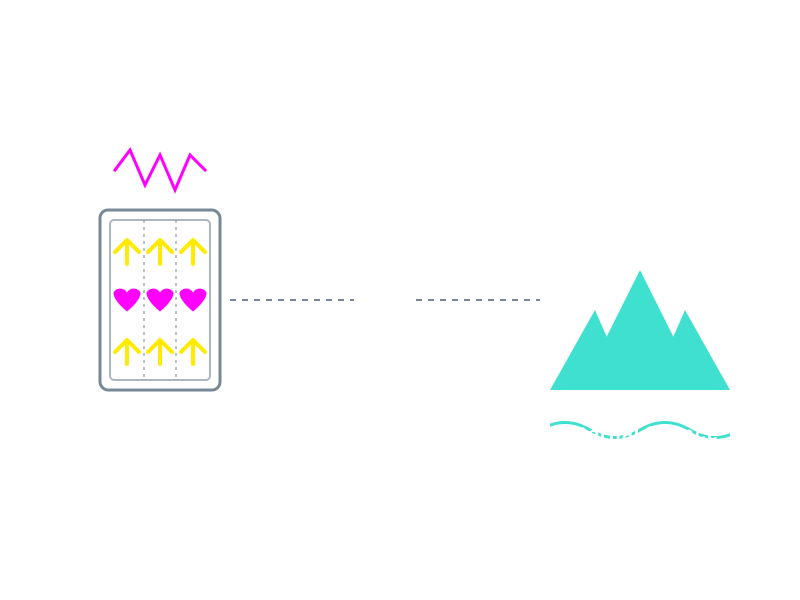
When we derive our foundational value from external sources, we become total slaves to the ego, and the ego is purely comparative. It only knows how to measure your worth as smarter, richer, or more popular than the person standing immediately next to you. In this specific context, modern social media acts as an absolute hyper-accelerant for psychological fragility. It transforms every mundane, private moment of human existence into a brutal, highly visible referendum on your personal value.
You might think a viral post with tens of thousands of likes would cement your confidence forever. Instead, it creates a terrifying new baseline of expectation that you now have to feed. The next time you post and receive only half the engagement, your ego automatically registers it as a catastrophic social failure. You aren’t comparing yourself to normal people anymore; you are hopelessly comparing yourself to the upper echelons of an algorithmic slot machine, spiraling further into deep insecurity.
Finding Silence in the Wilderness
To cultivate genuine confidence, you have to periodically sever the lifeline to the audience entirely. You have to aggressively remove the external judges and force your mind to generate value in a complete vacuum. This is exactly why spending time alone in raw nature is such a profound psychological reset. The wilderness absolutely does not care about your follower count, your leverage, or your manufactured personal brand.
If you hike to the top of a brutal, unforgiving mountain and don’t document a second of it, no one will hand you a trophy. If you fail halfway up and turn back in exhaustion, the trees won’t whisper insults behind your back. The entirety of the experience, the victory and the failure alike, belongs exclusively and intimately to you. When you learn to act boldly in the complete absence of an audience, you finally strangle the ego and allow quiet confidence to breathe1.
Distinguishing Conviction from Delusion
The Allure of the Contrarian
There is a distinct, intoxicating danger that arises when we finally begin to trust our own internal compass. When we successfully bet against the cultural consensus and turn out to be completely right, the dopamine hit is incredible. You get to stand on a pedestal, look down at all the skeptics, and relish in the immense satisfaction of your own genius. But to me, this is exactly where incredibly smart people frequently become breathtakingly stupid6.
The allure to “run it back” and violently reject all outside advice becomes an addictive ego trip. You begin to interpret any pushback not as useful friction, but as the same foolish resistance you successfully conquered last time. You deeply confuse the impulsive, emotional rebellion of a stubborn teenager with the rational courage of genuine conviction. History is absolutely littered with brilliant minds who took the wrong lessons from their early triumphs and eventually blew their legacies to pieces6.
Doing the Hard Work of Discernment
True confidence requires the excruciatingly mature work of actively separating your ego from your instinct. When you encounter fierce resistance to your bold ideas, you must sit quietly and ask yourself what is actually driving your defiance. Is it a fragile ego that simply hates being told what to do, or have you genuinely done the painstaking research to justify your stance? You must deliberately cultivate the humility to talk down the reactionary kid inside you and sincerely listen to critical feedback.

If, after careful deliberation, you realize you actually possess a unique, evidence-backed insight, then you hold the line. You don’t double down because it feels good to rebel; you double down because you have a rational thesis. This delicate balance is the ultimate hallmark of a highly developed mind. You remain radically open to being completely wrong, yet possess the unyielding fortitude to stand completely alone when you know you are right.
The Danger of the Toxic Echo Chamber
When arrogance is left unchecked and masquerades as conviction, it actively poisons the surrounding environment. In a professional setting, an egotistical leader will routinely talk down to teammates and assert dominance through fear. They contribute to a highly toxic dynamic because their primary objective isn’t collective success, but personal glorification. They eagerly surround themselves with compliant sycophants who will never challenge their dangerously brittle worldview2.
A truly confident person, however, makes for an extraordinary teammate and a deeply transformative leader. They don’t aggressively hoard the spotlight because their ego isn’t starved for constant validation. They actively inspire confidence in others, uplifting their peers and identifying the unique strengths in the people around them. They lead from a place of profound peace of mind, knowing that someone else’s brilliance doesn’t diminish their own.
Conclusion
We spend our entire lives running desperately from the feeling of failure, assuming that if we can just accumulate enough flawless wins, the chronic anxiety will finally dissipate. We construct elaborate masks, chase high-leverage careers, and meticulously optimize our digital avatars to project a bulletproof superiority. But it is all a tragically misguided attempt to solve an internal crisis with highly volatile external materials. We are constantly treating the symptom while aggressively feeding the disease.
True confidence is not the polished, frictionless absence of self-doubt that modern society eagerly sells us. It is the raw, gritty, fiercely held knowledge that you are a deeply flawed human being who can survive the absolute worst the world has to offer. It is the hard-won peace of mind that comes from finally knowing your worth isn’t up for public debate. A life built on faking perfection will shatter at the first sign of a storm, but a life built on survived failures is utterly indestructible.


