


The child sat alone in the room, eyes locked on the single marshmallow in front of him. The researcher had promised two if he could just wait.
But the minutes stretched like hours. His fingers twitched. His stomach growled.
And then—he gave in, snatching the treat. Was this a failure of willpower? Or something far more revealing?
Years later, researchers like Celeste Kidd would uncover the truth: that child wasn’t just impulsive. He was rational. In her Rational Snacking study, Kidd showed that when children experienced broken promises—when the world proved unreliable—they grabbed the marshmallow immediately.
Why? Because in their lives, waiting rarely paid off. The lesson wasn’t about self-control. It was about trust.
What if the real test wasn’t patience, but the environment we create? Could it be that the ability to delay gratification hinges more on the reliability of our surroundings than on sheer willpower?
The Original Marshmallow Test and Its Findings
The Original Marshmallow Test Explained
The original Marshmallow Test, conducted by Walter Mischel in the 1960s, was designed to measure children’s ability to delay gratification. In the study, children were offered a choice: they could eat one marshmallow immediately or wait for a period of time to receive two marshmallows. The test aimed to assess self-control and the ability to resist immediate temptation for a larger reward later. Mischel’s work was groundbreaking, as it suggested that the ability to delay gratification could be an indicator of future success in various aspects of life, including academic achievement and social competence.
The study was conducted with a sample of preschool-age children, primarily from the Stanford University community. The initial findings showed that children who could wait longer for the larger reward tended to have better life outcomes, as measured by SAT scores and parental reports of behavior.
However, it’s important to note that the follow-up studies focused on much smaller samples, and the associations between delay time and later outcomes were not adjusted for potential confounding factors. This has led to questions about the generalizability and robustness of the original findings. 1 2 3
The Marshmallow Test’s Controversial Legacy
The key findings of the original Marshmallow Test suggested that children who could delay gratification had better life outcomes. For instance, Shoda and colleagues observed large correlations between delay time and SAT scores, as well as parent-reported behaviors such as attentiveness and concentration. These findings have been widely cited and have influenced both academic research and popular understanding of self-control and success. However, recent research has challenged these findings, suggesting that environmental factors and socioeconomic background play significant roles in a child’s ability to delay gratification.
For example, a study by Watts et al. (2018) found that the association between delay of gratification and academic achievement was highly sensitive to the inclusion of control variables and did not appear to be linear across the delay-of-gratification distribution. This suggests that the original findings may not be as robust or generalizable as previously thought. Moreover, the original study’s sample was highly selective and small, which limits the generalizability of the findings.
The children in the study were primarily from the Stanford University community, and the follow-up studies focused on even smaller samples. This has led to questions about whether the findings can be applied to a broader population. Despite these limitations, the Marshmallow Test remains a seminal study in the field of psychology and has sparked important discussions about the role of self-control in success. 1
Challenges to the Original Findings
Watts et al. (2018) Challenge the Marshmallow Test’s Predictive Power
The 2018 study by Watts et al. marked a pivotal moment in the ongoing debate about the Marshmallow Test’s validity and predictive power. This research, published in Psychological Science, aimed to replicate and extend the original findings by Shoda, Mischel, and Peake (1990). However, it introduced a more rigorous methodology and a larger, more diverse sample size. The study focused on children whose mothers had not completed college, providing a broader socioeconomic perspective than the original Stanford-based research.
Watts and his team found that while there was still a correlation between delay of gratification and later academic achievement, the effect size was significantly smaller than previously reported. Specifically, an additional minute waited at age 4 predicted only a modest gain in achievement at age 15. Moreover, this correlation was further reduced when controlling for family background, early cognitive ability, and home environment.
This suggests that the original Marshmallow Test’s predictive power may have been overestimated due to the lack of control for these confounding variables. One of the key differences in the Watts study was the inclusion of a more diverse sample, which allowed for a better understanding of how socioeconomic factors influence a child’s ability to delay gratification.
The study also used advanced statistical models to address potential biases and small sample sizes, ensuring a more robust analysis. By pre-registering the study with the Open Science Framework, the team aimed to enhance transparency and reduce researcher bias, a practice that has become increasingly important in psychological research.
How Socioeconomic Background Affects Self-Control
The Watts study underscored the significant role that socioeconomic background plays in a child’s ability to delay gratification. The research highlighted that children from lower socioeconomic backgrounds often face environmental challenges that can impact their decision-making processes. For instance, children from less privileged backgrounds may have less reliable access to resources, making immediate rewards more appealing than waiting for larger, future rewards. The study also found that children from higher socioeconomic backgrounds tended to wait longer for the larger reward, suggesting that environmental stability and resources play a crucial role in self-control.
This aligns with the findings of the Rational Snacking study, which demonstrated that children’s decisions are heavily influenced by their expectations of future resource availability. In other words, if a child’s environment is unpredictable or resource-scarce, they are more likely to opt for immediate gratification. Furthermore, the Watts study emphasized the importance of considering the home environment and early cognitive abilities when interpreting the results of the Marshmallow Test.
The research showed that children’s performance on the test was influenced by factors such as maternal education, household income, and the quality of the home environment. These findings challenge the notion that the Marshmallow Test is a pure measure of innate self-control, suggesting instead that it is a complex interplay of environmental and cognitive factors.
In conclusion, the 2018 study by Watts et al. provides a more nuanced understanding of the Marshmallow Test and its implications. By highlighting the role of socioeconomic background and environmental factors, the research challenges the original findings and underscores the need for a more comprehensive approach to studying self-control and delayed gratification. 1
Environmental Reliability and Rational Decision-Making
How the Rational Snacking Study Redefined Willpower
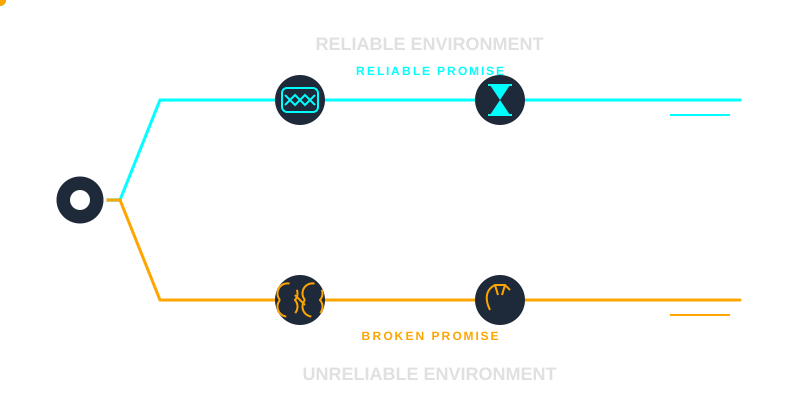
The Rational Snacking study, conducted by Celeste Kidd and her team, offers a fascinating twist to the classic Marshmallow Test narrative. This research demonstrates that children’s ability to delay gratification isn’t solely about self-control—it’s also about rational decision-making based on environmental reliability. In the study, children were exposed to either a reliable or unreliable experimenter before taking the marshmallow task. The results were striking: children in the reliable condition waited an average of 12.03 minutes, while those in the unreliable condition waited only 3.02 minutes.
This suggests that children’s decisions are heavily influenced by their trust in the environment and their expectations of future outcomes. What’s particularly compelling is that the study highlights how children assess risk and make decisions based on their surroundings. If a child believes that waiting won’t pay off—perhaps because their environment has been unpredictable—they’re more likely to take the immediate reward.
This rational decision-making process is just as influential as self-control, if not more so. The study challenges the notion that the Marshmallow Test is purely a measure of innate willpower, instead suggesting that children’s beliefs about the stability of their world play a critical role in their behavior.
How Children Evaluate Risk and Rewards
The Rational Snacking study also sheds light on how children evaluate risk and rewards in real-time. Before the marshmallow task, children participated in an art project where the experimenter either followed through on promises (reliable condition) or failed to do so (unreliable condition). This priming activity set the stage for how children approached the subsequent delay-of-gratification task. Those who experienced reliability were far more willing to wait, demonstrating that their decisions were not just impulsive but strategically calculated based on prior experiences.
This aligns with broader research on decision-making, which suggests that children—and even adults—weigh the costs and benefits of their actions based on environmental cues. If a child grows up in an unstable environment where promises are often broken, they may develop a worldview that prioritizes immediate rewards over uncertain future gains. Conversely, children in stable, predictable environments are more likely to trust that waiting will lead to better outcomes.
This rational approach to decision-making underscores the importance of considering context when interpreting behaviors like those observed in the Marshmallow Test. Ultimately, the Rational Snacking study reminds us that self-control is only part of the story.
Children’s ability to delay gratification is deeply intertwined with their perceptions of reliability, trust, and environmental stability. This nuanced understanding challenges the oversimplified narrative of the original Marshmallow Test and invites us to consider how broader societal and environmental factors shape behavior from an early age. 4
The Impact of Environment on Self-Control
How Environment Shapes Delayed Gratification
Imagine a child sitting in a room, staring at a single marshmallow, debating whether to eat it now or wait for two later. What if the real question isn’t just about willpower, but about trust? The Rational Snacking study by Celeste Kidd and her team reveals that children’s ability to delay gratification is deeply influenced by their environment’s reliability. In the study, children were divided into two groups: one experienced a reliable experimenter who followed through on promises, while the other faced an unreliable one who broke commitments.
The results were stark—children in the reliable condition waited an average of 12.03 minutes, compared to just 3.02 minutes in the unreliable group. This isn’t just about patience; it’s about rational decision-making. Children in unstable environments learn that waiting doesn’t always pay off. If promises are frequently broken, why trust that a second marshmallow will ever appear?

The study’s design—where children first engaged in an art project with either reliable or unreliable outcomes—primed them to approach the marshmallow task with a specific mindset. Those who experienced reliability were more likely to believe that waiting would yield results, while those in the unreliable condition acted on the assumption that immediate rewards were safer bets 2. This challenges the original Marshmallow Test’s assumption that delayed gratification is purely a measure of self-control.
Instead, it suggests that children are making calculated decisions based on their experiences. If a child’s world is unpredictable, taking the immediate reward isn’t impulsive—it’s strategic. This insight reshapes how we interpret behaviors like those observed in the Marshmallow Test, emphasizing that context matters just as much as innate ability.
How Trust and Predictability Shape Children’s Self-Control
Trust isn’t just a social nicety; it’s a survival mechanism. The Rational Snacking study underscores how deeply trust influences decision-making, even in young children. When children are exposed to a reliable environment—where promises are kept and expectations are met—they’re more willing to delay gratification. Conversely, in unreliable environments, children adapt by prioritizing immediate rewards, a rational response to unpredictability.
This aligns with broader research on decision-making, which shows that children (and adults) weigh risks based on environmental cues. If a child grows up in a home where resources are scarce or promises are often broken, they’re more likely to develop a worldview that values immediate gains over uncertain future rewards. The study’s findings suggest that children’s wait times reflect not just their self-control but their learned expectations about the world’s stability. This has profound implications for how we understand self-control.
It’s not just about teaching children to resist temptation; it’s about creating environments where trust and predictability are the norm. When children feel secure in their surroundings, they’re more likely to take risks that require patience, knowing that their efforts will be rewarded. This shifts the focus from blaming individuals for lack of willpower to examining the systems and environments that shape their decisions.
In essence, the Rational Snacking study reminds us that self-control is only part of the equation. Trust and predictability play equally critical roles in shaping how children—and all of us—navigate decisions about delayed gratification. This nuanced perspective challenges the oversimplified narrative of the original Marshmallow Test and invites us to consider how broader societal and environmental factors influence behavior from an early age.
Reevaluating the Marshmallow Test
Why the Marshmallow Test Fails to Predict Success
The Marshmallow Test, while groundbreaking, has faced significant criticism for its limitations in predicting long-term outcomes. One of the primary issues is its narrow focus on self-control as the sole determinant of success. Recent research, including the Watts et al. (2018) study, has shown that the test’s predictive power is greatly diminished when controlling for socioeconomic factors and cognitive abilities. This suggests that the original findings may have overestimated the role of delayed gratification in shaping life outcomes.
The Watts study found that the association between delay of gratification and academic achievement was highly sensitive to the inclusion of control variables. When factors like family background, early cognitive ability, and home environment were accounted for, the correlation between wait times and later success became nearly negligible. This indicates that the Marshmallow Test, in isolation, may not be a reliable predictor of future achievement. Instead, it reflects a complex interplay of environmental and cognitive influences that extend far beyond a child’s ability to resist temptation in a controlled setting 3.
Moreover, the original study’s sample size and demographic limitations further undermine its generalizability. The participants were predominantly from the Stanford University community, a relatively homogeneous and privileged group. This raises questions about whether the findings can be applied to broader, more diverse populations.
The Watts study addressed this by focusing on children from lower socioeconomic backgrounds, revealing that environmental reliability and resource availability play crucial roles in decision-making. Children from unstable environments, where promises are often broken, are more likely to prioritize immediate rewards—a rational response to unpredictability rather than a lack of self-control.
Beyond the Marshmallow Test: Better Ways to Measure Self-Control
Given the limitations of the Marshmallow Test, researchers have explored alternative measures of self-control that account for broader cognitive and environmental factors. One such approach is the Rational Snacking study, which demonstrates that children’s decisions are influenced by their beliefs about environmental reliability. In this study, children exposed to a reliable experimenter waited significantly longer for a larger reward compared to those in an unreliable condition. This suggests that self-control is not solely an innate trait but is deeply intertwined with a child’s expectations about their environment.
Another alternative measure involves assessing self-control within the context of executive function tasks, such as the A-Not-B task, which evaluates a child’s ability to inhibit immediate responses. These tasks provide a more comprehensive view of self-control by considering cognitive maturation and individual differences in inhibitory control. For instance, younger children may struggle with these tasks due to underdeveloped executive functions, while older children exhibit greater self-control as their cognitive abilities mature. However, even these measures are influenced by environmental factors, such as the stability of a child’s home life and the reliability of their caregivers 2.
Ultimately, the Marshmallow Test’s limitations highlight the need for a more nuanced understanding of self-control. While it remains a valuable tool for studying delayed gratification, it should not be viewed in isolation.
Instead, researchers and educators must consider the broader context of a child’s life, including their socioeconomic background, cognitive abilities, and environmental reliability. By doing so, we can develop more accurate measures of self-control and better strategies for fostering success in children from all walks of life.
Implications for Education and Policy
Teaching Delayed Gratification: Strategies for Building Self-Control in Schools
Walter Mischel, the originator of the Marshmallow Test, remained a staunch advocate for teaching delayed gratification skills, even as research challenged the test’s predictive power. He believed that self-control could be cultivated, not just measured, and worked directly with charter schools to embed these principles into daily lessons. His approach wasn’t about shaming children who struggled with waiting but about equipping them with strategies to resist immediate temptations for greater rewards later. This philosophy aligns with modern educational strategies that emphasize executive function skills—like planning, focus, and impulse control—as teachable competencies rather than fixed traits.
One effective method involves “scaffolding” self-control by breaking tasks into smaller, manageable steps. For example, teachers can guide students to set short-term goals (e.g., finishing a paragraph before a break) and gradually extend the delay period. Research shows that children who practice these techniques in structured environments develop better self-regulation over time, regardless of their initial performance on tasks like the Marshmallow Test. Additionally, incorporating mindfulness exercises—such as brief breathing pauses before transitions—helps children pause and reflect before acting on impulses.

Another key strategy is fostering a “growth mindset” around self-control. Educators can frame challenges as opportunities to strengthen willpower, much like a muscle. For instance, praising effort (“I noticed how you waited patiently for your turn!”) rather than innate ability (“You’re so good at waiting”) encourages persistence.
This approach is supported by studies showing that children’s beliefs about their ability to improve directly impact their performance on delayed gratification tasks. By normalizing struggles and celebrating progress, schools can create environments where self-control feels achievable, not innate.
Systemic Policy Solutions to Build Self-Control
The Marshmallow Test’s limitations underscore the need for policies that address the root causes of disparities in self-control: socioeconomic instability and environmental unpredictability. One critical step is expanding access to high-quality early childhood education, particularly for children from low-income families. Programs like Head Start, which provide structured routines, nutritious meals, and consistent caregiver interactions, help build the trust and predictability that underpin delayed gratification. Research shows that children in such programs exhibit better self-regulation skills, not because they’re inherently more patient, but because their environments become more reliable.
Policy efforts should also focus on reducing household instability, which directly impacts children’s decision-making. Initiatives like housing vouchers, food assistance, and parental job training can mitigate the “scarcity mindset” that drives children to prioritize immediate rewards. For example, the Watts et al. study found that children from families with stable incomes and educated parents waited longer for rewards, suggesting that economic security fosters patience. Policymakers could further support schools in low-income areas by funding social-emotional learning (SEL) programs that teach self-control within the context of real-world challenges, such as managing stress or resolving conflicts.
Finally, public health campaigns can reframe the narrative around self-control. Instead of labeling children as “impulsive” or “disciplined,” messaging should highlight how environmental factors shape behavior.
For instance, community workshops could educate parents on creating predictable routines at home—like consistent bedtimes or meal schedules—to reinforce the reliability that children need to trust in delayed rewards. By shifting the focus from individual willpower to systemic support, policies can create conditions where all children, regardless of background, have the opportunity to develop self-control as a learned skill, not a privilege.
Conclusion
The Marshmallow Test wasn’t just about patience—it was a mirror reflecting the world children live in. If a child grabs the treat, it’s not always a failure of willpower; it’s often a rational response to an unreliable environment.
Studies like Watts et al. (2018) and the Rational Snacking experiment reveal that trust and predictability shape decisions far more than innate self-control. Children from stable backgrounds wait longer because they’ve learned that waiting pays off. Those from unpredictable environments? They take the sure thing.
This reframing changes everything. It shifts blame from the child to the system, from “lack of discipline” to “lack of trust.” And it demands action—not just in how we measure self-control, but in how we build environments where children feel safe enough to wait. Schools can teach strategies, but policy must address the root causes: poverty, instability, and broken promises.
So what’s the real lesson? Self-control isn’t just a skill—it’s a privilege. And until we make reliability the norm, not the exception, we’ll keep misunderstanding the choices children make. Want to dive deeper? Explore our other posts on how environment shapes behavior, or discover practical ways to foster trust in education. The conversation doesn’t end here—it’s just getting started.
Footnotes
-
New Study Disavows Marshmallow Test’s Predictive Powers - UCLA Anderson Review ↩ ↩2 ↩3
-
Kidd, Celeste, Holly Palmeri, and Richard N. Aslin. “Rational snacking: Young children’s decision-making on the marshmallow task is moderated by beliefs about environmental reliability.” Cognition 126.1 (2013): 109-114. ↩ ↩2 ↩3
-
Revisiting the Marshmallow Test: A Conceptual Replication Investigating Links Between Early Delay of Gratification and Later Outcomes ↩ ↩2
-
44 Harsh Truths About The Game Of Life - Naval Ravikant (4K) ↩


