


If you want to instantly command the attention of a room full of smart people, tell them the world is ending. Tell them that the financial system is a house of cards, that society is irreversibly fracturing, or that a hidden catastrophe is barreling toward us. They will immediately pull up a chair, lean in, and treat you like a profound intellectual.
But if you stand in that same room and suggest that tomorrow will likely be a little bit better than today, you will be met with polite, pitying smiles. For some strange reason, we have collectively decided that optimism is a delusion reserved for the naive, while relentless pessimism is the undisputed hallmark of a serious mind.
This is a devastating intellectual trap. We are living through an era of unprecedented leverage, where the tools to build a magnificent future are sitting right in front of us. Yet, a thick fog of cynicism has settled over our culture, convincing millions that giving up is the only rational choice.
It is time to dissect this phenomenon and understand exactly why your mind is constantly lying to you about the trajectory of the world. We need to look at the biological hardware that makes doom so delicious, and the psychological cowardice that keeps us addicted to it.
The Evolutionary Armor We Refuse to Shed
The Biology of the Pessimistic Ape
To understand our modern obsession with catastrophe, we have to travel back a few hundred thousand years. Our brains were not designed to make us happy, fulfilled, or accurate in our sociological predictions. They were designed to do exactly one thing: keep us alive long enough to pass on our genes. We are quite literally the genetic descendants of the most anxious, terrified apes that ever wandered the prehistoric landscape.
Imagine two early humans walking through a dense jungle when they suddenly hear a violent rustling in the bushes nearby. The optimist assumes it is merely a gentle breeze or a delicious animal waiting to be hunted, so he walks toward it. The pessimist assumes it is a lethal predator, immediately turns around, and sprints in the opposite direction.
If the optimist is right, he gets a nice meal, but if he is wrong, he is eaten and his genetic line ends right there. The pessimist, on the other hand, survives to reproduce, which is why human beings are biologically hardwired to prioritize bad news over good news 1.
We are built to avoid ruin at all costs. In a natural environment, pessimism is the ultimate evolutionary shield. But modern society operates on entirely different mechanics than the prehistoric jungle. The environments we navigate today are overwhelmingly safe, yet our brains are still frantically scanning the horizon for tigers.
The Barbell Strategy for Modern Survival

The tragedy of the modern cynic is that they are applying a jungle survival strategy to a world defined by nonlinear upside. In the ancestral environment, the absolute best-case scenario was finding enough food for the day. In the modern world, the mathematical reality of risk and reward has completely inverted. If you invest in a company and it goes bankrupt, you lose your initial capital, but if you invest in the next major technological breakthrough, your returns can compound by a thousand times 1.
This asymmetric upside exists everywhere in contemporary life, from financial markets to human relationships. If you go on fifty terrible dates, the temporary embarrassment means absolutely nothing once you finally meet the person you are going to marry. The single successful iteration wipes out the sting of all previous failures because a lifelong relationship compounds continuously. The same principle applies to your career; fifty failed job interviews are completely irrelevant the moment you secure the role that changes your life.
To thrive in this environment, you must adopt a barbell strategy for your worldview. You should maintain a healthy skepticism about any specific, individual opportunity, assuming it might fail. However, you must remain aggressively optimistic in the general sense, trusting that continuous iteration will eventually yield a massive win. You cannot afford to let biological pessimism paralyze you when society is uniquely engineered to forgive failure.
The Counterfeit Currency of Intelligence
Why Doom Sounds Like Good Advice
If optimism is mathematically the superior strategy, why do we view optimists with such intense suspicion? The answer lies in the rhetorical framing of information. Optimism almost always sounds like a desperate sales pitch from someone who wants your money. Pessimism, conversely, sounds like a grave warning from a wise mentor who is actively trying to save your life.
This framing creates a pervasive cultural delusion where despair is repeatedly mistaken for intellectual depth. Many public intellectuals routinely signal their intelligence by predicting collapse, viewing optimism as an embarrassing display of ignorance. They engage in a societal-level victim mentality, dragging the collective imagination down with eloquent, articulate doom 2.
The fundamental error these cynics make is conflating scientific prediction with cultural prophecy. In physics, you can perfectly predict when a dropped ball will hit the ground because the governing laws are immutable. But when commentators apply this rigid certainty to complex systems like global economics or sociology, they cease to be scientists and become mere crystal ball gazers 2.
The Failure of Straight-Line Forecasting
History is a graveyard of highly educated prophets who predicted the end of the world and were spectacularly wrong. In December 2008, the Wall Street Journal ran a front-page story featuring a Russian professor who confidently predicted that the United States would soon break into six separate pieces. Because the economy was crashing at the time, this apocalyptic fantasy was treated as serious, front-page news.
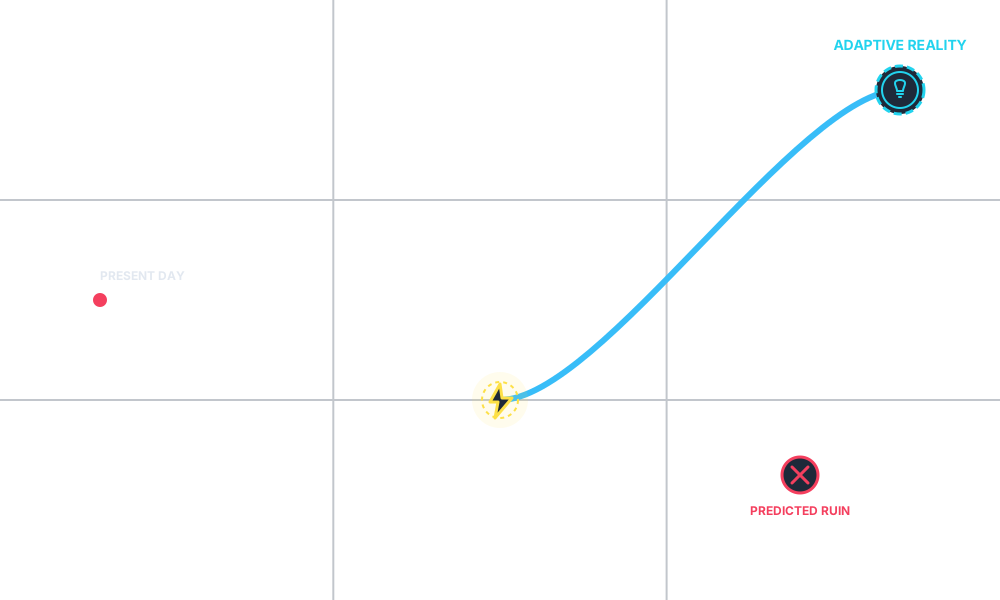
Imagine the exact inverse of that scenario happening just after World War II in Japan. If a Japanese academic in 1946 had predicted that their ruined nation would quickly become an economic superpower with record life expectancy and zero unemployment, they would have been committed to an asylum. Outrageous optimism is laughed out of the room, even when it turns out to be exactly what happens in reality.
Pessimists constantly fail because they forecast human events in a straight line, completely ignoring our capacity for adaptation. In 2008, environmentalists warned that China’s growing demand would require 98 million barrels of oil a day, far exceeding the world’s 85 million barrel output. They assumed we would simply run out of energy, completely forgetting that rising prices instantly create financial incentives for massive technological innovation.
When oil prices surged, it became highly profitable to extract oil that was previously considered too expensive to drill. This economic reality sparked the fracking revolution, and by 2019, United States oil production had exploded from five million barrels a day to thirteen million. The pessimist’s straight-line forecast broke because threats inevitably incentivize solutions of equal or greater magnitude.
The Asymmetry of Human Progress
Slow Miracles and Fast Tragedies
There is a structural asymmetry in how events unfold over time, which dramatically skews our perception of the world. Destruction is an event, but progress is a process. An earthquake, a stock market crash, or a terrorist attack can shatter our reality in a matter of seconds, instantly dominating every news cycle on the planet.
Miracles, however, are agonizingly slow and notoriously bad at capturing headlines. In January 1889, the Detroit Free Press confidently declared that human flight was physically impossible and that nature had reached its absolute limit. Just six months later, Orville Wright dropped out of high school to help his brother begin tinkering in their shed, completely ignoring the consensus of the era.
Even after the Wright brothers successfully conquered the skies, the world barely noticed the magnitude of their achievement. The Washington Post wrote a deeply cynical piece in 1909 claiming that commercial aerial freighters would never exist. The very first cargo plane took off a mere five months after that dismissive article was published.
The Invisible Momentum of Compounding
Because good news compounds over decades, it operates quietly in the background, entirely hidden from our daily awareness. If you look at medical progress on a month-to-month basis, it appears stagnant, leading many to believe that the healthcare system is failing. But if you zoom out, you see an awe-inspiring reality that dramatically alters the human condition.
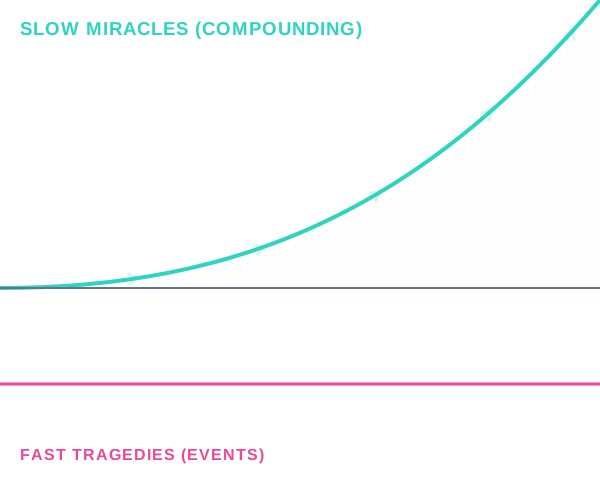
Since 1965, the age-adjusted death rate from heart disease has plummeted by more than 70 percent. This silent, grinding progress saves approximately half a million lives every single year. It is the statistical equivalent of saving the entire population of Atlanta from sudden death annually, yet we barely register it.
If a natural disaster wiped out half a million people, it would be the defining historical tragedy of our generation. But because those same lives are saved slowly, across thousands of hospitals over decades, it fails to trigger our evolutionary alarm bells. We remain obsessively focused on the short sting of sudden loss while remaining completely blind to the powerful, compounding pull of human progress.
The Psychological Safety of Despair
Cynicism as a Coward’s Refuge
Beyond our biological programming and media structures, there is a dark psychological utility to adopting a pessimistic worldview. Most people begin their lives in a state of sheltered naivety, completely blind to the malevolence of the world. When reality inevitably strikes and shatters that innocence, the natural psychological reaction is to retreat into rigid cynicism 3.
Cynicism is certainly a minor intellectual upgrade from blind naivety, as the veils have finally fallen from your eyes. However, the true tragedy occurs when intelligent people decide to make cynicism their permanent psychological residence. They become deeply arrogant in their despair, utterly convinced that anyone who believes things can improve is simply an idiot 3.
What these cynics fail to realize is that their profound doubt is actually a sophisticated defense mechanism to avoid taking responsibility. If the world is permanently broken and the future is destined for catastrophic failure, then you are entirely let off the hook. You don’t have to build a business, fix your relationships, or contribute to your community, because nothing matters anyway.
This abdication of duty can spiral into terrifyingly dark places if left unchecked. The Columbine killers represented the ultimate extreme of this mindset; they determined that existence was inherently cruel and responded by giving a violent middle finger to God and society. Cynics rarely question the moral validity of their own resentment, failing to see how their intellectualized doubt is just a coward’s way of turning away from the world 3.
The Shadow of Competence
Lowering your expectations is the easiest way to ensure you are never disappointed by reality. When Stephen Hawking was diagnosed with a paralyzing motor-neuron disease at age 21, he noted that his expectations for life were immediately reduced to zero. He famously remarked that everything he experienced after that moment was simply a bonus.
While Hawking’s perspective highlights a beautiful resilience, adopting a baseline of zero expectations artificially narrows the gap between outcomes and feelings. It is much harder to look at the future with genuine, earnest hope and risk having your heart broken by failure. Breaking out of this cynical paralysis requires something much more demanding than intelligence: it requires pure courage.
Sometimes, breaking free from a dark psychological rut means temporarily feigning the confidence you lack. In certain subcultures, like the pickup artist community, young men are taught to approach fifty women in a single day just to harvest phone numbers. While often morally questionable, the raw exposure therapy teaches them that rejection is not fatal, proving they can keep moving forward despite failure.

This is precisely why controversial figures often appeal to young men who are trapped in dependent, harmless, and bitter neuroticism. The shadow of aggression and false confidence beckons to the undeveloped mind because it is a massive step up from being chronically passive. However, if that forced confidence is not eventually integrated into genuine competence, it merely devolves into scripted, jaded psychopathy.
Reclaiming the Rational Optimist
Enthusiastic Building in a Cynical Age
To genuinely affect the world, you must actively reject the cultural programming that demands you act aloof and detached. In certain environments, like the United Kingdom’s “tall poppy syndrome,” there is a cynical, crabs-in-a-bucket mentality that ruthlessly mocks anyone who tries to rise above the baseline. Contrast this with the frantic, earnest energy found in American entrepreneurial circles, where high enthusiasm is actively celebrated rather than suppressed 4.
We need to make earnestness and sincere enthusiasm culturally acceptable again. There is a deeply flawed, selfish version of Stoicism today that treats the philosophy merely as a lifehack for waking up early or managing personal stress. True Stoicism demands much more; it requires you to master yourself so you can actually step up and care for others, rather than abdicating your responsibility to worse people 4.
This means you must ruthlessly curate the people you allow into your professional and personal life. You cannot partner with cynics and pessimists, because their toxic beliefs will always become a self-fulfilling prophecy. If you succeed, you make them look bad, but if you fail, they get the perverse satisfaction of proving their grim worldview correct 5.
The classic military doctrine offers three choices: lead, follow, or get out of the way. The eternal pessimist arrogantly demands a fourth option, where they refuse to lead or follow, but insist on standing in your way to explain exactly why your vision will fail. True builders possess a relentless action bias, ignoring the critics and taking the very first step just to see what happens 5.
The Ultimate Leverage Over the Future
A rational optimist does not wander blindly into traffic hoping the cars will magically stop. They maintain a clear-eyed view of reality, acknowledging the pitfalls and ruthlessly avoiding any risk of total ruin. You must stay out of jail, protect your physical health, and never gamble all your capital on a single bet 5.
Once you have insulated yourself from catastrophic ruin, the only logical move is to take massive, audacious swings at the future. Given the existential risks in the background of our cultural landscape, it is easy to understand why people feel displaced and despondent. But there has never been a moment in human history with more opportunity to live a truly good life and exert massive leverage over the future 6.
We are not merely passengers on a sinking ship; it is entirely up to us to get this right. During World War II, it was entirely rational to be terrified, but a conscious choice had to be made to secure a better reality. The difference between submitting to a Thousand-Year Reich and fighting for the world we actually inherited was the direct result of courageous action, not cynical surrender 6.
Your mind will constantly lie to you, telling you that the game is rigged and the end is near. It will try to convince you that retreating into the shadows of pessimism is the only way to prove your intelligence. But the ultimate truth is that the future belongs entirely to those who are brave enough to believe it can be built. Cynicism is the death of imagination, but optimism is the heavy lifting of history.


