


The gym was packed on January 2nd. Mark, sweating through his third set of squats, swore this year would be different. He’d white-knuckle his way through cravings, resist the siren call of the office donut tray, and finally shed those 20 pounds—pure willpower.
By February, his gym card gathered dust, and the donuts won. Again.
Willpower isn’t the hero of this story—it’s the villain. The real power lies in the invisible scripts running our lives: habits. They don’t ask permission; they just take over. And if you want to change, you don’t fight them—you rewrite them.
The Myth of Willpower: Why Suppression Fails
The Myth of Willpower: Why Habits Matter More
The cultural belief in willpower as the key to success is deeply ingrained in our society. This is particularly evident when it comes to weight loss, where a staggering 75% of Americans believe that self-control and willpower are the primary factors in achieving and maintaining a healthy weight. This belief is so pervasive that it shapes our approach to behavior change, often leading us to think that if we just want something badly enough, we can make it happen through sheer force of will. However, research suggests that this belief might be misplaced.
Wendy Wood, a professor of psychology and business at the University of Southern California, has found that willpower is not the driving force behind sustained behavior change. Instead, habits play a crucial role. Wood’s research indicates that while intentions and commitments are important for initiating change, they are not sufficient for maintaining it over time. This is because our actions often become automatic and unconscious, much like driving a car, where we don’t constantly think about every decision we make.
The cultural emphasis on willpower can be counterproductive. It sets us up for failure by suggesting that if we don’t achieve our goals, it’s because we lack sufficient willpower.
This can lead to feelings of guilt and inadequacy, rather than encouraging us to develop effective strategies for behavior change. Understanding the role of habits and the limitations of willpower can help us approach our goals more effectively and with greater compassion for ourselves. 1
The White Bear Study: Why Thought Suppression Backfires
Daniel Wegner’s famous ‘white bear study’ provides compelling evidence that thought suppression can be counterproductive. In this study, participants were instructed not to think about a white bear. The result was that they found it nearly impossible to avoid thinking about the white bear, and in fact, the thought became obsessive. This phenomenon is known as the ‘ironic process theory,’ which suggests that trying to suppress a thought can actually make it more salient and intrusive.
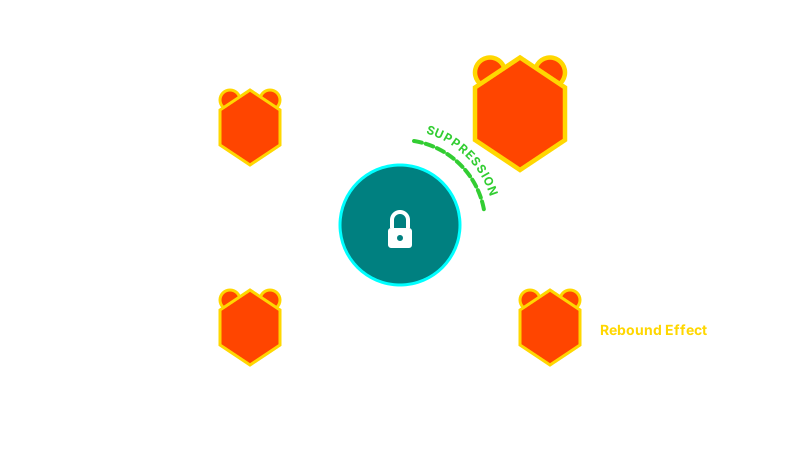
This study has important implications for our understanding of willpower. It suggests that trying to resist temptations or suppress desires can backfire, leading to an increased focus on the very things we are trying to avoid. This is particularly relevant when it comes to behaviors we want to change, such as quitting smoking or eating healthier. The challenge is not just to make a one-time change, but to maintain that change over the long term.
Relying solely on willpower can be ineffective and even counterproductive, as it can lead to a cycle of resistance and obsession. Wendy Wood’s research supports this idea. She found that people who are successful at achieving their goals are not necessarily those who have the most willpower, but those who have developed habits that make it easier to avoid temptations.
For example, they might not have cake in the refrigerator, or they might have coded certain foods as off-limits. This approach is more effective than trying to resist temptations through sheer willpower, which can be exhausting and ultimately unsustainable.
Why Willpower Alone Isn’t Enough for Change
Wendy Wood’s cousin provides a real-life example of the limitations of willpower and the importance of habit formation. The cousin announced on Facebook that she was going to lose weight, seeking public accountability and support. While she received plenty of encouragement and positive reinforcement, her commitment ultimately failed because she lacked a system for habit formation. This example highlights the difference between intentions and actions.
While intentions are important for initiating change, they are not sufficient for maintaining it over time. This is because our actions often become automatic and unconscious, much like driving a car. Without a system in place to support these automatic behaviors, it can be difficult to sustain change.
Wood’s research suggests that successful behavior change requires more than just willpower and intentions. It requires the development of habits that make it easier to avoid temptations and maintain desired behaviors.
This might involve setting up our environment in a way that supports our goals, such as not having cake in the refrigerator, or developing routines that make healthy behaviors more automatic. By understanding the role of habits and the limitations of willpower, we can approach our goals more effectively and with greater compassion for ourselves. 1
How Habits Really Work: The Science of Automatic Behavior
The Power and Formation of Habits
Habits are the invisible architects of our daily lives. They are automatic, unconscious behaviors that form through repetition in a consistent context. Imagine driving to work—you don’t consciously think about every turn or stop sign; your brain operates on autopilot. This is the power of habit.
Research reveals that about 43% of our daily actions are habitual, meaning they’re performed almost without thought, much like the routine of brushing your teeth or making your morning coffee. These actions aren’t driven by deliberate decision-making but by deeply ingrained patterns that free up mental space for other tasks. The formation of habits is a slow, incremental process. Each time you repeat an action in the same context and receive a reward—whether it’s the satisfaction of crossing off a to-do list or the rush of endorphins after a workout—your brain strengthens the association between the context and the behavior.
Over time, this association becomes so strong that the behavior feels effortless. For example, a writer who commits to writing 500 words a day eventually finds that sitting down at the keyboard becomes as automatic as breathing. The key is consistency: the more predictable and repetitive the action, the faster it becomes a habit. But habits aren’t just about efficiency—they’re also about survival.
Our brains are wired to conserve energy, and habits allow us to navigate the world without constantly reinventing the wheel. However, this also means that bad habits can form just as easily as good ones. The neighbor who drives to her child’s school instead of walking, even when walking is faster, illustrates how deeply ingrained habits can override logic.
The trick to breaking bad habits? Add friction—make the behavior more conscious.
If you’re trying to stop mindless snacking, eat with your non-dominant hand. The extra effort forces you to pause and reconsider, breaking the autopilot cycle.
How High Achievers Avoid Temptation Completely
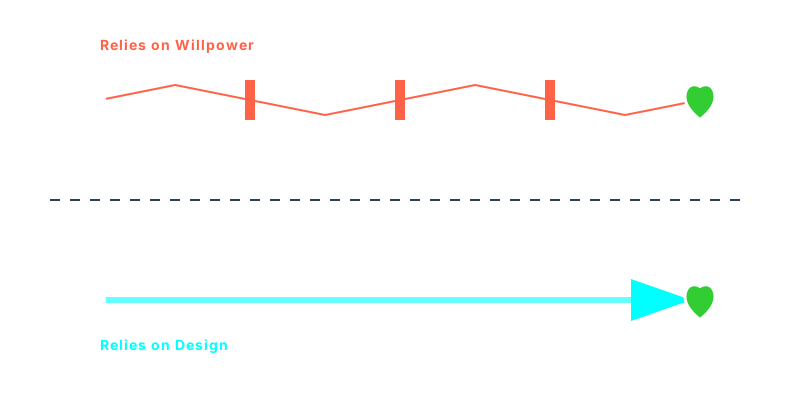
High achievers aren’t superhuman—they’re just really good at avoiding temptation. A German study turned the myth of willpower on its head by revealing that people who successfully stick to their goals aren’t the ones white-knuckling their way through resistance. Instead, they’re the ones who’ve designed their lives to sidestep temptation altogether. Think of it like an “irresistible staircase”: if you want people to take the stairs instead of the elevator, make the stairs more appealing—add music, bright colors, or even turn them into a piano keyboard.
The goal isn’t to force discipline but to make the desired behavior the easiest, most attractive choice. This study found that high achievers experience fewer temptations because they’ve coded their environments to support their goals. They don’t keep cake in the fridge; they don’t even see it as an option. Instead, they’ve mentally categorized it as “off-limits” or “for the kids,” making the decision automatic.
It’s not about resisting the cake—it’s about removing the cake from the equation entirely. This approach is far more sustainable than relying on willpower, which is a finite resource. When you’re not constantly battling desires, you conserve mental energy for what truly matters.
The beauty of this strategy is its self-reinforcing nature. The more you ignore temptations, the stronger your habits become, creating a feedback loop that makes sticking to your goals easier over time.
Wendy Wood’s own experience biking with a professional cyclist friend illustrates this perfectly. Even when the alternative (like taking a shortcut) is objectively easier, the habit-driven behavior persists because it’s no longer a conscious choice—it’s just what you do.
How Long Does It Take to Build a Habit?
Habits don’t form overnight—they’re built through repetition, and the timeline varies depending on the complexity of the behavior. Simple habits, like drinking a glass of water every morning, can become automatic in about two months. These actions are straightforward, requiring minimal effort and decision-making. The brain quickly associates the context (waking up) with the behavior (drinking water), and soon, you’re doing it without thinking.
Complex habits, however, take longer to solidify. Activities like going to the gym or writing daily involve multiple steps—getting dressed, traveling to the location, performing the action—and require more mental and physical effort. For these behaviors, it can take three to four months of consistent repetition before they become truly habitual. The key is consistency: the more you repeat the action in the same context, the stronger the mental association becomes.
Over time, the behavior shifts from a conscious effort to an automatic response. But here’s the catch: variability slows down habit formation. If you’re inconsistent—skipping days, changing routines—the brain takes longer to form those strong associations. This is why athletes and writers who stick to rigid schedules (e.g., writing 1,000 words every morning at 6 a.m.) find it easier to maintain their habits.
The predictability reinforces the behavior, making it feel effortless. So, if you’re trying to build a new habit, start small, stay consistent, and give it time.
The payoff? A behavior that sticks for life.
Designing Your Environment: The Power of Friction
How the Bullitt Center’s ‘Irresistible Staircase’ Boosts Stair Use to 65%
The Bullitt Center in Seattle offers a masterclass in how environmental design can nudge behavior change without relying on willpower. The architects didn’t just install stairs—they made them irresistible. By placing the staircase front and center with sweeping views of the city, they turned a mundane act into an experience. The result?
A staggering 65% of people opt for the stairs over the elevator. This isn’t about discipline; it’s about making the healthier choice the easier choice. The key here is friction reduction.
The elevator isn’t banned—it’s just tucked away, requiring extra effort to access. Meanwhile, the stairs are visually striking, socially inviting (with landings for conversation), and rewarding (thanks to those panoramic views).
It’s a perfect example of how small tweaks in our surroundings can override autopilot behaviors. If you want to change a habit, don’t fight your brain—redesign your environment to work with it.
How Proximity Influences Gym Attendance and Habit Formation
Distance might seem trivial, but research shows it’s a habit killer. A study found that people who live 3.5 miles from a gym go about five times a month, while those 5 miles away go just once a month. That 1.5-mile difference creates enough friction to derail consistency. The lesson? Proximity matters more than motivation. If your gym is a hassle to reach, your brain will default to the couch.
This principle applies beyond fitness. Want to eat healthier? Keep junk food out of sight and pre-cut veggies at eye level.
Want to read more? Place a book on your pillow instead of your phone. The less effort a good habit requires, the more likely it’ll stick.
How Uber’s Auto-Assign Feature Boosts Driver Retention
Uber cracked the code on habit formation by eliminating decision fatigue. Early on, drivers quit before hitting 10 rides because the mental load—deciding whether to take another fare—was exhausting. Uber’s solution? Automatic ride assignments. The moment a ride ends, the next one pings. No pause, no debate.
Just momentum. This mirrors how Netflix auto-plays the next episode or how fast-food chains ask, “Fries with that?” Corporations exploit friction (or lack thereof) to shape behavior. The takeaway? Design your habits like a product. Remove steps between you and the action.
If you want to write daily, leave your laptop open to a blank doc. If you want to meditate, keep a cushion in plain sight. Make the start effortless, and the habit will follow.
The Reward System: Why Immediate Gratification Wins
How Dopamine Reinforces Habit Loops
Dopamine isn’t just about pleasure—it’s the brain’s habit architect. Every time you perform a behavior and receive a reward, your brain releases dopamine, reinforcing the connection between the cue (the trigger), the behavior (the action), and the reward (the payoff). This creates a neural loop that, over time, becomes automatic. Think of it like a well-worn path in a forest: the more you walk it, the easier it becomes to follow without thinking.
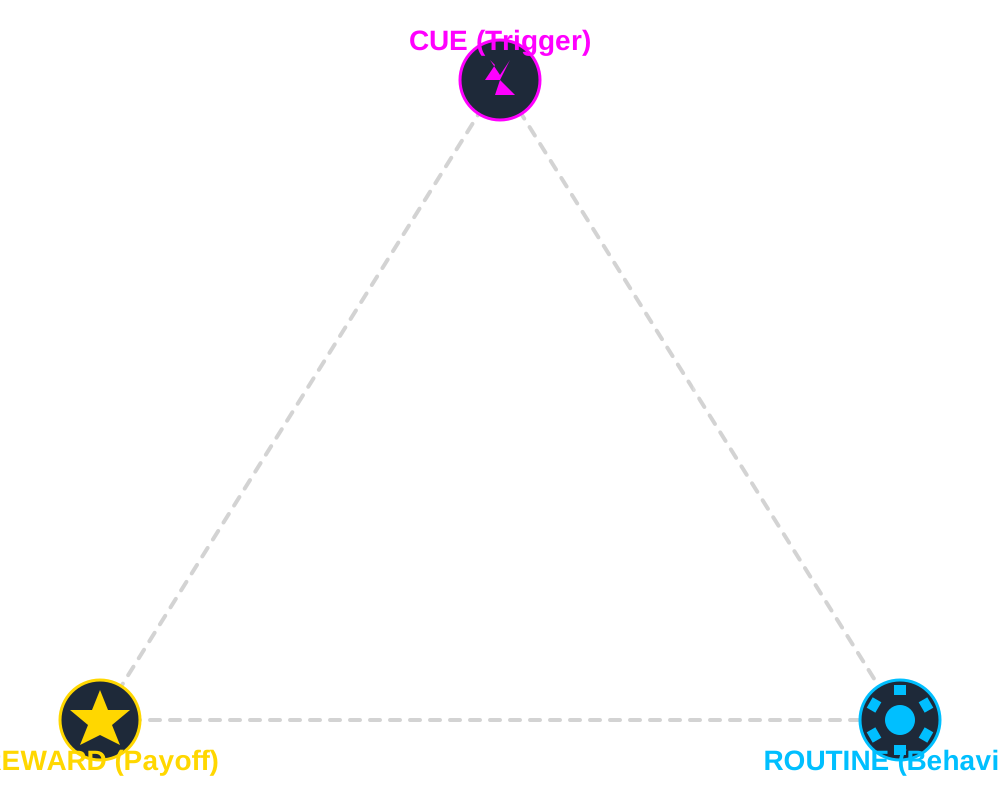
The key here is immediacy. Bad habits—like scrolling social media or snacking on junk food—thrive because they deliver instant dopamine hits. Your brain doesn’t care about long-term consequences; it’s wired to prioritize short-term rewards.
That’s why smoking, gambling, or binge-watching Netflix feel so effortless to maintain—they’re hardwired into your brain’s reward system. But healthy behaviors?
They often lack that immediate payoff. Exercising or eating veggies might not feel rewarding in the moment, even if they’re great for you long-term.
Why Immediate Rewards Are Key to Building Lasting Habits
If you’ve ever tried to motivate yourself with a distant reward—like promising a vacation after months of dieting—you’ve likely failed. That’s because delayed rewards don’t trigger the dopamine surge needed to reinforce habits. Wendy Wood’s research shows that habits only form when the reward is immediate. For example, if you force yourself to eat veggies but hate the taste, your brain won’t associate the behavior with pleasure, and the habit won’t stick.
But if you find a way to make veggies delicious—maybe by roasting them with your favorite spices—or pair them with a food you love, you create an instant reward. Suddenly, your brain starts linking healthy eating with satisfaction, making it easier to repeat. This principle explains why public health campaigns like “5 A Day” flopped.
The campaign educated people on the long-term benefits of eating fruits and veggies, but it didn’t address the immediate reward gap. Knowledge alone doesn’t change behavior—especially when habits are automatic.
Most people shop the same grocery aisles, buy the same foods, and eat the same meals without conscious thought. Without an instant payoff, the habit loop never forms.
How to Make Boring Habits Stick by Pairing Them With Rewards
Wendy Wood’s elliptical trick is a masterclass in habit hacking. She admits that working out on an elliptical is mind-numbingly boring—until she pairs it with competitive cooking shows. By restricting her favorite shows to workout time only, she turns exercise into a rewarding experience. The dopamine hit from the show reinforces the habit of working out, making it something she looks forward to rather than dreads.
This strategy works because it hijacks your brain’s reward system. If you’re trying to build a habit you dislike—like running or meal prepping—pair it with something you enjoy. Listen to a podcast only while jogging, or save your favorite playlist for gym sessions.
The key is to make the reward contingent on the behavior. Over time, your brain starts associating the habit with pleasure, and the behavior becomes automatic.
From Theory to Action: Practical Strategies for Habit Change
How to Build New Habits with Habit Stacking
One of the most effective ways to build new habits is by piggybacking—or stacking—them onto behaviors you already do automatically. Wendy Wood explains this as inserting a new action into an existing routine, like adding a link to a chain. For example, if you want to remember to take medication every night, place the pills on your nightstand and tie them to the last thing you do before bed—whether that’s turning off your phone or setting your alarm. Over time, the new behavior becomes as automatic as the old one.
This technique works because it leverages the brain’s love for efficiency. Your existing habits are already deeply ingrained, requiring minimal mental effort. By attaching a new habit to an established one, you bypass the need for willpower or conscious decision-making. The key is consistency: perform the new action in the same context every time.
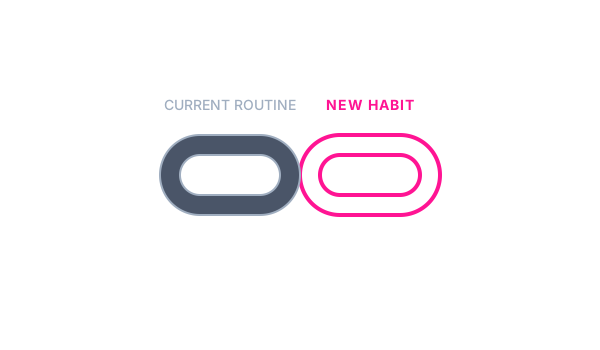
Eventually, your brain will link the two behaviors so tightly that skipping the new habit will feel incomplete, like forgetting to brush your teeth after washing your face. The beauty of piggybacking is its simplicity. You’re not trying to overhaul your entire routine—you’re just making small, strategic tweaks. Want to drink more water?
Keep a glass next to your coffee maker and sip it while waiting for your brew. Trying to stretch more?
Do it right after you take off your shoes at the end of the day. The less you have to think about it, the more likely it’ll stick.
How to Use Consistent Cues to Build Strong Habits
Cues are the invisible triggers that prompt habits, and Wendy Wood uses them masterfully in her own life. For her, breakfast with her husband isn’t just a meal—it’s a signal that the next step is sitting down to write for two hours. This consistency removes the mental debate of when or if she’ll work; the cue makes it automatic. By structuring her schedule this way, she eliminates decision fatigue and ensures her writing habit remains unshakable.
The power of cues lies in their predictability. Your brain thrives on patterns, and when a specific context (like breakfast) is consistently paired with a behavior (like writing), the association strengthens over time. This is why smokers often light up in the same spots—porches, car rides, or after meals. The environment becomes the cue, making the habit feel effortless.
To harness this, identify a reliable daily cue and anchor your new habit to it. For instance, if you want to meditate, do it right after your morning coffee.
If you want to read more, place a book on your pillow so seeing it triggers the habit. The more consistent the cue, the faster the habit forms. 1
How to Use Life Disruptions to Build Better Habits
Life’s chaos—moving, changing jobs, or even a global pandemic—can feel destabilizing, but it’s also a golden opportunity for habit reinvention. Wendy Wood calls this “habit discontinuity,” a moment when your usual cues disappear, forcing you to rebuild routines from scratch. Without the familiar triggers (like your old commute or office snack drawer), bad habits lose their grip, and new ones can take root. Research shows that people undergoing major life changes are more open to trying new behaviors because their autopilot is temporarily offline.
For example, someone who moves to a new city might start biking to work instead of driving simply because the old habit no longer fits the new environment. The key is to intentionally design your new context to support the habits you want. If you’re starting a remote job, set up a dedicated workspace to signal focus. If you’ve relocated, explore healthy grocery stores or gyms near your new home.
The takeaway? Don’t fear disruptions—exploit them.
Use these moments to reset your habits by removing old cues and introducing new ones. It’s like hitting the “refresh” button on your brain’s autopilot.
Conclusion
So here’s the truth: willpower isn’t the hero—it’s the sidekick. The real power lies in the habits we build, the environments we design, and the rewards we choose. Mark didn’t fail at the gym because he lacked discipline; he failed because he didn’t rewrite his habits. The donuts won because they were the easiest choice, not because he was weak.
Habits aren’t just behaviors—they’re the invisible scripts running our lives. They form through repetition, thrive on immediate rewards, and crumble when friction gets in the way. High achievers don’t white-knuckle their way through temptation; they remove it entirely. The Bullitt Center’s irresistible staircase isn’t a gimmick—it’s a blueprint for how we should design our lives.
And here’s the kicker: change doesn’t require Herculean effort. It requires strategy. Stack new habits onto old ones. Use life’s disruptions as a reset button.
Pair boring tasks with dopamine hits. Make the right choice the easiest choice.
If you’ve ever felt guilty for “failing” at a goal, remember this: it wasn’t your willpower that let you down. It was your system. Now go build a better one.
Want more insights on rewiring your brain for success? Dive into our other posts on habit science, productivity hacks, and the psychology of behavior change. Your future self will thank you.


