


The year was 161 AD, and Marcus Aurelius, the most powerful man in the Roman Empire, sat in his tent on the Germanic frontier, scribbling in his private journal. Outside, the roar of battle and the groans of the wounded filled the air. Yet, the emperor’s words were not of conquest or strategy, but of something far more radical: “You have power over your mind—not outside events. Realize this, and you will find strength.”
Just hours earlier, a messenger had delivered news of yet another betrayal—a trusted general had embezzled funds meant for the troops. His advisors seethed, demanding swift punishment.
But Marcus did something unexpected. He paused. He breathed. Then, he wrote: “The best way to avenge yourself is not to become like your enemy.”
He saw what his advisors could not: the general’s greed was not a personal attack, but a failure of his own character—a flaw born of fear, not malice. Marcus chose not to blame, but to understand. He redirected the funds, reprimanded the general, and moved on. The empire’s problems remained, but his suffering did not.
The Stoic Path: Freedom Through the Dichotomy of Control
The Stoic Secret: Your Judgments Shape Your Suffering
You’re stuck in traffic, late for an important meeting, and your blood pressure is rising. Your first thought? “This traffic is ruining my day.” But here’s the Stoic twist: traffic isn’t the problem. Your judgment about traffic is. Epictetus nailed it when he said, “What upsets people is not things themselves but their judgments about things.” This isn’t just philosophical wordplay—it’s a radical shift in how we experience the world.
The traffic exists, yes, but the anger, the frustration? That’s all you. And if it’s all you, then you have the power to change it.1 Now, let’s be real—understanding this concept is one thing; living it is another. It’s easy to nod along to Epictetus when you’re reading his words in a quiet room.
But when you’re in the thick of it—when your boss snaps at you, or your partner forgets an important date—suddenly, your judgments feel very real, and changing them feels like trying to stop a freight train with your bare hands. That’s because this principle isn’t about suppressing emotions or pretending everything is fine. It’s about recognizing that your emotions are a response to your interpretation of events, not the events themselves. And interpretations?
Those can be rewritten. Take Marcus Aurelius’ observation: “How much more grievous are the consequences of anger than the causes of it.” Think about that. The anger you feel in traffic might last five minutes, but the consequences—snapping at your kid, making a reckless driving decision, carrying that stress into your meeting—can ripple outward, creating more suffering than the traffic ever could.
The Stoics aren’t asking you to be a robot. They’re asking you to be a strategist. If your judgments are the root of your suffering, then mastering them is the ultimate hack for a happier life.2 3
The Three Levels of Blame: From External Fault to Inner Wisdom
Imagine blame as a ladder. Most of us start at the bottom rung: the uneducated person, who blames everyone and everything else. Your bad mood? Your partner’s fault.
Your failed project? Your boss is an idiot. This mindset is seductive because it lets you off the hook. If the world is to blame, you don’t have to change.
But here’s the catch: you also don’t get to grow. You’re stuck in a cycle of powerlessness, where your happiness is always at the mercy of external forces. And let’s be honest—how’s that working out for you? The next rung is the partly educated person, who flips the script and blames themselves.
This is progress! You’re taking responsibility, owning your role in your struggles. But it’s also a trap. Self-blame can become a form of self-flagellation, where you’re so busy beating yourself up that you forget to actually fix anything.
You might think, “I’m such a failure,” instead of, “I made a mistake, and here’s how I’ll learn from it.” This level is necessary—humility and self-awareness are crucial—but it’s not the endgame. Then there’s the top rung: the educated (or wise) person, who blames neither others nor themselves. This is where things get interesting. The wise person doesn’t see events as problems to be blamed on anyone.
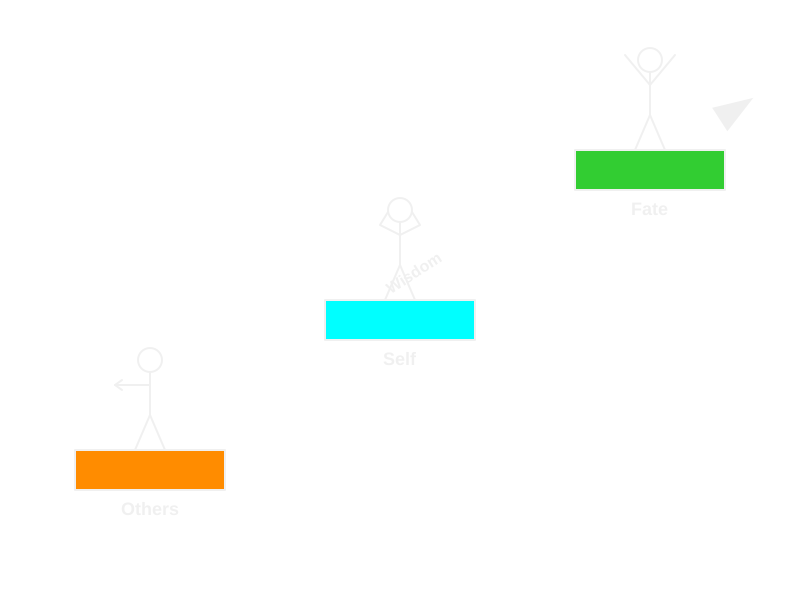
They see them as facts to be dealt with. This is the Stoic principle of amor fati—love of fate. It’s not about passively accepting everything that happens. It’s about actively embracing reality as it is, without the mental baggage of blame.
Why? Because blame is a distraction. It keeps you stuck in the past, reliving the injustice, instead of focusing on what you can do now. This aligns beautifully with Buddhist teachings on dependent origination, which remind us that suffering arises from conditions—greed, hatred, delusion—and not from independent, isolated events.
The Buddha taught that suffering ceases when its causes are removed. So, if blame is a cause of suffering (and it is), then removing blame removes suffering.
The wise person understands this. They don’t waste energy on “Why me?” or “Why them?” They ask, “What now?” And that’s where true freedom begins. 4
Why Stoics Don’t Blame Others
Here’s a hard truth: most of what people do has nothing to do with you. That coworker who snapped at you? They’re not out to ruin your day. They’re dealing with their own causes and conditions—maybe they didn’t sleep well, or they’re stressed about a sick parent, or they’re just having a bad day.
The Stoics and Buddhists both emphasize this: people’s actions are the result of their own internal states, not a personal attack on you. When you internalize this, something magical happens. You stop taking things personally. Marcus Aurelius put it this way: “If you are distressed by anything external, the pain is not due to the thing itself, but to your estimate of it.” So, when someone cuts you off in traffic, your distress isn’t caused by their bad driving.
It’s caused by your judgment that their bad driving is an affront to you. But what if you reframed it? What if you thought, “Wow, they must be in a hurry. I hope they get where they’re going safely”?
Suddenly, the event hasn’t changed, but your suffering has. This shift isn’t about being a doormat or letting people walk all over you. It’s about recognizing that blame is a dead end. It doesn’t solve problems; it just creates more of them.
The wise Stoic (and the wise Buddhist) focuses on what they can control: their own actions, their own responses. They understand that blame is a form of ignorance—ignoring the web of causes and conditions that shape every moment.
And ignorance, as the Buddha taught, is the root of suffering. So, the next time you feel the urge to blame, ask yourself: “Is this helping me, or is it just adding to my suffering?” The answer might surprise you. 5
How to Apply Stoic Reframing in Daily Life
Let’s get practical. How do you actually apply this in the messy, chaotic reality of daily life? Start small. Next time you feel frustration bubbling up—maybe your internet is slow, or your kid spilled juice on your laptop—pause.
Instead of thinking, “This is ruining my day,” try, “I’m feeling frustrated because I expected things to go smoothly.” See the difference? The first thought makes you a victim. The second makes you an observer of your own mind. Here’s another trick: the Stoic reframe.
Take a situation that’s bothering you and ask, “What’s within my control here?” If your flight is delayed, you can’t control the airline’s schedule, but you can control how you spend the extra time. Read a book. Meditate. Call a friend.
The Dichotomy of Control isn’t about resignation; it’s about redirecting your energy to where it actually makes a difference. Epictetus said it best: “Suffering arises from trying to control what is uncontrollable, or from neglecting what is within our power.”
So, stop neglecting your power. Use it. And remember, this isn’t about suppressing emotions. It’s about understanding them.
When you feel anger, don’t judge yourself for feeling it. Instead, get curious. “Why am I angry? What judgment am I making here?” Often, you’ll find that your anger is tied to an expectation—you expected someone to behave differently, or you expected life to be fair. But life isn’t fair.
People are flawed. And that’s okay. The more you practice this, the more you’ll realize that your peace of mind isn’t dependent on the world behaving perfectly.
It’s dependent on you choosing to respond wisely. And that’s a superpower worth cultivating.
The Buddhist Path: Liberation Through Interdependence and No-Self
Understanding Dependent Origination: How All Actions Are Conditioned
Imagine you’re sipping your morning coffee, and someone bumps into you, spilling it everywhere. Your immediate reaction? Frustration, maybe even anger. But what if I told you that this anger isn’t just a reaction to the spill—it’s the result of a complex web of causes and conditions?
This is the heart of Dependent Origination, the Buddha’s profound insight into the nature of existence. Dependent Origination, or Paticca Samuppāda, teaches that nothing exists in isolation. Everything arises in dependence on other phenomena. Your anger isn’t just about the spilled coffee; it’s tied to your expectation of a smooth morning, your past experiences with similar incidents, and even your belief in a solid, unchanging self that was wronged.

The Buddha put it succinctly: “When this exists, that comes to be. With the arising of this, that arises. When this ceases, that ceases.” This isn’t just philosophy—it’s a roadmap to freedom.
By understanding the interconnectedness of all things, we can begin to untangle the knots of blame and suffering. The Twelve Links of Dependent Origination illustrate how suffering arises and perpetuates in a cycle.
It starts with ignorance (Avijjā), which leads to volitional formations (Sankhāra), and so on, until it culminates in aging and death (Jarāmaraṇa). This isn’t just a theoretical construct; it’s a practical tool for understanding our experiences. For instance, when someone cuts you off in traffic, your anger arises because of your expectation of courteous driving, your interpretation of their action as disrespect, and your past conditioning.
But if you change the conditions—perhaps by cultivating mindfulness or compassion—the entire experience shifts. Suddenly, you’re not a victim of circumstance; you’re an active participant in your own liberation.
Why Blame Stem from the Three Poisons: Greed, Hatred, and Delusion
At the core of blame lies ignorance, the first link in the chain of Dependent Origination. Ignorance here isn’t just a lack of knowledge; it’s a fundamental misunderstanding of reality. We cling to the illusion of a solid, unchanging self, and this clinging gives rise to the Three Poisons: greed, hatred, and delusion. These poisons fuel our tendency to blame others and ourselves, trapping us in a cycle of suffering.
The Buddha’s teaching on anātman, or no-self, challenges our deeply ingrained belief in a permanent, autonomous self. According to this teaching, what we call the “self” is merely a collection of ever-changing processes—thoughts, emotions, physical sensations—none of which are permanent or inherently “us.” This might sound unsettling, but it’s actually liberating. If there’s no solid self to defend or blame, then the entire framework of blame collapses.
We begin to see that our identities are fluid, and so are the identities of others. This realization fosters compassion, as we recognize that everyone is caught in the same web of causes and conditions.
Understanding the Buddhist Doctrine of No-Self
The concept of no-self isn’t about denying the existence of individuals; it’s about seeing through the illusion of a fixed, independent self. Think about it: you’re not the same person you were ten years ago. Your cells have regenerated, your thoughts and beliefs have evolved, and your experiences have shaped you in countless ways. The “you” of today is a transient collection of moments, not a static entity.
This understanding is crucial because it dismantles the foundation of blame. If there’s no solid “you” to be harmed, then there’s no solid “other” to blame. This doesn’t mean we stop taking responsibility for our actions.
On the contrary, it means we take responsibility more wisely. Instead of blaming ourselves or others, we focus on understanding the conditions that led to a particular outcome.
This shift in perspective allows us to respond with compassion rather than anger, with wisdom rather than ignorance. It’s a transformative insight that aligns beautifully with the Stoic practice of focusing on what we can control—our responses—rather than what we can’t.
Compassion Replaces Anger Through Interconnection
When we truly grasp the interdependent nature of reality, something remarkable happens: compassion naturally arises. We see that everyone is struggling with their own causes and conditions, just as we are. This realization dissolves the barriers of blame and separation. Instead of reacting with anger or frustration, we respond with empathy and understanding.
This is the ultimate tool for breaking free from the cycle of blame. By cultivating compassion, we not only liberate ourselves from suffering but also contribute to the well-being of others. It’s a win-win situation.
The next time you feel the urge to blame, pause and ask yourself: “What conditions led to this moment? How can I respond with compassion instead of anger?” This simple shift can transform your relationships, your emotional well-being, and your entire outlook on life. 4 1
Convergence and Divergence: Two Paths, One Destination
How to Achieve Inner Freedom Through Stoicism and Buddhism
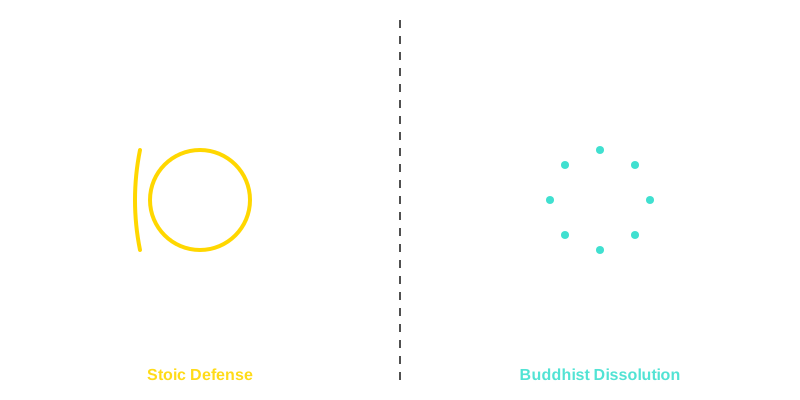
At first glance, Stoicism and Buddhism seem like distant cousins—one rooted in ancient Greece, the other in the foothills of the Himalayas. Yet, when you dig deeper, you find they’re both digging toward the same truth: freedom isn’t about controlling the world; it’s about mastering your relationship to it. The Stoics call this the Dichotomy of Control. Epictetus didn’t mince words: “Suffering arises from trying to control what is uncontrollable, or from neglecting what is within our power.” Think about that next time you’re fuming over a delayed flight or a rude email. The flight’s delay?
Out of your hands. Your blood pressure? Totally within your control. The Stoic doesn’t waste energy raging at the sky; they ask, What can I do right now? Maybe it’s reading a book, striking up a conversation, or simply practicing patience.
The result? Less suffering, more serenity.2 Buddhism, meanwhile, approaches this through Dependent Origination—the idea that everything arises in dependence on other things. That spilled coffee isn’t just a standalone disaster; it’s the result of a chain of causes: the barista’s hurry, your distracted step, the laws of physics. The Buddha taught that suffering comes from clinging to the illusion that things should be a certain way.
But when you see the interconnectedness of all things, you realize: This moment is exactly as it should be. There’s no cosmic conspiracy against you. Just causes and conditions, unfolding. Both philosophies, in their own ways, are telling us the same thing: You are not a puppet of external events. The Stoic trains their mind to focus on what they can control; the Buddhist dissolves the very notion of a separate self that needs to be in control. One uses reason to master judgment; the other uses insight to dissolve the judge.
But the destination? Identical: a life where outer chaos doesn’t dictate inner peace.
Stoicism vs. Buddhism: Mastering the Mind or Dissolving the Self?
Here’s where the paths diverge—at least on the surface. Stoicism is like a mental gym. It hands you tools: the Dichotomy of Control, Amor Fati (loving your fate), negative visualization. These are practical, rational techniques designed to reshape how you perceive the world.
Marcus Aurelius didn’t just philosophize about resilience; he practiced it while ruling an empire, dealing with plagues, and fending off invasions. When he wrote, “The pain is not due to the thing itself, but to your estimate of it,” he was offering a cognitive hack. Change the estimate, change the pain.
Buddhism, on the other hand, goes nuclear. It doesn’t just want to reshape your perceptions—it wants to dissolve the perceiver.
The doctrine of anātman (no-self) is radical. It says the “you” that’s getting angry, the “you” that’s feeling slighted? That’s a mirage. A temporary cluster of thoughts, sensations, and memories, not a fixed entity.
When you really grok this—viscerally, not just intellectually—blame becomes impossible. Who’s left to blame? There’s no solid “self” to defend, no solid “other” to vilify.
Just a fluid, interconnected dance of causes and conditions. So, Stoicism is about mastering the judge; Buddhism is about seeing through the illusion of the judge.
One is a top-down approach (train the mind), the other bottom-up (dissolve the mind’s foundations). But here’s the kicker: both lead to the same place.
The Stoic who masters their judgments and the Buddhist who sees through the self both end up in a state where external events—insults, setbacks, losses—don’t derail them. They respond instead of react.
Stoic vs. Buddhist: Responding to Road Rage
Let’s get concrete. Imagine someone cuts you off in traffic. How would a Stoic and a Buddhist handle it? The Stoic would deploy the Dichotomy of Control. Can I control the other driver’s actions? Nope. Can I control my reaction? Absolutely.
They might think: This person is in a hurry. Maybe they’re rushing to the hospital. My anger won’t change their driving, but it will ruin my mood. They reframe the event as an opportunity to practice patience—a virtue in their control. The Buddhist, meanwhile, would lean into anātman and compassion.
They’d recognize that the driver’s actions are the result of their own causes and conditions—maybe stress, maybe habit, maybe a bad day. There’s no “evil driver” to blame, just a person caught in their own web of suffering.
The Buddhist might even send a silent wish: May they arrive safely. May they find peace. Same scenario, different tools—but both lead to the same outcome: no blame, no suffering, just equanimity.
How a Stoic and a Buddhist Handle Insults
Let’s take it further. Suppose someone insults you in a meeting. Ouch. The Stoic would ask: Is my reputation within my control? Not entirely—people will think what they think. Is my response within my control? Yes. They might pause, take a breath, and choose to respond with curiosity instead of defensiveness: “That’s an interesting perspective. Can you tell me more about why you see it that way?” They’re not suppressing their emotions; they’re directing them.
The insult becomes a chance to practice wisdom and self-control. The Buddhist would go deeper. They’d notice the sting of the insult and ask: Who is feeling insulted?
The ego, the constructed self. But if there’s no fixed self, then the insult is like a arrow shot at the sky—it has nowhere to land. They might feel compassion for the insulter, recognizing that their words come from their own insecurity or suffering.
Instead of retaliating, they might silently repeat a mantra: “This person is struggling. May they find peace.” In both cases, the result is the same: the insult loses its power. The Stoic disarms it with reason; the Buddhist dissolves it with insight.
But the freedom? Identical.
Living Beyond Blame: Practical Integration for Modern Life
The Power of the Stoic Pause: Choosing Your Response
Imagine you’re in a heated argument, and your partner says something that feels like a personal attack. Your heart races, your face flushes, and you’re ready to fire back with a sharp retort. But what if, in that moment, you paused? Just for a second.
That’s the power of the Stoic pause—a tiny gap between stimulus and response where freedom lives. Marcus Aurelius reminded us that our distress comes not from events themselves but from our judgments about them. That pause is where you reclaim your power. It’s the moment you recognize: I don’t have to react.
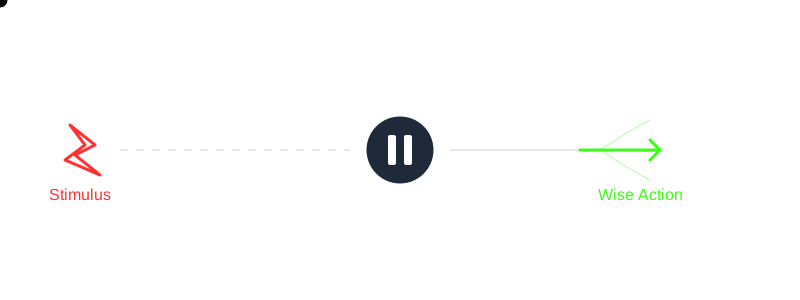
I can choose. This isn’t about suppressing emotions; it’s about acknowledging them without letting them dictate your actions. The pause is your mental circuit breaker, preventing automatic, blame-driven reactions.
Buddhism complements this with the insight of anātman—no-self. When you pause, you’re not just stopping a reaction; you’re seeing through the illusion that there’s a fixed “you” being attacked. The Buddha taught that what we call the self is just a bundle of perceptions and feelings, ever-changing.
So, when someone insults you, who exactly is being insulted? The pause lets you observe the arising of anger without clinging to it.
You realize: This is just a feeling passing through. It’s not me.
What’s Within Your Control? Stoic and Buddhist Inquiry
Once you’ve paused, the next step is inquiry. Stoicism offers a simple but profound question: What’s within my control here? Epictetus made it clear: we control our judgments, our actions, our attitudes. Everything else—other people’s words, traffic jams, the weather—is outside our sphere of influence. When you ask this question, you shift from blame to empowerment.
Let’s say your boss criticizes your work harshly. Instead of spiraling into self-blame or resentment, you ask: Can I control my boss’s tone? No. Can I control how I respond? Absolutely.
You might choose to listen for constructive feedback, ask clarifying questions, or simply let the criticism roll off you like water off a duck’s back. This inquiry isn’t about resignation; it’s about redirecting your energy to where it matters. Buddhism deepens this inquiry with the lens of Dependent Origination.
You ask not just What can I control? but What conditions led to this moment? Your boss’s criticism didn’t arise in a vacuum. Maybe they’re under pressure from their own supervisor, or they’re dealing with personal stress. Seeing the web of causes softens blame.
You realize: This isn’t about me. It’s about a chain of events I can’t fully see. This perspective fosters compassion, which, ironically, makes it easier to respond wisely.
Reframe Challenges as Growth Opportunities
Reframing is where the magic happens. It’s the art of seeing a situation not as a problem to blame but as an opportunity to grow. Stoicism teaches that every obstacle is a chance to practice virtue. Marcus Aurelius wrote, “The impediment to action advances action.
What stands in the way becomes the way.” That traffic jam? An opportunity to practice patience. That rude email? A chance to cultivate kindness.
Take a missed promotion. Instead of blaming your boss or yourself, reframe it: What can I learn from this? Maybe it’s a sign to develop new skills, or perhaps it’s a nudge to explore a different career path. The reframe turns suffering into a teacher.
It’s not about toxic positivity—it’s about seeing reality clearly and choosing a response that serves you. Buddhism reframes through the lens of impermanence (anicca).
That missed promotion? It’s just one moment in a vast, ever-changing flow. The Buddha taught that clinging to outcomes—whether success or failure—creates suffering.
When you reframe, you see: This is just a condition. Conditions change. This doesn’t mean passivity; it means engaging with life without the burden of blame or attachment. You act, but you don’t cling to the results. 4
Choosing Wise Action Over Blame
Finally, we arrive at action—the moment where wisdom meets the world. The Stoic and Buddhist paths converge here: both teach that freedom isn’t about avoiding blame but about acting wisely, regardless of circumstances. The wise person doesn’t waste energy on Why did this happen? They ask, What will I do next? Imagine a friend cancels plans last minute. The blame-driven response? *They’re so inconsiderate!
They never respect my time!* The wise response? I’ll use this evening to relax, read, or call another friend. You’re not ignoring your feelings; you’re choosing a response that aligns with your values. This shift from blame to choice is what transforms frustration into freedom.
This is the Stoic practice of amor fati—loving your fate, not because it’s perfect, but because it’s yours to shape. Buddhism adds the dimension of compassion. You recognize that your friend’s cancellation is part of their own web of causes—maybe they’re exhausted, or dealing with something unseen. Instead of blame, you send them a kind message: No worries, hope you’re okay. This isn’t weakness; it’s strength.
Compassion dissolves the illusion of separation, reminding you that we’re all interconnected.5 In the end, living beyond blame isn’t about being a passive doormat or a detached monk. It’s about engaging with life fully—feeling deeply, acting boldly, loving fiercely—but without the chains of blame.
You become the author of your responses, the master of your mind. And that’s where true freedom begins. 3
Conclusion
Both Stoicism and Buddhism, in their profound wisdom, guide us to the same liberating truth: we are not victims of the world or other people. The Stoic finds freedom by mastering their judgments and focusing on what is within their control—their own virtue and character. The Buddhist finds freedom by realizing the empty, interdependent nature of all things, including the self that feels offended.
By integrating the Stoic practice of reframing our thoughts with the Buddhist insight of compassion for all beings trapped in the cycle of conditioned reactions, we can move beyond blame. This is not a path of passivity, but one of profound empowerment, where we reclaim our emotional autonomy and engage with the world with clarity, wisdom, and peace.
The next time you feel the urge to blame—whether it’s the driver who cut you off, the coworker who undermined you, or even yourself for a mistake—pause. Ask yourself: What’s within my control here? And then choose wisely. Because in the end, the only thing we truly control is how we respond. And that’s where your power lies.*
If this resonated with you, explore more insights on Stoicism, Buddhism, and the art of living wisely. The journey to inner freedom is just beginning.


