


I want to talk about the strange, intoxicating loop of human approval. We are deeply social animals, hardwired from birth to seek the warm embrace of our peers. But in our modern scramble for validation, we’ve fundamentally broken our internal compasses. We spend our lives frantically chasing the applause of people who don’t even play the same game we do.
It is a subtle, corrosive trap. We start by just wanting to fit in, and we end up sacrificing our entire identity on the altar of public opinion.
The Trap of the Applause Meter
Hooked on the Wrong Social Feedback
The longing to be chosen and recognized is woven deep into our psychological DNA. It feels entirely natural to want the stamp of approval from the market, the crowd, and our colleagues 1. We view this social acceptance as a basic survival mechanism. But this primal desire quickly morphs into a chronic, soul-crushing habit of people-pleasing.
We continuously contort ourselves to meet the expectations of individuals who value entirely different things than we do. As a result, their praise becomes a deeply misguided measure of our actual worth 2. We end up calibrating our internal scales based on the arbitrary weights of strangers. It is a mathematical certainty that if you optimize for the crowd, you will inevitably lose yourself.
Trapped in the Hall of Mirrors
When you constantly twist your principles to extract validation from the masses, you don’t just deceive them. You ultimately deceive yourself. As Naval Ravikant observed, when you lie to elevate your status or meet external expectations, you inevitably get trapped in a psychological hall of mirrors 3.
Many public figures eventually burn out because they start feeling immense pressure to live up to in private the fake things they were projecting in public. You end up puppeted by a persona that doesn’t even exist. It’s a tragic paradox where you desperately try to impress people who fundamentally don’t care about the real you. If they saw the real you, they wouldn’t care, and the people who actually would like the real you never get to see it.
Demanding Respect from the Masses
This performative existence exhausts the spirit. You become a grifter to your own soul. We live in a world that severely lacks authenticity, where everyone wants to be seen as something they fundamentally are not 3.
If you are terrified of losing the crowd’s approval, you will never update your priors or admit your mistakes. You will freeze your intellectual development just to maintain an illusion of consistency. As Ravikant bluntly stated, demanding respect from the faceless masses is a complete fool’s errand. You truly only want the respect of the very few people that you genuinely respect 3.
The Error Correction of Life
Hypocrisy Versus Authentic Growth
The crowd despises when you change your mind. To the internet, updating your opinions looks identical to blatant hypocrisy. People love to dig up old podcast clips or past proclamations to catch you in an error, believing this somehow elevates their own fragile status.
But all life and all learning are fundamentally systems of error correction. Every knowledge creation system works by making bold guesses and then systematically correcting the inevitable errors. By definition, if you are genuinely learning, you are going to be wrong most of the time. You cannot allow the fear of public criticism to prevent you from being a dynamic, evolving system.
Disingenuous Versus Simply Wrong
There is a massive difference between being wrong and being disingenuous. If you make a guess about something complex—like the timeline for artificial intelligence—and you get it wrong, that is just the natural friction of intellectual pursuit. It is no big deal as long as you have a genuine reason for believing what you say.
However, purposefully lying just to look good to the crowd is a fatal character flaw. Our collective radars have become hyper-sensitized to smell this exact kind of grifter behavior. When you lie to protect your reputation, you are prioritizing the applause of strangers over the integrity of your own mind. We see this everywhere online with shills who never truly believed the things they were selling all along.
The Madmen and the Musician
Seeking Admiration from the Insane
Let’s look at how the ancient thinkers diagnosed this peculiar social sickness. The Stoic philosopher Epictetus possessed a notoriously sharp tongue when it came to dissecting the logic of social approval. In his Discourses (Book 1, Chapter 21), he challenged a student who was desperately craving the admiration of the general public.
Epictetus essentially asked him: Aren’t these the very people you normally describe as mad? He then delivered the fatal philosophical blow, asking if that was what the student truly wanted—to be admired by madmen. We have to ask ourselves this exact same question every time we check our social media metrics or seek office validation.
Playing to an Empty Audience
To drive this point home, Epictetus frequently relied on the brilliant analogy of the musician. He asked us to consider the plight of a master musician tuning their instrument before a performance. A serious musician shouldn’t care for a single second if a tone-deaf non-musician applauds their tuning.

The applause of the uninitiated is completely meaningless to the mastery of the craft. Only another trained musician possesses the ear to know if the instrument is actually in tune. Why on earth would we treat the mastery of our own lives any differently?
Winning the Wrong Game Entirely
This logic translates perfectly to the pursuit of character and virtue. Only a person of virtue can accurately judge the actions of another person of virtue. If you deeply value integrity, but you seek the approval of those who worship externals like money, status, and popularity, you are committing a massive logical error.
Their praise essentially means you have succeeded at their superficial game, not your own deeply considered one. You are scoring points on a scoreboard that you don’t even believe in. It is the ultimate tragedy to reach the top of the ladder only to realize it was leaning against the wrong wall.
The Reverse Indicator of Success
When Public Applause Means Failure
This brings us to one of the most counterintuitive, yet intensely powerful, concepts in both Stoic philosophy and modern behavioral psychology. The idea that praise can actually be a sign that you have strayed from your path is foundational to Stoicism. Epictetus warned in Discourses (Book 2, Chapter 1) that mainstream popularity frequently comes at the direct expense of a person’s character.
He suggested that if you find yourself effortlessly pleasing the “many,” you have likely “lost your work” and derailed your philosophical progress. He went so far as to claim that the praise of the unphilosophical masses should be treated as a literal “reverse indicator” 4. If they blindly love what you are doing, you are probably doing something terribly wrong.
Inheriting Their Shared Misery
The logic here is cold, hard, and undeniably accurate. People naturally judge others in accordance with their own specific values, not the values of the people they are actually judging. Therefore, if superficial people suddenly think you amount to something, it is time to deeply distrust yourself 4.
The absolute surest way to win the praise of the unhappy crowd is to adopt their values, which allows them to indirectly praise themselves through you. But the fatal snag in this Faustian bargain is that by sharing their values, you will inevitably end up sharing their misery. You cannot inherit their approval without inheriting their anxiety.
The True Goal of the Stoic
We forget that the core objective of these ancient frameworks wasn’t to win popularity contests. A Stoic’s primary goal in life was simply to attain and maintain tranquility. They wanted to systematically avoid experiencing negative emotions while continuing to enjoy positive ones.
To achieve this, they had to ruthlessly sever the tie between their internal state and external validation. Epictetus wouldn’t even share his setback stories with others just to impress them with his resilience, knowing that trying to gain praise from non-Stoics was utterly pointless. He viewed their criticism not as an insult, but as hard evidence that he was actually on the right track.

Deploying the Comedic Frame
Instead of chasing applause, a sensible person actively ignores the praise of those who don’t share their core values. We have to learn how to actively deflect the judgment of the crowd. The Romans favored employing a “comedic frame” to deal with the sheer absurdity of public opinion.
Seneca reminded his followers that laughter, and a massive amount of it, is the only correct response to the things that drive us to tears 4. Socrates used this same technique, responding to a physical assault not with anger, but with a wry joke about the misfortune of not knowing whether to wear a helmet on a walk. Laughter acts as an impenetrable shield against the heavy demands of the crowd.
The Architecture of Authenticity
Turning the Hostile Eye Inward
When we constantly adjust our behavior to match the crowd, we absorb their toxic metrics into our own subconscious. We begin to enforce their rules upon ourselves. Jordan Peterson noted that the standards you use to judge other people will inevitably become the exact standards by which you judge yourself 5.
You simply become what you practice. There is no escaping this psychological law of reciprocity. If you adopt a shallow, hyper-critical standard to please the masses, you will relentlessly turn that hostile eye inward upon your own soul.
Disagreeableness and Intellectual Combat
We often avoid asserting our true values because we are terrified of social combat. We shy away from being disagreeable because we want to keep the peace. But thinkers like Douglas Murray showcase the profound value in a judicious pitilessness.
Murray is highly disagreeable and enjoys intellectual combat, refusing to let people off the hook for bad ideas. It is a dangerous game to play, requiring immense care with words, but it is necessary to defend the truth. When you combine that sharp, combative intellect with a vicious sense of humor, you become entirely immune to the mob’s approval.
Dealing With the Bloody Bottom
To break out of these old psychological patterns, we have to stop avoiding the necessary friction of authenticity. People-pleasing is often just a cowardly avoidance of difficult conversations. If you have a problem, you must deal with it right now, right to the absolute bottom 5.
It is incredibly unpleasant in the moment, but if you do it, you only have to do it once and the problem eventually goes away 5. You stop carrying the bloody problem every single day for the rest of your life. We have to apply this exact same uncompromising pitilessness to our desire for public approval.
Auditing Your External Praise
We need a functional system to process external feedback without losing our minds or our morals. You must recognize that all praise is simply neutral data. It is not a moral victory; it is merely an informational input.
If your stated goal is depth or virtue, but you receive glowing praise from someone who exclusively values the superficial, that data is screaming that you’ve done something superficial. It isn’t a compliment in the slightest. It is negative feedback that requires immediate, aggressive course correction.
Applying the Rigorous Filter
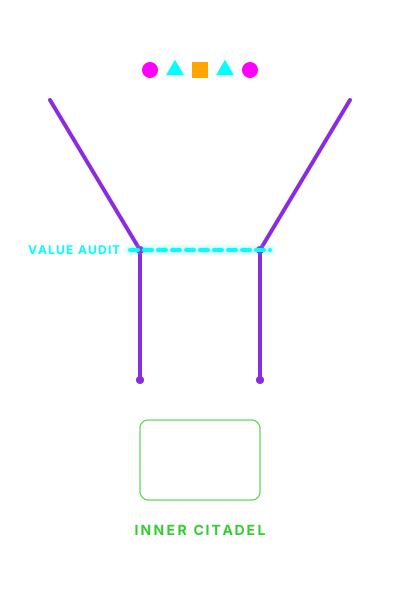
This means you must ruthlessly audit every single piece of praise before accepting it into your psyche. When someone claps for you, you have to stop and ask: Does this person actually value what I value? 2.
If the answer is no, you must discard the applause immediately. You cannot build a solid foundation on the shifting sands of public opinion. You must become completely immune to both the venom of your critics and the honey of your false admirers.
Cultivating the Inner Citadel
Surrounding the Imperial Throne
History is littered with cautionary tales of those who failed to filter their applause and lost their minds as a result. The Roman Emperor Marcus Aurelius dealt directly with the intoxicating adulation of crowds and the suffocating presence of sycophants. He realized that these false friends offered fake appreciation solely to extract favors.
He understood the brutal reality of power dynamics. He knew these same sycophants would happily offer their undying love to his replacement tomorrow if he were to be deposed. Their praise was entirely transactional, devoid of any real substance or truth. They were a virus in the guise of a fan club.
The Modern Corporate Sycophant
These types of false friends aren’t just relics of ancient Rome. They abound in all sorts of modern workplaces, swarming positions of influence and often suffocating those with actual power. They nod at your bad ideas, laugh too hard at your terrible jokes, and shower you with unearned praise.
If you occupy a position of authority, you must realize that whatever praise they heap upon you is not real. It is a transactional illusion that must be ruthlessly disregarded.
Discarding the Utterly Worthless
Aurelius understood that praise from such hollow sources wasn’t just inaccurate; it was utterly worthless. He learned to completely disregard the cheap flattery of the court, applying the exact same philosophical detachment to their inevitable criticisms.
He knew that a man’s true delight is simply to do the things he was made for, free from the deafening noise of public opinion. He focused entirely on cultivating his own inner virtues, recognizing that his character was the only thing he truly controlled. As Seneca noted in his work On the Happy Life, no man can live a happy life if he cares what strangers think about him.
The Only Witness You Truly Need
Ultimately, your character is your only permanent possession. Seeking the validation of others inevitably weakens your personal integrity and derails your path of self-improvement 1. You cannot serve two masters; you cannot pursue quiet virtue while desperately performing for the loud crowd.
As Epictetus wisely advised, if you ever find yourself tempted to look for outside approval, realize that you have already compromised your integrity. You don’t need the crowd to validate your existence. If you need a witness to your virtue, you must be your own.
Conclusion
We spend so much of our remarkably limited time on this rock desperately trying to win games we don’t even want to play. We trade our peace of mind for the fleeting, transactional applause of strangers who will forget us by tomorrow morning. We build massive, hollow monuments to our own insecurities, hoping that enough social approval will somehow fill the quiet void inside.
But true freedom begins the exact moment you stop outsourcing your self-worth to the crowd. It requires the immense, terrifying courage to let the masses think you are entirely failing while you quietly build a life of genuine substance. It means walking away from the applause meter, auditing your feedback, and trusting your own internal compass. The applause of the crowd is merely the sound of your own chains being forged.
Footnotes
-
Friends, Romans, Countrymen, or How to deal with the desire for the approval from other people. – The Stand Up Philosophers ↩ ↩2
-
44 Harsh Truths About The Game Of Life - Naval Ravikant (4K) ↩ ↩2 ↩3
-
De Mello, Anthony. Awareness: The Perils and Opportunities of Reality. Edited by J. Francis Stroud, Image-Doubleday, 1990 ↩ ↩2 ↩3
-
The War Between Who You Are & Who You Could Be - Jordan Peterson (4K) ↩ ↩2 ↩3


