


Steve Jobs stood before the Stanford graduates in 2005, his voice steady but his words heavy with the weight of mortality. “Remembering that I’ll be dead soon is the most important tool I’ve ever encountered to help me make the big choices in life,” he said. The man who built an empire on innovation wasn’t fixated on stock prices or market share in that moment.
He spoke of love, of loss, of the fleeting nature of time. Just six years later, he would be gone—leaving behind not just a company, but a legacy of moments that mattered.
Yet, in the years leading up to that speech, Jobs had been a man obsessed. Not with time, but with money, with success, with the relentless pursuit of the next big thing. He had driven himself and his teams to the brink, trading hours for dollars, relationships for productivity.
And then, cancer. A diagnosis that didn’t just threaten his life but shattered the illusion that money could buy him more of what truly mattered: time with his family, the chance to see his children grow, the quiet joy of a life well-lived.
We chase money believing it will buy us happiness, only to find that the more we accumulate, the more we lose sight of what truly enriches our lives. The greatest currency isn’t in our wallets—it’s in the hours we spend, the connections we nurture, the moments we choose to savor. And yet, we trade it all away, one paycheck at a time.
The Money-Happiness Paradox: Why What We Believe Is Wrong
The Happiness Paradox: Why More Money Isn’t Making Us Happier
It’s a paradox we’ve all bought into: money equals happiness. When researchers surveyed 127 American university students, “happiness” was the most common emotion tied to money. It makes sense—money fuels the American Dream, the pursuit of comfort, security, and freedom. Yet, the data tells a different story.
Despite a five-decade surge in national wealth, American happiness levels have barely budged. Psychologists like Diener and Biswas-Diener (2002) have long noted the weak link between income and well-being, while economists like Easterlin (1995) highlight the stagnation of happiness despite economic growth. So, why the disconnect? 1 The answer might lie in what we’re not focusing on: time. While money dominates our aspirations, time governs our daily experiences.

Americans, in their quest for wealth, have increased work hours, leaving less room for relationships and leisure—key drivers of happiness. Europeans, contrastingly, have used economic gains to reduce work hours, prioritizing time with loved ones. The result?
Rising happiness levels across Europe. This suggests that the pursuit of money, without a balanced focus on time, may leave us richer but no happier.
Europe’s Time vs. America’s Money
Europe’s approach offers a compelling case study. As wealth grew, Europeans chose to work less, investing time in social connections and personal well-being. The outcome? Higher happiness levels.
Americans, however, doubled down on work, trading time for money—yet happiness flatlined. This isn’t just about economics; it’s about priorities. Research by Layard (2005) underscores that happiness thrives when time is spent on meaningful relationships, not just productivity. The lesson?
Money can buy comfort, but time buys joy. The European model challenges the American work ethic, suggesting that happiness isn’t a byproduct of wealth but of how we allocate our most finite resource: time.
Why Focus on Time, Not Money, for Happiness
Enter Resource Salience Theory, a game-changer in understanding happiness. It posits that what we focus on—time or money—shapes our behavior and well-being more than what we have. Thinking about time nudges us toward social connections, while fixating on money drives us toward work. This isn’t just theory; experiments show that priming people to think about time increases their desire to spend it with loved ones, boosting happiness.
Conversely, money-focused thoughts lead to isolation and overwork, despite the productivity gains. The psychology behind this is profound. Time is emotionally charged—it’s tied to mortality, relationships, and personal meaning. Money, however, is transactional.
Studies reveal that even subtle reminders of money (like seeing dollar signs) make people less likely to help others or engage socially. Meanwhile, time-focused individuals prioritize experiences over possessions, aligning with research by Van Boven and Gilovich (2003) that experiential purchases yield greater happiness. The takeaway?
Happiness isn’t about having more; it’s about focusing on what truly enriches life. Shift your attention from dollars to hours, and you might just find the joy you’ve been chasing.
The Psychology of Time vs. Money: Two Different Mental Worlds
How Time Shapes Emotional Well-Being and Social Connections
Time isn’t just a ticking clock—it’s the fabric of our most meaningful experiences. When we think about time, we’re drawn to what truly matters: relationships, personal growth, and moments that define us. Research shows that time-focused individuals prioritize social connections, spending more hours with loved ones rather than chasing productivity. This shift isn’t trivial—it’s tied to deeper fulfillment.
Studies by Reis (2000) highlight how autonomy, competence, and relatedness (the pillars of well-being) thrive when time is prioritized over money. The emotional weight of time also stems from its finite nature. Unlike money, which can be earned and lost, time is irretrievable.
This scarcity makes it precious, nudging us toward experiences that enrich our lives. Experiments reveal that even subtle reminders of time—like a clock or a birthday—can prompt people to seek out social interactions, which are strongly linked to happiness. It’s no coincidence that Europeans, who prioritize leisure and family time, report higher happiness levels than Americans, who often trade time for money.
How Money Shapes Our Relationships and Self-Worth
Money, on the other hand, operates in a different psychological realm. It’s transactional, tied to utility and self-sufficiency. When money dominates our thoughts, we’re more likely to prioritize work, productivity, and individual achievement—often at the expense of social bonds. Studies by Vohs et al. (2006) show that even passive exposure to money (like seeing dollar signs) can make people less likely to help others or engage in communal activities.
The result? A focus on money can leave us feeling isolated, even if our bank accounts grow. This isn’t to say money is inherently bad—it provides security and opportunities.
But when it becomes the primary lens through which we view life, we risk losing sight of what truly enriches us. The psychological consequences of money, as explored by Zhou et al.(2009), reveal that it can even alter our perception of social distress, making us less empathetic. The takeaway? Money can buy comfort, but it can’t buy connection.
How Mortality Awareness Shifts Priorities to Relationships

Facing mortality has a way of clarifying what truly matters. Research in near-death psychology shows that when people confront their own finitude, their priorities shift dramatically—away from professional ambitions and toward relationships. This phenomenon, known as mortality salience, underscores the emotional weight of time.
When we’re reminded of life’s fragility, we crave connection, not cash. This aligns with the broader findings of Resource Salience Theory: time-focused thinking fosters happiness because it aligns with our deepest human needs.
Whether through near-death experiences or everyday reflections, the message is clear: time spent with loved ones is time well spent. 1 The lesson? Shift your focus from dollars to hours, and you might just find the joy you’ve been chasing.
Experimental Evidence: How Priming Changes Behavior and Happiness
How Time Priming Affects Social and Work Plans
In a national sample of 318 adults, researchers found that priming participants to think about time significantly increased their planned socializing and decreased their planned working time. The effect was statistically robust, with a clear distinction between time-primed individuals and those primed with money or neutral stimuli. Interestingly, the study also revealed that low-income individuals, who might be expected to prioritize money due to financial constraints, were not influenced by money priming in the same way as their higher-income counterparts.
This suggests that for those with limited financial resources, money concerns may already be so salient that additional priming has little effect. The findings underscore the power of psychological focus—even in a diverse population, shifting attention to time can override financial pressures and encourage social connection.
Psychological Focus Overrides Financial Scarcity
Even among low-income populations, where financial necessity might dominate decision-making, time priming proved effective. In this study, 76 low-income participants were primed with time, money, or neutral words. Despite their economic constraints, those primed with time reported planning to spend more time socializing and less time working compared to the money-primed group.
This result is particularly striking because it demonstrates that psychological focus can transcend financial reality. The study also found that socializing was consistently rated as more happiness-inducing than working, regardless of priming condition. This reinforces the idea that time-focused thinking fosters behaviors aligned with well-being, even when money is scarce.
Time-Primed Individuals Socialize More and Report Higher Happiness in Café Study
In a real-world café setting, the effects of time vs. money priming were put to the test. Participants were subtly primed with time, money, or neutral words before entering the café, where their behavior was unobtrusively observed. The results were striking: time-primed individuals spent 60% of their time socializing, compared to just 25% for those primed with money.
Moreover, time-primed participants reported significantly higher happiness and satisfaction ratings (M=4.17) than their money-primed counterparts (M=3.53). This field study confirms that the psychological shift induced by time priming translates into tangible behavioral changes—even in a noisy, real-life environment. The findings highlight how a simple nudge toward time awareness can lead to more fulfilling, happiness-rich experiences.

The Social Connection Mediator: Why Time Thinking Boosts Happiness
Social Connection Mediates Link Between Time Focus and Happiness
The data doesn’t lie: social connection is the secret sauce linking time-focused thinking to happiness. In a rigorous mediation analysis, researchers found that socializing significantly mediated the relationship between time salience and well-being (Sobel’s z = 2.49, p =.01). This means that when people think about time, they’re more likely to seek out social interactions—and those interactions, in turn, boost their happiness. The numbers tell a compelling story.
Participants primed with time spent far less of their day working (M =.06) compared to those primed with money (M =.41). But here’s the kicker: time-primed individuals didn’t just work less—they socialized more. Even compared to a neutral control group, time-focused people were more likely to engage with others, while money-focused individuals were less likely.
And when happiness was measured? Time-primed participants left the café feeling significantly happier (M = 4.17) than their money-primed counterparts (M = 3.53). The mediation analysis confirmed it: the happiness boost came from the increased socializing, not just the shift in focus. 1
Socializing and Intimate Relations Boost Happiness Most
Not all activities are created equal when it comes to happiness. The research reveals a stark contrast: socializing (M = 5.23) and intimate relations (M = 5.51) rank as the top happiness-inducing activities, while working (M = 3.54) and commuting (M = 2.66) drag us down. Even relaxing (M = 5.40) and eating (M = 5.17) scored high, but the study zeroed in on social connections because they’re the cornerstone of well-being. Why?
Because humans are wired for connection. Reis et al. (2000) and Ryan & Deci (2001) have long established that relatedness—our need to feel connected to others—is a fundamental psychological requirement for happiness.
Time-focused thinking naturally nudges us toward these high-value activities, while money-focused thinking pulls us toward the low-happiness grind of work and commuting. The lesson? If you want to maximize joy, prioritize people over productivity.
Why Social Connection Is Key to Lasting Well-Being
This isn’t just about feeling good in the moment—it’s about fulfilling core human needs. Self-Determination Theory tells us that well-being thrives when three key needs are met: autonomy, competence, and relatedness. Time-focused thinking addresses all three, but its superpower lies in relatedness. When we prioritize time, we invest in relationships, which satisfy our deep-seated need for connection.
Money, on the other hand, often leads us to prioritize autonomy (independence) and competence (achievement) at the expense of relatedness. The result? A lopsided approach to happiness that leaves us feeling accomplished but isolated.
The research underscores that social connection isn’t just a nice-to-have—it’s a must-have for lasting well-being. By shifting our focus from money to time, we align our daily choices with what truly fulfills us.

Practical Applications: Using Time Awareness for Better Living
Focus on Time, Not Money, to Boost Happiness
What if the key to happiness isn’t earning more, but simply thinking differently about what you already have? Research shows that redirecting attention from money to time can enhance happiness without requiring additional resources. In one study, participants primed with time-related words (like “clock”) planned to spend more time socializing and less time working compared to those primed with money-related words (like “price”). This shift didn’t demand more hours in the day—just a change in focus.
The magic lies in how time-focused thinking aligns with what truly brings joy. Socializing and intimate relations rank among the highest happiness-inducing activities, while working and commuting drag us down. By consciously redirecting attention—whether through reminders, journaling, or mindful reflection—we can nudge ourselves toward behaviors that foster connection and well-being.
The lesson? Happiness isn’t about having more; it’s about focusing on what enriches life.
Balancing Productivity and Social Connection in the Workplace
Workplaces often prioritize financial metrics, but what if they shifted focus to time and relationships? Creating environments that support both productivity and social connection could transform employee well-being. For instance, companies could design spaces that encourage spontaneous interactions, like communal areas or flexible work hours that allow for socializing.
Even small changes—like framing deadlines in terms of time saved rather than money earned—could foster a culture where employees feel more connected and engaged. The data is clear: Americans’ long workdays cut into time spent with loved ones, yet relationships are essential for happiness.
Workplaces that integrate time awareness—such as encouraging breaks for socializing or recognizing the value of non-work interactions—could see happier, more productive teams. The goal isn’t to abandon productivity but to balance it with what truly fulfills us.
Teaching Time Awareness and Relationships in Financial Education
Traditional financial literacy education focuses on money management, but what if we also taught time awareness? Integrating relationship skills and time-focused thinking into curricula could equip students with tools for lasting well-being. For example, schools could incorporate exercises that highlight the emotional value of time—like journaling about meaningful moments or discussing how social connections contribute to happiness.
Research shows that students’ happiness peaks during social interactions, not academic work. By emphasizing time as a finite, precious resource, educators can help students prioritize experiences that foster joy and connection.
The result? A generation that values relationships as much as financial success.
Cultural and Societal Implications: Rethinking Success Metrics
Why Time-Rich Cultures Are Happier Than Money-Obsessed Ones
The cultural lens through which we view resources—time or money—shapes our collective well-being. The research suggests that America’s obsession with money may be a psychological trap, one that Europe has largely avoided. While Americans chase financial success, Europeans have leaned into time-rich lifestyles, prioritizing leisure, family, and social bonds. The result?
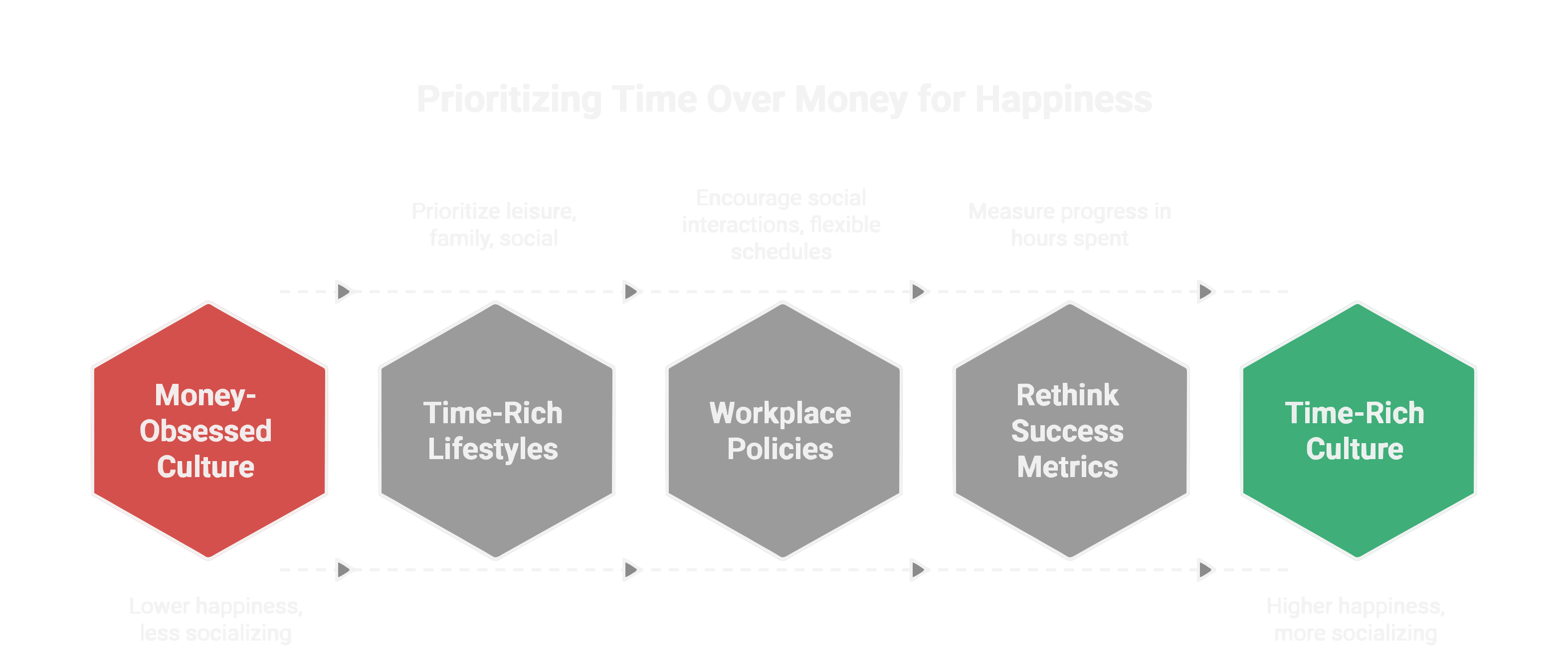
Higher happiness levels across the Atlantic, despite similar economic prosperity. This isn’t just about policy; it’s about psychology. The study hints that money may be more frequently primed in American culture—through media, work culture, or societal expectations—than in Europe. When money dominates our mental landscape, relationships and happiness suffer.
The data from Experiment 2 (Fig. 2) is telling: time-primed individuals spent 60% of their café time socializing, while money-primed participants spent just 25%. This behavioral shift isn’t trivial—it’s a reflection of deeper cultural priorities. The implications stretch beyond borders.
Would the effect hold in cultures where time awareness is already ingrained, like Buddhist traditions? Or among those whose work is their primary source of social connection?
These questions challenge us to rethink how societies define success. If happiness thrives on time and relationships, perhaps it’s time to measure progress not just in GDP, but in hours spent with loved ones.
Rethinking Workplace Policies for Better Well-being
Workplaces are ground zero for the money-time tension. Current policies often prioritize financial incentives—bonuses, overtime pay, productivity metrics—but what if they shifted focus to temporal well-being? The research suggests that even small changes could yield outsized happiness gains. For instance, companies could redesign workspaces to encourage spontaneous social interactions, or implement flexible schedules that protect personal time.
Consider the café study: time-primed participants reported higher happiness (M=4.17) than money-primed ones (M=3.53). Now imagine applying this to offices. Instead of framing deadlines in terms of financial stakes (“This project is worth $X”), what if leaders emphasized time saved (“This will free up hours for your family”)? Or what if performance reviews included metrics for team connection, not just output?
The policy potential is vast. From mandated “social hours” to subsidized family time, workplaces could become laboratories for happiness—proving that productivity and well-being aren’t mutually exclusive.
Rethinking Success: Why Money Doesn’t Equal Happiness
The research forces us to confront an uncomfortable truth: financial achievement is a flawed proxy for life satisfaction. The data is clear—socializing (M=5.23) and intimate relations (M=5.51) rank far above working (M=3.54) in happiness ratings.
Yet, societies continue to equate success with wealth, GDP growth, or stock market gains. What if we measured progress differently? Picture a world where policies prioritized time affluence—ensuring citizens have hours for relationships, not just dollars for consumption.
Where schools taught time awareness alongside financial literacy, or where urban design favored communal spaces over shopping malls. The research offers a roadmap: by manipulating psychological focus, we can nudge entire populations toward happier behaviors. This isn’t utopian thinking; it’s evidence-based.
The study’s mediation analysis (Sobel’s z=2.49) proves that social connection mediates the link between time focus and happiness. The message? Collective well-being isn’t about having more—it’s about focusing on what truly enriches life. The question is: will we listen?
Limitations and Future Directions
Sustaining Time Salience: From Short-Term Boost to Lasting Habit
The research on Resource Salience Theory offers compelling evidence that shifting focus from money to time can boost happiness in the short term. But a critical question lingers: can these effects be sustained over time? The café study and lab experiments demonstrate immediate behavioral changes—more socializing, less working—but what happens when the novelty of time priming wears off?
Behavioral science suggests that sustained change requires more than one-time interventions. For time salience to become a lasting habit, it may need to be integrated into daily routines.
Techniques like mindfulness practices, time-tracking apps, or even workplace policies that encourage time awareness could help reinforce this shift. The key lies in making time-focused thinking automatic, not just a temporary nudge.
The Need for Cross-Cultural Validation
The study’s findings are rooted in American and European contexts, but how do they apply to cultures with fundamentally different relationships to time and money? In societies where time is already highly valued—such as Buddhist traditions that emphasize mindfulness—would time priming still yield the same happiness boost? Conversely, in cultures where financial survival is a daily struggle, might money priming override time-focused thinking?
Cross-cultural research is essential to determine whether Resource Salience Theory holds universal truth or if its effects are shaped by societal norms. Understanding these variations could unlock tailored interventions for diverse populations.
How Personality and Life Stage Affect Time-Money Choices
Not everyone responds to time and money priming in the same way. Personality traits—like conscientiousness or extraversion—could influence how strongly individuals prioritize social connection over work. Life stages matter too: a young professional climbing the career ladder may be more money-focused, while a retiree might naturally gravitate toward time-rich activities. Professional contexts also play a role.
Someone in a high-pressure finance job may find it harder to shift focus away from money, even with priming. Future research should explore these individual differences to refine interventions.
The goal? To move beyond one-size-fits-all solutions and create personalized strategies for lasting happiness.
Conclusion
Steve Jobs stood on that Stanford stage not as a billionaire, but as a man who had glimpsed the fragility of time. His words weren’t about stock options or market dominance—they were about love, mortality, and the moments that define us. That’s the paradox this research lays bare: we chase money believing it will buy us happiness, only to discover that the real currency is time.
The numbers don’t lie. Despite decades of economic growth, American happiness has flatlined while European well-being has risen—not because Europeans have more money, but because they’ve chosen to spend it on time.
Time with family, friends, and themselves. The research is clear: when we focus on time, we invest in relationships, and those relationships are the bedrock of joy. Money, for all its utility, can’t buy that.
But here’s the hopeful twist: happiness isn’t about having more—it’s about focusing on what you already have. A simple shift in attention—from dollars to hours—can rewrite the script.
The café study proved it: people primed to think about time socialized more and left happier. No windfall required. Just a change in perspective.
So what now? Start small. Notice the moments. Choose the conversation over the overtime.
Measure your days not in paychecks, but in laughter, connection, and the quiet satisfaction of time well spent. The research gives us permission to step off the treadmill and ask: What if the life I’ve been chasing is already here? Because in the end, no one ever wished they’d spent more time at the office.
Hungry for more insights on happiness, productivity, and the art of living well? Dive into our other posts.


