Explore how the financialization of the human soul turns life into a spreadsheet. Learn to reclaim meaning beyond numbers and embrace true human connection.
We are currently living through a strange, quiet epidemic of hyper-optimization. Every time I open a podcast app or browse social media, I am bombarded by people trying to hack their existence into a perfectly calibrated machine. We track our sleep cycles, we measure our macros, and we evaluate our relationships based on their perceived return on investment.
It feels as though a bizarre strain of corporate accounting has infected the way we think about being human. I hear friends describe dating as a “numbers game” or a “funnel,” using the exact same vocabulary a sales manager uses to describe closing software deals. We are no longer simply living our lives; we are managing them like an asset portfolio.
This mindset didn’t emerge in a vacuum. It is the logical conclusion of a society that has decided the only truth worth trusting is one that can be plotted on an axis. But when you start viewing every interaction, every relationship, and every moral choice through the lens of a transaction, something vital begins to rot.
We have convinced ourselves that if we just run the numbers correctly, we can solve the fundamental vulnerability of the human condition. It is a seductive lie. We are trying to balance a ledger that was never meant to be balanced.
The Trap Of Expected Value
If you spend any time in finance, tech, or modern self-improvement circles, you will inevitably collide with the concept of “Expected Value” (EV). It is the golden calf of the modern rationalist. On the surface, calculating the expected value of a decision seems like a wildly effective way to navigate a chaotic world.
The formula is painfully simple. You multiply the probability of an outcome by the payoff of that outcome, subtract the costs, and you have your expected value. It is the perfect tool for a professional poker player trying to decide whether to call a bet on the river.
When you apply this framework to resource allocation or business strategy, it works beautifully. It strips away emotional bias and forces you to confront cold, hard probabilities. But the rationalist’s fatal flaw is the belief that a tool useful in one domain must be universally applicable to all domains.
When the EV framework bleeds into your personal life, it mutates into a kind of socio-pathology. People start trying to calculate the expected value of attending a friend’s wedding, weighing the cost of the flight against the probability of making a useful networking connection. They ignore the intangible, unquantifiable aspects of life because a spreadsheet cannot process love, loyalty, or duty.
Why Life Is Not A Repeatable Game
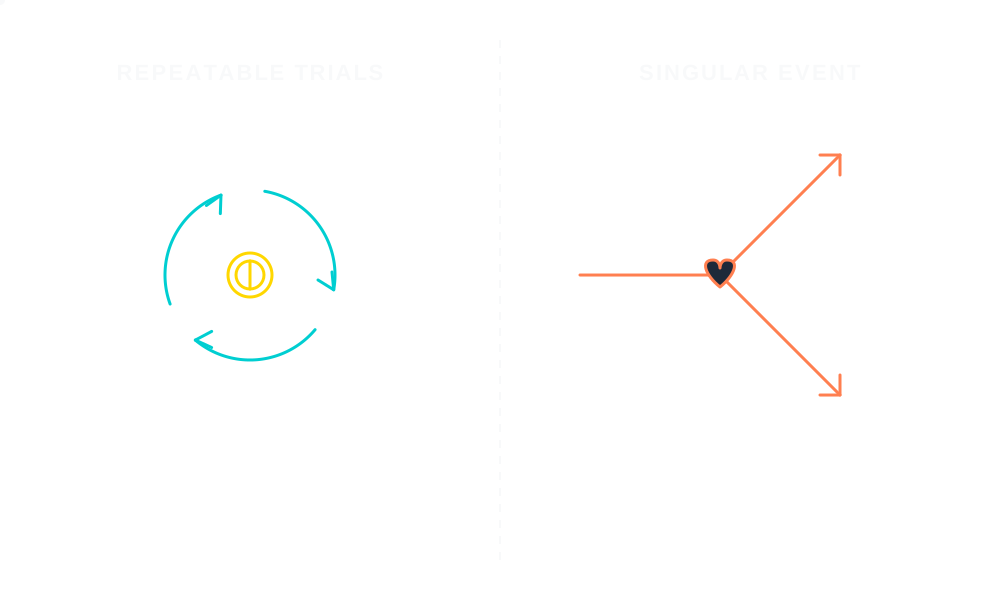
The most glaring flaw in the EV mindset isn’t just its coldness; it’s the mathematical reality of its limitations. Critics within the EV community itself frequently note a devastating caveat to the entire philosophy. Expected value fundamentally assumes repeatable trials.
The math of EV only works if you can play the game thousands of times. If a coin flip offers you a 50% chance to win ten million dollars and a 50% chance to lose your life savings, the expected value is massively positive. Over ten thousand flips, you would be a billionaire.
But you do not get ten thousand flips in the game of life. You only have one life savings, meaning if you lose on the first flip, you are ruined, and the game ends forever. Most consequential life decisions - choosing a spouse, having a child, starting a business, or making a major moral compromise - happen only once.
The “long-run average” logic is entirely useless when navigating irreversible, high-stakes choices. You cannot divorce your wife to test a different dating hypothesis and simply average out the happiness scores over a thirty-year timeline. When you apply probabilistic gambling mechanics to singular, irreplaceable human events, you are not being rational; you are being dangerously reckless.
From Market Economy To Market Society
We have reached a point where we instinctively apply market logic to situations where it has absolutely no business being applied. This isn’t just a quirky cultural trend; it is a profound philosophical shift. We have allowed the vocabulary of economics to become the primary language of our social lives.
Harvard philosopher Michael Sandel meticulously documents this shift in his book What Money Can’t Buy: The Moral Limits of Markets. He argues that we have drifted away from merely having a market economy to actively being a market society 1. A market economy is a tool - a valuable and effective tool - for organizing productive activity.
A market society, however, is a way of life where market values seep into every aspect of human endeavor. Sandel points out that market reasoning has successfully colonized domains like friendship, education, healthcare, and even death 1. Areas of human experience that were previously governed by norms, morals, or mutual affection are now governed by price.
It is easy to miss this colonization because it happens by degrees. We start by commodifying small conveniences, and before we know it, we have commodified the human experience itself. We assume that adding a financial transaction to a social interaction doesn’t change the interaction, but we are entirely wrong.
The Crowding Out Effect On Morality
When you introduce money into a non-market setting, it doesn’t just sit there neutrally. It actively changes the character of the goods or practices being exchanged. Sandel calls this the “crowding out” effect, where introducing a market incentive actually degrades or destroys the intrinsic meaning of an act.
Consider the idea of paying children cash incentives to get good grades or to read books. On a purely transactional level, it might boost reading rates in the short term. But it fundamentally corrupts the child’s relationship with learning, transforming reading from a path of self-discovery into a tedious wage-labor job 1.
The examples Sandel documents are simultaneously hilarious and deeply depressing. He notes the existence of companies you can hire to craft custom apologies to your loved ones, or services where you can purchase pre-written, professionally delivered best-man toasts for a wedding. The moment the audience finds out the toast was purchased, the entire emotional resonance of the act evaporates instantly.
You cannot buy a genuine apology any more than you can buy a genuine friend. Monetizing these acts completely destroys their value, because their value was entirely derived from the effort, care, and sacrifice required to produce them. As Sandel warns, we are actively “economizing love,” and in doing so, we are bankrupting ourselves.
The Myth Of Universal Commensurability
At the heart of this transactional worldview is a deep philosophical assumption that we rarely question. We assume that all good things in life are ultimately commensurable. Commensurability is the idea that everything can be compared on a single, uniform scale of value - usually utility or money.
If everything is commensurable, then everything has a price. It means that the joy of holding your newborn child, the satisfaction of a job well done, and the taste of a really good cheeseburger are all just different quantities of the exact same generic “goodness.” This is the underlying logic that makes cost-benefit analysis feel universally applicable.
But anyone who has ever lived a full, messy, complicated human life intuitively knows this is false. You cannot weigh the betrayal of a friend against the acquisition of a new car. They do not exist on the same spectrum.
When we try to force incommensurable goods onto a single spreadsheet, we don’t gain clarity. We merely blind ourselves to the actual texture of reality. We lose the ability to understand why certain sacrifices are noble and why certain compromises are shameful.
Categorically Different Modes Of Valuation
This is where the work of philosopher Elizabeth Anderson becomes absolutely vital. In her book Value in Ethics and Economics, she directly attacks the idea that all goods are comparable on a single scale. She argues convincingly that traditional cost-benefit analysis completely fails when it is applied to social relationships and deep ethical commitments.
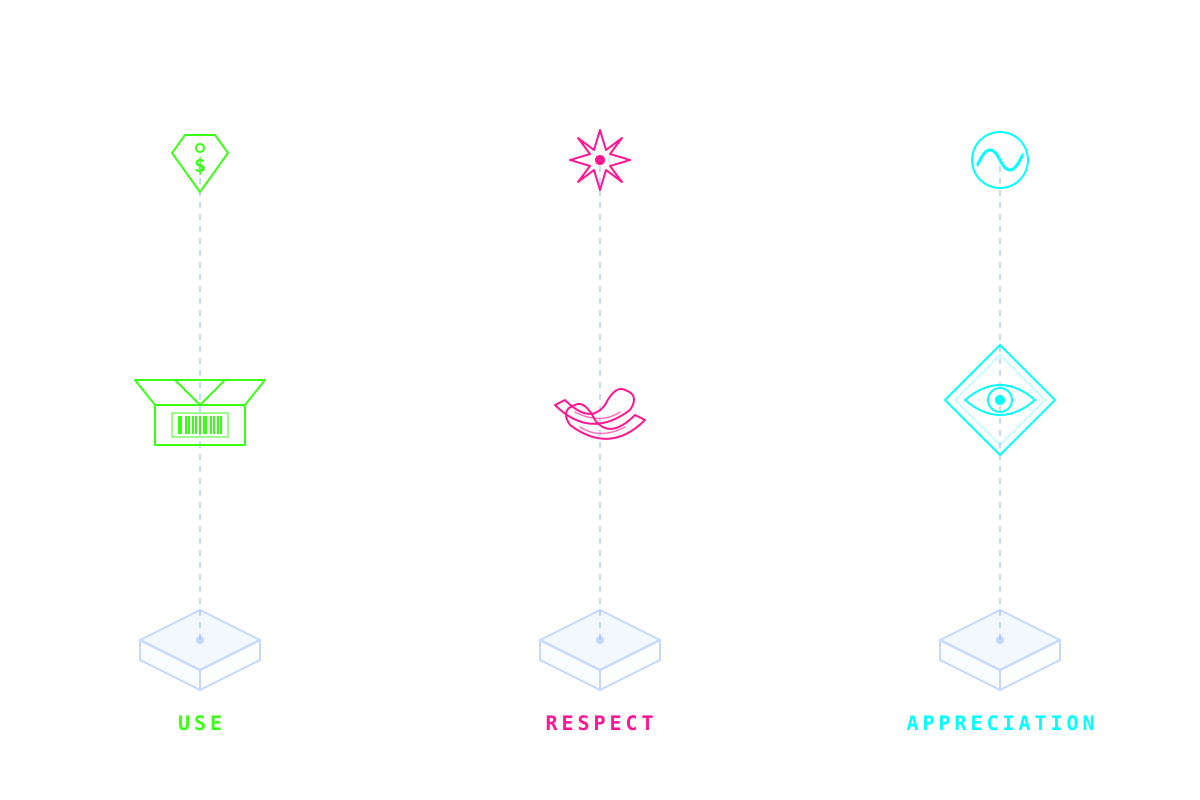
Anderson proposes a pluralist theory of value, which is a fancy way of saying that different things matter in fundamentally different ways. The way we value a commodity (like a television) is entirely different from the way we value a person (like a daughter). It is not that the daughter simply has a much higher dollar value than the television; it is that applying a dollar value to the daughter is a category error.
Different goods call for fundamentally different modes of valuation. We value commodities through use and pricing. But we value human beingss](/blog/universal-consciousness#are-you-just-consciousness-wearing-different-masks) through respect, we value art through appreciation, and we value spouses through love.
These are not just different numbers on the same scale; they are entirely different currencies. Anderson’s framework finally gives us a rigorous philosophical vocabulary for those “intangibles that can’t be measured.” They aren’t just stubbornly difficult to quantify; they are categorically different kinds of value that resist quantification by their very nature.
Why Spreadsheets Fail To Capture Human Connection
When you understand Anderson’s pluralist theory, the absurdity of the hyper-optimized life becomes crystal clear. You realize why scheduling a “sync” with your romantic partner feels so incredibly bleak. You are applying the valuation mode of a corporate enterprise to an entity that requires the valuation mode of romantic devotion.
A spreadsheet is a tool of utilization. It exists to track assets, minimize liabilities, and maximize output. But human connection is not an asset to be utilized; it is an experience to be inhabited.
If you view your friendships through a transactional lens, you will only cultivate relationships with people who are “useful” to you. But the deepest, most life-sustaining friendships are often profoundly useless. They are the friends who call you weeping at 2 AM, the ones who need your help moving a couch, the ones who offer absolutely zero networking value but know the exact shape of your soul.
When we try to measure the ROI of our relationships, we immediately destroy the unconditional nature of those bonds. Love that is contingent on a positive expected value is not love at all. It is merely a temporary alliance of convenience, waiting to be dissolved the moment the market conditions change.
Reclaiming The Unquantifiable Life
So, how do we step off this exhausting treadmill of optimization? How do we deprogram ourselves from a culture that demands a positive ROI on every waking hour? It begins with a deliberate, radical act of compartmentalization.
We must draw hard borders around the sacred areas of our lives. We have to look at our marriages, our friendships, our hobbies, and our civic duties, and explicitly declare them off-limits to market reasoning. We must refuse to run the numbers.
This requires a certain kind of bravery in a world obsessed with efficiency. It means intentionally doing things that are wildly inefficient, mathematically suboptimal, and economically irrational. It means spending three hours cooking a meal for someone you love, even though ordering takeout would save time and maximize your hourly earning potential.
It means standing in line in the freezing rain to vote, not because your single vote has a high expected value of changing the election, but because citizenship is a duty you honor, not a gamble you place. We have to relearn how to do things simply because they are good, true, or beautiful, regardless of what the ledger says.
The Courage To Be Deeply Inefficient
To be fully human is to be spectacularly inefficient. Machines are efficient. Algorithms are optimized. But human beings are messy, contradictory, emotional creatures who need poetry just as much as they need caloric sustenance.
When you stop viewing every interaction as a transaction, the world opens up in miraculous ways. You start talking to strangers on a train without wondering if they can help your career. You start reading books that are hundreds of years old just for the sheer joy of the prose, rather than to extract three actionable bullet points for your morning newsletter.
You begin to recognize that the friction in life - the arguments, the misunderstandings, the slow process of building trust - is not a bug to be optimized away. That friction is the actual texture of reality. It is where all the meaning lives.
The things that matter most in this life will never fit neatly into a cost-benefit analysis. They will never yield a clean, predictable expected value. And thank God for that.
If we reduce our existence to a series of calculated trades, we may end up rich, safe, and perfectly optimized, but we will have lost the plot entirely. We will have survived the game, but we will have forgotten how to live. Life is not a ledger to be balanced; it is a mystery to be inhabited.
We use limited cookie-free measurement to understand overall traffic. Allow analytics cookies to help us recognize returning visits and learn which essays and paths serve readers best. You can change this choice at any time.





Responses