


I used to believe the only way to buy my freedom was to earn more money. I spent my twenties operating under the assumption that financial independence was entirely a revenue problem. If I could just crack the code on a higher salary, secure that next promotion, or launch a lucrative side hustle, I would eventually cross an invisible finish line into autonomy. It seemed like straightforward, undeniable math at the time. I was playing a game of accumulation, measuring my progress by the size of my paycheck and the sheer volume of my possessions.
But then I realized the math I was using was fundamentally flawed. I was trapped in an economic system that brilliantly disguised a treadmill as an escalator. The harder I ran, the more my baseline desires expanded to consume my new resources.
The Trap of the Infinite Treadmill
We are culturally conditioned to solve our problems through addition rather than subtraction. When we feel overwhelmed or financially insecure, our immediate instinct is to look for ways to add more income to the equation. But this approach completely ignores a brutal psychological reality.
Why More Income Rarely Means More Freedom
The fatal flaw in standard wealth-building advice is that human desires naturally expand to consume whatever resources become available. As your paycheck grows, so does your baseline for what feels normal, necessary, and acceptable in your daily life. A larger house, a premium vehicle, and nicer vacations suddenly mutate from rare luxuries into standard requirements for your existence. You might be earning double what you made a decade ago, but your actual timeline to freedom hasn’t shifted an inch.
We tell ourselves that we are just upgrading our lifestyle to appropriately match our hard work. In reality, we are simply tightening the invisible chains that bind us to our employers and our mounting debts. We are trading the irreplaceable hours of our fleeting lives for depreciating assets that will eventually end up in a landfill.
The Hidden Math Behind the Target Number
If you look closely at the mechanics of early retirement, the standard financial advice completely falls apart. If you spend 100 percent of your income, you will never be prepared to retire, meaning your required working career is technically infinite 1. This grim reality applies whether you are earning thirty thousand dollars a year or three million dollars a year. The raw number of dollars flowing into your bank account is entirely irrelevant if the exact same number of dollars is flowing right back out.
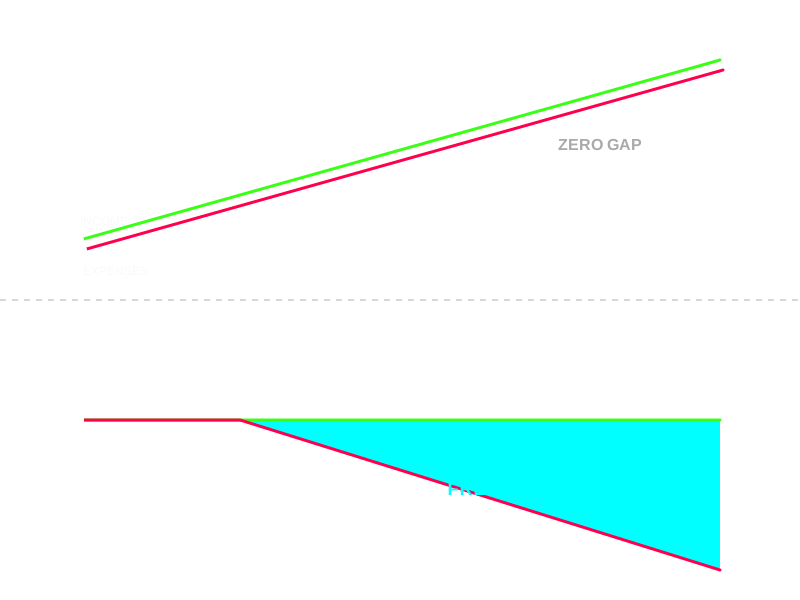
The timeline to financial independence actually depends entirely on a single, highly controllable metric. It comes down to your savings rate as a percentage of your take-home pay 1. We have been obsessing over the wrong variable for our entire lives. The moment you realize this, the entire landscape of personal finance shifts beneath your feet.
The Magic of the Double Effect
When you stop collecting things you don’t actually need, something mathematical and almost magical happens to your reality. It is not just about having a slightly padded bank account at the end of the month. Stopping the endless acquisition of physical things has a profound double effect on your path to financial freedom. You are suddenly attacking the financial independence equation from both ends simultaneously.
Effect A: The Supply Side Cash Flow
The first part of this equation is the most obvious, though we often drastically underestimate its raw power. When you stop buying things you don’t need, you immediately decrease your monthly expenses. This frees up a massive surge of pure cash flow to save and invest today. You are essentially injecting high-octane rocket fuel into the “supply side” of your wealth-building machine.
Think of it as plugging a massive leak in the hull of a sinking ship. Every dollar you don’t spend on a fleeting consumer good is a dollar that gets deployed into the market to work relentlessly on your behalf. As soon as you start saving and investing your money, it begins earning money all by itself, creating a runaway exponential snowball of passive income.
Effect B: The Demand Side Target Drop
This is the secret weapon that most traditional financial planners completely fail to mention during their pitch. Every time you permanently reduce your living expenses, you lower the ultimate target number required for your financial independence. Because your desire to buy things decreases, the total nest egg you need to support your life forever shrinks dramatically. You are moving the finish line closer to yourself while simultaneously running much faster toward it.
This is exactly why minimalism directly intersects with the pursuit of personal finance 2 1.3. You need less to live, so you need a significantly smaller pile of capital to generate the passive income required to sustain that life. It is a beautiful, elegant loop of extreme efficiency.
Rethinking the Four Percent Rule
To truly understand this target drop, you must grasp the fundamental math of long-term wealth preservation. Most reliable financial models rely on a safe withdrawal rate, assuming you can withdraw around four percent of your invested portfolio each year forever. This means you need a total nest egg equal to twenty-five times your annual living expenses.
If you cut your spending by just one hundred dollars a month, you reduce your annual expenses by twelve hundred dollars. Multiply that by twenty-five, and you have instantly reduced your required retirement portfolio by thirty thousand dollars. That is thirty thousand dollars you no longer have to earn, save, and painfully invest before you can walk away from your desk.
The Non-Linear Accelerator Explained
When you combine these two effects, you trigger a fascinating mathematical anomaly that shatters conventional consumer logic. Cutting your spending rate is infinitely more powerful than increasing your income because it permanently decreases the amount you will need every month for the rest of your life. This dynamic creates a non-linear accelerator within your financial timeline.
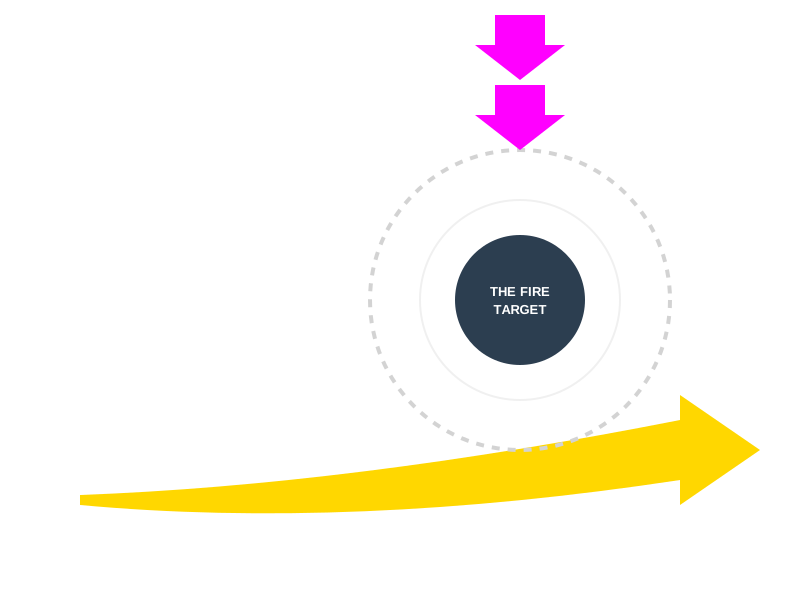
A linear reduction in your spending produces an exponential reduction in the time required to reach true financial independence. Consider a middle-class family earning fifty thousand dollars who saves ten percent of their income; they are mathematically on track to work for fifty-one grueling years. But simply cutting out cable television and a few lattes would instantly boost their savings rate to fifteen percent, allowing them to retire a staggering eight years earlier.
You have to ask yourself a very uncomfortable question. Is keeping pace with consumer culture actually worth sacrificing a decade of your precious freedom?
The Psychological Friction of Owning Things
We rarely account for the mental overhead that accompanies our massive accumulation of physical possessions. Every single item you bring into your home demands a subtle fraction of your cognitive bandwidth. When you multiply this tiny tax by thousands of objects, the mental load becomes completely staggering.
The Hidden Tax of Ongoing Maintenance
Every object you own is effectively a tiny, needy pet that requires your constant attention. Things must be cleaned, organized, insured, repaired, and eventually disposed of or upgraded. This creates a relentless cycle of maintenance that drains not just your wallet, but your most precious resource: your time. You think you own your possessions, but more often than not, your possessions actually own you.
When you drastically reduce the number of things you collect, you completely eliminate this hidden maintenance tax. You are not just freeing up money; you are freeing up massive chunks of psychological space. This newly discovered mental clarity is often the exact catalyst people need to launch a business, write a book, or completely reinvent their lives.
The Dangerous Illusion of Sunk Costs
One of the hardest parts of stopping the acquisition game is dealing with the things you have already bought. We fall victim to the sunk cost fallacy, hoarding items we no longer use simply because we paid good money for them in the past. But holding onto a mistake just because you spent a long time making it is a terrible financial strategy.
The Stoics would forcefully remind us that the past is entirely outside of our control. The money is already gone, and letting the physical object continue to clutter your space only compounds the initial error. The moment you let go of the physical object, you instantly sever the emotional weight attached to it.
Redefining the System of Needs
Our culture dictates that a successful life requires an ever-expanding footprint of physical possessions. We are taught to view our houses as giant storage containers for our accumulating status symbols. But what if we treated our lives not as a mindless accumulation game, but as an optimization puzzle?
Applying Systems Theory to Personal Finance
This radical paradigm shift was brilliantly articulated by Jacob Lund Fisker, an astrophysicist who authored the wildly influential book Early Retirement Extreme. Fisker applies complex systems theory to personal finance, treating household economics like an engineering problem waiting to be efficiently solved 3 1.2. He argues that the standard approach to money is terribly inefficient, leaking precious energy and resources at every possible connection point.
By designing a highly integrated lifestyle system, you can radically alter the baseline physics of your daily existence. It requires shifting away from compartmentalized, linear thinking toward a holistic understanding of how your consumption impacts your timeline. You begin to see the hidden, compounding costs embedded in every convenience our society aggressively sells us.
Rejecting Dependency on the Monetary System
The core thesis of Fisker’s philosophy is as radical as it is relentlessly effective. By drastically reducing your perceived “needs,” you successfully sever your dependency on the modern monetary system 3 1.2. You learn to substitute cold, hard capital with applied intelligence, practical skill, and fierce resourcefulness.
This isn’t about deprivation or living in a miserable state of self-imposed poverty. It is about reclaiming your autonomy from a system fundamentally designed to keep you perpetually dependent on a bi-weekly paycheck. In doing so, you can literally buy your freedom decades earlier than the societal norm 3 1.2].
The Philosophy of Enlightened Material Restraint
This mathematical and systemic approach to wealth isn’t just a modern life hack born from spreadsheet enthusiasts on the internet. It is part of a much broader, deeply rooted philosophical tradition that questions the very nature of human contentment. We are, at our core, grappling with the exact same existential questions that plagued our ancestors centuries ago.
Embracing the Voluntary Simplicity Movement
For decades, a powerful cultural current known as Voluntary Simplicity has advocated for a radical shift in how we view our material possessions. This movement rejects the high-consumption, materialistic lifestyles of consumer cultures in favor of deliberate, highly intentional living 4. It arises from the stark recognition that our ordinary consumption habits are degrading the planet and failing to provide meaningful human satisfaction 4.
Historian David Shi perfectly encapsulates this ethos by defining voluntary simplicity as the practice of “enlightened material restraint”. It is a conscious, empowered choice to step off the endless consumer carousel. You deliberately consume less so that you can focus entirely on non-material sources of deep satisfaction.
The Ancient Roots of Modern Minimalism
The notion of living simply is not a new trend born out of modern internet blogs. The profound virtues of moderation and material restraint have been championed by historical figures ranging from Lao Tzu and Buddha to Henry David Thoreau. They all intuitively understood what our modern society has desperately forgotten. Abundance cannot be found at the bottom of a plastic shopping bag.
These thinkers recognized that extravagance and acquisitiveness are an unfortunate waste of human life. Living simply does not mean regressing to a primitive state or becoming a self-righteous puritan. It is simply about discovering the profound freedom and contentment that comes with knowing how much consumption is truly “enough”.
Outwardly Simple but Inwardly Rich
The goal of this lifestyle isn’t to live in a barren room, sleep on the hard floor, and stare blankly at a white wall. The objective, as described by author Duane Elgin, is to cultivate a manner of living that is outwardly simple but inwardly rich 4. By refusing to define your personal progress through the conspicuous display of wealth, you unlock vast reserves of time, energy, and focused attention.
You trade the fleeting dopamine hit of a new purchase for the enduring, quiet satisfaction of a well-examined life. You realize that true abundance is a state of mind, not a quantity of consumer products you can hoard in a closet. This shift in perspective is the ultimate form of rebellion in a society built on endless consumption.
Ancient Stoicism as a Modern Wealth Strategy
I find it incredibly fascinating that the most cutting-edge financial strategies of the 21st century inevitably lead us back to the marble pillars of ancient Greece and Rome. Modern financial minimalism is heavily indebted to the great Stoic philosophers like Seneca, Marcus Aurelius, and Epictetus. They understood the intricate psychology of human desire far better than modern advertising executives ever will.
The Four Cardinal Virtues in Personal Finance
Stoicism operates on a solid foundation of four cardinal virtues: wisdom, courage, justice, and temperance. When actively applied to personal finance, temperance becomes the ultimate superpower against a hyper-consumer-driven culture 5. It is not about forced, miserable moderation, but about cultivating the self-control and strict discipline required to avoid impulsive purchases.
The other virtues play an equally critical role in wealth building. Wisdom helps individuals make highly informed decisions about their finances, while courage enables them to persevere through terrifying financial challenges. Justice reminds you that your resources can be deployed for purposes far greater than your own immediate, selfish gratification.
The Dichotomy of Control in Investing
One of the most powerful tools in the Stoic arsenal is the dichotomy of control, which divides the world into things we can control and things we cannot. By focusing intensely on what is within our control, such as our thoughts, attitudes, and spending actions, we develop a deep sense of peace 5. This is extraordinarily useful in personal finance, where unexpected expenses and wild market fluctuations routinely cause severe panic.
If the stock market experiences a sudden, violent downturn, a Stoic investor focuses solely on their own reactions rather than obsessing over external economic factors. This mental discipline helps them make rational, calculated decisions about their investments rather than succumbing to fear and selling at the bottom. You become a rock in a stormy sea of market volatility.
Cultivating Resilience and True Eudaimonia
The ancient Stoics believed deeply that true wealth consists not in having great possessions, but in having remarkably few wants. By actively training your mind to desire less, you build an impenetrable fortress of emotional and financial resilience. This daily practice helps you navigate terrifying market fluctuations and economic downturns with absolute, unshakeable equanimity 5.
Ultimately, this philosophical approach to money leads to eudaimonia—a state of profound human flourishing and inner peace. According to Stoicism, true happiness and fulfillment come not from external circumstances, but entirely from within. By focusing on building a strong financial foundation aligned with your values, you achieve a level of contentment that no amount of money can ever purchase.
Escaping the Scarcity Mindset Forever
There is a tragic, inescapable irony in how modern society defines success. We are told that whoever dies with the most toys wins, yet the people playing this game always seem to be desperately running out of time. They are drowning in a self-imposed scarcity, forever chasing a horizon that violently recedes with every step they take.
Buying Decades of Freedom Instead of Things
When you finally realize that every object you purchase is essentially a tax on your future freedom, your entire worldview shifts. You stop seeing a luxury car as a symbol of status and start seeing it as three years of mandatory corporate servitude. You stop viewing a massive, sprawling house as an achievement, recognizing it instead as a gilded cage requiring constant maintenance, property taxes, and capital.
This isn’t just about spreadsheets, withdrawal rates, and compound investment returns. It is about taking radical responsibility for your brief, incredibly beautiful window of existence on this planet. The ultimate luxury in this modern world is not a closet full of designer clothes, but a calendar completely devoid of obligations you despise.
The Final Paradigm Shift for Financial Independence
The greatest trick the modern economy ever pulled was convincing us that our ultimate liberation could be bought on credit. We have been relentlessly sold a vision of the good life that fundamentally requires our perpetual exhaustion. But the exit door is sitting right there, unlocked, unguarded, and entirely free to use.
All it takes to walk through that door is the courage to want less than your neighbor. When you stop collecting things, you immediately start collecting back the stolen hours of your life. Wealth is simply the space between your desires and your resources.
Footnotes
-
How Does Minimalism Relate to Financial Independence? → Question ↩
-
What happened to Early Retirement Extreme? An update from Jacob Lund Fisker ↩ ↩2 ↩3
-
What is Voluntary Simplicity? | The Simplicity Collective | The Simplicity Collective ↩ ↩2 ↩3
-
Stoicism & Personal Finance: Stoic Philosophy for Financial Stability ↩ ↩2 ↩3


