


I’ve always been fascinated by the way our brains betray us. You’d think that expressing an opinion is just that—an expression, a fleeting moment of thought. But no. The moment you say something out loud, especially to an audience, it’s like your brain takes a screenshot and files it under “Core Identity.” Suddenly, that offhand remark about politics or that half-baked take on productivity isn’t just an opinion anymore; it’s you.
This isn’t just about saving face. It’s not even just about cognitive dissonance, though that’s part of it. It’s about the way your brain, in its relentless quest for efficiency, starts rewiring itself to make your public statements true. You teach a concept enough times, and suddenly you’re not just explaining it—you’re embodying it. You tweet a hot take, and before you know it, your brain is scrambling to make that take a foundational belief.
It’s like your mind is a lawyer, and the second you speak, it starts building a case to prove you right—no matter the cost. And here’s the scary part: it doesn’t care whether the belief is true or useful. It just cares about consistency.
So what happens when you realize you were wrong? When new information comes along that contradicts your public persona? That’s when the real cognitive acrobatics begin.
Your brain will twist, distort, and rewrite your own memories just to keep the narrative intact. You’ll convince yourself you always believed this new thing, or that you were never really committed to the old thing. It’s not lying—it’s survival.
But here’s the thing: this mechanism isn’t just a flaw. It’s a feature. If you use it intentionally, it can be a tool for growth.
Teach what you want to believe. Speak the person you want to become into existence.
But be careful—because the moment you start performing a version of yourself that isn’t true, you’re not just fooling others. You’re rewiring your own mind to live the lie. And that’s a prison no one can break you out of but yourself.
The Saying-is-Believing Effect: How Expression Becomes Belief
The Saying-is-Believing Effect: How Communicating Ideas Reshapes Your Beliefs
There’s something almost alchemical about the act of articulating an idea. When you craft a message for others—whether it’s a lesson, a speech, or an ad—you’re not just transmitting information; you’re reshaping your own mind. The Saying-is-Believing Effect reveals how this process works: by externalizing a belief, we internalize it more deeply. It’s not just about repetition; it’s about the cognitive labor of structuring thoughts for an audience.
When you teach a concept, you’re forced to organize it logically, defend it, and anticipate counterarguments. This act of construction doesn’t just reinforce the idea—it becomes the idea in your mind. The brain, ever the efficiency seeker, thinks, Well, if I’m saying it, I must believe it. This phenomenon isn’t just psychological—it’s neurological. Studies like those by Izuma et al. (2010) show that cognitive dissonance lights up specific brain regions, pushing us to resolve the tension between what we say and what we believe.
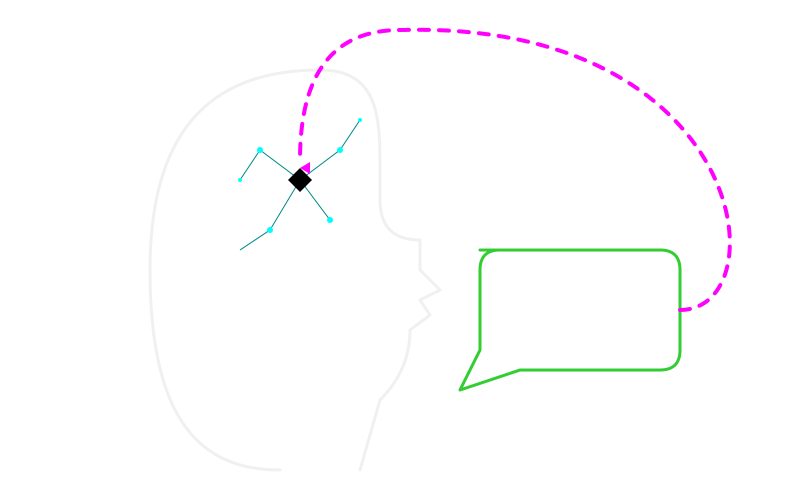
The anterior cingulate cortex, a hub for conflict detection, essentially nudges us toward consistency. So when you stand in front of a classroom or a boardroom and advocate for something, your brain starts rewiring to align with your words. It’s a survival mechanism, really—a way to avoid the mental friction of hypocrisy.
But here’s the kicker: this process doesn’t care whether the belief is true or useful. It just cares about coherence.
That’s why marketers can start drinking their own Kool-Aid, or why a teacher might find themselves more convinced of a theory after explaining it for the tenth time. The act of persuasion becomes self-persuasion. 1 2
The Saying-is-Believing Effect in Action
Consider the teacher who starts the semester skeptical of a new pedagogical theory but, after breaking it down for students week after week, finds themselves a convert. Or the public speaker who takes on a corporate gig advocating for a product they initially doubted, only to leave the podium half-convinced. These aren’t just anecdotes; they’re manifestations of the Saying-is-Believing Effect in action. In advertising, copywriters often joke about “falling in love with the product,” but it’s not just a joke—it’s a cognitive inevitability.
The more you craft messages that highlight benefits, the more your brain starts treating those benefits as real, even if you began with skepticism. But there’s a darker side here, too. The internet’s favorite pastime is calling out hypocrisy, but what if what looks like hypocrisy is just learning? Jordan Peterson touches on this in his discussions about public personas: when you make loud proclamations, you’re not just committing to an idea—you’re committing to a version of yourself.
Updating your beliefs later can look like flip-flopping, but in reality, it’s just the messy process of human growth. The problem arises when people don’t update their beliefs, clinging to old statements out of fear of looking inconsistent.
That’s when the Saying-is-Believing Effect becomes a cage. The key, then, is to wield this psychological quirk intentionally: use it to reinforce what’s true, but stay vigilant against the seduction of your own rhetoric. 3
Why Your Brain Rewrites Your Past Opinions
Memory isn’t a static recording; it’s a dynamic reconstruction. And when it comes to our own opinions, it’s downright malleable. The moment you declare something publicly, your brain starts editing your past beliefs to match. This isn’t just about saving face—it’s about maintaining a coherent narrative of you.
Cognitive dissonance theory explains why: the discomfort of holding two conflicting ideas is so aversive that your brain will literally rewrite history to avoid it. You might recall being more skeptical about a topic than you actually were, or convince yourself you always felt a certain way. It’s not lying; it’s self-preservation. This memory distortion has real-world stakes.
In politics, leaders who flip-flop are often accused of hypocrisy, but what if they’re just victims of their own past statements? The brain’s drive for consistency can trap us in outdated beliefs, making it harder to adapt. The solution isn’t to avoid public commitments—it’s to approach them with humility.
Acknowledge that your current stance might evolve, and that’s not weakness; it’s wisdom. As Emerson said, “A foolish consistency is the hobgoblin of little minds.” The trick is to use the Saying-is-Believing Effect as a tool for growth, not a chain to your past self.
Cialdini’s Consistency Principle: Why We’re Hostage to Our Public Statements
Why We Obsess Over Staying Consistent
There’s something almost primal about our need to appear consistent. It’s not just about keeping promises—it’s about maintaining a coherent identity, both to ourselves and to others. When we make a public statement or take a visible stand, we’re not just expressing an opinion; we’re staking a claim on who we are. And once that claim is out there, our brains go into overdrive to ensure we don’t contradict it.
This isn’t just social pressure—it’s neurological. The moment you declare something publicly, your brain starts editing your past beliefs to match. Cognitive dissonance theory explains why: the discomfort of holding two conflicting ideas is so aversive that your brain will literally rewrite history to avoid it. You might recall being more skeptical about a topic than you actually were, or convince yourself you always felt a certain way.
It’s not lying; it’s self-preservation. This memory distortion has real-world stakes. In politics, leaders who flip-flop are often accused of hypocrisy, but what if they’re just victims of their own past statements? The brain’s drive for consistency can trap us in outdated beliefs, making it harder to adapt.
The solution isn’t to avoid public commitments—it’s to approach them with humility. Acknowledge that your current stance might evolve, and that’s not weakness; it’s wisdom.
As Emerson said, “A foolish consistency is the hobgoblin of little minds.” The trick is to use the Saying-is-Believing Effect as a tool for growth, not a chain to your past self.

The Science of Public Commitments
The power of public commitments isn’t just theoretical—it’s been demonstrated in some fascinating experiments. Take Thomas Moriarty’s beach blanket study, for example. When a researcher simply placed a radio near subjects on a beach and a staged “thief” attempted to steal it, few intervened. But when the researcher first asked subjects to “please watch my things,” securing a small verbal commitment, 19 out of 20 subjects actively tried to stop the thief.
That’s a 95% increase in helping behavior, all because of a tiny, public promise. This isn’t just about politeness—it’s about the psychological weight of commitment. Once you’ve said you’ll do something, your brain starts treating that promise as part of your identity.
It’s why restaurants reduce no-shows by simply changing their phrasing from “Please call if you have to change your plans” to “Will you please call if you have to change your plans?” and waiting for a “Yes.” That small verbal commitment makes all the difference.
It’s a mental shortcut, a way for our brains to navigate the complexity of daily decisions without constantly reevaluating. But it can also make us vulnerable to influence, sometimes causing us to act unthinkingly or ignore reason if it contradicts a prior stance. 1
The Power of Public Commitments in Shaping Identity and Behavior
Public commitments don’t just influence behavior—they shape identity. When you take a visible stand, you’re not just expressing an opinion; you’re crafting a version of yourself for the world to see. And once that version is out there, your brain works overtime to keep your actions aligned with it. This is where impression management comes into play.
We’re inherently social creatures, and the way others perceive us matters deeply. Once we’ve publicly committed to a position, we strive to appear consistent with it to maintain a favorable social image. But it’s not just about appearances—it’s about self-image. Daryl Bem’s Self-Perception Theory suggests that we infer our own attitudes from our behavior, much like an external observer would.
If you see yourself consistently acting in a certain way, you start to believe that’s who you are. This is why public commitments are so powerful: they create a feedback loop where your actions shape your identity, and your identity reinforces your actions.
It’s a cycle that can be incredibly hard to break, especially when the commitment is central to how you see yourself. The more a commitment is tied to your identity, the stronger the pressure to stay consistent—even when it might not be the best choice.
The Teaching Effect: How Explaining Deepens Your Practice
Master Any Skill With the Learn-Do-Teach Cycle
There’s a rhythm to real learning that doesn’t end with consumption. The “learn, do, teach” cycle isn’t just a pedagogical cliché—it’s a neurological and psychological hack for deep mastery. When you learn something, you’re absorbing information. When you do it, you’re testing that information against reality.
But when you teach it, something profound happens: you’re forced to dismantle the concept, examine its parts, and reconstruct it in a way that makes sense to someone else. This isn’t just reinforcement; it’s a crucible where half-baked ideas either solidify or crumble. The act of teaching demands rigor. You can’t gloss over gaps in your understanding when a student’s confused face is staring back at you.

You have to answer questions you hadn’t considered, defend positions you took for granted, and simplify complexities you’d overlooked. This process doesn’t just expose weaknesses—it forces you to address them. As the transcript from the video discussion notes, teaching wraps your identity around the subject because you become its advocate. You’re no longer just someone who knows something; you’re someone who stands for it.
That shift in identity deepens your practice because your self-image becomes intertwined with the subject matter. 4 But here’s the catch: this cycle only works if you’re honest. The moment you start teaching something you don’t genuinely believe or understand, you’re not just misleading others—you’re rewiring your own brain to accept falsehoods as truth. The Saying-is-Believing Effect doesn’t discriminate between authentic expertise and performative bullshit.
If you teach with integrity, the cycle elevates you. If you teach with deception, it degrades you. The choice isn’t just about ethics; it’s about self-preservation.
Teaching Changes Your Identity: Why What You Teach Becomes Who You Are
When you teach, you’re not just sharing knowledge—you’re staking a claim on it. You become the person who knows this thing, who defends this thing, who embodies this thing. That’s not just a social role; it’s a psychological anchor. The more you advocate for an idea, the more your brain treats it as a core part of who you are.
This isn’t just about cognitive dissonance; it’s about identity construction. Your public persona starts to shape your private self, and suddenly, the line between what you teach and who you are begins to blur. This is why the best teachers aren’t just experts—they’re evangelists. They don’t just know the material; they live it.
And that’s also why the worst teachers aren’t just incompetent—they’re dangerous. When you teach something you don’t truly believe, you’re not just spreading misinformation; you’re corrupting your own mind. As Jordan Peterson warns, “When you practice falsehood, you become false.” The brain doesn’t care whether the beliefs you’re reinforcing are true or useful—it just cares about consistency. 5 The solution isn’t to avoid teaching—it’s to teach with humility and honesty.
Acknowledge that your understanding is evolving, that your current stance might change, and that’s not a flaw—it’s a sign of growth. The “learn, do, teach” cycle isn’t about achieving perfection; it’s about embracing the messy, iterative process of becoming.
The deeper your investment, the more you stand to gain—but also the more you stand to lose if you’re not careful. Teach like your identity depends on it, because it does.
Neurological Rewiring: When Falsehood Becomes Who You Are
How False Personas Reshape Your Identity
There’s a chilling truth in Peterson’s warning: when you practice falsehood, you become false. It’s not just about lying to others—it’s about lying to yourself until the lie becomes your reality. The brain doesn’t distinguish between truth and fiction when it comes to consistency. If you construct a false persona—whether for social media clout, professional gain, or even just to fit in—your mind starts rewiring to make that fiction feel real. This isn’t just metaphorical.
Neurologically, the more you perform a role, the more your brain treats it as you. The story you tell in public doesn’t just influence how others see you; it reshapes how you see yourself. The guy who stopped writing online because he realized his public persona was warping his private identity? That’s not an edge case—that’s the rule. Your brain doesn’t have a “fake self” and a “real self.”
It just has you, and it will bend reality to keep your actions and beliefs aligned, even if that means distorting your own perception. The danger isn’t just hypocrisy—it’s self-betrayal. When you adopt a false persona to extract resources from the world, you’re not just manipulating others; you’re corrupting your own soul.
And by “soul,” I mean the structure through which you perceive reality. Lie enough, and you don’t just believe the lie—you see the world through its lens. That’s not just bad ethics; it’s bad survival strategy. 5
How Falsehoods Become Unquestioned Truths That Shape Perception
Falsehoods don’t stay on the surface. They sink into the bedrock of your mind, becoming unquestioned axioms—implicit assumptions that shape how you interpret everything. This isn’t just about beliefs; it’s about perception. Cognitive dissonance theory explains why: when your actions contradict your beliefs, your brain doesn’t just adjust the beliefs—it rewires your entire framework.
The more you repeat a falsehood, the more it becomes part of your identity. It’s not just that you believe it; it’s that you can’t not believe it. Your brain treats it as a foundational truth, filtering reality through its lens. This is why people who lie for status or validation don’t just seem inauthentic—they are inauthentic, because their perception of the world is built on a corrupted structure.
The solution isn’t just to avoid lying—it’s to be ruthlessly honest about what you’re reinforcing. Every time you say something, you’re not just communicating; you’re constructing the framework through which you’ll see the world. Choose wisely. 2 1
How False Beliefs Corrupt Your Perception of Reality
Your soul—if we’re using Peterson’s definition—isn’t some mystical entity. It’s the framework through which you perceive reality. When you corrupt that framework with falsehoods, you don’t just distort your beliefs; you distort your entire experience of the world. You start seeing only what your lies allow you to see, filtering out anything that contradicts them.
This is why authenticity isn’t just a moral virtue—it’s a survival mechanism. If your perception is built on falsehoods, you’re navigating the world with a broken compass. You’ll miss opportunities, misjudge threats, and ultimately, lose touch with reality. The more you reinforce a false persona, the more it becomes your reality, and the harder it is to escape.
The takeaway? Be careful what you practice.
Every public statement, every performative role, every little lie—it all adds up. Your mind will adapt to whatever you feed it, for better or worse.
Authentic Growth vs. Hypocrisy: Changing Opinions Isn’t Failure
Naval Ravikant: Learning Means Correcting Errors

There’s a dangerous myth floating around that changing your mind is a sign of weakness. We’ve all seen it—the internet pounces on someone for updating their stance, screaming “hypocrite!” as if growth were a crime. But Naval Ravikant cuts through this noise with a simple truth: learning is error correction. If you’re not wrong most of the time, you’re not learning. The Saying-is-Believing Effect doesn’t just lock you into past statements—it’s a tool for evolution, not stagnation.
The key distinction here is between being wrong and being disingenuous. If you make a guess, get it wrong, and update your beliefs, that’s not hypocrisy—it’s intelligence. But if you lie to elevate your status, you’re not just misleading others; you’re trapping yourself in a hall of mirrors. Your brain will force consistency with your past proclamations, even if they were false. That’s the real danger: becoming a puppet to a persona you never truly believed in. 3 The internet’s obsession with “gotcha” moments misses the point.
People latch onto single proclamations because it makes them feel smart—*Aha, I caught you! *—but real growth isn’t about being right all the time. It’s about being honest enough to admit when you’re wrong.
The world doesn’t lack intelligence; it lacks authenticity. And authenticity means embracing the messy, dynamic process of learning.
Emerson: Why Authenticity Beats Consistency
Emerson’s famous line isn’t just a witty remark—it’s a psychological lifeline. Foolish consistency isn’t just stubbornness; it’s a cognitive trap. When you cling to past statements out of fear of looking inconsistent, you’re not just limiting your growth—you’re corrupting your own mind. The brain’s drive for consistency can turn into a prison if you let it.
The difference between integrity and hypocrisy isn’t about never changing your mind—it’s about why you change it. If you update your beliefs because you’ve learned something new, that’s wisdom. If you flip-flop because you’re chasing approval, that’s weakness. The internet’s hypersensitivity to hypocrisy isn’t just about catching liars; it’s about sniffing out inauthenticity.
People can tell when you’re saying things you don’t believe, and worse, you can tell too. The solution? Stop trying to impress people who don’t care about you.
The respect of the masses is a fool’s errand. The only people worth impressing are the ones who respect authenticity—and they’ll respect you more for evolving than for clinging to outdated beliefs. 4
Is Self-Importance Blocking Your Growth?
There’s a peculiar kind of suffering reserved for those who take themselves too seriously. When you treat your opinions as sacred, unchangeable truths, you’re not just limiting your growth—you’re setting yourself up for misery. The more you tie your identity to being “right,” the harder it becomes to adapt. And adaptation isn’t just a skill; it’s the essence of happiness.
The moment you start believing your own press releases, you’re in trouble. The brain doesn’t care whether your public persona is accurate—it just cares about consistency.
So if you’ve built an identity around being the “smart one” or the “expert,” your mind will twist itself into knots to maintain that illusion, even when reality contradicts it. That’s not just bad for your growth; it’s bad for your soul. The antidote?
Humility. Recognize that your current beliefs are temporary, that your opinions are works in progress, and that changing your mind isn’t failure—it’s progress.
The less you care about appearing consistent, the more you’ll actually grow. And paradoxically, the more you grow, the more authentic you’ll become.
Practical Applications: Using Public Expression for Positive Transformation
Record “Fake Podcasts” for Intellectual Rigor
There’s a peculiar tension in the act of recording your thoughts. On one hand, it forces you to articulate ideas clearly, to defend them, to make them coherent. On the other, it creates a permanent record—one that can haunt you if your beliefs evolve. Ryan Holiday’s suggestion to record “fake podcasts” as a tool for intellectual rigor is brilliant precisely because it exploits this tension.
When you speak your ideas aloud, even if no one else hears them, you’re engaging in a form of self-persuasion. The act of verbalizing forces you to confront gaps in your reasoning, to anticipate counterarguments, and to refine your thinking. But here’s the catch: it also creates a reference point. This isn’t just about accountability; it’s about tracking the evolution of your beliefs.

When you look back at old recordings, you’re not just seeing what you thought—you’re seeing how you thought. Did you defend that idea because you truly believed it, or because it sounded good in the moment? Did you dismiss a counterargument out of hand, or did you grapple with it honestly? The recording doesn’t lie.
It’s a mirror, and like all mirrors, it reveals flaws as much as it reflects strengths. But there’s a darker side to this practice. If you’re not careful, the recordings can become a cage.
The more you listen to your past self, the more you might feel compelled to stay consistent with those old ideas—even when they no longer serve you. The key is to use the recordings as a tool for growth, not a chain to your past.
Treat them like a scientist treats data: as evidence to be analyzed, not as gospel to be obeyed. The goal isn’t to avoid changing your mind; it’s to change it well—with honesty, rigor, and self-awareness. 5
Why Tracking Your Belief Evolution Matters More Than Pretending You Never Changed
The internet has a strange relationship with consistency. On one hand, it rewards those who double down on their beliefs, who never waver, who present an unshakable front. On the other, it punishes hypocrisy with a vengeance, digging up old tweets and past statements to expose any hint of inconsistency. This creates a perverse incentive: to either cling to outdated beliefs or to pretend you never held them in the first place.
But there’s a third option: embrace the evolution. Keep a record of your past beliefs—not to justify them, but to understand them. A private journal, a series of voice memos, even a “fake podcast” archive—these aren’t just tools for reflection; they’re tools for honesty. When you can look back and see how your thinking has shifted, you’re less likely to fall into the trap of rewriting history.
You’re less likely to convince yourself that you “always believed this” or “never thought that.” This isn’t just about intellectual integrity; it’s about psychological survival. The brain’s drive for consistency can turn into a prison if you let it.
But if you have a clear record of your past beliefs, you can say, Yes, I used to think that, and here’s why I changed my mind. That’s not hypocrisy—that’s growth. The internet might still call you a flip-flopper, but the people who matter—the ones who value authenticity over performative consistency—will respect you more for it.
The Power of Conscious Public Accountability for Personal Growth
Public accountability is a double-edged sword. On one side, it can be a powerful motivator. When you announce a goal—whether it’s quitting smoking, writing a book, or learning a new skill—you’re not just committing to yourself; you’re committing to everyone who hears you say it. The fear of looking inconsistent, of being seen as unreliable, can push you to follow through even when motivation wanes.
But on the other side, it can be a trap. If you’re not careful, the need to appear consistent can lock you into paths that no longer serve you. You might stick with a project you’ve outgrown, defend a belief you no longer hold, or cling to an identity that no longer fits—all because you’re afraid of looking like a hypocrite. The key is to use public accountability consciously. Choose your commitments wisely.
Don’t make promises you’re not ready to keep, and don’t tie your identity to beliefs that might evolve. And when they do evolve—when you realize you’ve outgrown an old stance or discovered a new truth—own it. Say, I used to think this, but now I think that, and here’s why. That’s not weakness; it’s wisdom.
The people who matter won’t see it as inconsistency; they’ll see it as growth. And the ones who do see it as inconsistency? They’re not the audience you should be worrying about. 4
Conclusion
So here we are, at the end of this winding journey through the labyrinth of our own minds. The evidence is clear: when you express beliefs publicly, you’re not just sharing information—you’re actively shaping your identity. The neurological rewiring that occurs through repeated expression means we literally become what we practice saying. This understanding carries both warning and opportunity.
The warning is that careless public expression can lock us into inauthentic identities; the opportunity is that intentional, thoughtful sharing can accelerate genuine growth and expertise. The key lies in distinguishing between authentic learning—which naturally involves changing opinions—and the compulsive need to appear consistent.
As we navigate an increasingly public world, the ancient wisdom holds truer than ever: be careful what you practice, because practice becomes identity. (And let’s be honest, who among us hasn’t cringed at an old tweet or a past belief?)
But here’s the thing: this isn’t about fear. It’s about awareness. It’s about recognizing that every public statement is a seed you’re planting in the garden of your mind.
Water it with honesty, and it will grow into something strong and true. Water it with deception, and it will choke you with weeds.
So the next time you’re about to hit “post” or step onto a stage, ask yourself: Is this something I want to become? Because whether you like it or not, you will. And that’s not just a metaphor—it’s a neurological fact. The question isn’t whether you’ll change your mind—it’s whether you’ll have the courage to let it change well. (And maybe, just maybe, to laugh at your past self along the way.)
After all, as the Stoics knew, the only real consistency worth striving for is the consistency of integrity—not of opinion, but of character. And character, unlike a tweet, can’t be deleted.
So go ahead, speak your truth—but make sure it’s a truth you’re willing to live with. Because in the end, you’re not just telling the world who you are. You’re telling yourself.


