


I often catch myself completely ruining a perfectly good moment just by thinking about it too much. You are sitting on a quiet beach, feeling the warm sun on your skin, and suddenly your brain decides to ask if you are maximizing your vacation time. In an instant, the pure physical sensation of living evaporates, abruptly replaced by a relentless internal auditor. We spend our entire lives trapped in this bizarre cognitive hostage situation, oscillating wildly between the self that breathes and the self that judges.
This exhausting dynamic is not just a quirky personality flaw, but a fundamental architectural feature of human consciousness. The delicate balance between the experiential self who lives in the present moment and the critical self who narrates, judges, and analyzes is a rich territory spanning psychology, neuroscience, and philosophy. If we cannot figure out how to harmonize these two disparate modes of being, we become alienated tourists in our own minds. The existential stakes are high.
Consider how desperately we try to hoard our lived experiences using modern technology, constantly pulling ourselves out of the moment. We hold up our phones at concerts, desperately trying to document the magic, which ironically kills the present joy. But cognitive reality suggests you just need 1 video to capture and remember an event, and your memory will effortlessly fill the rest in. Once you satisfy the anxious archivist in your brain, you can finally return to the music.
The Architecture of the Divided Mind
The Tyrant Who Keeps the Score
Nobel laureate Daniel Kahneman offered a crucial distinction that completely reshapes how we view this internal psychological divide. He brilliantly argued that we are fundamentally split into two distinct entities: the Experiencing Self and the Remembering Self. The Experiencing Self is the you who actually lives through the present moment, feeling the visceral sensation of pain or intense joy as it unfolds. Meanwhile, the Remembering Self is the abstract storyteller who looks back, keeps the score, and essentially dictates our future decisions.
The most profound insight Kahneman provides is that the Remembering Self is an absolute tyrant. It ruthlessly ignores the actual duration of an experience—how long you were genuinely happy or miserable—and focuses exclusively on the peak intensity and the end of the event. This quirk of human psychology is known as the Peak-End Rule, explaining why a terrible flight home can entirely ruin your memory of a two-week vacation. Your critical narrator often falsifies your lived history to create a tidy, emotionally resonant story.
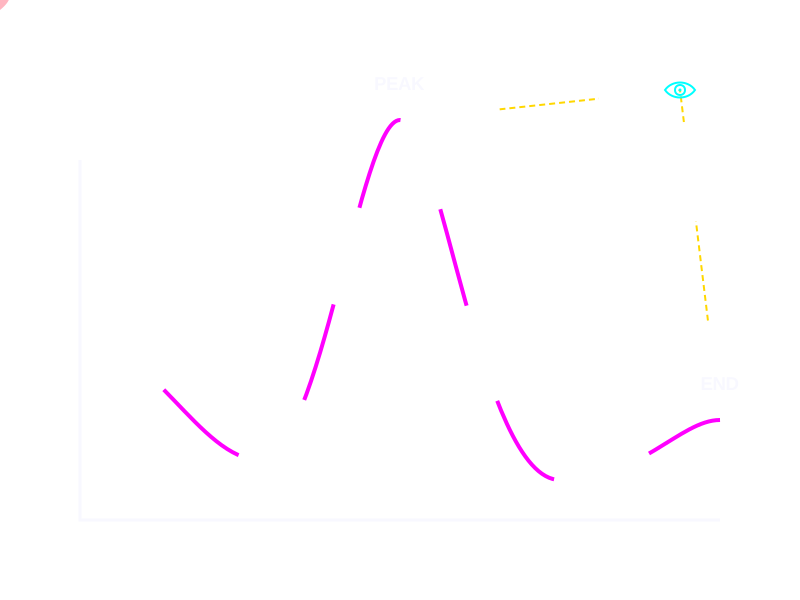
When people attempt to create a cohesive life arc, they are almost exclusively consulting this heavily biased internal storyteller. They interrogate themselves about whether they have achieved enough, essentially ignoring the quiet daily reality of the Experiencing Self. The overarching story we tell about our past is a highly curated highlight reel, not a factual log of our existence. Because of this blind spot, we frequently make disastrous choices that sacrifice our present happiness.
The Vibration of the Present Moment
Long before we had access to functional brain scans, psychologist Seymour Epstein mapped this exact internal conflict through his Cognitive-Experiential Self-Theory 1. Epstein posited that humans operate using two parallel processing systems that constantly interact, often creating severe psychological friction in our daily lives. The Experiential System is fast, automatic, emotional, and heavily driven by past conditioning or unspoken environmental vibes. It is an entirely holistic mechanism that moves at lightning speed.
Conversely, the Rational System is slow, logical, verbal, and analytical, serving as the cold residence where the critical self lives 1. The internal conflict arises because the rational system is often too slow to guide real-time behavior, yet it frequently tries to aggressively override the experiential system after the fact. You might think to yourself, “I feel sad, but I shouldn’t feel sad,” which triggers a miserable cognitive dissonance. You end up actively invalidating your own reality.
Epstein famously argued that a truly well-adjusted individual doesn’t brutally suppress one system for the other, but rather allows them to inform each other harmoniously. The rational system can gently correct the experiential by noting that a specific phobia is completely irrational without demanding that the fear disappear instantly. In return, the experiential system provides the vital passion and the essential felt sense that cold logic utterly lacks. It is a continuous negotiation, not a bloody war of attrition.
The Neurology of Focus and Flow
Silencing the Default Mode Network
When we look under the hood at the actual neuroscience, this psychological split maps perfectly onto distinct and measurable brain networks. When you are not actively engaged in a demanding task, your brain predictably defaults to the Default Mode Network, which acts as the neurological home of your critical self 2. This specific network is heavily associated with self-referential thought, anxious rumination, and that nagging inner critic. It is the exhausted voice that constantly asks, “How am I doing?” or brutally whispers, “That was incredibly stupid.”
On the flip side, we have the Task-Positive Network, which brilliantly lights up when we are fully immersed in an engaging activity. When you enter a state of deep focus or flow, the Default Mode Network actually deactivates, completely silencing the endless mental chatter 2. The self as a critical, judging entity temporarily vanishes entirely, leaving behind only pure experience and unfiltered creative agency. For a brief, beautiful window, you become the action itself.
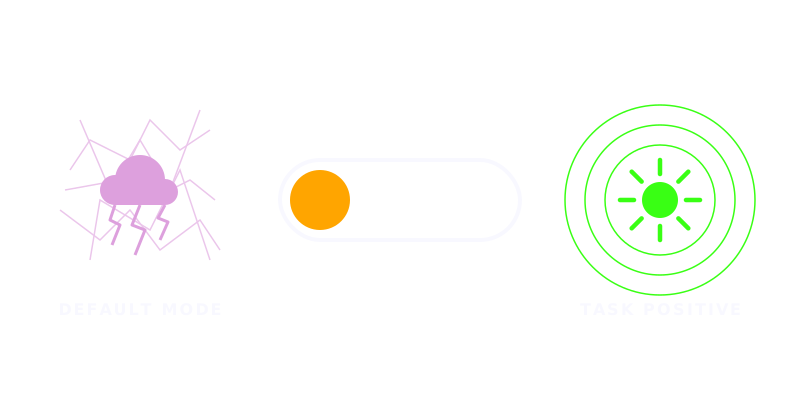
Interestingly, modern research on creativity proves that you cannot rely on just one of these specialized networks if you want to produce great work. The inner critic must be aggressively downregulated to generate fresh ideas and enter flow, effectively allowing the inner Picasso to take over. However, that exact same critical network must be deliberately upregulated later to edit, refine, and polish those raw artistic ideas. The secret to mastery is sequential, not simultaneous—you have to know exactly when to switch gears.
The Danger of the Extrinsic Reward
This delicate balance is constantly threatened by our societal obsession with validation, a trap that even the most disciplined thinkers struggle to avoid. The joy and the fun of any meaningful pursuit live entirely in the process of doing the work, in the thick of solving an invigorating daily problem 3. That immersive flow state is the absolute best place for a creator to reside, fully embodying their unburdened experiential self. The ultimate reward for succeeding in your field should never involve abandoning the actual craft.
Yet, the critical self constantly craves extrinsic validation, hopelessly addicted to the dopamine hit of hitting a prestigious bestseller list or receiving widespread public recognition. When you wake up anticipating a massive career announcement, you have to actively decide to prioritize a simple physical experience—like a morning swim—over the impending judgment 3. You must recognize that the incoming news, whether thrillingly good or devastatingly bad, is merely a metric that belongs entirely to the critical self. You owe it to yourself to protect your lived reality.
In a deeply counterintuitive observation, it becomes clear that sudden good news is just as much a catastrophe as bad news when it comes to maintaining true presence. If you receive incredible career news before engaging in a physical activity, your mind will race with excitement and inflated ego the entire time, completely disconnecting you from your body. You trade a tangible, visceral experience for an abstract, fleeting concept of social success. Indulging the critical narrator in this way effectively destroys the present moment.
Mastering the Cognitive Friction
Regulating the Noise of Inner Dialogue
This is precisely where the ancient philosophy of Stoicism serves as a vital bridge between our impulsive physical sensations and our judgmental cognitive narratives. Stoicism is frequently misunderstood as the complete eradication of emotion, but it is actually about the masterful regulation of those emotions in the face of deep uncertainty. It openly acknowledges that you will feel anger, anxiety, or envy, which are just the raw, natural outputs of the experiential system. The true discipline lies in knowing you don’t have to blindly act on them.
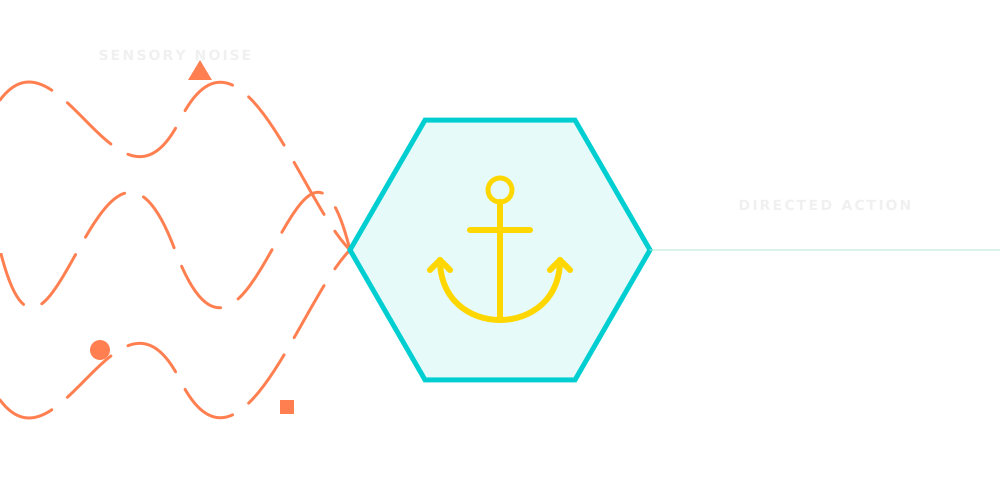
Physical training serves as an absolutely perfect metaphor for this necessary psychological regulation. You might wake up feeling intensely tired, freezing cold, or entirely unmotivated to exercise—a clear, desperate message from your comfort-seeking experiential self 3. Your rational, critical self then purposefully steps in to declare that those temporary bodily feelings do not actually matter in the grand scheme of your goals. You learn to consciously decide who holds the reins.
Dealing with frustrating open loops, like waiting two agonizing weeks for a medical test result, is the ultimate trial of this self-regulation. Your critical self desperately wants to agonize over the vast unknown, keeping you awake at four in the morning to ruminate on worst-case scenarios. Mastering your own mind means developing the fierce capacity to say, “I am deciding not to think about this,” thereby preventing the critical self from hijacking your nervous system.
The Illusion of the Narrative Overlay
We can push this deconstruction even further by realizing that the raw events of our lives are entirely neutral until we actively evaluate them. Two ordinary people can walk down the exact same street, absorbing the identical sensory data, yet one feels profoundly happy while the other feels deeply sad 4. The stark difference is purely the subjective narrative running on a loop in their heads, constructed by their relentless internal critic 4. How you ultimately choose to interpret the transient events of your life is entirely up to you.
In fact, trying to find permanent stability in the transient nature of your mind or body is exactly like building a massive castle on shifting sand. You are born, you endure a complex set of sensory experiences, and then you die; practically everything else is just an artificial overlay of human judgment. While it is tempting to force a relentlessly positive psychological spin on everything, it is often much better to simply not have any interpretations at all. The highest form of peace is learning to step back and just allow things to be.
Of course, completely turning off the interpreting machine is practically impossible for a healthy, functioning human brain. You are still going to have interpretations because your critical self is biologically hardwired to generate them without your permission. But the profound shift happens when you realize that an interpretation is just a passing thought, a meaningless cognitive artifact you can simply leave alone. You do not actually have to believe your own story.
The Tragedy of Unchecked Pure Sensation
A Genius Consumed by the Present
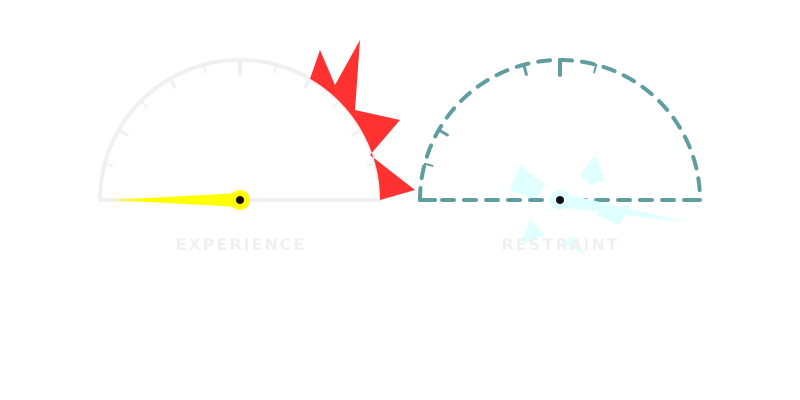
While the critical self can easily become a tyrant that ruins our peace, completely silencing it forever is a recipe for absolute disaster. Consider the heartbreaking life of George Best, a footballing genius who was mesmerizing on the pitch but profoundly torn apart by his two warring selves. He possessed one of the most naturally gifted athletic talents the world had ever seen, yet his life became a fascinating and ultimately tragic exploration of this exact internal conflict. His cautionary story proves that pure, unadulterated experience requires a structural anchor.
Best’s experiential self was permanently stuck in overdrive, deeply and fatally addicted to the immediate thrill of the present moment. He thrived on the deafening roar of the crowd, the novelty of dating supermodels, and the sheer pleasure of living an uninhibited rockstar lifestyle. He famously admitted that he spent most of his fortune on booze, birds, and fast cars, while the rest was simply squandered. It was a brilliant, chaotic existence utterly dominated by instant gratification.
The fatal problem was that his critical self—the inner judge that demands discipline, foresight, and responsibility—was entirely incapable of reining him in. Without that essential cognitive friction, he routinely missed crucial training sessions, clashed violently with managers, and spiraled tragically into severe alcoholism. His experiential self craved endless visceral pleasure, while his suppressed critical self likely suffered deeply from the weight of those disastrous choices. He lacked the very psychological mechanism needed to apply the brakes.
Finding the Middle Path of Consciousness
The tragic outcome of Best’s severe imbalance serves as a grim warning for anyone chasing pure, unfiltered hedonism as a lifestyle. His unparalleled sporting career was cut incredibly short, his physical health deteriorated rapidly, and he died far too young at the age of 59. We correctly remember him for his breathtaking footballing ability, but we also mourn the immense lost potential of a man who surrendered to his own demons. It is a stark reminder that unchecked impulsivity will eventually consume the host.
So, what are we supposed to do with this bizarre, contradictory biological hardware we’ve all been given? George Best’s rapid rise and tragic fall reminds us that neither the experiential self nor the critical self is inherently evil or uniquely virtuous. We absolutely need both modes to construct a life that is both deeply felt and practically sustainable over the long, unpredictable term. The grand trick of human existence is finding a fragile, dynamic balance between enjoying the visceral moment and making highly responsible, calculated choices. Self-awareness is undeniably crucial.
Understanding your own psychological triggers is the only effective way to manage the endless border war between these two compelling selves. If you find yourself endlessly ruminating on the past or paralyzed by anxiety, your critical network needs to be forcefully muted through flow or mindful presence. Conversely, if you are acting out impulsively and completely ignoring your future well-being, you desperately need to awaken your internal editor. If the balance feels impossible to strike on your own, seeking help from a therapist is a completely logical and vital step.
George Best’s messy, beautiful, and ultimately heartbreaking life offers three distinct and highly independent rules for anyone trying to navigate this psychological split:
- You must ruthlessly cultivate self-awareness to understand your own emotional triggers, recognizing exactly when your impulse control begins to systematically fail.
- You must actively engineer a lifestyle balance where neither the impulsive experiential self nor the rigid critical self is allowed to establish a permanent monopoly over your daily decisions.
- You must swallow your pride and seek professional, therapeutic help the moment you realize your internal editor has lost the ability to pull you back from the edge of self-destruction. We are all navigating this precise tightrope, trying desperately to feel alive without accidentally destroying our own lives in the process. We must learn to let the experiential self run wild when we need raw passion, and let the critical self take the wheel when we need strategic direction. The next time you are tempted to surrender entirely to your base impulses, pause and listen carefully to that quiet, analytical voice in your head. The unexamined life is dangerous, but the over-examined life is dead.


