


We live in an era practically defined by the endless accumulation of physical objects. You can summon almost any product to your doorstep with a solitary swipe of glass, triggering a momentary dopamine spike that feels genuinely incredible in the present moment. Yet, this relentless acquisition utterly fails to provide lasting psychological fulfillment as the mundane days roll by. The initial thrill of a purchase evaporates almost instantly, leaving behind a bland physical remnant that merely occupies space.
Basic logic suggests a deep internal conflict when deciding where to allocate our hard-earned capital. The intuitive part of our brain argues that a tangible item is a fundamentally superior economic investment. After all, a solid oak dining table will effortlessly outlast the fleeting weekend of a raucous music festival. This creates a powerful cognitive illusion that physical duration equals lasting value, leading us to prioritize tangible goods over ephemeral adventures.
Behavioral economics, however, paints a radically different picture of human satisfaction. Exhaustive research demonstrates that the exact opposite of our intuition is actually the fundamental truth of human happiness. We simply aren’t engineered to extract ongoing joy from static, unchanging items resting in our physical environment. Instead, we are dynamic creatures who ultimately derive our deepest subjective value from the emotional durability of memories. 1
The Intuitive Trap of Material Permanence
The False Promise of Physical Goods
When a consumer finally purchases a gleaming new sports car, the initial drive feels like a transcendent earthly experience. The leather smells intoxicating, the engine roars with undeniable promise, and their social status feels instantaneously elevated. Yet, within a remarkably short window of time, this miraculous machine devolves into just another mundane transportation vessel. They no longer notice the intricate stitching on the steering wheel as they trudge mindlessly through the morning commute.
Material objects suffer from a fatal psychological flaw that renders their physical durability completely irrelevant. While a premium leather sofa might persist flawlessly for generations, it rapidly fades into the background of everyday consciousness. The human brain is ruthlessly efficient at ignoring anything that remains static in our immediate environment. Therefore, inanimate objects inevitably lose their intrinsic capacity for joy, undergoing a steep psychological depreciation curve despite their sturdy construction. 2
I find it utterly fascinating how quickly a coveted premium object becomes totally invisible to its owner. We spend months agonizing over the specific shade of a velvet armchair, convinced it will revolutionize our daily aesthetic reality. Fast forward three months, and that expensive piece of furniture is nothing more than a glorified laundry receptacle. We are entirely blind to our own neurological programming when we swipe our credit cards at the checkout counter.
Unpacking the Tragedy of the Hedonic Treadmill
This pervasive phenomenon of fading excitement is academically categorized as the dreaded hedonic treadmill. We constantly sprint toward the next shiny material purchase, hoping it will finally deliver permanent life satisfaction. Unfortunately, humans quickly get completely used to whatever new baseline material standard they have recently achieved. We are forced to keep aggressively spending just to maintain our baseline level of happiness, trapped in an endless cycle of consumption. 3
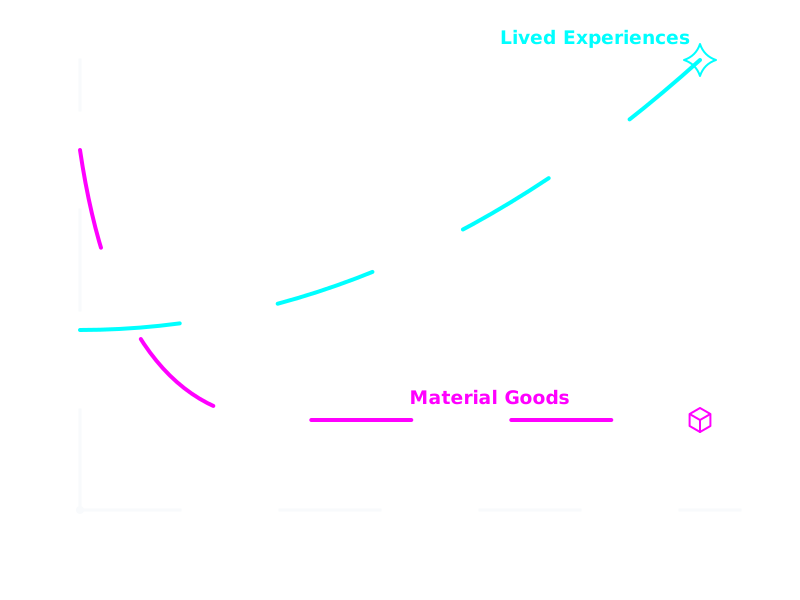
From an evolutionary standpoint, this adaptation mechanism was vital for the survival of our ancient ancestors. If a hunter-gatherer was perpetually satisfied with a single successful hunt, they would quickly starve to death in the wilderness. Discontent is a highly effective survival strategy that keeps a species constantly moving forward. However, in a modern consumer paradise, this exact same biological wiring becomes a crippling psychological vulnerability.
Modern consumer culture specifically weaponizes this biological adaptation to keep the economic wheels turning indefinitely. Advertisers sell us the profound illusion that the next product will definitively cure our lingering existential angst. It’s a brilliantly executed trap that convinces us to trade our finite temporal resources for depreciating physical assets. Stepping off this treadmill requires a radical shift toward prioritizing intangible lived experiences over static physical possessions. 3
Kahneman and the Divided Human Mind
Getting to Know Your Experiencing Self
To genuinely understand why we misjudge our purchases, we must accept that human consciousness is fundamentally divided. Nobel laureate Daniel Kahneman beautifully articulates this profound realization through his conceptualization of our two distinct internal identities. The Experiencing Self is the primal entity that lives purely in the vivid, unedited present moment. This self deeply enjoys the immediate tactile sensations of life, absorbing reality in a continuous, fleeting stream of sensory input.
When you take a bite of an extraordinary culinary masterpiece, your Experiencing Self is heavily engaged. It revels in the rich flavors, the warmth of the ambient lighting, and the joyful background laughter. But this specific version of your consciousness is entirely transient and possesses zero long-term storage capacity. Once the meal is physically consumed, the Experiencing Self simply moves onto the next stimulus, leaving the past behind entirely.
This creates a fascinating dilemma when we attempt to evaluate the overall quality of our own lives. If the Experiencing Self is completely blind to history, it cannot possibly determine our long-term life satisfaction. It merely reacts to whether the current room is too cold or the current task is too boring. We desperately need another cognitive framework to construct a coherent overarching identity out of these scattered moments.
The Remembering Self Takes the Wheel
This is precisely where the formidable Remembering Selff](/blog/retrospective-analyses#we-are-not-the-authors-of-our-actions) forcefully enters the psychological equation. This secondary version of your consciousness acts as a ruthless internal historian, constantly curating the chaotic past into a neat narrative. It doesn’t care about the duration of an event, but rather the intensity and the final conclusion. The Remembering Self is the undisputed dictator of your macro life decisions.
It turns out that this internal historian completely dominates how we choose to spend our money and time. When we decide to return to a specific restaurant, we aren’t consulting the raw data of our past sensory experience. Instead, we are consulting the summarized emotional memory that the Remembering Self actively decided to file away. We are relentlessly driven by the pursuit of emotional durability, not the fleeting perfection of a physical moment.

The profound realization here is that physical objects offer incredibly poor material for the internal historian. A television might last for an entire decade, but it provides virtually zero novel narrative data for the brain to process. Experiences, despite being physically transient, provide dense, emotionally rich chapters for the Remembering Self to proudly archive. We naturally gravitate toward adventures because they offer high-quality narrative fuel for our internal autobiography.
The Amnesic Vacation Thought Experiment
Wiping the Mental Slate Completely Clean
To illustrate the sheer dominance of the Remembering Self, Kahneman poses a truly brilliant hypothetical scenario. Imagine packing your bags for the ultimate luxury getaway, deeply anticipating endless sunsets and pristine ocean breezes. You envision a week of absolute bliss in Bora Bora, perfectly tailored to delight your Experiencing Self. It promises to be a flawless sensory masterpiece from the moment your plane touches down on the island.
Now, imagine a dark twist awaits you at the departure gate as you prepare to fly back home. A mandatory memory-wiping pill will be administered, entirely erasing every single trace of the magnificent tropical vacation. You are strictly forbidden from taking photographs, keeping souvenirs, or retaining even a fragmented recollection of the trip. The moment you land back in your hometown, your mind will be a completely blank slate.
Here is the provocative question that fundamentally shatters our intuitive understanding of consumer behavior. If you knew you would retain absolutely zero memory of the experience, would you still spend the money to go? Your Experiencing Self would undeniably get to enjoy a week of pure unadulterated pleasure. Yet, almost nobody is willing to make this bizarre psychological trade-off. 1
We Buy Memories Instead of Mere Moments
The overwhelming majority of people instantly reject the premise of the amnesic vacation. They outright refuse to endure the financial cost if they cannot keep the retrospective mental souvenir. This beautifully proves that we rarely consume experiences strictly for the present moment alone. The undeniable truth is that the memory is the actual product we are intentionally purchasing with our hard-earned money. 1
I frequently marvel at how this exposes our genuine priorities as conscious beings navigating a material world. We think we are buying a relaxing week on a beach to soothe our tired physical bodies. In reality, we are paying a premium to carefully script a beautiful chapter for our Remembering Self to cherish forever. The moment-to-moment pleasure is practically deemed worthless without the guarantee of emotional permanence.
This completely flips the traditional script on what constitutes a solid financial investment. If the memory is the true commodity, then experiences are infinitely more valuable than stagnant physical objects. A tangible good decays over time, whereas a powerful memory frequently solidifies and deeply enriches our internal landscape. We aren’t wasting money on a fleeting weekend; we are aggressively funding our long-term psychological wealth.
The Economics of Psychological Decay
Depreciating Objects in a Static World
When financial analysts evaluate a business, they meticulously track how physical equipment depreciates over time. We curiously fail to apply this exact same rigorous accounting standard to our personal domestic lives. The moment a shiny new appliance is plugged into the wall, its true emotional value peaks and then plummets. We are completely blind to this quiet and inevitable domestic emotional bankruptcy.
Consider the classic societal obsession with purchasing an astronomically expensive luxury diamond ring. It practically boasts absolute physical permanence, flawlessly engineered to reflect light for multiple consecutive generations. Yet, the wearer inevitably stops noticing the heavy weight of the stone on their finger within a few short months. The magnificent piece of jewelry silently transforms into a practically invisible shiny ghost.
This reveals the deeply tragic irony of stubbornly buying items purely for their advertised durability. We obsess over the long-term physical warranty of a product, falsely assuming that longevity perfectly equates to a lifetime of happiness. In reality, the physical persistence of the object is precisely the mechanism that causes our brains to aggressively ignore it. We pay a massive premium for permanence, only to receive absolute psychological apathy in return.
The Appreciating Asset of Wild Adventure
Experiences represent a fundamentally different class of asset within the human mind. They are undeniably transient in the physical realm, vanishing the moment the concert music stops playing. However, they possess an incredible psychological persistence that entirely defies the laws of physical decay. An experience actually grows roots in your consciousness, becoming a deeply embedded emotional anchor. 2
There is a unique cognitive magic where a lived event genuinely becomes more valuable as time passes. While a car slowly rusts in the driveway, a memory of a cross-country road trip becomes universally sweeter and more profound. You recall the laughter, the unexpected detours, and the undeniable sense of sheer freedom. The experience functions as a highly lucrative compounding psychological asset in your mental portfolio.
It’s clear that we drastically misprice the value of the intangible. We balk at the high price of a plane ticket because we can’t securely hold it in our hands. Yet, that single ticket often yields a higher dividend of joy over twenty years than any piece of electronics ever could. We must learn to properly value the enduring emotional architecture that adventures permanently build within us.
The Editing Room of Mental Retrospection
Deleting the Agony of Airport Lines
The internal Remembering Self is far from an objective journalist; it is a highly biased Hollywood editor. It systematically deletes the incredibly boring, monotonous, or stressful parts of our boldest travel adventures. When you look back on a European vacation, you don’t remember the grueling exhaustion of the long security lines. Your brain effectively completely scrubs the mundane logistical misery from the final cinematic cut.

This phenomenon is closely tied to the psychological principle known as the peak-end rule. We judge an experience almost entirely based on its most intense moments and how the narrative ultimately concluded. The three hours spent aggressively arguing with a rental car agent simply vanish into the mental ether. What remains is only the pure distilled magic of standing beneath the Eiffel Tower at absolute midnight.
Because of this aggressive mental editing, the historical record of an experience is almost always better than the reality. During the actual trip, your Experiencing Self might have been severely dehydrated and incredibly cranky. But five years later, the Remembering Self insists that it was the greatest cultural immersion of your entire life. This cognitive bias actively works in our favor, permanently elevating the historical value of our travels.
How Absolute Misery Matures Into Comedy
Consider the notoriously disastrous scenario of a rainy weekend camping trip gone completely wrong. When a torrential downpour heavily floods a campsite, the immediate reality is nothing but shivering misery and deep muddy regret. The present tense of this specific scenario feels like an absolute unmitigated disaster that you would pay dearly to escape. The Experiencing Self loudly demands to be instantly rescued from this appalling outdoor nightmare.
Yet, fast forward five years, and this exact agonizing ordeal magically morphs into a glorious narrative. It transforms from a traumatic event into a hilarious family legend told loudly around dinner tables over wine. The frantic midnight scramble to save the collapsing tent becomes the dramatic climax of an epic survival story. The inherent asset value of the experience incredibly appreciates through the sheer act of retrospective communal storytelling. 2
This is the ultimate competitive advantage that experiences hold over physical material possessions. A broken washing machine never miraculously becomes funny; it just remains a highly annoying financial liability. But a miserably failed vacation is aggressively recycled by the brain into top-tier comedic entertainment. Only experiences possess this incredible superpower to successfully transmute absolute misery into enduring joy.
The Social Architecture of True Happiness
Enhancing Connections Through Shared Escapades
Humans are deeply social creatures fundamentally wired to aggressively seek out meaningful tribal connection. Experiences act as a remarkably powerful social glue that binds us to our fellow human travelers. We bond fiercely over shared adversity, spontaneous laughter, and the electric thrill of successfully navigating an unfamiliar city. These shared emotional peaks effortlessly forge an unbreakable interpersonal solidarity that objects simply cannot replicate.
You rarely, if ever, genuinely bond with a random stranger over the specific brand of your kitchen refrigerator. Material possessions are inherently isolating, actively building tall defensive walls of status between otherwise compatible individuals. Conversely, discovering that someone else has hiked the same obscure mountain trail instantly bridges the vast social divide. Experiences naturally invite rich storytelling, rapidly accelerating the vulnerable exchange of human emotion.
This social dimension heavily multiplies the baseline happiness we extract from our financial expenditures. A concert attended with your three closest friends pays endless dividends in the form of recurring inside jokes. The physical tickets eventually fade into dust, but the strengthened interpersonal relationships violently outlive the event. Buying an experience is practically synonymous with aggressively investing in the structural integrity of your community.
Escaping the Trap of Social Comparison
Material accumulation practically guarantees an inevitable descent into the dark depths of toxic envy. When you excitedly purchase a luxury sedan, your neighbor can easily neutralize your joy by purchasing a slightly faster model. Physical items actively invite a ruthless, zero-sum game of endless social benchmarking that severely degrades mental health. It is a highly toxic competition that violently destroys your hard-earned inner peace.
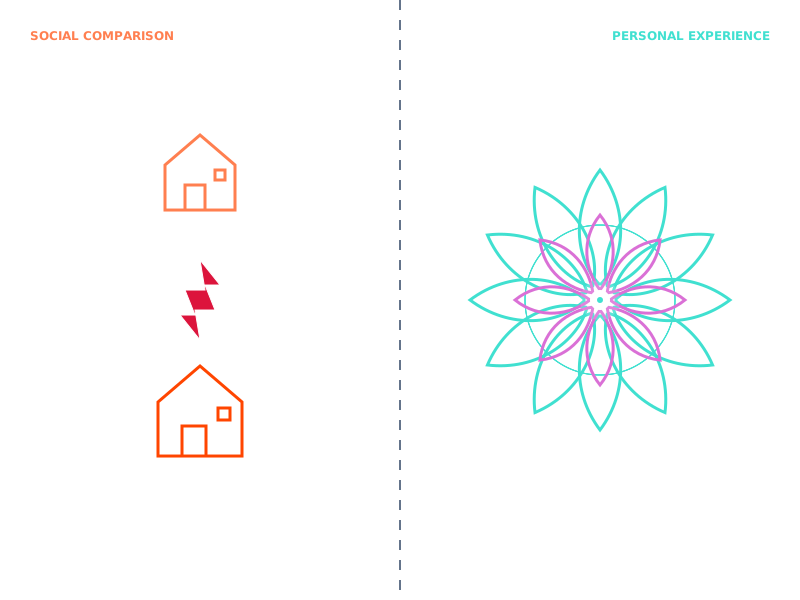
Conversely, experiential purchases are uniquely personal and remarkably immune to this specific brand of direct comparison. Your deeply spiritual yoga retreat in Costa Rica doesn’t invalidate your neighbor’s culinary tour of Rome. Because subjective experiences are internally consumed, they cannot be neatly arranged on a hierarchical societal scoreboard. They are evaluated entirely on their own magnificent terms, rendering them beautifully immune to external validation.
This immunity drastically reduces the anxiety typically associated with modern hyper-consumerism. You don’t have to desperately worry if your memory is an objectively newer model than someone else’s memory. The joy you derive from learning to perfectly surf a wave is utterly insulated from the judgments of the market. Experiences gracefully allow us to entirely opt out of the exhausting societal rat race.
You Are Distinctly Not Your Furniture
Identity is Forged Through Bold Action
Extensive psychological research proves that our self-concept is deeply intertwined with how we spend our time. We are literally the absolute sum of our lived experiences, completely uncoupled from our static material possessions. A vintage guitar hanging on the wall is merely carved wood until someone actually spends hundreds of hours practicing it. It is the raw action of learning, failing, and playing that actively builds a robust human identity.
Material goods sit strictly on the external periphery of who we fundamentally are as individuals. You might genuinely love your expensive designer jacket, but it does not represent your core spiritual essence. If you unfortunately lose all your possessions in a tragic fire, your underlying identity remains completely intact. However, if a disease violently strips away your memories, your fundamental sense of self is utterly annihilated.
This explains why experiential purchases form a vastly bigger part of a person’s core identity than anything they buy at a mall. The challenges we overcome and the foreign cultures we navigate physically rewire our internal neural architecture. We aren’t just briefly visiting a new destination; we are actively downloading new perspectives into our consciousness. We quite literally construct our own souls through the relentless pursuit of novel adventure.
Cultivating the True and Authentic Self
If you genuinely want to know someone’s true self, you never ask them about the square footage of their home. You ask them about their wildest travels, their passionate hobbies, and the mistakes they barely survived. The answers to these deeply experiential questions effortlessly reveal the exact contours of their human spirit. We connect heavily over our shared actions, completely ignoring the superficial catalog of our belongings. 3
Society desperately wants us to believe that we can successfully purchase an identity right off the rack. It insists that adopting a specific brand aesthetic will suddenly grant us the profound depth we internally crave. But a well-curated living room is nothing but an empty stage waiting for actual life to happen. True substance is only ever forged in the messy, unpredictable crucible of lived reality.
The ultimate realization is that true existential wealth is possessing a richly populated autobiographical memory. When the twilight of life rapidly approaches, we won’t seek comfort in our perfectly preserved antique furniture. We will desperately cling to the vibrant mental footage of the times we dared to step into the unknown. The most vital imperative of the human condition is to aggressively build an impenetrable fortress of profound memories.
Conclusion
The great paradox of modern consumerism is that spending money to enrich the self often requires abandoning the physical entirely. We intuitively grasp for permanence in the shape of heavy objects, falsely believing that solid matter protects us from the fleeting nature of time. Yet, the overwhelming consensus of human psychology demands that we look directly past the illusion of the tangible. Realizing that experiences uniquely appreciate in value forces us to fundamentally rethink the entire architecture of our desires.
The things you boldly do will constantly outlive the things you merely own. Stop decorating your physical house and furiously begin decorating the walls of your mind. True permanence is never meticulously manufactured in a factory; it is violently forged in the unforgettable moments that take our breath away.


