Perfectionism is a psychological trap paralyzing your potential. Discover why focusing on high volume and rapid iteration is the true path to mastery. Read more!
I have noticed a quiet, pervasive sickness lurking among incredibly ambitious people. We are absolutely terrified of creating something mediocre. It feels like our very souls are on the line every time we hit publish, launch a new product, or merely reveal our rough ideas to the world. We disguise this terror as having exceptionally high standards, but it is actually a crippling psychological trap.
The modern obsession with flawless execution has effectively paralyzed our ability to simply do the work. We sit in silent rooms theorizing about greatness while the world passes us by entirely. Our hyper-competitive culture demands both ceaseless daily productivity and immaculate outcomes, creating an absolutely impossible paradox. To break this exhausting cycle, we must adopt an incredibly counterintuitive strategy for success.
We desperately need to stop aiming for perfection and start aiming for massive volume. By completely surrendering our stubborn attachment to the final masterpiece, we accidentally unlock the exact caliber of quality we were chasing in the first place. The sheer, unglamorous repetition of creating garbage is the only reliable path to mastery. This approach requires a radical shift in how we view ourselves.
The Architecture of Our Creative Fear
Tying Your Deepest Self to Temporary Outcomes
Perfectionism is almost never about the actual work itself. At its dark core, this obsession is a heavy, iron chain anchored directly to our fragile ego. We are terrified to fail because we secretly believe that a failed project signifies a fundamentally flawed human creator. This dangerous assumption turns every single creative attempt into a devastating referendum on self-worth.
When your identity is tethered to your output, you simply cannot afford to make a mistake. Every brushstroke, every line of code, and every published sentence carries the unbearable weight of your entire personality. You begin to curate your efforts meticulously, avoiding any arena where you might look foolish or less than completely brilliant. In this state of mind, perfection becomes a survival mechanism.
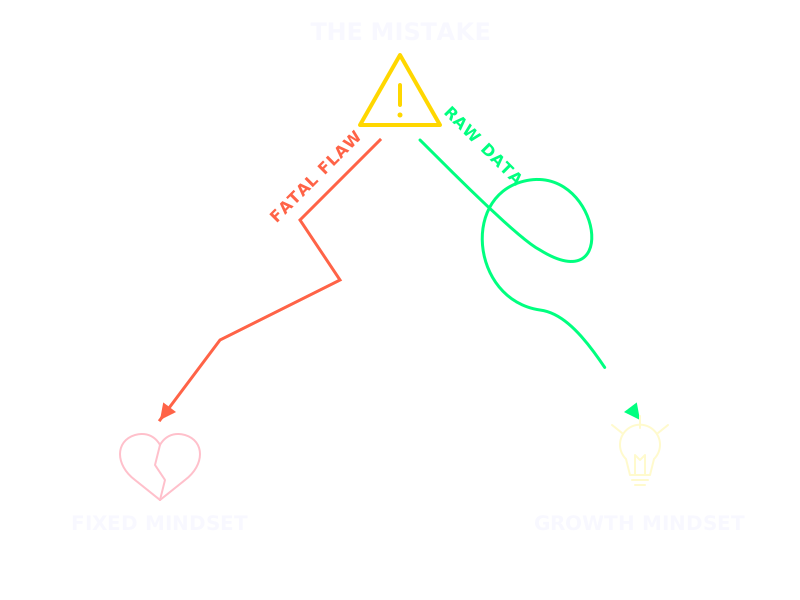
The renowned psychologist Carol Dweck famously articulated this psychological prison through her extensive academic research. She identified that people afflicted with a rigid fixed mindset view their innate abilities as entirely static and unchangeable. In this deeply limiting framework, a mistake is not just a temporary setback; it is undeniable proof of inherent incompetence. When you believe your talent is forever capped, failure feels absolutely fatal.
The necessary alternative is actively cultivating what Dweck elegantly calls a growth mindset. Under this radically different operating system, every single failure is treated as highly useful raw data rather than a final blow to your identity. High-quantity work forcibly extracts you from the ego trap by generating so much information that you cannot possibly obsess over any single data point. You stop staking your ultimate value on a flawless attempt and start measuring your constant adaptation.
The Healing Power of Low-Stakes Mistakes
Clinical psychology actually offers a fascinating parallel to this very specific creative struggle. For patients suffering from severe, paralyzing anxiety, trained therapists frequently utilize targeted exposure therapy to systematically dismantle their phobias. This technique involves deliberately forcing patients into mild discomfort until their primitive brain realizes the perceived danger is entirely illusory. The exact same neurological mechanism directly applies to our profound fear of bad work.
Producing a massive volume of output acts as mandatory, daily exposure therapy for recovering perfectionists. When you force yourself to churn out rapid attempts, you inevitably make frequent, wonderfully low-stakes mistakes. You slowly realize that publishing a mediocre essay or writing a terrible melody does not actually cause the sky to fall. This crucial habituation process eventually strips away the paralyzing anxiety of human imperfection.
Consider how a musician actually learns to master a remarkably difficult and complex instrument. They do not sit in a quiet room reading sheet music for a year before attempting to play a single, flawless concert performance. Instead, they hit thousands of incredibly wrong notes in the privacy of their bedroom until their fingers simply know the correct path. The bad notes are not a sign of failure; they are the essential roadmap to harmony.
We readily accept this messy learning process for physical hobbies, yet we completely reject it for intellectual or professional pursuits. If you write a terrible first draft of a novel, your brain maliciously tries to convince you that you lack fundamental literary talent. We brutally punish ourselves for producing bad art, forgetting that bad art is the only bridge to good art. Overcoming this cognitive dissonance is the secret to unlocking rapid growth.
The sheer repetition acts as a blunt instrument against your most neurotic tendencies. You simply do not have the luxury of time to ruminate on a single failure when the next deadline is already looming. By flooding your system with completed projects, the sting of a negative reception is heavily diluted by the rhythm of forward momentum. You teach your nervous system to thrive in the messy trenches.
The Legendary Tale of the Dead Clay
How a Simple Experiment Revealed the Truth
There is a famous, widely circulated parable that perfectly illustrates why high volume always defeats theoretical perfection. In the seminal book Art & Fear, authors David Bayles and Ted Orland describe a brilliant, highly unorthodox experiment conducted in a ceramics class. The crafty teacher dramatically split the large studio room in half on the very first day. The students sitting on the left side were evaluated solely on their literal physical output1.
The grading rubric for this left-leaning faction was unapologetically simple and entirely quantitative. If they brought fifty pounds of pots to the bathroom scale, they would earn an A; forty pounds secured a B, and so forth. Meanwhile, the students banished to the right side of the room were graded purely on absolute pristine excellence. This second group only needed to produce one single, theoretically flawless pot to receive a top academic mark.
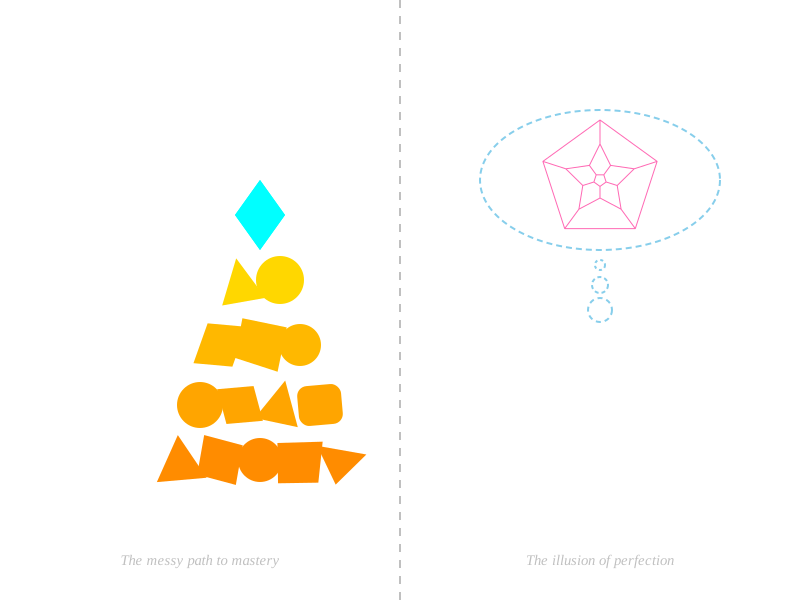
When the final grading day finally arrived, a wildly counterintuitive and fascinating outcome emerged from the studio. The highest quality pieces, possessing the most beautiful glazes and perfect symmetry, were entirely produced by the students in the quantity group. The explanation for this strange phenomenon is both painfully simple and deeply profound. The sheer act of continuous repetition had naturally fostered an environment of accidental brilliance.
The quantity group spent the entire semester busily churning out massive piles of work, making fatal mistakes, and learning physically from the wet clay. They experimented with different kiln temperatures, tested structural integrity through failure, and honed their muscle memory daily. Meanwhile, the quality group sat around in sterile circles intellectualizing about absolute greatness. The perfectionists ended up with nothing but grandiose, unverified theories and a massive pile of dead clay.
Discovering the Abstract Origins of the Parable
Interestingly enough, the true historical origins of this ceramic parable actually stem from a completely different artistic medium. Jerry Uelsmann, a professor at the University of Florida, originally ran this exact classroom experiment with his film photography students. James Clear famously retold this specific photographic version of the tale in his bestselling book regarding incremental behavioral habits. The core moral translates perfectly regardless of the chosen artistic discipline.
It makes total logical sense that the underlying truth of this story applies to both physical pottery and abstract photography. The photography students who took hundreds of photos mastered lighting, exposure, and composition through the brute force of iteration. You simply cannot learn how to manipulate shadows in a darkroom by sitting at a desk and thinking about light. Rapid iteration beats theoretical planning because complex skill is acquired strictly through the physical act of doing1.
The authors of Art & Fear intentionally modified the story to feature ceramics because they wanted to broaden the scope of their literary examples. However, the exact medium invoked in the tale is ultimately irrelevant to the deeper psychological lesson. Whether you are throwing wet mud or exposing fragile film, the human mind learns best through constant, iterative collision with reality. Avoiding these messy collisions is a guaranteed recipe for lifelong creative stagnation.
Building the Engine of Innovation
Leveraging the Power of the Minimum Viable Product
The modern corporate world has quietly weaponized this artistic concept to build incredibly lucrative, billion-dollar software empires. In contemporary business strategy and technological design, this philosophy is formally structured and celebrated as the iterative design process. Silicon Valley companies completely abandoned the antiquated idea of building flawless products behind closed doors several decades ago. Instead, they fully embraced a dynamic methodology that prioritizes rapid prototyping over endless planning.
This aggressively pragmatic methodology operates on a ruthless, universally understood mantra of failing fast and learning fast. The underlying corporate logic suggests that the sooner you produce a flawed version of your idea, the sooner you discover what actually breaks in reality. Waiting to launch your startup until a concept feels utterly foolproof is a guaranteed recipe for immediate obsolescence. You absolutely must get your ugly, unpolished drafts into the blinding light to gather essential user feedback.
Innovative technology companies now rely almost entirely on the core concept of the Minimum Viable Product. Instead of polishing a digital masterwork in a vacuum, they boldly release the simplest functional software version to the general public immediately. This aggressive strategy is merely the industrial equivalent of our beloved, messy ceramics class experiment. Pushing out an early prototype allows founders to see real market results rather than debating unverified consumer theories.
The Minimum Viable Product strategy forces developers to confront reality long before they feel emotionally secure and ready. To execute this properly, an early launch must genuinely satisfy three highly specific and uncompromising operational conditions:
The product must possess enough core value that early adopters are genuinely willing to use it immediately.
The system must demonstrably prove the fundamental business hypothesis without any unnecessary or distracting features.
The release must establish a highly reliable feedback loop to accurately guide all future developmental iterations.
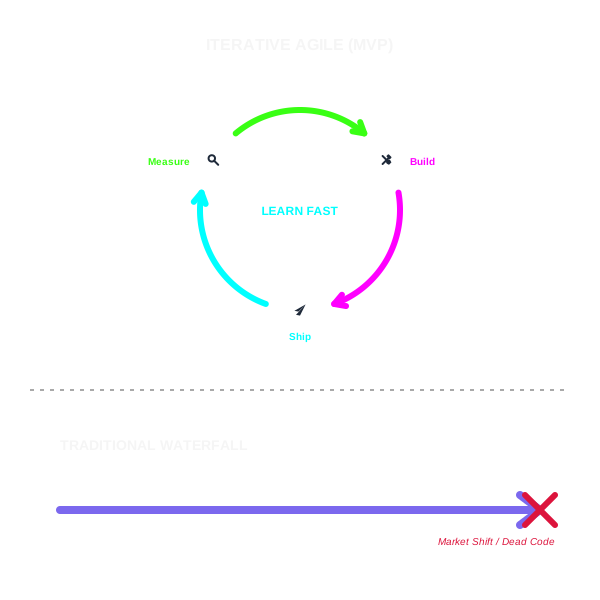
The traditional, waterfall method of software development perfectly embodies the tragic flaw of the quality group. Companies used to spend years writing massive, impenetrable documents detailing exactly how a product should function before writing a single line of raw code. By the time engineering finally finished building the theoretically perfect application, the underlying consumer problem had usually vanished entirely. They successfully built a flawless solution for a world that no longer existed.
Modern iterative frameworks like Agile were explicitly invented to violently destroy this incredibly wasteful paradigm. By forcing teams to ship incredibly small, imperfect updates every two weeks, the system prevents engineers from retreating into their comforting caves of isolation. It forcibly extracts them from the theoretical realm and throws them directly into the messy, unpredictable fires of user reality. Constant shipping acts as a crucial reality check against delusion.
When businesses refuse to adopt this iterative model, they inevitably suffer the exact same tragic fate as the quality group in the pottery studio. They burn through millions of dollars in venture capital trying to predict human behavior through elaborate boardroom guesswork. By the time they finally unveil their pristine creation, the market has usually shifted entirely. They are left holding a highly polished, terribly expensive pile of dead code.
Reclaiming the Joy of the Process
Escaping the Clutches of the Western Productivity Machine
There is a significantly darker side to our modern obsession with output that we must bravely address. Western society has deeply instilled a highly toxic belief that our finite time is only valuable if it generates a perfectly optimized financial outcome. This cultural neurosis cruelly forces us to treat our own lives as sterile, hyper-efficient factory assembly lines. We are constantly churning through our daily tasks simply to maintain the illusion of productivity.
When we focus entirely on the prestige of the final product, the actual daily work becomes intensely miserable. We completely lose our innate, human connection to the messy beauty of creation because our anxious eyes are entirely fixated on the distant horizon. This specific brand of capitalist perfectionism quickly turns our deepest passions into incredibly heavy burdens. It drains the vibrant joy from our days and leaves us feeling hollow and chronically exhausted.
The tragedy of this productivity mindset is that it actively destroys the very quality it claims to pursue. Creativity simply cannot thrive in an environment defined by relentless pressure and punishment. When your only goal is to cross a perfect item off a list, you take the safest, most boring route possible to get there. You stop taking wild, beautiful risks because you are paralyzed by the potential downside.
We have somehow convinced ourselves that suffering is a mandatory prerequisite for producing truly great work. We falsely assume that if we are not bleeding over every single detail, we simply do not care enough about the integrity of our craft. This martyr complex is nothing more than a convenient, romanticized excuse for our own paralyzing insecurities. True greatness flows from a state of relaxed playfulness, not from an atmosphere of sheer terror.
When we inevitably fail to meet these impossibly high, self-imposed standards, the shame we feel is absolutely suffocating. We begin to actively resent the very projects that once sparked our deepest, most profound feelings of intellectual curiosity. The joy of discovery is entirely replaced by the exhausting, paralyzing dread of disappointing our imaginary audience. We transform our sacred creative sanctuaries into prisons of our own making.
Embracing the Chaos of the Present Moment
Shifting our primary focus toward high-volume creation offers a miraculous, life-saving escape route from this misery. When you genuinely accept that most of your output will be deeply flawed, you finally learn to embrace the inherent beauty of uncertainty. You are no longer holding your breath for months on end, waiting for a flawless masterpiece to instantly validate your existence. You finally give yourself permission to exist comfortably inside the chaos of the present moment.
The ultimate goal of prioritizing quantity over quality is not to transform yourself into a mindless content machine. The true, underlying objective is to lower the emotional stakes so significantly that you can actually enjoy the creative challenge again. When the crushing pressure for absolute perfection finally vanishes, natural curiosity instantly rushes back into the newly created void. You enthusiastically begin to play with your chosen craft again, eagerly exploring wild, untested ideas and celebrating the inevitable failures.
This mental shift allows you to detach your personal ego from the immediate, short-term results of your labor. You stop demanding that every single painting, essay, or business venture serve as a monument to your supposed innate genius. Instead, you start treating yourself with the profound grace and patience of a curious, lifelong student. You realize that you are merely a conduit for the work, and your only real job is to keep the pipeline flowing.
Letting go of perfectionism means finally making peace with the incredibly awkward, clumsy reality of being a beginner again. It requires you to publicly stumble, face the potential judgment of your peers, and simply shrug off the sting of their criticism. This radical acceptance of mediocrity ironically becomes your greatest possible superpower in a world obsessed with flawless optics. By choosing to be relentlessly prolific, you quietly build an unshakable armor against public opinion.
Conclusion
Discovering the True Path to Better Creative Work
We have spent far too many decades worshipping blindly at the glittering altar of pristine, flawless execution. The mounting evidence from clinical psychology, modern business strategy, and historical art education clearly points in the exact opposite direction. Clinging to the comforting illusion of perfection will only guarantee your irrelevance and stagnation in a rapidly moving, chaotic world. To find the undeniable greatness you so desperately seek, you must be willing to create massive piles of trash.
Your fundamental self-worth as a human being is completely independent of your daily, fluctuating creative output. Stop violently viewing every single project as a final judgment on your soul, and start treating your work as a continuous, low-stakes scientific experiment. Get your hands dirty, ruin the expensive canvas, and aggressively launch the terribly broken software prototype. True, lasting mastery is always forged quietly in the fires of relentless, daily repetition.
Ultimately, the desperate pursuit of immaculate quality is nothing more than an incredible, exhausting paradox. You simply cannot capture brilliant lightning in a bottle by staring intensely at an empty, fragile glass container. You must willfully and repeatedly step outside into the raging storm until the magic finally strikes you. Perfection is a cowardly retreat, but iteration is the path to genius.
We use limited cookie-free measurement to understand overall traffic. Allow analytics cookies to help us recognize returning visits and learn which essays and paths serve readers best. You can change this choice at any time.




Responses