The Dark Side of Meritocracy: Why Modern Autonomy Breeds Misery
Modern autonomy promised freedom but delivered a loneliness epidemic. Learn why strict meritocracy and the loss of third places are crushing our mental health.
We’re living through a deeply unsettling and entirely paradoxical era in human history. By almost every objective measure of material wealth, we are easily the most prosperous humans to ever walk the earth. Yet I look around and see that we’re also increasingly miserable, terribly isolated, and thoroughly overwhelmed by a profound sense of emptiness. We are secretly drowning.
The Harvard Graduate School of Education recently released a devastating report regarding the mental health of young adults. An astonishing 34 percent of respondents reported severe daily loneliness, while 51 percent felt completely crushed by the pressure to achieve. Even more terrifyingly, a staggering 58 percent claimed they lacked any meaning or purpose in the previous month. The young are decidedly not okay.
This specific demographic of young adults is reporting roughly twice the rates of anxiety and depression as modern teenagers. The transition into adulthood has definitively become the primary battlefield where severe psychological difficulties rapidly mount and compound. I think we must honestly ask ourselves why we’re suffering so deeply amidst such staggering technological abundance. The answer is our autonomy.
The Architecture of Our Deep Loneliness
Trading the Security of the Village for the Suburb
Sociologists have been desperately trying to understand this tragic trade-off for well over a century. French sociologist Émile Durkheim published a groundbreaking book on suicide in the year 1900, attempting to contrast ancient societies with modern ones 1. He discovered that modern, technologically driven, and highly individualistic societies cause a massive share of their most ambitious members to simply take their own lives. Modernity quietly breeds ultimate despair.
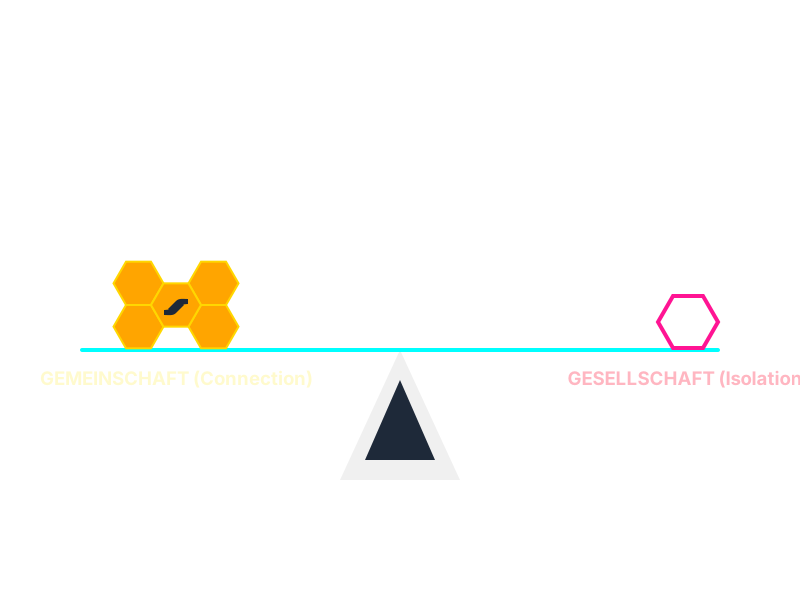
Ancient agricultural societies were fundamentally village-based, and heavily relied on strict religious frameworks to guide daily human behavior. We eventually traded that stifling security for the vibrant, individualistic freedom of the modern urban landscape. We gained unparalleled personal autonomy, but I believe we severely fractured the deep social cohesion that kept us mentally stable. We chose freedom over connection.
This terrifying trend of modern alienation is only accelerating in our current decade. The Campaign Against Living Miserably recently noted that someone dies by suicide in the United Kingdom every single ninety minutes. Suicide is now the absolute leading cause of death for men under the age of forty-five, and we’re seeing a tragic, exploding trend of young female suicidality as well. The modern soul is fracturing.
This loss of connection perfectly mirrors the warnings of German sociologist Ferdinand Tönnies from 1887. He famously defined the traditional village community as Gemeinschaft, a place where emotional, lifelong bonds forced people to constantly look out for one another. In stark contrast, he described the modern urban society as Gesellschaft, an environment dominated by impersonal, transactional, and entirely temporary relationships. We engineered our own rootlessness.
When humans migrate to massive cities, we certainly gain a highly desirable freedom from prying eyes. However, this beautiful anonymity heavily strips away the comforting security of the traditional village. This perfectly illustrates the stark contrast between the American culture of fierce independence and the Japanese culture of community, which highly values group harmony. Both systems exact heavy tolls.
The Tragic Demise of the Crucial Third Place
Our fierce American autonomy is actually built directly into the physical landscape of our daily lives. We deliberately construct sprawling suburban neighborhoods, erect massive privacy fences, and enforce a strict car dependency that isolates citizens in mobile metal boxes. This deeply hostile architecture actively prevents the spontaneous encounters that naturally weave a healthy community together. Our landscape isolates us by design.
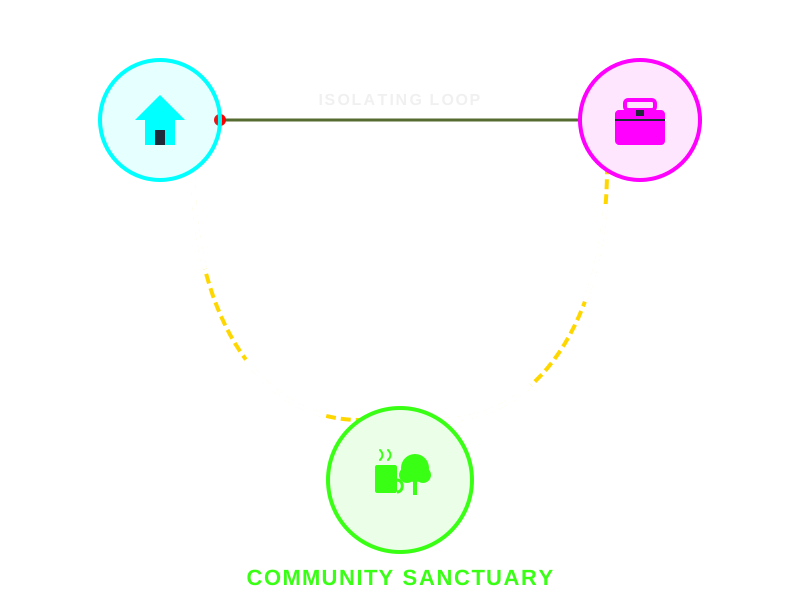
We previously possessed natural buffer zones where this vital social interaction could organically flourish. Urban sociologist Ray Oldenburg beautifully conceptualized these crucial areas as “Third Places,” defining them as informal gathering spaces located far outside the home and the workplace. These are the accessible, highly neutral grounds like local cafes, vibrant public parks, and quiet libraries where deep relationships are actually formed. Community requires a neutral ground.
Without these accessible community hubs, we are entirely reduced to bouncing pointlessly between our couches and our cubicles. A proper third place heavily prioritizes relaxed and informal conversation, allowing residents to genuinely connect without the heavy pressures of family or corporate life. When cities fail to integrate these vital communal environments, they slowly strangle the social backbone of their own neighborhoods. We are losing our sanctuaries.
When Personal Failure Rapidly Becomes a Moral Flaw
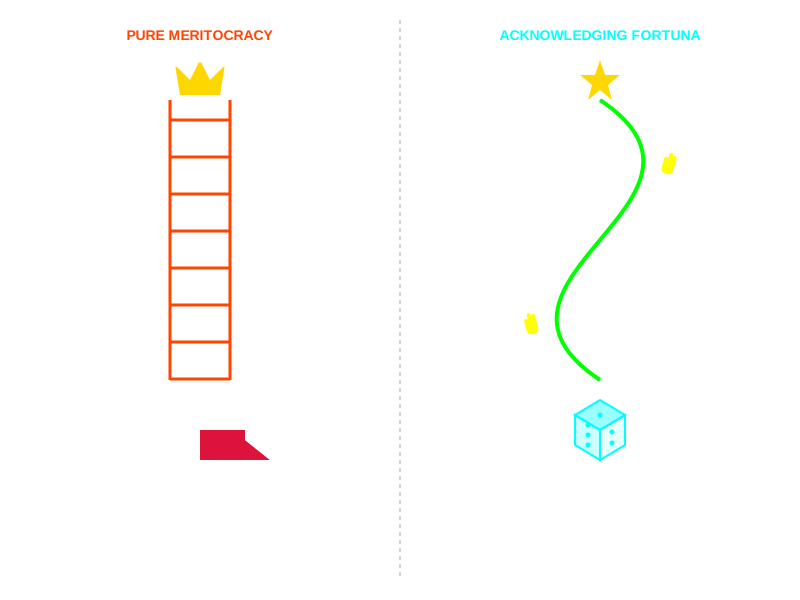
Our physical isolation is heavily compounded by an equally punishing psychological ideology regarding personal success. We are deeply obsessed with the very concept of a pure meritocracy, a system praised by politicians across the entire political spectrum. The rhetoric promises a fair world where anyone who works hard can rightfully reach the absolute top of the hierarchy. Meritocracy carries a devastating psychological toll.
If you genuinely believe in a system where those at the top rightfully deserve their incredible success, you’re making a very dark assumption. You are implicitly positing the existence of a world where those at the bottom completely deserve their total failure. This brutal worldview turns personal outcomes from a matter of random chance into a highly necessary and moral fate 1. It naturally makes winners heartless.
Because the winners believe they achieved everything alone, they feel absolutely no obligation to support the wider society. They begin to actively resent paying taxes, while the citizens stranded at the bottom are completely crushed under the weight of their perceived inadequacy. I think this is exactly why people don’t just end their lives when external circumstances get overwhelmingly bad. They break when they feel responsible.
When a deeply ambitious person fails in a meritocratic system, they cannot safely disassociate their trouble from a paralyzing sense of personal shame. This was absolutely not the case for long, continuous stretches of human history. In Old English, a poor person was gently referred to as an “unfortunate,” a word deeply rooted in the Roman goddess of luck, Fortuna. Our ancestors understood random tragedy.
Ancient Romans were constantly sacrificing to this outside agency to humbly acknowledge that fate was largely beyond human control. Today, in the intensely individualistic United States, we cruelly label our struggling citizens as “losers”. This brutal linguistic trajectory over four hundred years tells a terrifying story about how we strictly assign ultimate blame. We entirely deny the benefit of luck.
The Dangerous Myth of the Self-Made Human Identity
This relentless inward focus has completely infected our modern therapeutic culture and our basic understanding of mental wellness. Modern therapists, who often function as secular liberal Protestants, tend to dangerously conceptualize mental health as something entirely subjective 2. They teach us that mental health is a personal accessory you simply carry around inside your own head. This perspective is fundamentally flawed.
This highly subjective framework has birthed the perfectly ridiculous idea that you can unilaterally define your own identity. People boldly claim that they are whoever they say they are, completely ignoring the fact that other human beings exist in reality. Society actually has to play along with your specific game, and they will only do so voluntarily or through pure coercion. Identity requires mutual external negotiation.
If you are forced to use physical coercion to make people accept your identity, your entire social strategy is already ruined. And if you genuinely want them to play along voluntarily, the relationship simply cannot be all about you. We have foolishly swallowed the poisonous pill that our deepest well-being is purely an internal, solitary achievement. Your mental health depends on others.
You absolutely cannot remain genuinely sane in the total absence of long-term, highly stable relationships. True sanity requires a deep commitment to another human being that stretches far beyond the fleeting, impulsive desires of the current moment. If your life is only about what the selfish part of you wants right now, you’re living a life of immature aimlessness. Impulsiveness is the precise definition of insanity.
You must actively commit to your partner, your immediate family, and your broader, deeply interconnected community. Voluntarily adopting these complex levels of hierarchical responsibility actually gives you a concrete identity and a profound sense of lasting purpose. This structured social integration serves as a vital psychological shield, completely protecting you from the paralyzing grip of existential anxiety 2. Responsibility is the ultimate cure.
We falsely assume that if everyone else simply adjusted to our unique worldview, we’d finally achieve lasting happiness. In clinical reality, there is virtually no statistical difference between chronically thinking about yourself and being utterly miserable. All the descriptive statements that reflect high self-consciousness heavily load onto incredibly negative emotional states. Self-obsession guarantees human misery.
The Culture War Between the Self and Society
The Eternal Pendulum of Concentrated Human Power
This fierce tension between the solitary ego and the wider group is the fundamental engine driving our modern cultural conflicts. The battle between heavy collectivist forces and fiercely independent individuals is literally as old as humanity itself 3. We are naturally not a completely individualistic species, but we’re also absolutely not a mindless, drone-like Borg colony. We constantly swing back and forth.
We perpetually bounce between craving strong, unified leadership and aggressively demanding the right to break away and do our own thing. The modern flavor of this ancient conflict, however, features an entirely new and highly disruptive variable. The lone individual is rapidly becoming immensely powerful due to the staggering technological leverage provided by modern capital and media. The great men are growing stronger.
A single figure like Elon Musk can now command tens of thousands of brilliant engineers, endless automated factories, and massive communication networks 3. This represents vastly more concentrated power than any lone historical figure could have possibly wielded in the past. But while this leverage raises the average wealth, it drastically widens the painful gap in relative societal status. We are fundamentally relative creatures.
Because we judge our lives by looking sideways, the massive increase in invisible, low-status citizens inevitably breeds severe democratic resentment. These perceived losers outnumber the massive winners, and they will eventually attempt to use democratic systems to vote the winners down. This uncomfortable dynamic exposes a very dark truth about how our societal structures actually function beneath the polite surface. Power always precedes the political vote.
We dangerously confuse cause and effect, naively assuming that the democratic right to vote is what initially grants us our authority. In reality, historical power and the potent capacity for physical violence are what allowed elites to peacefully divide power through voting in the first place. When citizens without actual physical power try to disarm or control those who do possess it, the society eventually fractures. Nature remains red in tooth and claw.
Why the Coordinated Mob Always Hates the Truth
Because our human institutions are built on this precarious social consensus, they are fundamentally incapable of discovering objective reality. A collective group will absolutely never willingly admit its mistakes, nor can it quickly pivot when it encounters devastating contradictory evidence 4. Institutions exist solely to coordinate human action, completely relying on social approval rather than natural feedback mechanisms. Institutions are not truth-seeking entities.
Only the lone individual possesses the necessary cognitive independence to aggressively pursue and accept the unvarnished truth. We must always rely on first principles reasoning rather than seeking the comfortable, mindless applause of the coordinated mob 4. Any discipline that relies entirely on peer approval, like the various social sciences, is highly susceptible to severe political corruption. The mob enforces dangerous conformity.
This is exactly why the modern authoritarian reflex to aggressively censor dissenting voices is so incredibly short-sighted and dangerous. Naive young people eagerly believe that infallible institutions can just easily stop the bad people from speaking or owning weapons. They fail to realize that the people whom you trust to forcefully disarm the population will inevitably become the new tyrants. The censors eventually become the evil.
History consistently proves that when you can no longer allocate precious resources through actual merit, your only remaining option is pure power. This is exactly why every utopian Marxist revolution inevitably ends with a brutal thug like Stalin or Mao seizing total control. If you genuinely desire freedom at the individual level, you must vigorously ensure that rights and power are widely dispersed. Most human systems naturally concentrate power.
We must actively champion decentralized technologies like cryptography, mathematics, and the strict right to bear arms to protect ourselves from inevitable overreach. These are the rare capabilities that successfully distribute authority among the populace, preventing any single entity from achieving total dominance. Without the latent ability to physically protect your fundamental rights, your precious freedoms will simply be stripped away. Freedom requires a massive defensive capacity.
Transcendence and the Heavy Duty of the Capable
Understanding the True Alpha Male Social Compact
While the massive collective always fails to seek the truth, it still provides the crucial arena in which we must boldly act. Only the solitary individual can truly transcend the immense obstacles facing them, making any reliance on group identity a guaranteed path to bitter disappointment. However, this vital individual transcendence does not mean sitting isolated in your apartment indulging your worst possible daily habits. You must aggressively engage the world.
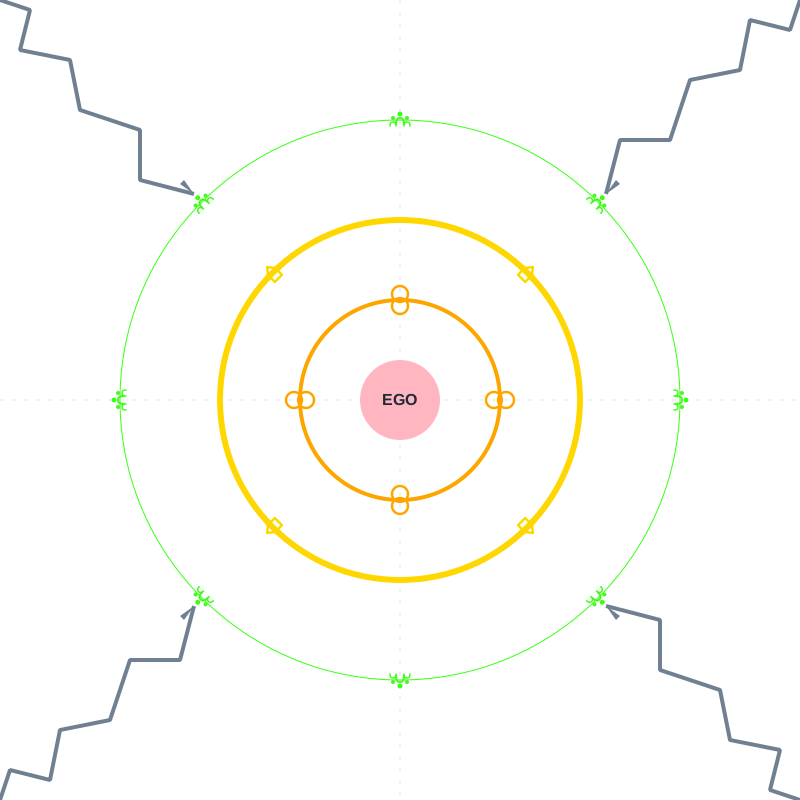
There is absolutely nothing worse in a functioning society than a lazy, highly capable man who simply leaves his immense potential on the table. You must start by taking deep responsibility for yourself, and then rapidly extend that firm protection to your immediate and extended family. As you generate more resources, you deliberately take on the heavy burden of your local tribe and eventually the wider world. Capability demands a heavy communal contribution.
This expanding radius of care is the necessary social compact we must make with the highly ambitious members of our society. A true alpha male is never the first selfish person to gorge himself at the communal feast. The actual leader feeds absolutely everyone else first, taking immense pride in his ability to provide and protect. True leadership is an act of sacrifice.
In fair exchange for this deep sacrifice, society correctly rewards these contributing individuals with the precious currency of elevated social status. When we reflexively demonize the wealthy and powerful who actually attempt to build hospitals or advance humanity, we totally destroy this vital incentive structure. If you carefully formulate good goals, they will naturally iterate across time and positively impact a massive multitude of people 2. Good goals inherently serve the collective.
Reclaiming Our Shared Human Salvation Together
We are currently standing at a very precarious crossroads between suffocating modern isolation and a terrifying, tyrannical collectivism. We have clearly discovered that absolute, unfettered autonomy inevitably leads to a desperate and highly suicidal loneliness. Yet we also deeply understand that blind submission to the massive group completely destroys objective truth and human innovation. We must somehow bridge this massive divide.
The challenging path forward requires us to fiercely guard our individual rights while voluntarily submitting ourselves to the heavy burdens of community. We must physically rebuild our shared third places, entirely reject the poisonous shame of strict meritocracy, and actively embrace our sacred duties to one another. Autonomy is a magnificent tool, but community is our only true salvation.
We use limited cookie-free measurement to understand overall traffic. Allow analytics cookies to help us recognize returning visits and learn which essays and paths serve readers best. You can change this choice at any time.




Responses