The Death of Character in a Culture of Personality
Exhausted by personal branding? Discover how we traded quiet character for the loud culture of personality, and learn how to reclaim your authentic self today.
We live in an era where your worth is relentlessly measured by your visibility, creating a profound, underlying exhaustion in our modern social sphere. We are all living on a brightly lit stage, constantly managing our digital reflections to appease an audience of absolute strangers. The performance never stops, and it feels as though it is draining the very substance out of us. Psychological data confirms this isn’t just a collective illusion 1.
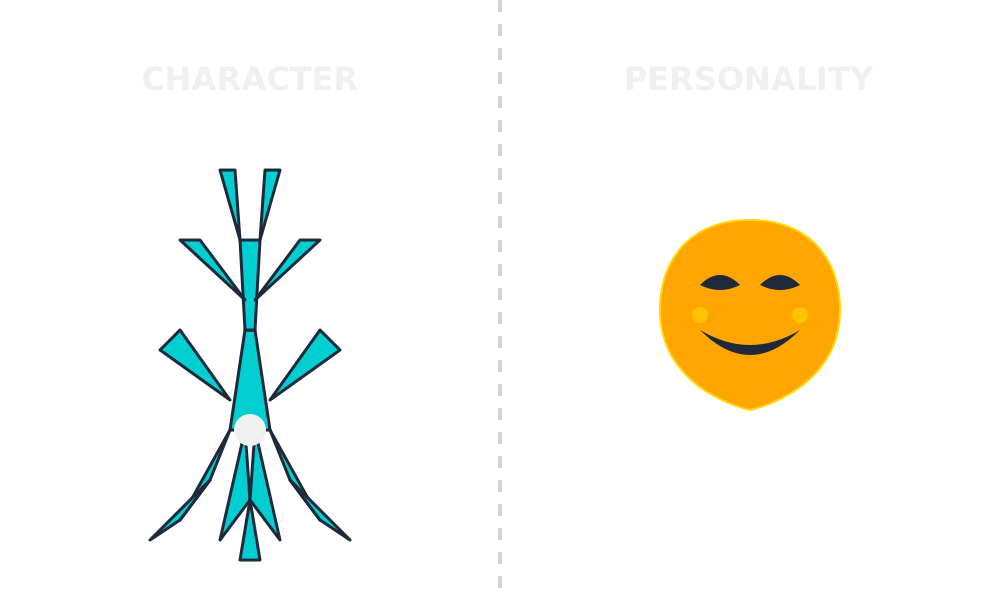
This modern anxiety represents a fundamental shift in how human beings evaluate one another. There was a time when society judged you based on what you did when the doors were locked. Now, we have traded the quiet dignity of internal ethics for the loud, desperate scramble for approval. We are living deep inside the culture of personality, entirely consumed with how well we smile when the cameras are rolling.
This is not merely a philosophical complaint about contemporary digital habits. It is a documented historical transition that has entirely rewired the modern mind, shifting us away from private duty and toward public magnetism. We must analyze the moment when human value became a commodity, realizing that our obsession with personal branding is a modern invention. The research of cultural historian Warren Susman provides the perfect map for this journey.
The Great Historical Pivot
The Silent Era of the Unseen Self
During the nineteenth century, the cultural ideal was firmly rooted in a concept known as the culture of character. Society was primarily agricultural, meaning most people lived in small towns and worked alongside individuals they had known since childhood. Your actual behavior mattered, because your neighbors observed your serious and disciplined nature every single day.
The self-help literature of that era reflects this profound internal focus, boasting titles that celebrated character as the grandest thing in the world. They elevated historical figures like Abraham Lincoln for being modest, unassuming, and fundamentally decent. Ralph Waldo Emerson even praised Lincoln as a man who did not offend by his superiority. Virtue was entirely private, and people were valued for their ethical substance rather than their ability to entertain a crowd.
You did not need to be a charismatic speaker to be deemed a good person in this older world. If you paid your debts, took care of your family, and acted with integrity, society respected you. Honor was a quiet achievement, built slowly over decades of consistent, ethical choices. This created a stable social foundation where trust was earned through action, grounding individuals in a sense of duty that did not require constant public validation.
Proving Your Worth to Strangers in the City
The transition into the twentieth century shattered this quiet, agricultural existence. The rise of big business and industrialization forced people to migrate from small villages into booming urban centers. You had to prove yourself quickly and decisively to masses of absolute strangers who knew nothing about your internal moral compass.
This demographic upheaval birthed the culture of personality out of sheer economic necessity. To get a job or secure a loan, you had to make an immediate, magnetic impression. Magnetism replaced morality as the primary currency of success, turning charisma into a mandatory survival skill for the modern worker. Society began to worship the bold and assertive, leaving the quiet, modest individuals at a distinct disadvantage 1.
Warren Susman and the Heavy Performer’s Burden
Cultural historian Warren Susman brilliantly chronicled this massive psychological shift in American society. He noted that the transition moved people away from valuing citizenship and duty, pushing them toward dominant self-presentation. Everyone became a performer, desperately trying to capture the attention of a distracted audience rather than focusing on fundamental reliability. Susman realized that this shift fundamentally altered our human psychological expectations.
The self-help industry rapidly pivoted to accommodate this new, performative reality. Books stopped focusing on noble character and began teaching readers how to win friends and influence people, replacing unassuming statesmen with incredibly effective, charismatic salesmen. The goal was likability, regardless of whether that likability was rooted in genuine virtue. We learned to optimize our public impression management, wearing carefully constructed masks to secure social and financial capital 1.
The Digital Acceleration of Personality
Viewing Charisma as a Highly Calculable Metric
If the twentieth century invented the culture of personality, the twenty-first century has weaponized it. Social media platforms took the need for charisma and scaled it to a global, instantaneous level. Approval is mathematically tracked, displayed publicly through follower counts, likes, and algorithmic reach. We have turned magnetic appeal into a digital stock market where everyone is day-trading their own identity.
Modern charisma online is no longer an organic expression of human warmth. It is a highly strategic set of performative behaviors combining status signals, visual presence, and contrived authenticity. Attention is the only currency, and the platforms relentlessly punish those who refuse to play the game by rendering them invisible. Reputation management is now a daily obligation, forcing us to project an aura that captivates a scrolling audience within seconds.
The Deep Psychological Neuroticism of the Feed
This constant demand for performative distinctiveness takes a massive psychological toll on the human brain. Social media platforms create an environment that vastly amplifies our desperate need for uniqueness through constant social comparison. The pressure is suffocating, breeding a deep anxiety about whether your digital avatar is sufficiently interesting compared to millions of polished performances. Recent psychological studies provide hard evidence of the damage caused by this daily digital grind.
Research specifically demonstrates that heavy Instagram use can temporarily increase neuroticism in users. The platform forces individuals to obsess over their distinctiveness, driving a frantic need to stand out from the digital herd. The algorithm feeds on insecurity, rewarding outrageous behavior that elevates engagement over quiet, stable mental health. This leaves us trapped in a cycle of performative anxiety, constantly refreshing the feed to check our social standing.
Optimizing the SEO of the Human Soul
We have reached a point where we actually optimize our personalities for search engines. The strategic use of hashtags, trending audio, and algorithmic keywords has become a terrifying substitute for genuine character cultivation. Originality is completely flattened, replaced by a standardized template as people mimic influential figures to trick the algorithm into granting them visibility. We are witnessing the automation of human charm.
This optimization process strips away the nuances that make actual human connection meaningful. Instead of developing deep, idiosyncratic traits, we smooth our edges to fit neatly into predefined digital categories. We are packaging ourselves, treating our own identities as products sitting on a digital supermarket shelf. Authentic character cannot survive when every action, thought, and aesthetic choice is calculated for maximum digital reach.
The Commodification of Virtue
The Depressing Moment When Altruism Becomes Advertising
Perhaps the most depressing symptom of this shift is how it has corrupted the concept of doing good. In the past, activities like volunteering, reading, or quiet reflection were methods for building a strong internal character. Virtue requires an audience today, because an undocumented good deed offers zero return on social investment. We have transformed genuine altruism into a sophisticated form of personal public relations.
If you travel to build houses in a developing nation, you must document the experience with perfect lighting. If you read a difficult book, you must post an aesthetic picture of the cover alongside your morning coffee. Morality is now content, fed into the machine to prove to strangers that you are a good person. This visual documentation of ethics completely hollows out the private soul, making the action itself secondary to the proof.
The Complete Rebranding of the Self-Help Industry
The modern self-help industry fully embraces this inversion of traditional values. We have moved entirely from building internal character to managing external perception with ruthless efficiency. The focus is entirely external, centered on building personal brands and generating positive reviews from your professional and social network. Traditional self-improvement has been assassinated and replaced by sleek marketing strategy.
This represents a complete, structural inversion of what it means to genuinely improve oneself. The original goal of self-help was developing deep values that guided your private conduct, especially in difficult times. It is incredibly cynical, teaching people to manufacture trust and craft a bulletproof image that consistently wins public approval. We are instructed to value the reflection in the mirror over the actual person standing in front of it.
Choosing Social Mimicry Over True Moral Courage
In a culture obsessed with personality, mimicking the right traits becomes far more lucrative than possessing true moral courage. We see this constantly in corporate leadership, where charismatic sociopaths are frequently promoted over diligent, quiet workers. The mask becomes reality, allowing terrible behavior to hide behind a highly optimized, warm smile. Social magnetism provides a perfect camouflage for individuals who are entirely lacking in foundational character.
This dynamic creates a society that is fundamentally vulnerable to massive fraud and manipulation. We elect politicians, hire executives, and follow influencers based almost entirely on their performative charisma. Charm is incredibly dangerous, because it short-circuits our critical thinking and demands our immediate, unearned affection. We desperately need to recover our skepticism of the spotlight, realizing that the loudest voices often hide the weakest ethics.
To find a way out of this trap, we must look at the people who actively rejected the culture of personality. History shows us that some of our most transformative leaders and creators were profoundly introverted and shy. He walked alone, wandering through the woods and emphatically turning down social invitations to protect his peace, allowing Charles Darwin to formulate the theory of evolution. Profound insight requires a level of solitude that the modern world actively tries to destroy.
Theodor Geisel dreamed up his amazing Dr. Seuss creations in a lonely bell tower office behind his house, terrified that children would expect a jolly, Santa-like figure. Steve Wozniak invented the first Apple computer sitting entirely alone in his cubicle at Hewlett-Packard. Solitude is a catalyst, providing the necessary oxygen for ideas that challenge the established status quo. These quiet innovators understood that true creativity cannot be crowdsourced or successfully managed by a committee.
Uncovering the Solitary Roots of Genuine Progress
When psychologists study the lives of the most creative people, they consistently find a serious streak of introversion. Highly creative individuals are certainly good at exchanging ideas, but they also possess a vital capacity for deep isolation. Distance provides clarity, allowing the mind to wander away from the suffocating pressure of public consensus. The best ideas are almost always born in the dark, far away from the glaring judgment of the crowd.
Major religious traditions have understood this fundamental truth for thousands of years. Seekers like Moses, Jesus, and Buddha did not find revelation while working in an open-plan office or managing their personal brands. They sought the unseen, embracing the quiet space where true character and visionary insights are actually forged. You cannot access transcendent truth while simultaneously worrying about your follower count or daily engagement metrics.
Building an Unseen Foundation for the Future
We must consciously decide to step off the stage and rebuild the private architecture of our lives. This means valuing the hours of the day when nobody is looking, validating, or liking what we are doing. We must log off, deliberately retreating into spaces where our actions leave absolutely no digital footprint. True character is built precisely in those rare moments when public performance is completely impossible.
This requires a radical rebellion against the demands of the modern economy and the social media ecosystem. You have to be willing to be perceived as less interesting, less dynamic, and less visible than your peers. Substance outlasts style, even if it takes years for anyone else to finally notice the difference. By protecting our inner moral landscape, we save ourselves from the neuroticism of the algorithmic feed.
The shift back to character will not be easy, as the financial incentives for performative personality remain massive. However, the psychological cost of living as a hollow brand is entirely unsustainable for the human spirit over the long term. We are meant to be real, possessing jagged edges, private thoughts, and a quiet dignity that cannot be monetized. The culture of personality is a glittering prison, but intentional solitude is the key to unlocking the door.
We have spent a century perfecting the art of being seen, but we have entirely forgotten how to simply exist. The spotlight reveals nothing, blinding us to the complex, unmarketable truths that make us genuinely human. The quiet darkness is where we finally meet ourselves, completely free from the neurotic demands of the digital crowd. Let us have the courage to close the curtain, remembering that real virtue requires no audience. True character is what remains when the performance finally ends.
We use limited cookie-free measurement to understand overall traffic. Allow analytics cookies to help us recognize returning visits and learn which essays and paths serve readers best. You can change this choice at any time.




Responses