Stop Bullying Your Brain: Rewire It With A Growth Mindset
Stop letting failure define your identity. Learn how to rewire your brain, build a growth mindset, and use cognitive wedges to unlock your hidden potential..
Have you ever noticed how quickly we label ourselves after a single mistake? You miss an important deadline at work, and suddenly you are just a fundamentally flawed person. We tend to take a localized event and map it directly onto our core human identity. This is a strange psychological quirk, and it is quietly ruining our potential.
We live in a culture obsessed with innate talent and effortless genius. We love the myth of the prodigy who simply wakes up brilliant and ready to conquer the world. This obsession creates a hidden trap that forces us to view our capabilities as entirely static. We wrongly assume that our current abilities reflect our absolute maximum threshold for future success and growth.
But this deterministic view of human potential is biologically incorrect. The brain is remarkably plastic, wiring and rewiring itself constantly based on our daily actions and thoughts. If we want to change our outcomes, we must first deeply change how we interpret our struggles. We have to learn how to rewire our automated scripts through tiny intentional movements.
This journey requires a radical departure from how we usually talk to ourselves in our darkest moments. You cannot simply bully your brain into adopting a fresh perspective through sheer willpower. You must negotiate with your own psyche like a highly skilled hostage negotiator. By validating our darkest doubts, we can finally unlock the cognitive flexibility required for true psychological evolution.
The Psychology of Static Identity
How Static Identity Sabotages Your True Potential
The core issue underlying our self-sabotage is a fundamental misunderstanding of human identity itself. We tend to construct our self-image as a rigid, finished sculpture rather than a lump of wet clay. When the sculpture gets chipped by a professional failure, we feel as though our very essence has been permanently vandalized. We must learn to view our identity as a highly fluid process, ensuring that our internal sense of worth remains completely untouched by failure.
If you tie your identity to being the smartest person in the room, every new room becomes a terrifying psychological threat. You will naturally begin to avoid challenging environments where your intellectual supremacy might be called into question. This desperate need to protect your static identity forces you to shrink your life down to a highly manageable, mediocre size. You become a prisoner of your own ego, aggressively defending your fragile historical accomplishments instead of pursuing new frontiers.
When we treat our talents as immutable traits, every setback feels like an existential verdict. A rejected manuscript, an awkward date, or a missed sales target ceases to be a momentary friction point. Instead, it transforms into an indictment of our fundamental biological worth. This toxic framing induces cognitive paralysis, driving us to abandon promising creative endeavors before we ever reach genuine technical mastery.
Separating Your Deepest Worth From Your Daily Output
A healthier mindset fundamentally severs this toxic connection between your output and your intrinsic human value. When you truly believe that abilities are highly malleable, a public failure no longer feels like a deeply personal indictment. You are able to objectively analyze the disastrous outcome as a simple consequence of flawed situational tactics. Because you do not take the loss personally, you preserve the vital emotional energy required to recalibrate your strategic approach and try again tomorrow.
This identity detachment is the secret engine behind all world-class resilience and relentless perseverance. When a master craftsman ruins a piece of wood, he does not suddenly believe he is a fundamentally broken human being. He simply acknowledges the grain of the wood, sharpens his tools, and begins the labor all over again. We must treat our own minds with this exact same level of clinical objectivity, transforming our devastating personal tragedies into useful data points.
Imagine the psychological liberation that comes from realizing your failures do not belong to your soul. They belong entirely to the specific environment, your current level of preparation, and the execution strategy you deployed. When you view setbacks as external experiments rather than internal verdicts, your fear of judgment begins to evaporate. You can finally cultivate the profound intellectual humility necessary to navigate unpredictable life conditions.
Carol Dweck and the Science of Belief
How Fixed Beliefs Constrain Our Daily Motivation
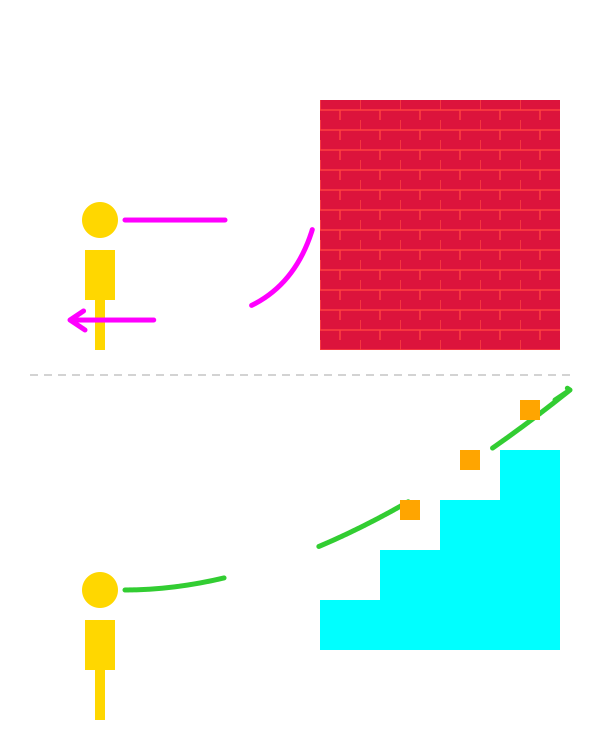
In her groundbreaking work, psychologist Carol Dweck outlines the stark difference between a fixed and a growth mindset. A fixed mindset assumes that character, intelligence, and creative ability are static givens which we cannot change in any meaningful way. Conversely, a growth mindset thrives on challenge and sees failure not as evidence of unintelligence but as a heartening springboard for growth. Her book famously demonstrates how our core beliefs shape our learning and motivation across all areas of life 1.
Consider the pervasive cultural mythology surrounding historical geniuses like Albert Einstein or Wolfgang Amadeus Mozart. We love to tell stories about their seemingly divine talent, conveniently ignoring their grueling thousands of hours of obsessive practice. This widespread romanticization of innate ability creates a toxic psychological environment for the rest of ordinary society. It tricks people into believing that their current lack of mastery is a permanent biological sentence.
Dweck’s research beautifully dismantles this prodigy myth by observing how we explicitly praise young children in academic settings. When we praise a student solely for being smart, we inadvertently teach them that their worth is tied to a static trait. The moment that child encounters a problem they cannot immediately solve, their entire self-concept shatters into pieces. They suddenly assume they are no longer smart, prompting them to abandon the difficult learning process entirely to protect their fragile ego.
Conversely, praising effort teaches children that competence is an ongoing construction project. They learn to interpret intellectual friction not as a wall, but as the precise sensation of neurons firing and adapting. When difficulty arises, they do not experience an existential threat to their character. They simply recognize that they need to devise better strategic solutions to conquer the intellectual obstacle before them.
Applying The Growth Mindset Across Life Arenas
The implications of Dweck’s work extend far beyond the walls of elementary school classrooms. Our implicit beliefs regarding ability bleed into how we lead companies, navigate athletic competition, and sustain long-term romantic partnerships. When you examine high performers across diverse fields, you find that their defining attribute is rarely effortless brilliance. Their real advantage is an unyielding psychological willingness to endure prolonged periods of humbling personal awkwardness.
To truly grasp the breadth of this concept, we must examine how it manifests in the primary arenas of our daily lives 1:
Academic environments: Students with a growth mindset view rigorous challenges as opportunities to expand their cognitive abilities rather than threats to their intellectual ego.
Corporate workplaces: Professionals who embrace malleability are far more likely to seek out constructive criticism and view their colleagues’ success as inspirational rather than intimidating.
Athletic pursuits: Competitors focused on growth emphasize grueling practice and incremental refinement instead of relying purely on their baseline natural talent.
Interpersonal relationships: Partners in a growth framework believe that conflict is a mechanism for deepening connection rather than a sign of fundamental incompatibility. In relationships, for example, the fixed mindset leads to the toxic belief that true love should be completely effortless. If partners experience conflict, they quickly conclude that they were simply not meant to be together. A growth-oriented couple, by contrast, understands that intimacy is a craft that requires constant emotional recalibration. They view disagreements not as fatal flaws, but as invaluable communicative opportunities to deepen their mutual emotional understanding.
Adopting The Solo Leveling Approach To Daily Reality
If you want a modern visual metaphor for Dweck’s research, look no further than the wildly popular anime known as Solo Leveling. The story follows a protagonist who starts off completely destitute and ranks as the absolute weakest hunter in the world. However, he accidentally acquires a mysterious interface that allows him to literally level up his abilities in real life. He essentially adopts a gamified growth mindset, treating every painful physical challenge as a quest.
What makes Sung Jinwoo’s journey so universally compelling is his radical acceptance of his absolute rock-bottom status. Before he acquires his leveling system, he is mocked, battered, and left for dead by his own peers in dangerous dungeons. Yet, he never adopts the identity of a helpless victim condemned by the cruelty of genetic lottery. He maintains a quiet, burning desire to survive, making him the perfect candidate for a limitless growth trajectory once the system finally awakens.
This anime perfectly encapsulates the thrill of viewing your own life as an accumulative role-playing game. Instead of crying over his baseline weakness, the protagonist focuses entirely on grinding through daily tasks to earn points. He upgrades his strength, agility, and intelligence systematically over time through sheer, unadulterated persistence. We can apply this exact same framework to our own reality by treating our daily productive efforts as tangible skill points.
Human beings are inherently drawn to the structured progression systems found in modern video games. When you play an incredibly difficult game like Elden Ring, you fully expect your character to die repeatedly. You do not throw the controller and conclude that you are a fundamentally worthless person who lacks gaming genetics. You simply analyze the boss mechanics, adjust your timing, and respawn with a slightly better tactical approach for your next rigorous attempt.
Treating Your Painful Efforts As Real Skill Points
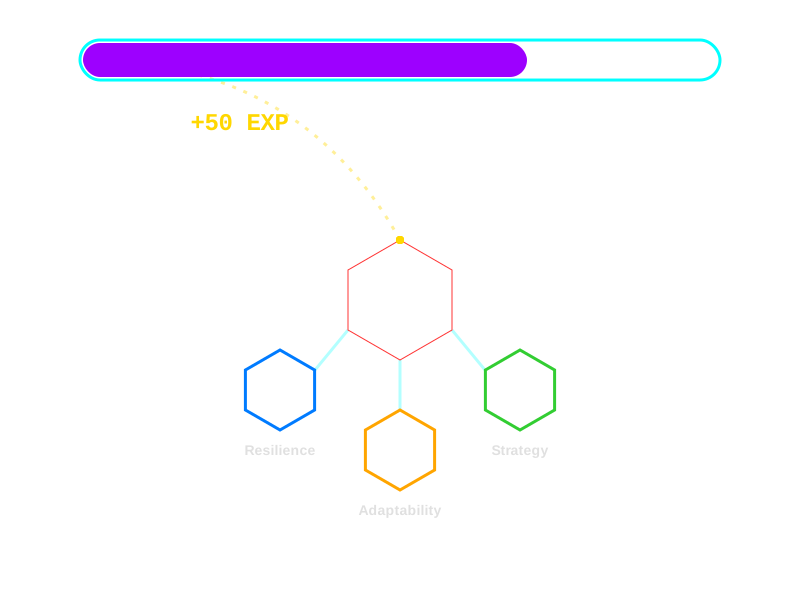
Imagine how your life would change if you truly treated your daily habits like acquiring experience points. A brutal rejection in a sales call is no longer a personal indictment of your natural human charisma. It is simply a necessary grind to acquire fifty experience points in your speech skill tree. This extreme psychological detachment allows you to endure immense friction while quietly building your ultimate character build in the real world.
We all possess our own invisible leveling interface, but we rarely bother to check our personal stats. Every difficult book you finish, every uncomfortable conversation you navigate, and every workout you endure is actively adding points to your character sheet. The tragedy is that ordinary reality does not provide floating neon text to validate your incremental daily progress. You must learn to internally visualize this point system, actively celebrating your tiny invisible victories to maintain your long-term motivational momentum.
When you reframe life as an open-ended role-playing game, failure loses its terrifying emotional sting. A failed startup is merely a catastrophic boss fight that drained your health bar and taught you the attack patterns of the market. You respawn at the campfire, gather your resources, and distribute your newly acquired wisdom into your strategic attributes. By adopting this playful mindset, you convert what once felt like debilitating personal shame into essential narrative progression.
The Neuroscience of Automated Thought
Understanding Your Mind As An Automated Script
Understanding the theoretical difference between these mindsets is entirely different from actually changing your own. There is a massive industry of self-help books and motivational videos preaching the gospel of boundless growth. The glaring problem is that almost none of them actually teach you the gritty mechanics of cognitive restructuring. We need to understand exactly how to shift our deeply entrenched neural pathways rather than just reading about it.
Dr. K from HealthyGamerGG provides a brilliant architectural framework for understanding how our thoughts actually operate. He suggests that we should view our current mindset as a massive, deeply ingrained AI script running quietly in the background. In the Sanskrit tradition, these deeply grooved psychological patterns are referred to as samskaras. They are highly automated cognitive habits that execute identically every single time we face a specific trigger.
He compares these neural pathways to the steady, unyielding flow of a massive river. Just as water carves a canyon over thousands of years, our repeated thoughts carve permanent routes into our brain chemistry. If you possess a fixed mindset, encountering a setback immediately triggers an automatic flood of self-defeating thoughts. To change this trajectory, we must figure out how to divert the rushing water toward a completely new cognitive direction.
These neural rivers are not easily moved by mere wishful thinking or superficial intellectual epiphanies. Every time you think a thought, the myelin sheath around that neural circuit thickens, making future signals travel faster. When you experience failure, the electricity of your brain naturally flows down the deepest, widest trench available. If that trench is labeled with personal inadequacy, your brain will arrive at catastrophic self-condemnation in a fraction of a second.
Why Bullying Your Brain With Positivity Fails
This brings us to the most counterintuitive realization about modern self-improvement and positive psychology. When people realize they have a negative script running, their first instinct is usually to violently force a positive thought into their head. They try to aggressively bludgeon their own minds into believing something blindly optimistic. This strategy of bullying your own brain is actually highly counterproductive.
When you try to force a toxic positivity script over a deep insecurity, your mind knows you are lying. If you truly believe you are inherently lazy, shouting affirmations in the mirror will only create massive internal dissonance. You might act the part for a day or two, but deep down, your subconscious outright rejects the new narrative. We must find a way to introduce a tiny cognitive wedge that feels authentically true to us.
Forcing an unearned positive thought onto an anxious mind is akin to telling an angry person to calm down. It produces an immediate rebound effect, intensifying the very resistance you were trying to eliminate. Your subconscious mind views this ungrounded optimism as an insult to its genuine, lived experiences of pain and failure. To achieve real change, you must abandon the sledgehammer of artificial cheerfulness and learn the art of compassionate inquiry.
The Art of the Cognitive Wedge
Validating Your Deepest Fears To Decompress Emotion
If raw mental force does not work, we must employ the subtle art of clinical validation. Dr. K points to the field of clinical psychiatry and the treatment of severe negative emotions. When a patient expresses suicidal ideation and claims they have no reason to live, a good psychiatrist never argues with them. Telling a deeply depressed person about all their wonderful blessings only serves to severely invalidate their current agonizing reality.
Instead, the clinician seeks to intensely validate the patient’s perspective, lowering the immediate emotional temperature of the crisis at hand. The most effective response is to sincerely acknowledge the overwhelming weight of the patient’s circumstances. By saying that it completely makes sense why they feel so hopeless, the psychiatrist drastically decompresses the negative emotion. We must apply this exact same radical empathy to our own internal fixed mindset scripts.
When you fail and feel utterly worthless, you must first validate that intensely painful human emotion rather than instantly fighting it. You have to look at your own despair and acknowledge that a part of you truly believes you will never succeed. This validation process diffuses the emotional bomb, giving you the mental breathing room needed to introduce a fundamental shift. Once the intense shame has been recognized, you can finally insert your tiny cognitive wedge into the restructuring process.
Validating your fear is not the same as surrendering to its fatalistic conclusions. It is simply an honest admission that your brain has developed a very specific, protective survival mechanism over time. When you tell yourself that your feeling of utter hopelessness is understandable, the nervous system stops blaring its alarm. In that quiet space of decompression, you regain the essential executive control required to redirect your thinking.
Inserting Tiny Wedges Into Fixed Neural Pathways
Once the emotional storm has subsided, you can begin the delicate work of cognitive restructuring. A cognitive wedge is a microscopic, undeniably true statement that subtly disrupts the absolutism of your fixed script. It is not an aggressive claim of imminent greatness, but rather a quiet observation that creates a tiny sliver of doubt. By introducing this gentle skepticism, you prevent your thoughts from rushing down the default canyon of unquestioned personal failure.
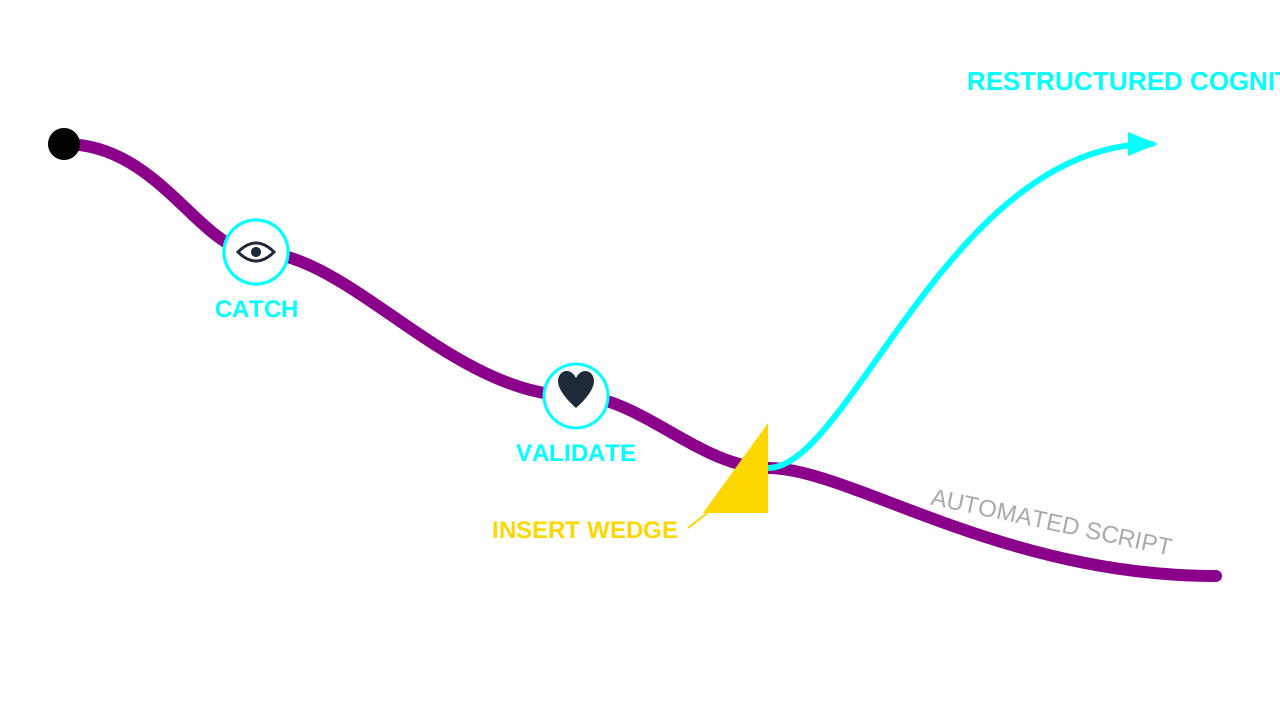
The actual practice of cognitive restructuring requires precision, patience, and a willingness to sit with uncomfortable truths. Dr. K outlines a highly specific technique for shifting these stubborn neural rivers in real time. Whenever you catch yourself spiraling into deterministic self-sabotage, you should immediately execute the following internal protocol:
Catch the script: Actively notice the exact moment your brain triggers a deterministic fixed mindset thought about your inherent traits.
Validate the despair: Authentically acknowledge to yourself that a deeply wounded part of you truly believes this negative outcome is permanent.
Insert the wedge: Introduce a tiny undeniably true counter-thought that provides just a fraction of wiggle room without triggering mental resistance.
Consider how this looks in the heat of an actual professional catastrophe. Your mind screams that you are fundamentally stupid, completely hopeless, and destined to be fired. Instead of shouting back that you are a genius, you pause and validate the terror of the situation.
Then, you insert your wedge: even though I feel entirely doomed right now, is it possible that I learned one useful lesson today? That tiny question is all the wedge your brain needs to fracture the rigid certainty of a paralyzing fixed mindset.
The Practice of Lifelong Transformation
Becoming The Conscious Architect Of Your Mind
Shifting from a fixed deterministic worldview to a fluid growth mindset is not a one-time intellectual exercise. It is a grueling, lifelong commitment to meticulously pruning the neural pathways of your own highly complex brain. You will face countless moments where the comfortable allure of the fixed mindset tries to pull you back into absolute stagnation. But armed with the right cognitive wedges, you can actively resist this powerful gravitational pull and continue your relentless upward climb.
The beauty of this framework is that it completely democratizes the pursuit of human excellence. You no longer need to be born with a silver spoon, perfect genetics, or a flawless baseline intellect to achieve greatness. You simply need the quiet courage to face your deepest inadequacies and the patience to grind out your daily skill points. By refusing to let failure define your core identity, you unlock an infinite reservoir of potential that cannot be easily exhausted.
Every time you choose awareness over autopilot, you carve a new tributary in the landscape of your mind. Over months and years, the rushing waters of your consciousness will naturally begin to favor this healthier, more productive route. What once required exhausting mental effort will gradually transform into an effortless, automatic baseline reaction to adversity. You will no longer view challenging situations as threats to your existence, but rather as exhilarating invitations to evolve into an exponentially more capable human.
Cultivating Relentless Curiosity Through Consistent Practice
True mental plasticity demands that we cultivate an insatiable, nonjudgmental curiosity toward our own psychological shortcomings. When you notice yourself falling into old habits of self-condemnation, do not greet the slip with anger. Treat the regression as an interesting biological artifact, an ancient software program that simply needs another minor debugging session. This playful, experimental posture transforms the tedious work of self-improvement into an infinitely fascinating game of lifelong self-discovery.
Ultimately, your mind is entirely yours to mold, reshape, and continuously upgrade until your final days. You are not a static piece of stone, but rather a wildly capable architect standing before an empty plot of land. Every validated fear and every tiny cognitive wedge you place is another brick in the foundation of your future self. The person you are today is simply the starting block for tomorrow. He who refuses to be defined by his stumbles will ultimately be defined by his distance.
We use limited cookie-free measurement to understand overall traffic. Allow analytics cookies to help us recognize returning visits and learn which essays and paths serve readers best. You can change this choice at any time.




Responses