Suppose you bought a stock a few years ago, watched it surge 50% or even double, and now you want to buy something expensive. Most people assume they have to sell shares, realize the gain, and hand over long-term capital gains tax on that $50 profit. Selling is optional, however, if you know how to pledge those shares for a loan, cover a bit of interest out of current income, and let the underlying portfolio keep compounding until the day you die.
That, in plain English, is the engine behind “Buy, Borrow, Die,” a strategy that sounds like a late-night bar bet until you realize how seriously the ultra-wealthy run it. Rather than treating wealth as something you cash out and spend down, practitioners treat appreciated stocks as permanent collateral. The entire playbook rests on a quiet partnership between favorable secured loan terms and a generous tax rule waiting at the end of life.
Everyday investors rarely hear the whole mechanism explained without either breathless hype or partisan outrage. Usually you are told that billionaires live off debt while you pay taxes, which misses both the technical elegance and the genuine fragility of the trade. Once you look under the hood at securities-backed credit, floating interest benchmarks, and modern trust law, the picture becomes far more nuanced.
I keep coming back to a simple question whenever this topic pops up over coffee. Is avoiding taxes today worth mortgaging your lifestyle to tomorrow’s stock market?
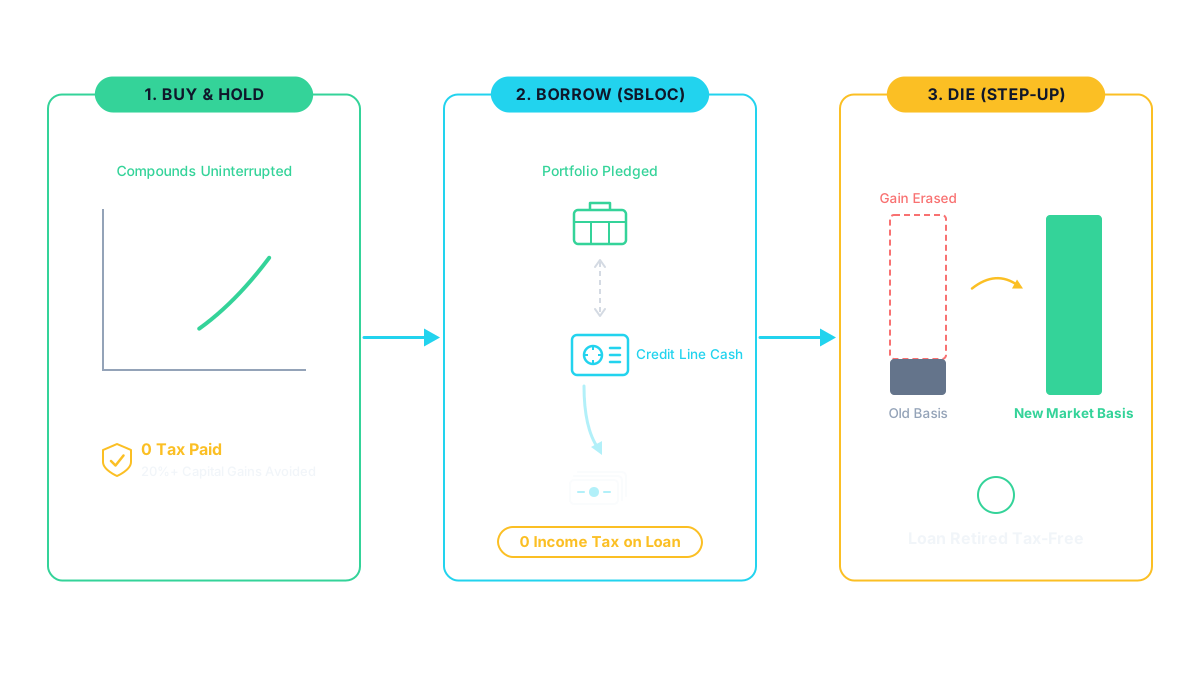
How the Three-Step Tax Engine Actually Runs
Buying Assets That Never Touch a Tax Return
Everything begins with the “Buy” phase, which requires acquiring assets that appreciate steadily over decades, typically stocks or real estate. The secret is holding indefinitely, because an unrealized gain sits completely outside the tax collector’s reach. Triggering a sale on long-term holdings can invite a federal capital gains tax bill of 20% or more, before you even add state taxes and the Net Investment Income Tax (NIIT).
Most investors get stuck inside a false binary: either liquidate shares and write a check to the IRS, or leave the portfolio untouched and stay cash-poor 1. Breaking compounding hurts twice, because paying tax today permanently shrinks the principal working for you tomorrow. Think about an investor who sells $200,000 in stock and loses $40,000 to taxes; she walks away with $160,000 in cash while her remaining portfolio compounds from a noticeably smaller base.
Compare that over twenty years against someone who keeps the full base intact. By refusing to realize gains, you preserve every dollar of upside, letting dividends and price appreciation stack quietly in the background. That compounding gap isn’t a rounding error; over two decades, it becomes a chasm.
Borrowing Cash Without Triggering an Income Event
Once your portfolio has grown fat with unrealized gains, you enter the “Borrow” phase by opening a Securities-Backed Line of Credit (SBLOC). Instead of selling shares to fund your life, you pledge the portfolio as collateral for revolving cash 2. Because the IRS doesn’t treat loan proceeds as income, you owe $0 in income tax on every dollar you draw.
Look at the arithmetic on a single hypothetical draw. Suppose a stock you bought at $100 per share now trades at $1,000, leaving a $900 gain per share; selling enough to raise $100,000 exposes $99,900 to capital gains tax and costs $19,980 at a 20% rate, whereas borrowing $100,000 through an SBLOC leaves your tax bill at zero. Scale that up to selling $1 million of stock carrying a $500,000 gain, and borrowing sidesteps $100,000 or more in immediate taxes 3.
What surprises newcomers isn’t just the tax shelter, though; it’s how frictionless the paperwork feels. At major brokerages like Schwab, Fidelity, Merrill, Morgan Stanley, Vanguard, and Interactive Brokers, setup takes less than a day, and cash often lands in your checking account within forty-eight hours. There is no income verification circus and no underwriter dissecting your tax returns, because your liquid portfolio serves as all the proof the bank needs.
Why Death Resets the Entire Tax Clock
Of course, a loan is not free money; it’s a deferred reckoning unless you execute the final step cleanly. Holding until death is what turns temporary tax deferral into permanent tax elimination. Under current U.S. tax rules, the cost basis of appreciated assets held at death receives a step-up in basis to their current fair market value.
Think about what that reset accomplishes in one stroke. Say your founder shares grew from pennies to $50 million over a lifetime while you quietly carried $10 million in SBLOC debt against them. When you pass away, the unrealized gain vanishes, allowing your heirs to sell just enough stock to retire the $10 million loan tax-free or keep the remaining shares with a brand-new tax basis.
That is why you repeatedly see names like Elon Musk and Jeff Bezos tied to securities-based lending. For a founder whose wealth sits inside concentrated company equity, selling shares shrinks control and guarantees a massive tax haircut. Borrowing turns static equity into cash while preserving both voting power and an eventual estate-planning exit.
Inside the Plumbing of a Securities-Backed Line
Understanding Advance Rates and Floating SOFR Spreads
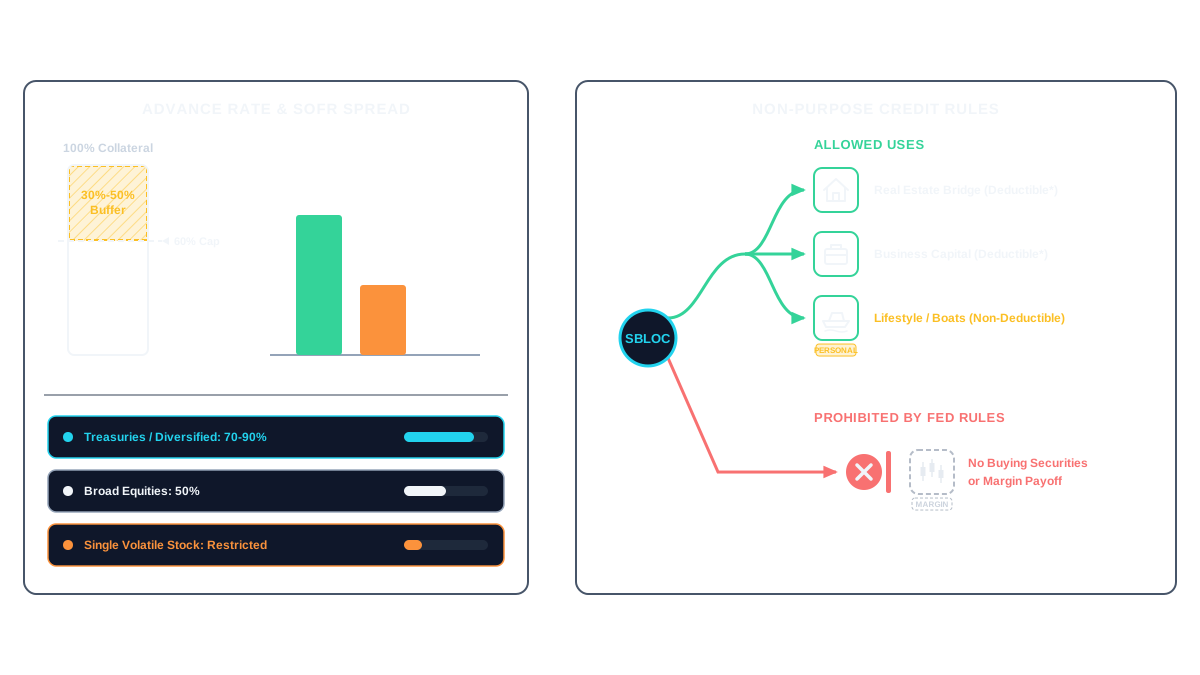
Walk into a private wealth desk and ask for an SBLOC, and the first two numbers you will hear are your interest spread and your advance rate. SBLOC rates are typically floating, usually pegged to a benchmark like SOFR (the Secured Overnight Financing Rate) plus a bank spread that shrinks as your account grows. Compared with credit cards, personal loans, or even many home equity lines, these secured rates tend to stay in the single digits1.
In lower-rate environments, a $1 million portfolio could borrow $500,000 at roughly 3% to 5%. If that portfolio compounds at 8% annually while the loan costs 3%, you pocket a net 5% spread without selling a single share. Even at a 7% borrowing cost, investors often compare that favorably against losing 20% to 30% up front to capital gains, especially when historical market returns of 7% to 10% help pay the freight.
Your borrowing ceiling, known as the advance rate, depends entirely on what sits inside the collateral account. Banks typically cap lending at 50% of portfolio value to build a safety buffer against market volatility, though blue-chip holdings and diversified mixes of equities, corporate bonds, U.S. Treasuries, and mutual funds can unlock 50% to 80% or even 90%. Pledge a volatile or single-stock portfolio, by contrast, and the lender will tighten your limit fast.
Non-Purpose Credit Rules and the Margin Distinction
People constantly confuse SBLOCs with standard brokerage margin loans, yet Federal Reserve rules draw a bright red line between them. An SBLOC is non-purpose credit, meaning you can spend the cash on almost anything except buying more securities or paying off an existing margin loan. Margin loans exist to buy stocks on leverage; SBLOCs exist to extract real-world liquidity.
In practice, wealth clients use SBLOCs as fast bridge financing for real estate deals with tight closing windows, working capital for businesses lacking conventional operating history, or cash to cover hefty tax bills. They also fund weddings, tuition, renovations, boats, yachts, aircraft, and fine art. Here, however, tax deductibility splits sharply based on how you spend the cash: interest on investment or business uses may be deductible with an accountant’s sign-off, whereas using SBLOC proceeds for lifestyle purchases like cars, vacations, or household bills counts as personal interest and gives you zero deduction.
Eligibility also separates the private wealth crowd from retail traders. Many institutions require $100,000 to $1 million in investable assets before opening an SBLOC, assigning a full team of wealth, portfolio, trust, and lending advisors to monitor the line. Smaller accounts are usually nudged toward standard margin loans, which are easier to open but carry far sharper risks.
State Arbitrage, Trusts, and the Estate Tax Maze
Chasing Zero-Tax States Before the Final Curtain
Federal income and capital gains rules are only half the chessboard; geography quietly decides the rest. State tax arbitrage is why billionaires treat moving vans like estate-planning instruments. When Jeff Bezos relocated from Washington State to Florida, joking observers noted he moved “to spend more time with dad,” though tax analysts immediately noticed Florida’s 0% state income and capital gains tax compared with Washington’s newly enacted capital gains levy.
If you spend thirty years avoiding federal capital gains only to die or sell in a high-tax state, your state treasury still takes a generous slice. Smart estate architects align residency long before any liquidity event or final transfer occurs. Moving assets into a well-structured trust adds a second layer of protection, ensuring shares pass cleanly to children without getting chewed up in probate court.
Yet “put it in a trust” is one of the sloppiest pieces of cocktail-party advice in personal finance. Not all trusts play by the same IRS rules, and picking the wrong wrapper can accidentally detonate the very step-up in basis you spent a lifetime engineering.
Revocable Trusts Versus the Irrevocable Tax Trap
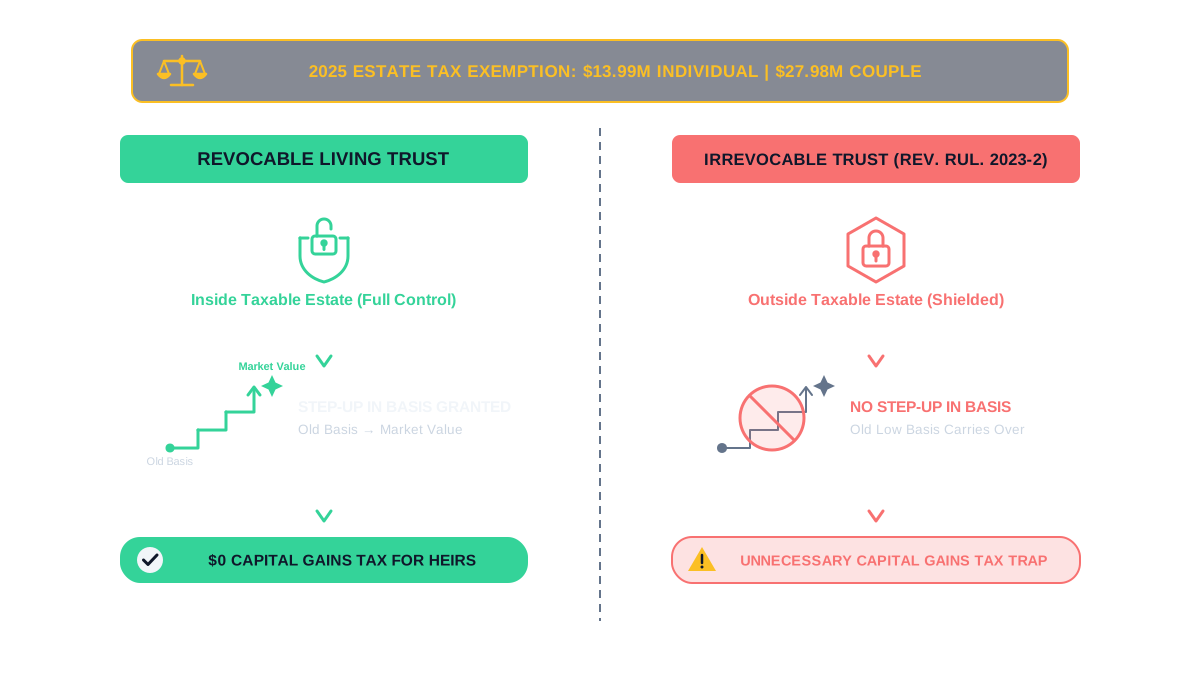
A revocable living trust is the workhorse of basic estate planning, letting you maintain control during life and pass assets seamlessly at death. Because assets inside a revocable trust remain part of your taxable estate, they do receive a full step-up in basis when you die. Your children inherit the stock at current market value, wiping out decades of embedded capital gains tax liability in an afternoon.
Irrevocable trusts are a completely different animal, traditionally built to shield wealth from creditors and federal estate taxes by removing assets from your taxable estate altogether. Under IRS Revenue Ruling 2023-2, however, assets tucked inside many irrevocable trusts do not receive a step-up in basis at death if they sit outside your taxable estate. Read that again, because it catches affluent families off guard every single year.
In 2025, the federal estate tax exemption climbed to $13.99 million per individual, or $27.98 million for married couples. If your net worth sits below that generous threshold, shielding assets in an irrevocable trust you didn’t actually need for estate taxes can forfeit the step-up in basis and hand your heirs an ugly capital gains bill. You dodge an estate tax you never owed, only to trigger an income tax you didn’t have to pay.
When the Math Turns Against the Borrower
How Maintenance Calls Trigger Forced Tax Bills
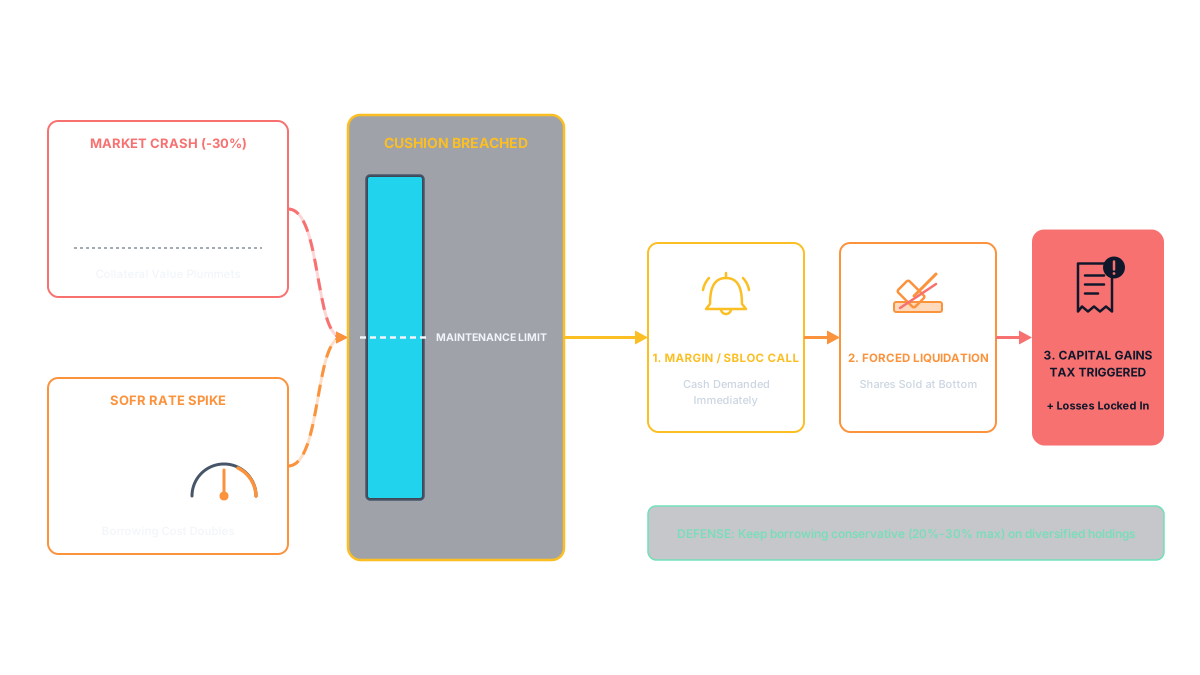
Every leveraged strategy looks brilliant during a decade-long bull market, right up until the floor gives way. Maintenance calls are the Achilles’ heel of borrowing against stocks. If a market crash shrinks your collateral below the lender’s required cushion, the bank demands immediate cash or extra securities 2.
Miss that deadline, and the lender will liquidate your portfolio without waiting for your permission. Imagine borrowing $100,000 right before a 30% market drop, only to watch the bank dump your shares at the exact bottom of the cycle. Forced liquidation triggers the exact taxes you spent years trying to avoid, locking in permanent losses and a fresh capital gains bill at the worst possible moment.
Surviving downturns requires boring, almost timid discipline. Conservative borrowers tap 20% to 30% of their portfolio’s value rather than maxing out at 70%, and they pledge broadly diversified holdings instead of a single volatile ticker. You should also know exactly who monitors your account for collateral warnings before you ever draw a dollar.
Floating Rates and the Cost of Living Shock
Collateral crashes aren’t the only way this trade can sour; interest rates move too. Because SBLOCs carry variable rates tied to benchmarks like SOFR, your cost of living can skyrocket without you buying a single extra thing. A credit line that felt almost free at 3% starts biting hard when central banks hike short-term rates and your borrowing cost doubles.
Worse, rate spikes rarely happen in a vacuum; they tend to arrive alongside choppy or stagnant stock markets. When loan interest outpaces portfolio returns, borrowing flips from profitable to corrosive3. If you are funding a lifestyle with non-deductible personal interest, you are paying after-tax cash every month just to stand still while waiting for markets to recover.
That is why experienced advisors stress having a real repayment plan before touching the line. Hoping that current income will always cover a “little bit of interest” works fine until interest stops being little. Never confuse temporary rate suppression with permanent structural free money.
Smarter Tax Moves for Everyday Portfolios
Here is the honest truth for anyone who doesn’t sit on a seven-figure brokerage balance or an appetite for leverage risk. You don’t need an SBLOC to play smart tax defense. Most long-term investors get 90% of the benefit without 100% of the margin-call anxiety by using plain-vanilla tax shelters first.
Start by maxing out Roth IRAs, 401(k) contributions, and Health Savings Accounts (HSAs), which deliver tax-free withdrawals, tax-deferred compounding, or triple tax advantages without a single bank lien. Inside taxable accounts, simply holding assets past one year unlocks lower long-term capital gains rates, while qualified dividend payers like Johnson & Johnson (JNJ) and Procter & Gamble (PG) deliver steady cash taxed at friendlier rates than ordinary wages. High earners seeking predictable income can also pair those holdings with municipal bonds for tax-free interest.
If you do qualify for an SBLOC and want to use it selectively, treat it like a surgical bridge rather than an ATM 2. Work with a wealth strategist or tax advisor to model volatility, confirm interest deductibility, and keep your borrowing ratio small enough to survive a brutal bear market.
Living on Borrowed Time and Borrowed Money
Buy, Borrow, Die persists not because billionaires discovered a secret cheat code, but because the U.S. tax system treats realized sales harshly while treating debt and death with remarkable gentleness. It rewards scale, diversification, and patience, turning liquid stock portfolios into private central banks for anyone rich enough to shrug off a 30% market dip. For everyone else, the allure of “$0 capital gains” can obscure a subtle shift in who owns your peace of mind. Once your groceries, mortgage, or weekend toys run on floating-rate credit tied to daily stock ticks, you haven’t escaped the taxman so much as traded him for a bank risk committee. Every tax shelter carries an invisible price tag paid in either complexity or volatility.
So before you fall in love with the idea of never selling a share, ask yourself how well you sleep when the S&P 500 drops 25% and SOFR sits two points higher than last spring. In the end, the market collects its toll one way or another: you either pay the IRS in cash today, or you pay the lender in nerves until your final breath.
We use limited cookie-free measurement to understand overall traffic. Allow analytics cookies to help us recognize returning visits and learn which essays and paths serve readers best. You can change this choice at any time.




Responses