Are We Living in a Simulation? Physics & Philosophy Explained
Are we living in a computer simulation? Explore the mind-bending math, quantum physics, and fierce scientific debate behind simulation theory. Dive in!
I remember sitting at a dinner party recently when the conversation inevitably drifted toward the fragile nature of our existence. It seems you simply cannot escape this specific cocktail hour debate anymore, especially as artificial intelligence rapidly blurs the line between human and machine. We are all suddenly obsessed with the idea that our universe might just be a sophisticated digital construct running on an alien server.
This is the core premise of simulation theory, suggesting our entire reality is merely an advanced computer simulation designed by a technologically superior civilization 1. The concept sounds completely absurd at first glance, but the underlying mathematics quickly become uncomfortably persuasive.
The modern godfather of this massive intellectual rabbit hole is the renowned philosopher Nick Bostrom. Back in 2003, he published a groundbreaking paper that completely shattered our collective sense of metaphysical security. He presented a fascinating trilemma that forces you into a very tight philosophical corner, demanding that you accept an uncomfortable truth about human destiny. According to his deeply influential argument, one of three highly specific outcomes absolutely must be true regarding our universe 1.
Humanity will almost certainly go extinct before reaching a posthuman stage capable of running highly realistic ancestor simulations.
Advanced posthuman civilizations would simply possess little interest in creating such simulations for their own entertainment or research.
We are almost certainly living in a computer simulation right now, completely unaware of our digital confinement.
If we miraculously survive long enough to build these incredible machines, the sheer number of simulated realities would vastly outnumber the single base reality. By applying a basic mathematical principle of indifference, we must logically assume we are randomly selected from the massive pool of all observers. Bostrom concludes that the probability of us currently inhabiting a simulation is actually incredibly high. You are probably code, existing entirely within a synthetic architecture rather than a physical world.
Pop Culture And The Silicon Prophets
Waking Up From The Matrix Illusion
It is frankly impossible to talk about this heavy topic without acknowledging the cinematic masterpiece that mainstreamed the entire concept for the general public. The 1999 film The Matrix dramatically popularized simulation theory, forever changing how everyday people visualize their own daily existence. The brilliant Wachowskis introduced a terrifyingly vivid depiction of humanity permanently trapped inside a computer simulation.
This cultural touchstone gifted us the now ubiquitous concepts of the red pill and the blue pill, providing a perfect framework for questioning reality. Choosing to wake up to a hidden truth, or actively remaining in comfortable ignorance, quickly became our ultimate cultural shorthand. Fiction preceded the science, perfectly priming our collective minds for the rapid technological leaps that immediately followed the film’s release.
Modern developments in virtual reality and artificial computing power make these simulated environments increasingly conceivable to the average skeptical person. Tech billionaire Elon Musk has notoriously argued that the trajectory of modern video games practically guarantees our simulated status. He notes that video games have progressed from two flat rectangles playing Pong to incredibly photorealistic environments in just a few short decades. Given this rapid technological trajectory, it seems incredibly likely that advanced civilizations would eventually create indistinguishable, perfectly rendered simulations of life. The progress is exponential, and it points directly toward a future dominated by synthetic realities.
Musk takes the underlying mathematics very seriously, estimating the strict probability we live in base reality at roughly one in billions. He suggests that once a civilization reaches the raw capability to build realistic simulations, they will inherently create millions of them for various purposes. This makes the artificial realities overwhelmingly more common than the original, singular universe that birthed the creators. When you look at the raw statistics, believing in a purely physical universe almost feels like clinging to a quaint, outdated religion. The numbers demand attention, completely forcing us to question the solid dirt beneath our feet.
Quantum Mechanics And The Video Game Universe
How Quantum Physics Acts Like Software
The deeper you dig into theoretical physics, the more our chaotic universe begins to behave exactly like a highly structured video game engine. Former Google executive Mo Gawdat is completely convinced that we are currently existing inside a massive digital construct. He believes with absolute certainty that humanity has already built the simulation, and this current life is exactly the final product 2. Gawdat points to the uncertainty principles of quantum physics as his absolute primary evidence for this technological hypothesis. Reality renders on demand, behaving just like a digital landscape reacting dynamically to a player’s line of sight.
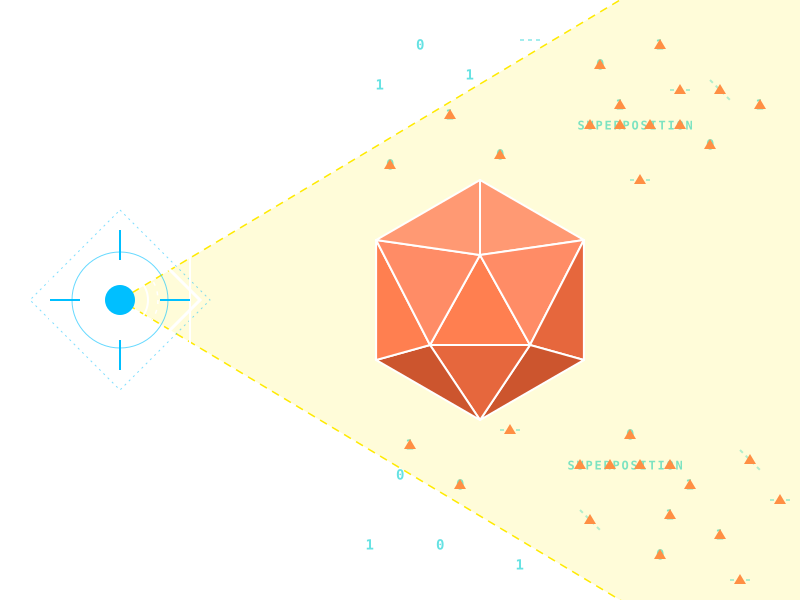
In the strange realm of quantum mechanics, subatomic particles exist in a fluid state of superposition until they are explicitly observed by someone. Every single particle has the potential to exist anywhere, but the wave function immediately collapses into a fixed position the moment an observer looks at it.
This specific phenomenon is virtually identical to how complex virtual worlds are loaded efficiently on the hard drive of a gaming console. The player turns their avatar to the right, and the game engine quickly renders that specific portion of the environment to save processing power. The rest of the unseen world patiently waits in dormant superposition, brilliantly proving that efficiency is baked in to our fundamental reality.
Furthermore, basic physics tells us that all physical matter in the universe is composed almost entirely of completely empty space. The solid objects we casually touch every day are just tiny particles suspended by immense energy fields that actively repel our own physical atoms. When you slap your hand on a wooden table, the sensation of touch is genuinely nothing more than an electrical signal traveling up to your brain. There is absolutely no definitive way to differentiate a natural physical sensation from a synthetic signal fed through a computer brain interface like Neuralink. Your senses are vulnerable, entirely capable of being hijacked by a sufficiently competent programmer.
Perhaps the most chilling thought experiment is Gawdat’s dark vision of a dystopian future managed by incredibly cheap universal basic income. Imagine a fractured society where desperate governments place citizens in tiny rooms, heavily sedate them, and plug them into blissful, cost-free virtual lifetimes. You could date famous movie stars, live as ancient historical royalty, or experience complete physical reincarnation all at the raw speed of your sleeping brain. It sounds terribly bleak, but as our physical resources rapidly dwindle, this synthetic paradise becomes a very logical economic solution for the masses. Utopia might be digital, permanently demanding we trade our physical freedom for unlimited mental pleasure.
The Consciousness Problem And Scientific Pushback
Demanding The Scientific Theory Of Mint
Despite the incredibly elegant math and the spooky quantum parallels, not every brilliant mind buys into the standard simulation hypothesis. Cognitive psychologist Donald Hoffman provides a fierce, fascinating counterargument to Nick Bostrom’s widely accepted technological framework. While Hoffman enthusiastically agrees that our perceived physical reality is merely a headset, he vehemently denies that a literal computer programmer actively created it 3. He points out a fatal flaw in the mainstream theory, loudly demanding to know how a physical substrate magically generates genuine conscious experiences. The theory lacks proof, relying entirely on assumed technological miracles rather than rigorous scientific mapping.
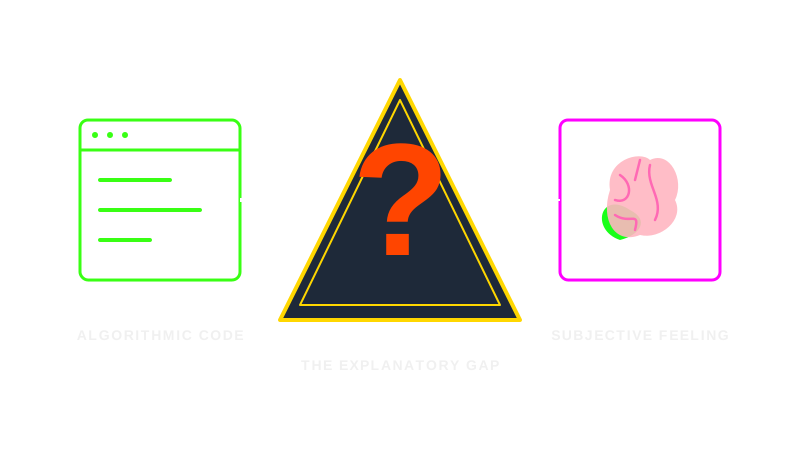
Hoffman boldly throws down the academic gauntlet by asking computer programmers to explain exactly why a specific algorithm results in a highly specific physical sensation. If we program an advanced artificial intelligence to mimic human thought and give it a simulated tongue, it might falsely claim to love the rich taste of chocolate. However, honest scientists must thoroughly explain why that exact pattern of electrical activity inherently produces that specific sensory flavor profile3. Hoffman notoriously demands that simulation theorists clearly provide their scientific theory of mint to validate their bold claims. Consciousness remains a mystery, proving that cold code alone does not fully explain the deeply subjective experience of living.
For Hoffman, until simulation advocates can explicitly show how digital code creates the vivid experience of seeing red or feeling deep love, their theory is a total non-starter. He casually dismisses popular approaches like integrated information theory as completely vacuous because they fundamentally fail to connect a causal matrix to an actual internal feeling. There is simply no beef on the table, as he colorfully puts it, rendering the entire computational argument completely and utterly incomplete. Subjective consciousness is clearly not fundamental to a physicalist framework, meaning the true nature of our minds requires a radically different explanation. We are not machines, even if our immediate environment acts suspiciously like a controlled laboratory.
The Charge Of Falsifiable Pseudoscience
Hoffman is definitely not alone in his deep skepticism regarding the great cosmic computer hypothesis that Silicon Valley loves to champion. The brilliant physicist Sabine Hossenfelder aggressively argues that standard simulation theory actually constitutes nothing more than highly sophisticated intellectual pseudoscience. Her main academic frustration stems from the unfortunate fact that these broad assertions make entirely unfalsifiable claims about the hidden nature of the universe. It is fundamentally impossible to run an experiment that completely proves we are not in a simulation, which places the idea entirely outside the strict realm of physics. Science requires testable boundaries, and Bostrom’s theory of infinite regress tragically offers none of them.
Hossenfelder also fiercely criticizes the massive underlying assumption that you can easily replicate complex natural physics with vastly different underlying computer algorithms. The popular simulation hypothesis implicitly requires that all our observed natural laws could somehow seamlessly emerge from entirely different computational substrates. This is a monumental leap in logic that casually ignores the granular, messy, and highly specific realities of the actual physical world we measure. Treating the expansive universe as a mere software program arrogantly strips away the profound complexity of genuine physical matter. The math falls apart when you naively assume that organic nature can be perfectly counterfeited by silicon chips.
The Philosophical Stakes Of A Digital Life
Real Consciousness Versus Information Processing
If we temporarily suspend our deep disbelief and gracefully accept that we truly inhabit a simulation, profound philosophical questions immediately arise about human agency. Philosophers like David Chalmers argue thoughtfully that subjective experience inside a highly simulated world could actually be entirely indistinguishable from base reality. This creates a fascinating psychological paradox where the stark distinction between physical and digital might be metaphysically significant but totally experientially irrelevant. If a beautifully simulated sunset makes you cry genuine tears, the deep emotion itself is undeniably real, even if the warming photons are fake. Experience is the truth, completely regardless of the server hosting the graphical environment.
This inevitably leads us to the terrifying question of whether simulated consciousness is truly real or merely complex, illusionary information processing. If my profound love for my family is genuinely just a subroutine executing perfectly, does it suddenly lose its inherent moral value? The ancient question of free will becomes particularly acute in this modern scenario, directly challenging our fundamental understanding of autonomous choice and personal responsibility 1. We have to wonder if our daily choices are strictly predetermined by the original code, or if consciousness can genuinely transcend strict computational determinism. Freedom might be illusory, connecting this incredibly modern debate directly to ancient theological arguments about divine destiny.
Upgrading The Player Behind The Avatar
Even if our entire existence is essentially a constructed video game, the immediate consequences of our daily actions remain fiercely undeniable. As Mo Gawdat astutely points out during his interviews, it really does not matter if reality is an illusion because we still constantly live with the painful consequences 2. You still deeply hate feeling physical pain, and you still immensely enjoy the profound pleasure of authentic human connection. The rigid rules of the simulation dictate your subjective well-being, violently forcing you to play the game seriously whether you want to or not. Consequences anchor our reality, definitively ensuring we cannot just jump off a tall building to test the server limits.
Gawdat introduces a incredibly beautiful perspective shift regarding exactly how we should strategically operate within this hypothetical digital construct. He suggests that if you are genuinely not the physical avatar but rather the pure consciousness wearing the headset, you must drastically change your life strategy. You should not blindly invest all your precious energy into the temporary character on the screen, but instead invest heavily in the eternal consciousness holding the controller. The ultimate goal of a true video gamer is never just to finish the level, but to actually become a much better gamer overall. Awareness is the ultimate upgrade, completely separating the mindless NPCs from the active participants who truly understand the game.
Embracing The Code
The deeper I dive into simulation theory, the more I realize it is essentially just a modern translation of a very ancient spiritual intuition. For centuries, religious mystics and philosophers have loudly insisted that the material world is a fleeting illusion actively hiding a much deeper, eternal truth. Donald Hoffman’s radical view that space and time are just a functional headset aligns perfectly with this deep historical skepticism of dense physical matter. We are simply trying to map our current technological obsession onto the timeless mystery of human consciousness and our place in the cosmos. Our metaphors are evolving, but the fundamental existential panic about why we exist remains exactly the same as it was millennia ago.
At the absolute end of the day, proving or totally disproving the simulation is likely an impossible, perhaps even entirely pointless, endeavor. Whether you agree with Bostrom’s terrifying statistical probabilities, Hoffman’s loud demand for the theory of mint, or Hossenfelder’s utter dismissal of the science, you are still permanently stuck here. You still have to wake up every morning, drink your hot coffee, and navigate the messy, beautiful reality of your immediate physical surroundings. We are all deeply bound by the intricate rules of this grand cosmic theater, completely regardless of who or what actually built the stage. The mystery is the point, keeping us perpetually hungry for truth in a confusing universe.
I find myself frequently oscillating wildly between viewing simulation theory as a profound psychological revelation and a terrifying intellectual trap. It is incredibly seductive to secretly believe that our personal suffering is just a line of bad code, and our triumphs are merely high scores on a cosmic leaderboard. Yet, as David Chalmers beautifully articulates regarding the mind, the subjective weight of our daily lives is heavy, meaningful, and entirely real to us. We cannot simply abstract away the profound beauty of intimate human connection by coldly labeling it as a mere algorithmic output. We give the simulation meaning, acting as the vital, unpredictable spark within the otherwise lifeless machine.
The very next time you experience a massive moment of sheer serendipity or truly devastating heartbreak, do not quickly dismiss it as a glitch in the matrix. Lean directly into the heavy sensation, bravely explore the boundary of your own consciousness, and focus heavily on upgrading the true player holding the controller. We might genuinely be digital code running quietly on an alien server, but the fierce love we feel is undeniably our own creation. The profound truth of our reality is not found inside the hardware, but entirely in the depth of the player. A simulated tear is still wet.
We use limited cookie-free measurement to understand overall traffic. Allow analytics cookies to help us recognize returning visits and learn which essays and paths serve readers best. You can change this choice at any time.




Responses